
Happy Xmas -- Is War Over? / Merry Anxious Christmas

Children's sermon
Illustration
Preaching
Sermon
Worship
For December 24/25/26, 2021:
 For Christmas
Happy Xmas — Is War Over?
by Chris Keating
Isaiah 9:2-7; Luke 2:1-20
And so it is Christmas: families are passing around eggnog and sipping wassail, nibbling off a charcuterie platter and devouring cookies and fruitcake. A few are debating when to head to church for Christmas Eve. Mom fears one more class of wassail and grandpa will be a no-show two years in a row, while the kids are pushing hard to skip worship completely. Intel on what Santa has brought is limited, and so guesses abound. The near and the dear ones, the old and the young.
John Lennon’s lyrics float through technology he could never have imagined. The fifty-year old Christmas song somehow feels particularly apt this Christmas Eve. Another year over, another variant emerging. Joined by the choir of children, Lennon offers his anthem: “And so this is Christmas/for weak and for strong/(war is over if you want it…)”
His words, aspirational and barely noticed in 1971, seem ever more prophetic in 2021. Lennon’s activist views come alongside Isaiah’s foretelling of a light blossoming in the desert. The prophet declares hope and promises peace. After all, war is over.
Or is it?
For the first time this century, American troops will not be celebrating Christmas in Afghanistan. “For the first time in 20 years, the United States is not at war,” declared President Biden at the United Nations this fall. “We’ve turned the page.”
But the book is still open. Indeed, while the US military announced the end of combat in Iraq, roughly 2,500 troops remain to “advise, assist, and enable.” It’s a big move that signals a transition in the US/Iraqi partnership, but may not be enough to satisfy Iranian-backed militia groups who have publicly said “targeting the US occupation in Iraq is a great honor.”
There’s no doubting that war persists. The global war on terror has expanded the active participation of the United States military to 80 nations on six continents. Across the world, there are more than 50 assorted active armed conflicts involving governmental and non-governmental militias or groups. That excludes the Covid-19 pandemic with more than 5.3 million deaths, or the growing numbers of deaths caused by climate and weather-related disasters.
And so it is Christmas. The weary world rejoices as the angel’s proclamation falls on the shepherd’s ears: "Do not be afraid; for see — I am bringing you good news of great joy for all the people: to you is born this day in the city of David a Savior, who is the Messiah, the Lord.”
In the News
Ryan Sanders, veteran journalist, minister, and columnist for the Dallas Morning News, readily admits he’s a Christmas hypocrite. He thinks that just about anyone who exchanges holiday greetings of peace may be hypocrites as well.
“Do we know that peace is even real?” Sanders wrote this week. “Can any of us sing about peace on Earth right now without a bit of cognitive dissonance or, worse, a sneer?” We may sing, read, and even preach about peace. But, as Sanders suggests, “purveyors of peace stack it deep and sell it cheap.” He argues that achieving peace is something that can’t be traded like a Non-Fungible Token or purchased online.
Instead, as host of heaven remind the shepherds, peace is the movement of God toward us. It’s the song Isaiah sings of the one who lifts the burden of the yoke of injustice and breaks the rod of the oppressor. It’s Christmas, Lennon would say, “without any fear.”
But the hopes and fears of all the years remain real this Christmas. The pandemic, fueled by the Omicron variant, remains a persistent threat. Climate change, global volatility, and potential threats by Russia and China make peace seem a distant hope. The problems, notes the Atlantic Council, are “intertwined like a Gordian knot that only bold action can untangle.”
And so it is Christmas.
Unlike much of Christmas pop music, Lennon’s song emerged as a protest song, a prophetic outcry against the Vietnam war. Two years earlier, Lennon and Ono posted billboards exclaiming “War is Over! If You Want It” on billboards in major world cities. The billboards were forerunners of the song’s message of personal accountability. “Happy Xmas” leans hard into the prophetic message that peace is more than slogans or products.
Like that message, few paid much attention to “Happy Xmas” or its whispered Christmas greetings to Lennon and Oko’s children, when it debuted in 1971. Ironically, however, it’s become an omnipresent Christmas soundtrack, a well-integrated part of holiday mass marketing. While other vocalists like Neil Diamond and Celine Dion have taken their aim at the song, it is the iconic Lennon/Oko version that endures, offering a cheerful, yet decidedly unromanticized image of Christmas peace.
Last week, the Latin Patriarch Emeritus of Jerusalem, Michel Sabbah, stirred hearts by comparing the on-the-ground realities of Christmas in the middle East with persistent Currier and Ives fantasies. Contemporary life in Bethlehem is “not a Christmas life,” Sabbah said. Pointing out ongoing strife and violence in Bethlehem and Jerusalem today, Sabbah said the “the song of the Angel is far away.”
“Christmas, every year reminds us that there is no peace on the earth, especially in Jerusalem and Bethlehem, and that we have to make [peace] again,” he said. Justice is lacking in those occupied territories, the patriarch said. “We know the pain. We taste the daily trauma. Sadly, we know that darkness yet hovers over the Holy Night. We must be the light of Christ.”
Sabbah led the Latin Patriarch of Jerusalem from 1987 until 2008, and is a prominent Palestine-born Christian leader. In 2009, he was one of the authors of the Kairos Palestine Document.
In the Scripture
There’s something about Christmas Eve worship that brings new meaning to words of “Away in a Manger.” Distracted by a million different hopes and fears, each the most patient parishioner squirms as the readings are proclaimed. There is a certain energy and intensity to both Isaiah and Luke 2 that, when coupled with Christmas Eve, edge us closer to the wondrous mysteries of the birth of Christ.
We do not need Isaiah to remind us that zeal runs rampant this evening. But we do need Isaiah’s song to direct our zeal from our preoccupation with December mass marketing. The zeal of Yahweh is not manufactured or imported. Rather, it emerges from God’s passionate mercy and longing for righteousness. Isaiah tells of the emerging child who will bring light to those who have been stumbling in darkness, and comfort to the discomforted. God will reverse the fortunes of Israel, multiplying joy instead of tears. The overabundant, ever-churning zealousness of God is a gift of love meant to inspire and transform those who pray for peace. Joy will counter the devastating blows of war.
A similar zeal erupts above the earth in Luke 2. Instead of billboards promoting peace, God sends an angel choir to sing their version of a protest song: “Glory to God in the highest heaven, and on earth, peace!” The shepherds exchange startled shrugs. The message is beyond explanation, forcing them to leave their sheep behind and head into town. Startled by the unimaginable sight, they quiet themselves at an even more mysterious vision: a child, lying in a manger, wrapped in bands of cloth.
And so it is Christmas.
In the Sermon
I’m wondering how your congregation might react if you announced that you’ll be singing protest songs instead of Christmas carols this year. While it might not be a brilliant career move, there’s some truth in the prophetic edge of Christmas Eve as protest. Lennon and Oko aim their protests at achieving transformed human relationships, while the prophetic messages of Luke and Isaiah aim at something even deeper.
The song of scripture is indeed a protest song — the protest of God against the injustices we perpetuate against one another, the unrelenting suffering of disease, and the thread bare notions of “peace” that do not embody the shalom of God. This is the Christmas song the angels bring to the shepherds, and it is the protest of Isaiah. It is a protest cry that declares God’s intention to bring the peace we so desperately long to know. It is song that asks us, “Let’s stop all the fight.”
It is a song for the near and the dear ones, the weak and the strong, the rich and the poor ones.
And so it is Christmas.
 For Christmas 1
Merry Anxious Christmas
by Mary Austin
Luke 2:41-52
“I hope you have seven daughters just like you,” my mother used to tell me. I don’t think she meant it in a good way. Exasperated with my rebellious teenage ways, she was hoping that I would someday feel the same frustration and anxiety she was feeling. We’ve heard Mary’s story on earlier Sundays this Advent, and now we see her feeling the same frustration she caused her parents. If they didn’t understand her calling from God, if they doubted the whole story about an angelic messenger (sure, sure, honey…) if they worried about her on her long trip to visit her cousin Elizabeth, now she knows how they felt. On the three-day journey back to Jerusalem to look for Jesus, she has plenty of time to feel anxious.
Anyone who takes care of children and young people — teachers, aunts, uncles, family friends, parents — can understand the level of panic Mary and Joseph feel in this story. Anyone who’s ever made a speech, given a toast or had a big presentation at work knows the feeling of anxiety. At this point in the pandemic, most of us are feeling anxious about something.
Larger questions remain for us all to ponder together. “The pandemic not only makes this month’s vacation or holiday celebrations seem uncertain, but also sometimes overwhelms understanding. How to assess the avalanche of statistics, opinions, warnings, closures, reopenings? What to make of the big business Covid-19 has become, with its vested interests? What to do about the glaring inequality in vaccine distribution? How to avert one’s gaze from the discarded masks that still dot streets, the pandemic’s perennial detritus?” And how will we live with the circularity of this pandemic? One day, life is “normal,” and we can go back to work and family, then we’re told to wait, to be cautious again, on and on in a repetitive circle. Meanwhile, we have ever increasing levels of loss.
Mary’s anxiety is a mirror for ours this Christmas season.
In the News
Levels of anxiety and depression climbed “globally by more than 25% in 2020, a devastating ripple effect of the Covid-19 pandemic that has particularly affected women and young people, according to a new study.” Mental health professionals knew that we were anxious and depressed during the pandemic, with its isolation and lack of structure, and still the very high levels surprised them. Anxiety and depression are even more prevalent than anyone suspected.
People seeking mental health help often can't pay for treatment, or find a provider. “Many people with mood disorders are unemployed and uninsured, says David Lloyd, a senior policy adviser at the mental health advocacy group the Kennedy Forum. "Some of these conditions — they're particularly disabling [and] can result in people being unemployed," he says. Losing insurance that way is not uncommon.” The spiral of anxiety and other mental health concerns spins faster and faster.
In this holiday month grief is also particularly acute for people. While not a mental health disorder, it takes a similar toll on energy, motivation and well-being. Professor and author Mary-Frances O’Connor says “grieving is a form of learning — one that teaches us how to be in the world without someone we love in it. "The background is running all the time for people who are grieving, thinking about new habits and how they interact now." Adjusting to the fact that we'll never again spend time with our loved ones can be painful. It takes time — and involves changes in the brain. "What we see in science is, if you have a grief experience and you have support so that you have a little bit of time to learn, and confidence from the people around you, that you will in fact adapt.” This year, Covid has left people with multiple losses, and layers of grief.
For Jesus and his parents, their separation from each other is temporary, and short lived. Here, in the Covid pandemic, many children have been permanently separated from their parents or other caregivers by death. “Of all the sad statistics the US has dealt with this past year and a half, here is a particularly difficult one: A new study estimates that more than 140,000 children in the US have lost a parent or a grandparent caregiver to Covid-19. The majority of these children come from racial and ethnic minority groups. "This means that for every four Covid-19 deaths, one child was left behind without a mother, father and/or a grandparent who provided for that child's home needs and nurture — needs such as love, security and daily care," says Susan Hillis, an epidemiologist at the Centers for Disease Control and Prevention…” The current estimate is now up to 175,000. This is a significant trauma, one that will impact these young people for decades to come. “And in terms of life outcomes, a body of earlier research shows that losing a parent can put kids at a higher risk of economic, food and housing insecurity. This adds a new layer of risk to kids in communities of color, which are already disadvantaged.”
Anxiety, and its mental health cousins, are all around us this Christmas season. We can all find a sense of kinship with Mary and Joseph, even though our own individual worries may take a different shape.
In the Scripture
People who come from extended family cultures understand this scripture better than Westerners, with our idea that parenting belongs to the small, thin-stretched nuclear family. In extended family groups, a child might be with other relatives, or with a group of kids the same age, only checking in at meal times or at the end of the day.
Scott Hoezee makes an interesting point about how differently Jesus and his parents see this adventure. He says, “Mary and Joseph spend 48 hours before finally tumbling to the idea that just maybe they should check the Temple. “I can’t imagine he’d be there” they must have said to each other, “but we’re running out of likely places so let’s check.” For his part Jesus is merely confused. The Temple was the first place they should have looked as it turns out. Jesus was not exactly “home alone” but he was “home” at the Temple. His parents don’t understand, however. They are too flush with a combination of intense relief and a little abiding post-traumatic stress to be able to suss it all out just then.”
The three days that Jesus is missing also strike an interesting chord for us. Later in his life, three days bring resurrection. Here, it’s restoration of the family — but with a new understanding of who Jesus is, for his parents. Something new comes to life in these three days, too.
In the Sermon
The sermon might talk about how every family is imperfect — even the family of Jesus had to work hard to understand each other. Coming at Christmas, when disappointment is as common at family gatherings as joy is, the sermon could remind the church that family struggles are normal.
Or, the sermon could bravely normalize the challenges of mental health, and work to erase some of the stigma that come with depression and anxiety? The sermon could educate the congregation on the lasting impact of trauma, and how it echoes down through the years. The sermon could offer ways to work with everyday level anxiety, and recommend professional help and perhaps medication for people whose challenges are larger.
The scripture says that Jesus and his family go to Jerusalem every year. This is their habit as a faithful family. The sermon might look at what habits we have as a family? Do different parents have different traditions? As a blended family, or an extended family, what are the habits? What new customs have in-laws and new partners brought to the family? What habits are we passing down to children and grandchildren?
The sermon could also talk about the hard work of listening to family members, and taking in new information about them. We think we know our kids, our siblings and our partners, and it’s easy to stop learning about them. Just as Jesus’ parents have to catch up to who he is, we fail to see the changes in someone close to us. We miss the fact that that someone isn’t the baby anymore, or the irresponsible one, or the spendthrift.
The anxiety of Jesus’ parents speaks to our own anxiety this holiday season. The young Jesus reminds us that we can find a new level of peace in God’s presence.
ILLUSTRATIONS
 From team member Tom Willadsen:
For Christmas...
Isaiah 9:2-9
A comma changes everything
Those of you who have Handel’s “Messiah” in your aural memory certainly resonate with v. 6b:
“Wonderful Counselor, Mighty God, Everlasting Father, Prince of Peace”
Handel seems to have inserted a comma after Wonderful, as though that word alone is a name for God. The New Revised Standard Version appears to consider wonderful an adjective. The original Hebrew is ambiguous; both readings are plausible — they didn’t even use vowels, much less punctuation!
How would you interpret this verse differently if “Wonderful” were a nickname, rather than an adjective?
* * *
Luke 2:1-14 (15-20)
Calling all you angels
We all know that the shepherds were “sore afraid” when the angel appeared to them — Linus has said it every December since 1965. The New Revised Standard Version says they were terrified. We skip over this fact too quickly. Most of the time when angels appear in scripture their first word is “Don’t be afraid!” Angels are scary. Imagine a Christmas tree topped with this.
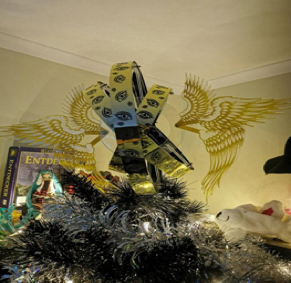
Then, after that one angel who announces the good news to the shepherds is done talking, “a multitude of the heavenly host” joined the lead angel. Multitude means there were lots and lots of them; “host” is another word for army, or perhaps we could update that to God’s Air Force.
A church I served early in my career had a tradition of a Christmas pageant, put on at twilight on Christmas Eve. The associate pastor was solely in charge, I was informed when I started serving there on November 1. The four year olds were sheep; the kindergarteners were angels; the first graders were various animals, etc. Thus is had been, thus it would always be. The new associate pastor introduced some tweaks to the script. I corrected some glaring historical errors. I decided to call the wise men “magi” because that year they were all girls. I put the angels up in the first row of the balcony and made sure they had microphones. For weeks the kindergarten teacher, at my urging, led the class in shouting “Glory to God in the highest heaven, and on earth peace among those whom God favors!!” They nailed it; the congregation jumped, startled at the sound of the amplified, energetic five year olds.
I didn’t last very long at that church.
* * *
Titus 2:11-14
What are we hoping for?
This lesson gets overlooked on Christmas Eve because Linus went with Luke 2, but if you decide to preach it, point out that it points beyond Christmas to Christ’s return. Texts earlier in Advent made that point, but you might want to challenge the E & C crowd with “while we wait for the blessed hope and the manifestation of the glory of our great God and Savior, Jesus Christ” (Titus 2:13). Even though Christmas has arrived, we’re still waiting, in hope, for God’s glory to fully appear. We’re not there yet; God’s not there yet.
For Christmas 1...
1 Samuel 2:18-20, 26, Luke 2:41-52
Biblical parenting
Hannah was so desperate to have a child that she poured out her heart so passionately that Eli, the priest at Shiloh, thought she was drunk. She made a vow over her first child, and when Samuel was born, at the earliest possible moment, she took him to the temple, donating him to the Lord’s service. Samuel grew into something like an apprentice priest and every year Hannah would visit him and bring him a new outfit.
When Jesus was 12 his family went to Jerusalem for Passover. It was a multiday trip from Galilee for Mary and Joseph. After they had been on the road home for one day they noticed that Jesus wasn’t with their group. Then it took them three days to find him. He was fine, making a good impression on the teachers at the Temple. Most parents I expect have had a moment like Mary and Joseph before they finally found Jesus — “If that boy isn’t dead, I’m gonna kill him!”
Jesus may have been a bit sassy when he told his parents they should have known to look for him in the Temple. Mary wasn’t steamed, it says she “treasured all these things in her heart.” She did the same thing a dozen years before, after the shepherds told her what the angel had told them. Hold up Mary as a model of faith; she needed time to accept the good news, not everyone bursts into song immediately, even the shepherds were terrified before they found their voice.
Ten years ago a member of my church informed me that Joseph and Mary were bad parents, not knowing where their child was. “Dude, get out of the 21st century and your privileged, First World worldview!” I imagined saying to him.
* * *
Luke 2:41-52
A pattern?
In Luke’s gospel lots of people go off alone. Jesus was just following a family tradition when he split off from his family’s trip back to Galilee and spent a couple days in the Temple with the teachers.
When Elizabeth finds she’s pregnant she goes into seclusion, 1:24.
Mary goes off to visit her cousin Elizabeth after Gabriel visits her, 1:39.
There’s today’s reading.
After his baptism, Jesus goes into the wilderness alone, 4:1-12.
He went to a deserted place in 4:42, but they found him there.
He withdrew to a deserted place in 5:16.
He went up the mountain to pray, 6:12.
When the disciples returned he wanted to take them on retreat, 9:10.
He was praying alone in 9:18.
After the Transfiguration, when Jesus set a course for Jerusalem, he stopped going off alone. Perhaps he was too busy, or he had learned that the people would find him whether he went off alone or not.
* * * * * *
 From team member Dean Feldmeyer:
For Christmas...
Luke 2:1-14 (15-20)
Authentic Evidence
When the choir of angels departs, the shepherds decide to go and see for themselves this thing the angels have described. They want to believe, it seems, but they need just a little more evidence than the testimony of Gabriel. That is, they want to authenticate the angel’s testimony.
The law generally holds that there are three ways to authenticate evidence:
The easiest and usually the least troublesome way to authenticate real evidence is by the testimony of a witness who can identify a unique object in court. The person who owns a wallet, for instance, can identify it as his/her own.
The second method — identification in court of an object that has been made unique, is extremely useful since it sometimes allows a lawyer or client to avoid the pitfalls of proving a chain of custody by exercising some forethought. Objects are often made unique by a signature or some other identifier placed upon it by the owner.
The third and least desirable way to authenticate real evidence is by establishing a chain of custody. Establishing a chain of custody requires that the whereabouts of the evidence at all times since the evidence was involved in the events at issue be established by competent testimony.
* * *
Luke 2:1-14 (15-20)
3 Types Of Witnesses
In criminal court cases, there are three types of witnesses that can be called to testify in a trial. These include eyewitnesses, expert witnesses, and character witnesses.
• Eye Witnesses
While eyewitness testimony has recently been proven to be less than perfectly reliable, it still provides strong evidence in many criminal trials. An eye witness is someone who observes an alleged crime in progress, as well as perpetrators who participated in events of the crime. Although eyewitness testimony is sometimes determined unreliable due to questionable facts, it has a greater impact on a verdict than circumstantial evidence. If more than one eyewitness is available, the attorney looks for consistency among the witnesses as inconsistency can nullify the value of all of the witnesses.
• Expert Witnesses
Expert witnesses are called to provide professional knowledge on certain topics that are outside the ordinary knowledge of a jury or judge. Expert witnesses often include psychiatrists and psychologists, therapists, physicians, forensic scientists, and handwriting experts. Evidence provided by expert witnesses in a criminal case is accepted by the court as reliable testimony because it’s based on proven facts backed up by scientific research, published studies, and professional experience.
• Character Witnesses
Character witnesses provide facts and assessments that address a defendant’s character. They are usually family members or people who know the defendant. In criminal trials, character witnesses are important to help establish a defendant’s history of behavior. Testimony from character witnesses is especially valuable when the defendant’s morality or honesty is in question.
In a court trial, all witnesses take an oath to tell the truth. Witnesses who lie under oath face perjury charges which come with monetary fines up to $10,000 and prison sentences up to 5 years.
* * *
Luke 2:1-14 (15-20)
Be Not Afraid?
Nearly every time angels show up in the Bible narratives their first admonition to those who behold them is, “Be not afraid.” Why?
Well, probably because these angels, usually also described as “seraphim” are just naturally scary beings. While they are described differently in the various accounts, the descriptions tend to hold some things in common.
For Christmas 1...
Luke 2:41-52
Fear and Anxiety
A lost child is a legitimate reason for anxiety. Other times, our anxiety is self-induced and uncalled for. I don’t know if there is any research to back this up, but popular wisdom among counselors and therapists indicates that anxiety is made up of:
40% – things that will never happen
30% – things about the past that can't be changed
12% – things about criticism by others, mostly untrue
10% – about health, which gets worse with stress
8% – about real problems that will be faced
* * *
Luke 2:41-52
I’ll Find You
When I was a child, my family would drive from Indianapolis to Dubois County in southern Indiana to spend holidays and special occasions with our extended family. And each year, we would pass a state forest where, years before a little boy had wandered away from his family, never to be seen again.
My parents never failed to point out that forest when we passed it and tell the story that they saw as a cautionary tale about what happens to kids who “wander away from their families.”
Then, one year we went camping in a state park and, on my way back from the bathhouse, I got lost and couldn’t find my family’s camping spot. I wandered and searched and, as it began to get dark, I panicked and began to run blindly through the campground. Eventually, and totally by accident, I came upon my family’s camp and ran, crying, into my mother’s arms.
The next day, I was still recovering from my fear and refused to move even a step outside our campsite when she took me aside.
“Dean, are you afraid you’ll get lost if you get too far away from our campsite?”
I nodded my head in vigorous affirmation.
“Okay, I understand. But know this: One, I would never leave without you. That’s the first thing. The second is this — if you ever get lost again, don’t try to find me. Stop where you are, sit down and wait. And I’ll find you.”
* * * * * *
 From team member Quantisha Mason-Doll:
For Christmas...
Isaiah 9:2-7
Now Would Be a Great Time for Some Light
The beginning of this prophecy of Isaiah is not actually as triumphant as we have been lead to believe. When we are told those who walked in darkness have seen a great light, our theology would lead us to believe that those unnamed people have transitioned into the light. Sadly, we do not receive that confirmation. Yes, their joys have been increased but we must ask ourselves do they still dwell in the darkness? Often we do not realize the weight someone is carrying until it is far too late. The Christmas season is definitely one of those times when we as pastors and church leaders must pay special attention to the “vibes” of the community.
Isaiah is calling for people to embrace a new life and new birth in the Lord.
* * *
Luke 2:1-14 (15-20)
The Fragile Things
It was a Friday night in early December 2021. My partner and I were visiting our best friends, another married couple, for a fun weekend of board gaming and friendship. I vividly remember the moment when our little get-together went from joy to utter devastation. The room got really quiet when I asked if anything had changed since we last hung out about two months ago. With all the casualness of ordering a coffee one of our friends drops the news that takes all the air out of my lungs “Well, we’re pregnant… We’re happy about it…I’m disappointed that we’re having a boy.” Civility is the only reason I was able to force a stilted “Congratulations I guess.” I was angry with myself because I resented my friend for having everything I have been so desperate for. Though I was happy, I felt no joy for her. That Sunday I preached Mary and Elizabeth I barely made it through without sobbing.
Fertility is difficult but we must remove the stigma. Our joy can be abusive without even realizing it.
Here are some great resources to use to begin the process of removing the stigma.
* * *
John 1:1-14
Love Is More Than A Word
I loved learning about action words in primary school. Action words were one of the few easily identifiable bits of grammar someone living with dyslexia could spot without anxiety. We spend a lot of time focusing on the profound love God has for creation, so much so that the Word becomes flesh. Yet we must look to the way that radical love changed the lives of those who got to witness it. By focusing on acts of love of the way they have influenced the life and community of the church.
For Christmas 1...
Luke 2:41-52
Children are much smarter than we think
Our children’s future is theirs alone. I assume that it is difficult for parents to trust in their children’s judgment and life choices. What we see here in Luke is proof positive that you can be the literal Son of God and your birth parent will still freak out when you decide to venture out on your own. By all standards, Jesus was almost a full-grown adult by cultural standards yet he can’t lecture in the Temple without permission. This is all to say that for the vast majority of our children’s lives we made decisions that kept them healthy and fed. Learning to release the grip we have on their lives is not something that can be learned overnight. Open communication and willingness to trust when to speak and know when to listen are foundations for a better parent-child relationship.
* * * * * *
 WORSHIP
by George Reed
(For Christmas 1)
Call to Worship
One: Praise God! Praise God from the heavens and in the heights!
All: Praise God, all you angels; praise God, all you host!
One: Praise God, sun and moon; praise God, all you shining stars!
All: Praise God, highest heavens, and waters above the heavens!
One: Let us praise the name of God, whose name alone is exalted.
All: God has raised up a horn for the people. Praise God!
OR
One: God comes to bring us wisdom and life.
All: We long to hear what God has to say to us.
One: We must be attentive for God speaks in many ways.
All: We will attend to the scriptures and the sermon.
One: God speaks in others ways and through many voices.
All: We will listen to others that we may hear God’s gracious voice.
Hymns and Songs
Once in Royal David’s City
UMH: 250
H82: 102
PH: 49
NCH: 145
CH: 165
ELW: 269
W&P: 183
STLT: 228
O Morning Star, How Fair and Bright
UMH: 247
PH: 69
NCH: 158
CH: 105
LBW: 76
ELW: 308
W&P: 230
Love Came Down at Christmas
UMH: 242
H82: 84
NCH: 165
W&P: 210
That Boy Child of Mary
UMH: 241
PH: 55
ELW: 293
W&P: 211
In the Bleak Midwinter
UMH: 221
H82: 112
PH: 36
NCH: 128
ELW: 294
W&P: 196
STLT: 241
What Child Is This
UMH: 219
H82: 115
PH: 53
AAHH: 220
NNBH: 86
NCH: 148
CH: 162
LBW: 40
ELW: 296
W&P: 184
Dona Nobis Pacem
UMH: 376
H82: 712
CH: 297
ELW: 753
STLT: 388
Renew: 240
Rise, Shine, Ye People
UMH: 187
LBW: 393
ELW: 665
W&P: 89
Of the Father’s Love Begotten
UMH: 184
PH: 309
NCH: 118
CH: 104
LBW: 42
ELW: 295
W&P: 181
Renew: 252
Lord, Be Glorified
CCB: 62
Renew: 172
Behold, What Manner of Love
CCB: 44
Music Resources Key
UMH: United Methodist Hymnal
H82: The Hymnal 1982
PH: Presbyterian Hymnal
AAHH: African American Heritage Hymnal
NNBH: The New National Baptist Hymnal
NCH: The New Century Hymnal
CH: Chalice Hymnal
LBW: Lutheran Book of Worship
ELW: Evangelical Lutheran Worship
W&P: Worship & Praise
AMEC: African Methodist Episcopal Church Hymnal
STLT: Singing the Living Tradition
CCB: Cokesbury Chorus Book
Renew: Renew! Songs & Hymns for Blended Worship
Prayer for the Day/Collect
O God who comes to your people to lead them to life:
Grant us the wisdom to discern your presence in others
that we may hear your speak to us this day;
through Jesus Christ our Savior. Amen.
OR
We praise you, O God, because you come to us and bring us the words of life. Sometimes that message comes in the words of a child. Help us to listen to others so that we may hear your voice. Amen.
Prayer of Confession
One: Let us confess to God and before one another our sins and especially the ways in which we clothe ourselves with deeds and words that do not reflect our Savior.
All: We confess to you, O God, and before one another that we have sinned. We have forsaken the garments of kindness, compassion, and humility. We have taken on rudeness, hard heartedness, and haughtiness. We have not sought peace but have allowed violence and hatred to grow around us. Forgive us and renew us in your Spirit that we may be true disciples of Jesus the Christ. Amen.
One: God seeks always to welcome us into the work of the Christ. Receive God’s forgiveness and grace and share God’s peace with all.
Prayers of the People
We praise you, O God, because you sent your Son to us to show us how to live as your children.
(The following paragraph may be used if a separate prayer of confession has not been used.)
We confess to you, O God, and before one another that we have sinned. We have forsaken the garments of kindness, compassion, and humility. We have taken on rudeness, hard heartedness, and haughtiness. We have not sought peace but have allowed violence and hatred to grow around us. Forgive us and renew us in your Spirit that we may be true disciples of Jesus the Christ.
We give you thanks for all the blessings you pour out upon us. You have blessed us with your love and with your very self. You have shared your love with us through family and friends and in this congregation.
(Other thanksgivings may be offered.)
We pray for all who are in need this day. We pray for those who do not find peace in their lives. We pray for those who struggle with health issues, for those who are dying, and for those who are grieving. We pray for those who are seeking to find meaning for their lives.
(Other intercessions may be offered.)
All these things we ask in the name of our Savior Jesus Christ who taught us to pray together saying:
Our Father....Amen.
(Or if the Our Father is not used at this point in the service.)
All this we ask in the name of the Blessed and Holy Trinity.
* * * * * *
 CHILDREN'S SERMON
Jesus Got Lost
Katy Stenta
Luke 2:41-52
This is a story of Mary and Joseph and Jesus when he was twelve years old. Every single year they made their way up to Jerusalem for the holiday of Passover, which was a big year for Jewish people. When the festival was over, the whole group started back home… except Mary and Joseph forgot Jesus, sort of. The truth is they probably thought he was hanging out with all of the kids on the journey, but at the end of the day, probably when the travelers sat down to eat together, Mary and Joseph looked around and realized that Jesus wasn’t there.
I bet you can imagine how Mary and Joseph felt at that moment...
Scared.
Angry.
Confused.
When Mary and Joseph realized that Jesus wasn’t there, what could they do? They, of course, went back to Jerusalem and started to look all over for him.
They probably started with all the normal places that twelve-year-old boys would hang out, and then all the dangerous places, and then all of the weird places.
Finally, three days later, they found him, at the Temple, which was the religious place, sitting among all the religious teachers, asking questions.
I bet you can understand how they felt then, too...
Relieved.
Angry.
Scared.
The Bible says that they were “astonished” to find him there. Mary says, “Child why have you treated us this way, we have been looking and looking for you and growing more and more worried about you.”
Jesus is not astonished. He is matter of fact, “Why have you been looking for me, didn’t you know I’d be here in my Father’s house?”
The Bible says his parents did not understand this.
Why do you think Jesus said he was in his father’s house?
Where would you go if you were lost?
Where would you feel safe?
Why do you think Jesus felt safe in the Temple?
What do you think Jesus was talking about in the Temple?
Do you think Jesus missed his parents while he was there?
Do you think Jesus got in trouble for staying and not telling his parents?
Prayer
Dear God,
We are thankful
that Jesus was human enough
to upset his parents
and that his parents found him again.
Help us find a place to feel safe when we
are alone or scared.
We pray, Amen.
* * * * * * * * * * * * *
The Immediate Word, December 25/26, 2021 issue.
Copyright 2021 by CSS Publishing Company, Inc., Lima, Ohio.
All rights reserved. Subscribers to The Immediate Word service may print and use this material as it was intended in sermons and in worship and classroom settings only. No additional permission is required from the publisher for such use by subscribers only. Inquiries should be addressed to or to Permissions, CSS Publishing Company, Inc., 5450 N. Dixie Highway, Lima, Ohio 45807.
- Christmas: Happy Xmas — Is War Over? by Chris Keating — Allow the angel’s proclamation to fill you with joy on Christmas Eve.
- Christmas 1: Merry Anxious Christmas by Mary Austin.
- Sermon illustrations by Dean Feldmeyer, Tom Willadsen, Quantisha Mason-Doll.
- Worship resources by George Reed.
- Children's sermon: Jesus Got Lost by Katy Stenta.
For ChristmasHappy Xmas — Is War Over?
by Chris Keating
Isaiah 9:2-7; Luke 2:1-20
And so it is Christmas: families are passing around eggnog and sipping wassail, nibbling off a charcuterie platter and devouring cookies and fruitcake. A few are debating when to head to church for Christmas Eve. Mom fears one more class of wassail and grandpa will be a no-show two years in a row, while the kids are pushing hard to skip worship completely. Intel on what Santa has brought is limited, and so guesses abound. The near and the dear ones, the old and the young.
John Lennon’s lyrics float through technology he could never have imagined. The fifty-year old Christmas song somehow feels particularly apt this Christmas Eve. Another year over, another variant emerging. Joined by the choir of children, Lennon offers his anthem: “And so this is Christmas/for weak and for strong/(war is over if you want it…)”
His words, aspirational and barely noticed in 1971, seem ever more prophetic in 2021. Lennon’s activist views come alongside Isaiah’s foretelling of a light blossoming in the desert. The prophet declares hope and promises peace. After all, war is over.
Or is it?
For the first time this century, American troops will not be celebrating Christmas in Afghanistan. “For the first time in 20 years, the United States is not at war,” declared President Biden at the United Nations this fall. “We’ve turned the page.”
But the book is still open. Indeed, while the US military announced the end of combat in Iraq, roughly 2,500 troops remain to “advise, assist, and enable.” It’s a big move that signals a transition in the US/Iraqi partnership, but may not be enough to satisfy Iranian-backed militia groups who have publicly said “targeting the US occupation in Iraq is a great honor.”
There’s no doubting that war persists. The global war on terror has expanded the active participation of the United States military to 80 nations on six continents. Across the world, there are more than 50 assorted active armed conflicts involving governmental and non-governmental militias or groups. That excludes the Covid-19 pandemic with more than 5.3 million deaths, or the growing numbers of deaths caused by climate and weather-related disasters.
And so it is Christmas. The weary world rejoices as the angel’s proclamation falls on the shepherd’s ears: "Do not be afraid; for see — I am bringing you good news of great joy for all the people: to you is born this day in the city of David a Savior, who is the Messiah, the Lord.”
In the News
Ryan Sanders, veteran journalist, minister, and columnist for the Dallas Morning News, readily admits he’s a Christmas hypocrite. He thinks that just about anyone who exchanges holiday greetings of peace may be hypocrites as well.
“Do we know that peace is even real?” Sanders wrote this week. “Can any of us sing about peace on Earth right now without a bit of cognitive dissonance or, worse, a sneer?” We may sing, read, and even preach about peace. But, as Sanders suggests, “purveyors of peace stack it deep and sell it cheap.” He argues that achieving peace is something that can’t be traded like a Non-Fungible Token or purchased online.
Instead, as host of heaven remind the shepherds, peace is the movement of God toward us. It’s the song Isaiah sings of the one who lifts the burden of the yoke of injustice and breaks the rod of the oppressor. It’s Christmas, Lennon would say, “without any fear.”
But the hopes and fears of all the years remain real this Christmas. The pandemic, fueled by the Omicron variant, remains a persistent threat. Climate change, global volatility, and potential threats by Russia and China make peace seem a distant hope. The problems, notes the Atlantic Council, are “intertwined like a Gordian knot that only bold action can untangle.”
And so it is Christmas.
Unlike much of Christmas pop music, Lennon’s song emerged as a protest song, a prophetic outcry against the Vietnam war. Two years earlier, Lennon and Ono posted billboards exclaiming “War is Over! If You Want It” on billboards in major world cities. The billboards were forerunners of the song’s message of personal accountability. “Happy Xmas” leans hard into the prophetic message that peace is more than slogans or products.
Like that message, few paid much attention to “Happy Xmas” or its whispered Christmas greetings to Lennon and Oko’s children, when it debuted in 1971. Ironically, however, it’s become an omnipresent Christmas soundtrack, a well-integrated part of holiday mass marketing. While other vocalists like Neil Diamond and Celine Dion have taken their aim at the song, it is the iconic Lennon/Oko version that endures, offering a cheerful, yet decidedly unromanticized image of Christmas peace.
Last week, the Latin Patriarch Emeritus of Jerusalem, Michel Sabbah, stirred hearts by comparing the on-the-ground realities of Christmas in the middle East with persistent Currier and Ives fantasies. Contemporary life in Bethlehem is “not a Christmas life,” Sabbah said. Pointing out ongoing strife and violence in Bethlehem and Jerusalem today, Sabbah said the “the song of the Angel is far away.”
“Christmas, every year reminds us that there is no peace on the earth, especially in Jerusalem and Bethlehem, and that we have to make [peace] again,” he said. Justice is lacking in those occupied territories, the patriarch said. “We know the pain. We taste the daily trauma. Sadly, we know that darkness yet hovers over the Holy Night. We must be the light of Christ.”
Sabbah led the Latin Patriarch of Jerusalem from 1987 until 2008, and is a prominent Palestine-born Christian leader. In 2009, he was one of the authors of the Kairos Palestine Document.
In the Scripture
There’s something about Christmas Eve worship that brings new meaning to words of “Away in a Manger.” Distracted by a million different hopes and fears, each the most patient parishioner squirms as the readings are proclaimed. There is a certain energy and intensity to both Isaiah and Luke 2 that, when coupled with Christmas Eve, edge us closer to the wondrous mysteries of the birth of Christ.
We do not need Isaiah to remind us that zeal runs rampant this evening. But we do need Isaiah’s song to direct our zeal from our preoccupation with December mass marketing. The zeal of Yahweh is not manufactured or imported. Rather, it emerges from God’s passionate mercy and longing for righteousness. Isaiah tells of the emerging child who will bring light to those who have been stumbling in darkness, and comfort to the discomforted. God will reverse the fortunes of Israel, multiplying joy instead of tears. The overabundant, ever-churning zealousness of God is a gift of love meant to inspire and transform those who pray for peace. Joy will counter the devastating blows of war.
A similar zeal erupts above the earth in Luke 2. Instead of billboards promoting peace, God sends an angel choir to sing their version of a protest song: “Glory to God in the highest heaven, and on earth, peace!” The shepherds exchange startled shrugs. The message is beyond explanation, forcing them to leave their sheep behind and head into town. Startled by the unimaginable sight, they quiet themselves at an even more mysterious vision: a child, lying in a manger, wrapped in bands of cloth.
And so it is Christmas.
In the Sermon
I’m wondering how your congregation might react if you announced that you’ll be singing protest songs instead of Christmas carols this year. While it might not be a brilliant career move, there’s some truth in the prophetic edge of Christmas Eve as protest. Lennon and Oko aim their protests at achieving transformed human relationships, while the prophetic messages of Luke and Isaiah aim at something even deeper.
The song of scripture is indeed a protest song — the protest of God against the injustices we perpetuate against one another, the unrelenting suffering of disease, and the thread bare notions of “peace” that do not embody the shalom of God. This is the Christmas song the angels bring to the shepherds, and it is the protest of Isaiah. It is a protest cry that declares God’s intention to bring the peace we so desperately long to know. It is song that asks us, “Let’s stop all the fight.”
It is a song for the near and the dear ones, the weak and the strong, the rich and the poor ones.
And so it is Christmas.
For Christmas 1Merry Anxious Christmas
by Mary Austin
Luke 2:41-52
“I hope you have seven daughters just like you,” my mother used to tell me. I don’t think she meant it in a good way. Exasperated with my rebellious teenage ways, she was hoping that I would someday feel the same frustration and anxiety she was feeling. We’ve heard Mary’s story on earlier Sundays this Advent, and now we see her feeling the same frustration she caused her parents. If they didn’t understand her calling from God, if they doubted the whole story about an angelic messenger (sure, sure, honey…) if they worried about her on her long trip to visit her cousin Elizabeth, now she knows how they felt. On the three-day journey back to Jerusalem to look for Jesus, she has plenty of time to feel anxious.
Anyone who takes care of children and young people — teachers, aunts, uncles, family friends, parents — can understand the level of panic Mary and Joseph feel in this story. Anyone who’s ever made a speech, given a toast or had a big presentation at work knows the feeling of anxiety. At this point in the pandemic, most of us are feeling anxious about something.
Larger questions remain for us all to ponder together. “The pandemic not only makes this month’s vacation or holiday celebrations seem uncertain, but also sometimes overwhelms understanding. How to assess the avalanche of statistics, opinions, warnings, closures, reopenings? What to make of the big business Covid-19 has become, with its vested interests? What to do about the glaring inequality in vaccine distribution? How to avert one’s gaze from the discarded masks that still dot streets, the pandemic’s perennial detritus?” And how will we live with the circularity of this pandemic? One day, life is “normal,” and we can go back to work and family, then we’re told to wait, to be cautious again, on and on in a repetitive circle. Meanwhile, we have ever increasing levels of loss.
Mary’s anxiety is a mirror for ours this Christmas season.
In the News
Levels of anxiety and depression climbed “globally by more than 25% in 2020, a devastating ripple effect of the Covid-19 pandemic that has particularly affected women and young people, according to a new study.” Mental health professionals knew that we were anxious and depressed during the pandemic, with its isolation and lack of structure, and still the very high levels surprised them. Anxiety and depression are even more prevalent than anyone suspected.
People seeking mental health help often can't pay for treatment, or find a provider. “Many people with mood disorders are unemployed and uninsured, says David Lloyd, a senior policy adviser at the mental health advocacy group the Kennedy Forum. "Some of these conditions — they're particularly disabling [and] can result in people being unemployed," he says. Losing insurance that way is not uncommon.” The spiral of anxiety and other mental health concerns spins faster and faster.
In this holiday month grief is also particularly acute for people. While not a mental health disorder, it takes a similar toll on energy, motivation and well-being. Professor and author Mary-Frances O’Connor says “grieving is a form of learning — one that teaches us how to be in the world without someone we love in it. "The background is running all the time for people who are grieving, thinking about new habits and how they interact now." Adjusting to the fact that we'll never again spend time with our loved ones can be painful. It takes time — and involves changes in the brain. "What we see in science is, if you have a grief experience and you have support so that you have a little bit of time to learn, and confidence from the people around you, that you will in fact adapt.” This year, Covid has left people with multiple losses, and layers of grief.
For Jesus and his parents, their separation from each other is temporary, and short lived. Here, in the Covid pandemic, many children have been permanently separated from their parents or other caregivers by death. “Of all the sad statistics the US has dealt with this past year and a half, here is a particularly difficult one: A new study estimates that more than 140,000 children in the US have lost a parent or a grandparent caregiver to Covid-19. The majority of these children come from racial and ethnic minority groups. "This means that for every four Covid-19 deaths, one child was left behind without a mother, father and/or a grandparent who provided for that child's home needs and nurture — needs such as love, security and daily care," says Susan Hillis, an epidemiologist at the Centers for Disease Control and Prevention…” The current estimate is now up to 175,000. This is a significant trauma, one that will impact these young people for decades to come. “And in terms of life outcomes, a body of earlier research shows that losing a parent can put kids at a higher risk of economic, food and housing insecurity. This adds a new layer of risk to kids in communities of color, which are already disadvantaged.”
Anxiety, and its mental health cousins, are all around us this Christmas season. We can all find a sense of kinship with Mary and Joseph, even though our own individual worries may take a different shape.
In the Scripture
People who come from extended family cultures understand this scripture better than Westerners, with our idea that parenting belongs to the small, thin-stretched nuclear family. In extended family groups, a child might be with other relatives, or with a group of kids the same age, only checking in at meal times or at the end of the day.
Scott Hoezee makes an interesting point about how differently Jesus and his parents see this adventure. He says, “Mary and Joseph spend 48 hours before finally tumbling to the idea that just maybe they should check the Temple. “I can’t imagine he’d be there” they must have said to each other, “but we’re running out of likely places so let’s check.” For his part Jesus is merely confused. The Temple was the first place they should have looked as it turns out. Jesus was not exactly “home alone” but he was “home” at the Temple. His parents don’t understand, however. They are too flush with a combination of intense relief and a little abiding post-traumatic stress to be able to suss it all out just then.”
The three days that Jesus is missing also strike an interesting chord for us. Later in his life, three days bring resurrection. Here, it’s restoration of the family — but with a new understanding of who Jesus is, for his parents. Something new comes to life in these three days, too.
In the Sermon
The sermon might talk about how every family is imperfect — even the family of Jesus had to work hard to understand each other. Coming at Christmas, when disappointment is as common at family gatherings as joy is, the sermon could remind the church that family struggles are normal.
Or, the sermon could bravely normalize the challenges of mental health, and work to erase some of the stigma that come with depression and anxiety? The sermon could educate the congregation on the lasting impact of trauma, and how it echoes down through the years. The sermon could offer ways to work with everyday level anxiety, and recommend professional help and perhaps medication for people whose challenges are larger.
The scripture says that Jesus and his family go to Jerusalem every year. This is their habit as a faithful family. The sermon might look at what habits we have as a family? Do different parents have different traditions? As a blended family, or an extended family, what are the habits? What new customs have in-laws and new partners brought to the family? What habits are we passing down to children and grandchildren?
The sermon could also talk about the hard work of listening to family members, and taking in new information about them. We think we know our kids, our siblings and our partners, and it’s easy to stop learning about them. Just as Jesus’ parents have to catch up to who he is, we fail to see the changes in someone close to us. We miss the fact that that someone isn’t the baby anymore, or the irresponsible one, or the spendthrift.
The anxiety of Jesus’ parents speaks to our own anxiety this holiday season. The young Jesus reminds us that we can find a new level of peace in God’s presence.
ILLUSTRATIONS
From team member Tom Willadsen:For Christmas...
Isaiah 9:2-9
A comma changes everything
Those of you who have Handel’s “Messiah” in your aural memory certainly resonate with v. 6b:
“Wonderful Counselor, Mighty God, Everlasting Father, Prince of Peace”
Handel seems to have inserted a comma after Wonderful, as though that word alone is a name for God. The New Revised Standard Version appears to consider wonderful an adjective. The original Hebrew is ambiguous; both readings are plausible — they didn’t even use vowels, much less punctuation!
How would you interpret this verse differently if “Wonderful” were a nickname, rather than an adjective?
* * *
Luke 2:1-14 (15-20)
Calling all you angels
We all know that the shepherds were “sore afraid” when the angel appeared to them — Linus has said it every December since 1965. The New Revised Standard Version says they were terrified. We skip over this fact too quickly. Most of the time when angels appear in scripture their first word is “Don’t be afraid!” Angels are scary. Imagine a Christmas tree topped with this.
Then, after that one angel who announces the good news to the shepherds is done talking, “a multitude of the heavenly host” joined the lead angel. Multitude means there were lots and lots of them; “host” is another word for army, or perhaps we could update that to God’s Air Force.
A church I served early in my career had a tradition of a Christmas pageant, put on at twilight on Christmas Eve. The associate pastor was solely in charge, I was informed when I started serving there on November 1. The four year olds were sheep; the kindergarteners were angels; the first graders were various animals, etc. Thus is had been, thus it would always be. The new associate pastor introduced some tweaks to the script. I corrected some glaring historical errors. I decided to call the wise men “magi” because that year they were all girls. I put the angels up in the first row of the balcony and made sure they had microphones. For weeks the kindergarten teacher, at my urging, led the class in shouting “Glory to God in the highest heaven, and on earth peace among those whom God favors!!” They nailed it; the congregation jumped, startled at the sound of the amplified, energetic five year olds.
I didn’t last very long at that church.
* * *
Titus 2:11-14
What are we hoping for?
This lesson gets overlooked on Christmas Eve because Linus went with Luke 2, but if you decide to preach it, point out that it points beyond Christmas to Christ’s return. Texts earlier in Advent made that point, but you might want to challenge the E & C crowd with “while we wait for the blessed hope and the manifestation of the glory of our great God and Savior, Jesus Christ” (Titus 2:13). Even though Christmas has arrived, we’re still waiting, in hope, for God’s glory to fully appear. We’re not there yet; God’s not there yet.
For Christmas 1...
1 Samuel 2:18-20, 26, Luke 2:41-52
Biblical parenting
Hannah was so desperate to have a child that she poured out her heart so passionately that Eli, the priest at Shiloh, thought she was drunk. She made a vow over her first child, and when Samuel was born, at the earliest possible moment, she took him to the temple, donating him to the Lord’s service. Samuel grew into something like an apprentice priest and every year Hannah would visit him and bring him a new outfit.
When Jesus was 12 his family went to Jerusalem for Passover. It was a multiday trip from Galilee for Mary and Joseph. After they had been on the road home for one day they noticed that Jesus wasn’t with their group. Then it took them three days to find him. He was fine, making a good impression on the teachers at the Temple. Most parents I expect have had a moment like Mary and Joseph before they finally found Jesus — “If that boy isn’t dead, I’m gonna kill him!”
Jesus may have been a bit sassy when he told his parents they should have known to look for him in the Temple. Mary wasn’t steamed, it says she “treasured all these things in her heart.” She did the same thing a dozen years before, after the shepherds told her what the angel had told them. Hold up Mary as a model of faith; she needed time to accept the good news, not everyone bursts into song immediately, even the shepherds were terrified before they found their voice.
Ten years ago a member of my church informed me that Joseph and Mary were bad parents, not knowing where their child was. “Dude, get out of the 21st century and your privileged, First World worldview!” I imagined saying to him.
* * *
Luke 2:41-52
A pattern?
In Luke’s gospel lots of people go off alone. Jesus was just following a family tradition when he split off from his family’s trip back to Galilee and spent a couple days in the Temple with the teachers.
When Elizabeth finds she’s pregnant she goes into seclusion, 1:24.
Mary goes off to visit her cousin Elizabeth after Gabriel visits her, 1:39.
There’s today’s reading.
After his baptism, Jesus goes into the wilderness alone, 4:1-12.
He went to a deserted place in 4:42, but they found him there.
He withdrew to a deserted place in 5:16.
He went up the mountain to pray, 6:12.
When the disciples returned he wanted to take them on retreat, 9:10.
He was praying alone in 9:18.
After the Transfiguration, when Jesus set a course for Jerusalem, he stopped going off alone. Perhaps he was too busy, or he had learned that the people would find him whether he went off alone or not.
* * * * * *
From team member Dean Feldmeyer:For Christmas...
Luke 2:1-14 (15-20)
Authentic Evidence
When the choir of angels departs, the shepherds decide to go and see for themselves this thing the angels have described. They want to believe, it seems, but they need just a little more evidence than the testimony of Gabriel. That is, they want to authenticate the angel’s testimony.
The law generally holds that there are three ways to authenticate evidence:
The easiest and usually the least troublesome way to authenticate real evidence is by the testimony of a witness who can identify a unique object in court. The person who owns a wallet, for instance, can identify it as his/her own.
The second method — identification in court of an object that has been made unique, is extremely useful since it sometimes allows a lawyer or client to avoid the pitfalls of proving a chain of custody by exercising some forethought. Objects are often made unique by a signature or some other identifier placed upon it by the owner.
The third and least desirable way to authenticate real evidence is by establishing a chain of custody. Establishing a chain of custody requires that the whereabouts of the evidence at all times since the evidence was involved in the events at issue be established by competent testimony.
* * *
Luke 2:1-14 (15-20)
3 Types Of Witnesses
In criminal court cases, there are three types of witnesses that can be called to testify in a trial. These include eyewitnesses, expert witnesses, and character witnesses.
• Eye Witnesses
While eyewitness testimony has recently been proven to be less than perfectly reliable, it still provides strong evidence in many criminal trials. An eye witness is someone who observes an alleged crime in progress, as well as perpetrators who participated in events of the crime. Although eyewitness testimony is sometimes determined unreliable due to questionable facts, it has a greater impact on a verdict than circumstantial evidence. If more than one eyewitness is available, the attorney looks for consistency among the witnesses as inconsistency can nullify the value of all of the witnesses.
• Expert Witnesses
Expert witnesses are called to provide professional knowledge on certain topics that are outside the ordinary knowledge of a jury or judge. Expert witnesses often include psychiatrists and psychologists, therapists, physicians, forensic scientists, and handwriting experts. Evidence provided by expert witnesses in a criminal case is accepted by the court as reliable testimony because it’s based on proven facts backed up by scientific research, published studies, and professional experience.
• Character Witnesses
Character witnesses provide facts and assessments that address a defendant’s character. They are usually family members or people who know the defendant. In criminal trials, character witnesses are important to help establish a defendant’s history of behavior. Testimony from character witnesses is especially valuable when the defendant’s morality or honesty is in question.
In a court trial, all witnesses take an oath to tell the truth. Witnesses who lie under oath face perjury charges which come with monetary fines up to $10,000 and prison sentences up to 5 years.
* * *
Luke 2:1-14 (15-20)
Be Not Afraid?
Nearly every time angels show up in the Bible narratives their first admonition to those who behold them is, “Be not afraid.” Why?
Well, probably because these angels, usually also described as “seraphim” are just naturally scary beings. While they are described differently in the various accounts, the descriptions tend to hold some things in common.
- The word, “seraphim” means, literally, burning ones. Scholars believe this means that seraphim were thought to appear in the midst of flames of fire.
- They are big. Really big. And scary looking. They are usually described as being the highest rank of the six ranks of heavenly beings.
- They are loud. In Isaiah, their singing voices create an earthquake that shakes the foundations of the thresholds of the houses.
- They are ugly. Different biblical sources describe them as having human-like bodies with heads of serpents, dragons, and other fierce animals.
- They can fly and the beating of their six wings creates wind and sound.
- They are God’s warriors, members in and leaders of the heavenly army in charge of the administration of heaven.
For Christmas 1...
Luke 2:41-52
Fear and Anxiety
A lost child is a legitimate reason for anxiety. Other times, our anxiety is self-induced and uncalled for. I don’t know if there is any research to back this up, but popular wisdom among counselors and therapists indicates that anxiety is made up of:
40% – things that will never happen
30% – things about the past that can't be changed
12% – things about criticism by others, mostly untrue
10% – about health, which gets worse with stress
8% – about real problems that will be faced
* * *
Luke 2:41-52
I’ll Find You
When I was a child, my family would drive from Indianapolis to Dubois County in southern Indiana to spend holidays and special occasions with our extended family. And each year, we would pass a state forest where, years before a little boy had wandered away from his family, never to be seen again.
My parents never failed to point out that forest when we passed it and tell the story that they saw as a cautionary tale about what happens to kids who “wander away from their families.”
Then, one year we went camping in a state park and, on my way back from the bathhouse, I got lost and couldn’t find my family’s camping spot. I wandered and searched and, as it began to get dark, I panicked and began to run blindly through the campground. Eventually, and totally by accident, I came upon my family’s camp and ran, crying, into my mother’s arms.
The next day, I was still recovering from my fear and refused to move even a step outside our campsite when she took me aside.
“Dean, are you afraid you’ll get lost if you get too far away from our campsite?”
I nodded my head in vigorous affirmation.
“Okay, I understand. But know this: One, I would never leave without you. That’s the first thing. The second is this — if you ever get lost again, don’t try to find me. Stop where you are, sit down and wait. And I’ll find you.”
* * * * * *
From team member Quantisha Mason-Doll:For Christmas...
Isaiah 9:2-7
Now Would Be a Great Time for Some Light
The beginning of this prophecy of Isaiah is not actually as triumphant as we have been lead to believe. When we are told those who walked in darkness have seen a great light, our theology would lead us to believe that those unnamed people have transitioned into the light. Sadly, we do not receive that confirmation. Yes, their joys have been increased but we must ask ourselves do they still dwell in the darkness? Often we do not realize the weight someone is carrying until it is far too late. The Christmas season is definitely one of those times when we as pastors and church leaders must pay special attention to the “vibes” of the community.
Isaiah is calling for people to embrace a new life and new birth in the Lord.
* * *
Luke 2:1-14 (15-20)
The Fragile Things
It was a Friday night in early December 2021. My partner and I were visiting our best friends, another married couple, for a fun weekend of board gaming and friendship. I vividly remember the moment when our little get-together went from joy to utter devastation. The room got really quiet when I asked if anything had changed since we last hung out about two months ago. With all the casualness of ordering a coffee one of our friends drops the news that takes all the air out of my lungs “Well, we’re pregnant… We’re happy about it…I’m disappointed that we’re having a boy.” Civility is the only reason I was able to force a stilted “Congratulations I guess.” I was angry with myself because I resented my friend for having everything I have been so desperate for. Though I was happy, I felt no joy for her. That Sunday I preached Mary and Elizabeth I barely made it through without sobbing.
Fertility is difficult but we must remove the stigma. Our joy can be abusive without even realizing it.
Here are some great resources to use to begin the process of removing the stigma.
* * *
John 1:1-14
Love Is More Than A Word
I loved learning about action words in primary school. Action words were one of the few easily identifiable bits of grammar someone living with dyslexia could spot without anxiety. We spend a lot of time focusing on the profound love God has for creation, so much so that the Word becomes flesh. Yet we must look to the way that radical love changed the lives of those who got to witness it. By focusing on acts of love of the way they have influenced the life and community of the church.
For Christmas 1...
Luke 2:41-52
Children are much smarter than we think
Our children’s future is theirs alone. I assume that it is difficult for parents to trust in their children’s judgment and life choices. What we see here in Luke is proof positive that you can be the literal Son of God and your birth parent will still freak out when you decide to venture out on your own. By all standards, Jesus was almost a full-grown adult by cultural standards yet he can’t lecture in the Temple without permission. This is all to say that for the vast majority of our children’s lives we made decisions that kept them healthy and fed. Learning to release the grip we have on their lives is not something that can be learned overnight. Open communication and willingness to trust when to speak and know when to listen are foundations for a better parent-child relationship.
* * * * * *
WORSHIPby George Reed
(For Christmas 1)
Call to Worship
One: Praise God! Praise God from the heavens and in the heights!
All: Praise God, all you angels; praise God, all you host!
One: Praise God, sun and moon; praise God, all you shining stars!
All: Praise God, highest heavens, and waters above the heavens!
One: Let us praise the name of God, whose name alone is exalted.
All: God has raised up a horn for the people. Praise God!
OR
One: God comes to bring us wisdom and life.
All: We long to hear what God has to say to us.
One: We must be attentive for God speaks in many ways.
All: We will attend to the scriptures and the sermon.
One: God speaks in others ways and through many voices.
All: We will listen to others that we may hear God’s gracious voice.
Hymns and Songs
Once in Royal David’s City
UMH: 250
H82: 102
PH: 49
NCH: 145
CH: 165
ELW: 269
W&P: 183
STLT: 228
O Morning Star, How Fair and Bright
UMH: 247
PH: 69
NCH: 158
CH: 105
LBW: 76
ELW: 308
W&P: 230
Love Came Down at Christmas
UMH: 242
H82: 84
NCH: 165
W&P: 210
That Boy Child of Mary
UMH: 241
PH: 55
ELW: 293
W&P: 211
In the Bleak Midwinter
UMH: 221
H82: 112
PH: 36
NCH: 128
ELW: 294
W&P: 196
STLT: 241
What Child Is This
UMH: 219
H82: 115
PH: 53
AAHH: 220
NNBH: 86
NCH: 148
CH: 162
LBW: 40
ELW: 296
W&P: 184
Dona Nobis Pacem
UMH: 376
H82: 712
CH: 297
ELW: 753
STLT: 388
Renew: 240
Rise, Shine, Ye People
UMH: 187
LBW: 393
ELW: 665
W&P: 89
Of the Father’s Love Begotten
UMH: 184
PH: 309
NCH: 118
CH: 104
LBW: 42
ELW: 295
W&P: 181
Renew: 252
Lord, Be Glorified
CCB: 62
Renew: 172
Behold, What Manner of Love
CCB: 44
Music Resources Key
UMH: United Methodist Hymnal
H82: The Hymnal 1982
PH: Presbyterian Hymnal
AAHH: African American Heritage Hymnal
NNBH: The New National Baptist Hymnal
NCH: The New Century Hymnal
CH: Chalice Hymnal
LBW: Lutheran Book of Worship
ELW: Evangelical Lutheran Worship
W&P: Worship & Praise
AMEC: African Methodist Episcopal Church Hymnal
STLT: Singing the Living Tradition
CCB: Cokesbury Chorus Book
Renew: Renew! Songs & Hymns for Blended Worship
Prayer for the Day/Collect
O God who comes to your people to lead them to life:
Grant us the wisdom to discern your presence in others
that we may hear your speak to us this day;
through Jesus Christ our Savior. Amen.
OR
We praise you, O God, because you come to us and bring us the words of life. Sometimes that message comes in the words of a child. Help us to listen to others so that we may hear your voice. Amen.
Prayer of Confession
One: Let us confess to God and before one another our sins and especially the ways in which we clothe ourselves with deeds and words that do not reflect our Savior.
All: We confess to you, O God, and before one another that we have sinned. We have forsaken the garments of kindness, compassion, and humility. We have taken on rudeness, hard heartedness, and haughtiness. We have not sought peace but have allowed violence and hatred to grow around us. Forgive us and renew us in your Spirit that we may be true disciples of Jesus the Christ. Amen.
One: God seeks always to welcome us into the work of the Christ. Receive God’s forgiveness and grace and share God’s peace with all.
Prayers of the People
We praise you, O God, because you sent your Son to us to show us how to live as your children.
(The following paragraph may be used if a separate prayer of confession has not been used.)
We confess to you, O God, and before one another that we have sinned. We have forsaken the garments of kindness, compassion, and humility. We have taken on rudeness, hard heartedness, and haughtiness. We have not sought peace but have allowed violence and hatred to grow around us. Forgive us and renew us in your Spirit that we may be true disciples of Jesus the Christ.
We give you thanks for all the blessings you pour out upon us. You have blessed us with your love and with your very self. You have shared your love with us through family and friends and in this congregation.
(Other thanksgivings may be offered.)
We pray for all who are in need this day. We pray for those who do not find peace in their lives. We pray for those who struggle with health issues, for those who are dying, and for those who are grieving. We pray for those who are seeking to find meaning for their lives.
(Other intercessions may be offered.)
All these things we ask in the name of our Savior Jesus Christ who taught us to pray together saying:
Our Father....Amen.
(Or if the Our Father is not used at this point in the service.)
All this we ask in the name of the Blessed and Holy Trinity.
* * * * * *
CHILDREN'S SERMONJesus Got Lost
Katy Stenta
Luke 2:41-52
This is a story of Mary and Joseph and Jesus when he was twelve years old. Every single year they made their way up to Jerusalem for the holiday of Passover, which was a big year for Jewish people. When the festival was over, the whole group started back home… except Mary and Joseph forgot Jesus, sort of. The truth is they probably thought he was hanging out with all of the kids on the journey, but at the end of the day, probably when the travelers sat down to eat together, Mary and Joseph looked around and realized that Jesus wasn’t there.
I bet you can imagine how Mary and Joseph felt at that moment...
Scared.
Angry.
Confused.
When Mary and Joseph realized that Jesus wasn’t there, what could they do? They, of course, went back to Jerusalem and started to look all over for him.
They probably started with all the normal places that twelve-year-old boys would hang out, and then all the dangerous places, and then all of the weird places.
Finally, three days later, they found him, at the Temple, which was the religious place, sitting among all the religious teachers, asking questions.
I bet you can understand how they felt then, too...
Relieved.
Angry.
Scared.
The Bible says that they were “astonished” to find him there. Mary says, “Child why have you treated us this way, we have been looking and looking for you and growing more and more worried about you.”
Jesus is not astonished. He is matter of fact, “Why have you been looking for me, didn’t you know I’d be here in my Father’s house?”
The Bible says his parents did not understand this.
Why do you think Jesus said he was in his father’s house?
Where would you go if you were lost?
Where would you feel safe?
Why do you think Jesus felt safe in the Temple?
What do you think Jesus was talking about in the Temple?
Do you think Jesus missed his parents while he was there?
Do you think Jesus got in trouble for staying and not telling his parents?
Prayer
Dear God,
We are thankful
that Jesus was human enough
to upset his parents
and that his parents found him again.
Help us find a place to feel safe when we
are alone or scared.
We pray, Amen.
* * * * * * * * * * * * *
The Immediate Word, December 25/26, 2021 issue.
Copyright 2021 by CSS Publishing Company, Inc., Lima, Ohio.
All rights reserved. Subscribers to The Immediate Word service may print and use this material as it was intended in sermons and in worship and classroom settings only. No additional permission is required from the publisher for such use by subscribers only. Inquiries should be addressed to or to Permissions, CSS Publishing Company, Inc., 5450 N. Dixie Highway, Lima, Ohio 45807.
