Life is a Participation Trophy

Children's sermon
Illustration
Preaching
Sermon
Worship
For October 23, 2022:

Life is a Participation Trophy
by Katy Stenta
2 Timothy 4:6-8, 16-18
In the News
Quiet quitting has been in the news lately as a kind of phenomenon as though setting boundaries at your workplace is a new up and coming thing. However, the truth is that the complaint that “no one wants to work these days” is timeless (thread with citations going back to 1894). And the idea that enough is enough is healthy.
In a world where showing up often does not seem like much, studies show that participation can often be a lot. Studies show that even a friendly text or note can make a big difference. Similarly, even caring for a plant also does this. Caring for a plant is a loving act, but it's more about showing up than it is about “winning” the race. It’s more about consistency than it is about perfection.
In the Scriptures
One cannot help but think of all the times in the Bible that the only thing Jesus requires is for people to be present. There are not complicated hoops to jump through, no membership guides or perfect formulas required for healings or teachings to be accessed. Mostly, Jesus says things like, “Let the children come.” Or to the woman who was hemorrhaging, “Your faith has made you well.” Or “healed you” (Matthew 9:20); or when he healed the ten lepers (Luke 18:42) or the man who was born blind but had not sinned (Luke 18:42).
Later there is Philip, who is told to meet the foreign Ethiopian eunuch and instruct them — and is asked by the eunuch, “What is to prevent me from being baptized.” To which there is no other answer to be given but, “Nothing.” There is nothing to prevent this foreign and other gendered/sexually different person from being baptized (Acts 8).
In the Sermon
As a Xiennal, I personally have borne the brunt of the participation trophies complaints. Is participating enough? Paul seems to make the argument here that, indeed, life is a participation trophy; it is not about winning. Indeed, the moment you make it about winning, you lose sight of the beauty of rest and sabbath that God has made intrinsic to our being. Tricia Hershey eloquently makes this argument in her Nap Ministry where she advocates for the radical and healing administration of rest. She expands upon this argument in her new book (which I fully expect to be a New York Times bestseller) Rest is Resistance.
Here are some helpful things to remember: Quitting is always an option. No is a complete sentences. Boundaries are healthy. There is only one Jesus, and you are not the Savior. And sometimes it’s important to say, “I’ve done all I can here.” That is what Paul is saying. He is not saying “I give up.” He is saying something way deeper and more beautiful: “I participated fully, I’ve done my niche, I’ve fought the fight, I’ve run all I can, I cannot finish the race, and it’s not up to me to win it.”
Here is the good new folks: the invisible church is not our responsibility. The saving of souls is not our responsibility. We are not the administrators of the kingdom of God.
Our job is to tell the good news, to help people, to pray, to celebrate, to feed Jesus’ sheep. We are to participate as we are able, and to leave some things to God. We cannot do all the things, and that is okay. We can close our eyes and trust that God can recognize us for our gifts, and will not shame us for what we cannot do, but love us for exactly as we are. Paul was not perfect, and he could call it a day. This is our job — participate when we can, and stop when we cannot. Tricia Hershy encourages us to rest and call it a day when we need to, so when should we take Sabbath? What if church was about calling it a day? How would that change the world?
ILLUSTRATIONS
 From team member Dean Feldmeyer:
Luke 18:9-14 — Humility
The story of the Pharisee and the Tax Collector in the temple brings with it many preaching points, not the least of which, is the virtue of humility. The problem comes with the last sentence of the text, which can lead us into a race to win the trophy for “most humble person.”
* * *
Under Oath
Henry Augustus Rowland, professor of physics at Johns Hopkins University, known for being a quiet, self-effacing, humble man, was once called as an expert witness at a trial. During cross-examination a lawyer demanded, "What are your qualifications as an expert witness in this case?"
Rowland answered softly, "I am the greatest living expert on the subject under discussion." Later a friend well acquainted with Rowland's normal disposition expressed surprise at the professor's uncharacteristic answer. Rowland answered, "Well, what did you expect me to do? I was under oath."
* * *
In Heaven
Although George Whitefield disagreed with John Wesley on many theological matters, he was careful not to harshly criticize Wesley lest his criticism be used to hinder the preaching of the gospel. When someone asked Whitefield if he thought he would see Wesley in heaven, Whitefield replied, "I fear not. I think he will be so near the eternal throne and we at such a distance that I shall hardly get a glimpse of him."
* * *
Lincoln The Fool
During the Civil War, Abraham Lincoln got caught up in a situation where he wanted to please a politician whose support he needed, so he issued a command to transfer certain regiments as the politician thought should be done. When Secretary of War, Edwin Stanton, received the order, he refused to carry it out. He said that the President was a fool. Lincoln was told what Stanton had said, and he replied, "If Stanton said I'm a fool, then I must be, for he is nearly always right. I'll see for myself." As the two men talked, the President quickly realized that his decision was a serious mistake, and changed it without hesitation.
* * *
How To Cultivate The Virtue Of Personal Humility
The web site catholicgentleman.com offers six ways to cultivate the virtue of personal humility in one’s life. I have taken the liberty of paraphrasing them in the spirit of ecumenicity:
1. Pray for it — It is safe to say that no virtue is ever formed in our souls except by frequent prayer. If you truly desire to be humble, pray every day for this grace, asking God to help you overcome excessive self-love.
2. Accept failure as part of life — Perhaps the most painful, but also the most effective, way to learn humility is by accepting the humiliation and embarrassment that comes with mistakes and failures.
3. Submit to legitimate authority — Key word, of course, is “legitimate.” If you choose to live in a democratic country, for instance, have the humility to accept the outcome of the election regardless of how you voted.
4. Be skeptical about yourself — Don’t trust flatterers or sycophants. Evaluate yourself and your achievements / accomplishments honestly. Give credit to others when they deserve it.
5. Consider the greatness of God — It’s hard to feel big when you stand on the rim of the Grand Canyon. St. John Vianney puts it this way: “Who can contemplate the immensity of a God without humbling himself into the dust at the thought that God created heaven out of nothing, and that with one word he could turn heaven and earth into nothing again.”
6. Think better of others than of yourself — Thomas à Kempis said, in The Imitation of Christ. “If there is good in you, see more good in others, so that you may remain humble. It does no harm to esteem yourself less than anyone else, but it is very harmful to think yourself better than even one. The humble live in continuous peace, while in the hearts of the proud are envy and frequent anger.”
* * *
Grandchildren Who Set You Straight
Since becoming a grandfather, I have discovered that few things can keep me humble as effectively as smart grandchildren.
Years ago, my son and daughter-in-law invited my wife and me to come with them and our grandsons to the Cincinnati Zoo and Botanical Gardens to see the Christmas light display. It was cold, but comfortable and we were having a wonderful time when I noticed that we were walking on a paved path through a bamboo forest.
I pointed to the bamboo, some of which was ten to twelve feet tall, and asked preschooler Luke (who is now in his teens) if he noticed that we were walking through bamboo. He said that he did. Thinking that I might use this as a teaching moment I asked him if he knew that bamboo was grass. In fact, he did. Whereupon he launched into a ten-minute lecture about the nature of bamboo, what it’s used for, what animals eat it, etc.
I noticed my son, Ben, chuckling to himself. “We have a zoo membership, Dad,” he said. Then he winked and said, “Kinda brought a knife to a gunfight, there, didn’t ya?”
* * *
2 Timothy 4: 6-8, 16-18 — Endings
As Paul wraps up his second letter to Timothy he ponders what may very well be the end of his life and ministry. He has survived the Roman arena once and expects that may not be the case the next time. Paul’s humility in the face of death leads us to consider endings and losses as they come to us through aging. These two illustrations take a humorous perspective:
Memory Loss
While visiting Doctor Lewellan last month, Mary, a long-retired schoolteacher, explained in some detail her problems while he listened very patiently.
“Now, Mary,” said the doctor, “you say you have shooting pains in your neck, aching knees, frequent dizzy spells, and constant nausea. Just for the record, how old are you?”
Mary spoke brightly and, perhaps, a little indignantly: “I'll be 49 on my next birthday.”
“Really?” commented the doctor quietly, “I see you have some slight memory loss, too.”
* * *
The Class of ’69
While waiting for her first appointment in the reception room of a new dentist, Louise noticed his certificate hanging on the wall — it gave his full name.
Thinking hard, Louise remembered that a tall, handsome boy with the same name had been in her high school class some 40 years ago.
Upon seeing him, however, she quickly discarded any such thought. This balding, grey-haired man with the deeply lined face was way too old to have been her classmate.
After he had examined her teeth, she asked him if he had attended the local high school. He replied that, indeed, he had.
“When did you graduate?” she asked.
He answered, “In 1969. Why?”
“You were in my class!” she exclaimed.
He looked at her closely, and then he thoughtlessly asked, “What did you teach?”
Louise found a different, younger dentist.
* * *
Joel 2:23-32 — Visions & Dreams
Ideas That Came from Dreams
Abby Nolan, writing for pastemagazine.com, allows that while other peoples’ dreams are notoriously less interesting than our own, these 3 of 10 great stories were inspired by dreams and visions:
1. Mary Shelley’s Frankenstein (1818) — Hanging out with friends in the Swiss Alps in 1816, one evening the talk turned to ghost stories. Poor Mary spent the night tossing and turning, unable to sleep, but the images that haunted her dreams that night became the stuff of Frankenstein, or The Modern Prometheus.
2. Robert Louis Stevenson’s The Strange Case of Dr. Jekyll and Mr. Hyde (1886) — One night in 1885, Stevenson’s wife awakened him from a nightmare. “I was dreaming a fine bogey tale,” he chided her and explained what the dream had been about. It became a novella the following year.
3. Joseph Heller’s Catch-22 (1961) — “I was lying in bed in my four-room apartment on the West Side,” Heller recalled, “when suddenly this line came to me: ‘It was love at first sight. The first time he saw the chaplain, someone fell madly in love with him.’”
He leapt out of bed, paced the floor and, that morning, wrote the first chapter of what would become a classic novel about the insanity of war.
* * *
A Boy With A Vision
James Irwin, one of only twelve human beings to walk on the moon, was inspired to do so by a vision he had when he was a child.
His mother tells of how, one night, she went to his bedroom just to check on him and found her son 11-year-old son staring quietly out of his window at the full moon and the scenery it illuminated. She gently pulled him away from the window, settled him into his bed, and tucked him in. She recalls that, as she left the room, he said, "Mommy, you know one day I'm going to walk on the moon."
That young visionary would go on to survive a near fatal motorbike crash that broke almost every bone in his body, and still, in 1971, become one of the few to walk on the moon.
* * *
How To Share Your Vision
Tech entrepreneur, Stacey Ferreira, co-founder and CEO of Forge, writing for inc.com, says that it’s not enough for a leader to have a vision. For the vision to become a reality it must be shared. She offers these four things (edited for brevity and clarity) to remember as we attempt to share our vision with those we are called to lead:
1. Don't pretend to have it all figured out. — You shouldn't have a perfectly formed vision when you go to share your ideas with the team. Collaboration is the foundation for authentic development.
2. Talk about the forest and the trees. — Many leaders have a tendency to only share the big picture of an idea because it tends to be more inspiring and exciting. However, sharing the details of a vision is just as important as the picture. Only then can we ask for collaboration on what we need to do to achieve our end goal.
3. Be concise. — When talking about your vision, be short and sweet. If you speak for an extended period of time, your vision will get lost. Your team members won't get on board if they don't understand.
4. Model the courage of the vision. — After sharing the vision, you need to go out and live it. Every action and moment should relate to that vision. Transformation occurs both top-down and bottom-up. You need to be the leader of that change.
* * * * * *
 From team member Tom Willadsen:
Luke 18:9-14
Pharisee v. tax collector
This appears to be another Lukan inversion, or a race to the bottom to get to the top. Groveling humility is the way to God’s heart one could conclude. A closer look at the Pharisee reveals that he exceeds the requirements of the law. The tax collector is not only a conspicuous sinner, he colludes with the Roman occupiers, a stigma that Jesus’ hearers would have found especially offensive.
The real difference is whom they trust, their own ability and piety, or the infinite mercy of the living God? That’s the contrast our congregations need to recognize.
* * *
Luke 18:9-14
Prayer contest
I attended School for Pastors, sponsored by the Omaha Seminary Foundation in 1993. 100 Presbyterian ministers descended on Hasting College in Nebraska for a week of free room and board and continuing education. We spent a lot of time on the golf course and playing bridge.
At the close of one of his presentations, Louis B. Weeks, now president emeritus of Union Theological Seminary in Richmond, VA, had those in attendance stand, close their eyes, and pray out loud. We were in a lecture hall, spread throughout a large room, and prayers popped up from all parts of the room. Sometimes two would start at about the same time and one praying voice would yield to another.
It did not take long for the exercise to devolve into a prayer contest. Large, full-throated, trained, stained glass, tall steeple voices resonantly lifted prayers to the Almighty. Since our eyes were closed, at least mine were, there was a certain anonymity, but that did not reduce the competition. One prayed that justice roll down like mighty streams, another prayed to the All-Seeing, All-Knowing, Omniscient and Omnipotent, Ineffable One. Others tried to join in, but didn’t quite have the chops. No one knew exactly when one person’s contribution ended, because it was unclear when the prayer would end, so no one said, “in the name of the Christ we pray…Amen.”
As my colleagues droned on, I contemplated whether I wanted to add my voice the effusion. Then it hit me, I’d win the competition by crying out, “Have mercy on me, a sinner!” I’d win the race to the bottom while everyone else was climbing to the top. In the moment I chose to keep silent, winning by not winning would have been opting in to the very exercise I found so tedious. Furthermore, I knew that my contribution would be the nugget for 100 colleagues’ sermons when they returned from School for Pastors. I didn’t feel like shaming them into recognizing my brilliance. So 30 years later I tell the story for The Immediate Word.
* * *
Joel 2:23-32
Grasshoppers or armies?
Some scholars contend that the locust plague that gives today’s reading its setting was a metaphor for a military invasion of Judea.

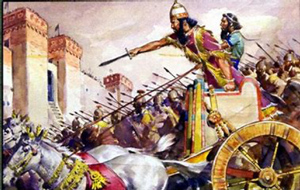
Both images are pretty cool, but chances are it was a genuine plague of locusts that prompted the Lord to give this word to Joel, son of Pethuel.
* * *
Joel 2:23-32
The outpouring of the Spirit
The dramatic reversal following the plague and the restoration God promises through the prophet is both material and spiritual. The latter part of today’s reading was part of the first sermon in Christian history found in Acts 2. You can cite it this Sunday and bypass all those difficult names that someone is always burdened with reading on Pentecost.
* * * * * *
 From team member Mary Austin:
2 Timothy 4:6-8, 16-18
Running the Race
“I have finished the race,” the epistle tells us. High school runner Josh Ripley’s cross country race turned out to be different one day from all his other races. In the first mile, he came upon Mark, a runner from another team, holding his ankle and bleeding. “It turns out Mark had been “spiked,” meaning he was stepped on or came in contact with pointed metal spikes some runners wear on their shoes to get better traction. Mark was taken to a hospital where he received more than 20 stitches.”
Mark got to the hospital because Josh noticed him and “carried the wounded runner for a half a mile to get him to his coach and parents. After making sure Mark was in good hands, Josh jumped back into the race.” Josh, then a junior, said that stopping to help was “just natural instinct.”
“I didn’t think about my race, I knew I needed to stop and help him,” Josh said. “It was something I would expect my other teammates to do. I’m nothing special; I was just in the right place at the right time.”
When someone saw Josh, and told his coach that Josh was carrying another runner, the coach thought he had heard wrong. Then Josh jogged into sight, carrying the injured runner. Josh handed him over, and went back to the race – and finished.
* * *
2 Timothy 4:6-8, 16-18
Running Into the Future
“I have fought the good fight, I have finished the race, I have kept the faith,” Paul writes.
The men and women who come to Back on My Feet can make a similar claim. The organization helps people move out of being homeless by helping them become runners. A man named Luis says that running is good preparation for other challenges. “With Back on My Feet's help and support, I interviewed for the job feeling confident because of the running, resume prep and interview workshops with Accenture. I had run two marathons. I could do this. And I did. I got the job. Then I applied for a promotion, and I got that too. It reinforced that you get what you put in, just like training."
Luis, a military veteran, suffered an injury in Desert Storm and was told he wouldn’t walk again. Through running, he built up the strength in his leg, ultimately adding so much strength and mobility that he didn’t need a planned surgery. He also realized that “mending the social connections in his life was also fundamental to his life-altering transformation. Luis renewed relationships with his family and set goals for his future. He found a place to live, got a job at Marriott/White Lodging, and then quickly got promoted.” He still runs with the group, and serves as a mentor to other runners.
Back on My Feet helps people who are homeless find health in body and mind, and say, along with Paul, “I have fought the good fight, I have finished the race.”
* * *
Luke 18:9-14
No Hate
Bishop Michael Curry comes from a religious tradition that includes his father, who was an Episcopal priest, and other relatives who were Baptist. Each part of the family might have looked down on the other part, and yet Bishop Curry says they had similar world views. Both sides of the family offered wisdom that would have benefitted the Pharisee and the man praying with him.
Curry says, “As a kid growing up, I remember my grandmother and Aunt Lillian, in particular, would often say on different occasions, for different reasons, “Never let any man drag you so low as to hate him.” Now, I didn’t know as a kid that they were actually — and I’m not sure they knew, either — they were actually quoting Booker T. Washington, who said that. But I grew up in a context where people really did believe that the kind of love that Jesus of Nazareth taught is the kind of love that can change personal life and social life. They really did believe that. And it was just ingrained in me.”
In contrast to the Pharisee in the parable, Curry says, “the love of God is the motive for everything God does… And so both my growing up as a Black kid and as an Episcopalian way of being Christian, centered on the way of love as the key to life itself.”
* * *
Luke 18:9-14
Common Ground
The two men in the parable have more in common than they can see, according to Bishop Michael Curry.
Curry starts small, and expands, saying, “We got a lot in common. We really do. First of all, we all inhale oxygen and exhale carbon dioxide. We have a lot in common. We happen to inhabit the same planet. You cut us, we all bleed. There’s a lot in common…A friend of mine said, one of the reasons God told Moses to take off his shoes, in Exodus 3, he said, because God was about to tell Moses his story. And whenever someone reveals the story of their life, that ground on which they’re standing is holy ground. That’s the common ground: we’re human, and we’ve got a story. And if I listen to yours, and you to mine, we won’t agree on a whole lot, but we’ll understand each other. And that produces common ground.”
In a time of division in the church, when it’s easy to look down on people with opposing views, Curry says, “one of the things I’ve really — and I struggle with this; it’s not easy to do this — is how do I stand and kneel at the same time, in my relationships with others, especially with those who disagree with me or I disagree with them? Because I’ve got to kneel before them as someone created in the image of God, a child of God just like me, loved of God equally. Love is an equal opportunity employer, and the love of God is equal. So I’ve got to kneel before them, in a sense. And yet, at the same time, I must stand with integrity.”
* * * * * *
 WORSHIP
by George Reed
Call to Worship
One: Let us lift up our eyes to the hills— from where will our help come?
All: Our help comes from God, who made heaven and earth.
One: Our God is our keeper; the shade at our right hand.
All: The sun shall not strike us by day, nor the moon by night.
One: God will keep us from all evil; he will keep our life.
All: God will keep our going out and our coming in forevermore.
OR
One: Our God comes and invites us to share our lives.
All: We offer to our loving God the stories of our lives.
One: God knows our needs but in love desires us to share them.
All: We offer to our loving parent the struggles we face.
One: God hears us and invites us to imitate divine love.
All: In gratitude we will lovingly listen to others.
Hymns and Songs
All Creatures of Our God and King
UMH: 62
H82: 400
PH: 455
AAHH: 147
NNBH: 33
NCH: 17
CH: 22
LBW: 527
ELW: 835
W&P: 23
AMEC: 50
STLT 203
Renew: 47
Joyful, Joyful, We Adore Thee
UMH: 89
H82: 376
PH: 464
AAHH: 120
NNBH: 40
NCH: 4
CH: 2
LBW: 551
ELW: 836
W&P: 59
AMEC: 75
STLT 29
Immortal, Invisible, God Only Wise
UMH: 103
H82: 423
PH: 263
NCH: 1
CH: 66
LBW: 526
ELW: 834
W&P: 48
AMEC: 71
STLT 273:
Renew: 46
O God, Our Help in Ages Past
UMH: 117
H82: 680
AAHH: 170
NNBH: 46
NCH: 25
CH: 67
LBW: 320
ELW: 632
W&P: 84
AMEC: 61
STLT 281
Breathe on Me, Breath of God
UMH: 420
H82: 508
PH: 316
AAHH: 317
NNBH: 126
NCH: 292
CH: 254
LBW: 488
W&P: 461
AMEC: 192
For the Healing of the Nations
UMH: 428
NCH: 576
CH: 668
W&P: 621
More Love to Thee, O Christ
UMH: 453
PH: 359
AAHH: 575
NNBH: 214
NCH: 456
CH: 527
AMEC: 460
Sweet Hour of Prayer
UMH: 496
AAHH: 442
NNBH: 332
NCH: 505
CH: 570
W&P: 478
AMEC: 307
Spirit of God, Descend Upon My Heart
UMH: 500
PH: 326
AAHH: 312
NCH: 290
CH: 265
LBW: 486
ELW: 800
W&P: 132
AMEC: 189
Let It Breathe on Me
UMH: 503
AAHH: 316
NNBH: 128
NCH: 288
CH: 260
AMEC: 295
Cares Chorus
CCB: 53
As We Gather
CCB: 12
Renew: 6
Music Resources Key
UMH: United Methodist Hymnal
H82: The Hymnal 1982
PH: Presbyterian Hymnal
AAHH: African American Heritage Hymnal
NNBH: The New National Baptist Hymnal
NCH: The New Century Hymnal
CH: Chalice Hymnal
LBW: Lutheran Book of Worship
ELW: Evangelical Lutheran Worship
W&P: Worship & Praise
AMEC: African Methodist Episcopal Church Hymnal
STLT: Singing the Living Tradition
CCB: Cokesbury Chorus Book
Renew: Renew! Songs & Hymns for Blended Worship
Prayer for the Day/Collect
O God who is our help in all times and all places:
Grant us the faith to trust that you wish us well
and desire for justice to reign through all creation;
through Jesus Christ our Savior. Amen.
OR
We praise you, O God, because you are our constant help. At all times and in all places you come to bring redemption. Open our hearts and strengthen our faith that we may welcome you as you come in justice for all. Amen.
Prayer of Confession
One: Let us confess to God and before one another our sins and especially our failure to look to God for help in times of trouble.
All: We confess to you, O God, and before one another that we have sinned. We profess our faith in you, God, but we are more likely to place our trust in money, military might, and political influence. We are quick to think of you as the unjust judge that we must pester constantly with our prayers rather than trusting that you hear us even before we pray. Strengthen our faith that we may truly trust you and find you an ever present help in times of trouble. Amen.
One: God is ever listening even when we don’t know what to say. Receive God’s grace and grant justice as freely as God does.
Prayers of the People
Praise and glory to you, O God, as you seek justice and mercy to rain down upon all your creation. You are the generous and just judge.
(The following paragraph may be used if a separate prayer of confession has not been used.)
We confess to you, O God, and before one another that we have sinned. We profess our faith in you, God, but we are more likely to place our trust in money, military might, and political influence. We are quick to think of you as the unjust judge that we must pester constantly with our prayers rather than trusting that you hear us even before we pray. Strengthen our faith that we may truly trust you and find you an ever present help in times of trouble.
We give you thanks for your constant presence with us and for your love that surrounds all you have created. We thank you for those who have come to know you and work for justice in your name. We thank you for our abundance home, this earth, that supplies abundantly that all may receive its bounty.
(Other thanksgivings may be offered.)
We pray for one another in our need. We pray for those who have been denied justice and mercy. We pray for those who have been imprisoned unfairly and for those who suffer under unjust regimes. We pray for those who face illness and death.
(Other intercessions may be offered.)
All these things we ask in the name of our Savior Jesus Christ who taught us to pray together saying:
Our Father....Amen.
(Or if the Our Father is not used at this point in the service.)
All this we ask in the name of the Blessed and Holy Trinity. Amen.
* * * * * *
 CHILDREN'S SERMON
Pointing Fingers
by Chris Keating
Luke 18:9-14
Jesus’ parable of the tax collector and the Pharisee is an opportunity to explore what it means to open ourselves to God’s faithfulness and love through honest prayer. While the typical approach includes vilifying the Pharisee, it’s important to remember that both the Pharisee and the tax collector have come to the temple to draw near to God. Yet the tax collector’s presence is distracting to the Pharisee. He (or she) has worked hard to do the things God expects; meanwhile, the tax collector has cheated others, and profited from lying and stealing. Jesus reminds the disciples that the dividing line between the two is the tax collector’s honesty and unwillingness to point fingers at anyone but himself.
The Pharisee knows how to point out flaws in others but has not yet learned what it means to ask for God’s mercy.
Begin the time with children by inviting them to play a quick game. Ask them to point to the thing or person you mention. Begin with something simple such as, “Can you point to a cross? Can you point to the Bible? Can you point to a piano?” and so forth. Then move from objects to people. Can you point to a person who is wearing something red? Can you point to a person who is wearing a tie? Can you point to someone named John? After a few general things such as clothing, hair, or names, ask them if pointing out people is easy or hard. It can be easy to point out people who may be wearing certain clothes (like a minister wearing a robe) but it is much harder to point out other things about people. How can we point out people who have made a mistake this week? (How would you know who made a mistake or not? After all, everyone makes some mistakes). Would it be possible to point to people who don’t like purple? (No, we don’t know that about people.) Can you point to someone who is left-handed? (Maybe, but that isn’t always clear.) How about someone who wants the Yankees to win the World Series, or someone who does not like Mexican food? Well, it gets complicated!
Remind them that while sometimes it is okay to point fingers (like when you’re playing a game), most times it is considered rude to point at other people. You can point to someone who needs help, for example, but you should not point at people who are different than you, or who you think might be “bad.” The Pharisee, for example, pointed out what he thought were the flaws in the tax collector.
But the truth is only God knows what is on our hearts. We have to be careful not to “pre-judge” someone (not to judge a book by its cover) just because of their race, what clothes they are wearing, or where they are from. The Pharisee thinks he knows that the tax collector is a bad sinner.
There are two things in this story that are always true: God loves us and we all make mistakes. The Pharisee did not pay attention to his own mistakes but was quick to point out the ways the tax collector had hurt others. But the tax collector, who had really hurt other people, had come seeking God’s mercy. Thankfully, God does not point fingers.
* * * * * * * * * * * * *
The Immediate Word, October 23, 2022 issue.
Copyright 2022 by CSS Publishing Company, Inc., Lima, Ohio.
All rights reserved. Subscribers to The Immediate Word service may print and use this material as it was intended in sermons and in worship and classroom settings only. No additional permission is required from the publisher for such use by subscribers only. Inquiries should be addressed to or to Permissions, CSS Publishing Company, Inc., 5450 N. Dixie Highway, Lima, Ohio 45807.
- Life is a Participation Trophy by Katy Stenta. When we talk about fighting the good fight, maybe life is about the participation trophy.
- Sermon illustrations by Dean Feldmeyer, Mary Austin, Tom Willadsen.
- Worship resources by George Reed.
- Children's sermon: Pointing Fingers by Chris Keating based on Luke 18:9-14.
Life is a Participation Trophy
by Katy Stenta
2 Timothy 4:6-8, 16-18
In the News
Quiet quitting has been in the news lately as a kind of phenomenon as though setting boundaries at your workplace is a new up and coming thing. However, the truth is that the complaint that “no one wants to work these days” is timeless (thread with citations going back to 1894). And the idea that enough is enough is healthy.
In a world where showing up often does not seem like much, studies show that participation can often be a lot. Studies show that even a friendly text or note can make a big difference. Similarly, even caring for a plant also does this. Caring for a plant is a loving act, but it's more about showing up than it is about “winning” the race. It’s more about consistency than it is about perfection.
In the Scriptures
One cannot help but think of all the times in the Bible that the only thing Jesus requires is for people to be present. There are not complicated hoops to jump through, no membership guides or perfect formulas required for healings or teachings to be accessed. Mostly, Jesus says things like, “Let the children come.” Or to the woman who was hemorrhaging, “Your faith has made you well.” Or “healed you” (Matthew 9:20); or when he healed the ten lepers (Luke 18:42) or the man who was born blind but had not sinned (Luke 18:42).
Later there is Philip, who is told to meet the foreign Ethiopian eunuch and instruct them — and is asked by the eunuch, “What is to prevent me from being baptized.” To which there is no other answer to be given but, “Nothing.” There is nothing to prevent this foreign and other gendered/sexually different person from being baptized (Acts 8).
In the Sermon
As a Xiennal, I personally have borne the brunt of the participation trophies complaints. Is participating enough? Paul seems to make the argument here that, indeed, life is a participation trophy; it is not about winning. Indeed, the moment you make it about winning, you lose sight of the beauty of rest and sabbath that God has made intrinsic to our being. Tricia Hershey eloquently makes this argument in her Nap Ministry where she advocates for the radical and healing administration of rest. She expands upon this argument in her new book (which I fully expect to be a New York Times bestseller) Rest is Resistance.
Here are some helpful things to remember: Quitting is always an option. No is a complete sentences. Boundaries are healthy. There is only one Jesus, and you are not the Savior. And sometimes it’s important to say, “I’ve done all I can here.” That is what Paul is saying. He is not saying “I give up.” He is saying something way deeper and more beautiful: “I participated fully, I’ve done my niche, I’ve fought the fight, I’ve run all I can, I cannot finish the race, and it’s not up to me to win it.”
Here is the good new folks: the invisible church is not our responsibility. The saving of souls is not our responsibility. We are not the administrators of the kingdom of God.
Our job is to tell the good news, to help people, to pray, to celebrate, to feed Jesus’ sheep. We are to participate as we are able, and to leave some things to God. We cannot do all the things, and that is okay. We can close our eyes and trust that God can recognize us for our gifts, and will not shame us for what we cannot do, but love us for exactly as we are. Paul was not perfect, and he could call it a day. This is our job — participate when we can, and stop when we cannot. Tricia Hershy encourages us to rest and call it a day when we need to, so when should we take Sabbath? What if church was about calling it a day? How would that change the world?
ILLUSTRATIONS
From team member Dean Feldmeyer:Luke 18:9-14 — Humility
The story of the Pharisee and the Tax Collector in the temple brings with it many preaching points, not the least of which, is the virtue of humility. The problem comes with the last sentence of the text, which can lead us into a race to win the trophy for “most humble person.”
* * *
Under Oath
Henry Augustus Rowland, professor of physics at Johns Hopkins University, known for being a quiet, self-effacing, humble man, was once called as an expert witness at a trial. During cross-examination a lawyer demanded, "What are your qualifications as an expert witness in this case?"
Rowland answered softly, "I am the greatest living expert on the subject under discussion." Later a friend well acquainted with Rowland's normal disposition expressed surprise at the professor's uncharacteristic answer. Rowland answered, "Well, what did you expect me to do? I was under oath."
* * *
In Heaven
Although George Whitefield disagreed with John Wesley on many theological matters, he was careful not to harshly criticize Wesley lest his criticism be used to hinder the preaching of the gospel. When someone asked Whitefield if he thought he would see Wesley in heaven, Whitefield replied, "I fear not. I think he will be so near the eternal throne and we at such a distance that I shall hardly get a glimpse of him."
* * *
Lincoln The Fool
During the Civil War, Abraham Lincoln got caught up in a situation where he wanted to please a politician whose support he needed, so he issued a command to transfer certain regiments as the politician thought should be done. When Secretary of War, Edwin Stanton, received the order, he refused to carry it out. He said that the President was a fool. Lincoln was told what Stanton had said, and he replied, "If Stanton said I'm a fool, then I must be, for he is nearly always right. I'll see for myself." As the two men talked, the President quickly realized that his decision was a serious mistake, and changed it without hesitation.
* * *
How To Cultivate The Virtue Of Personal Humility
The web site catholicgentleman.com offers six ways to cultivate the virtue of personal humility in one’s life. I have taken the liberty of paraphrasing them in the spirit of ecumenicity:
1. Pray for it — It is safe to say that no virtue is ever formed in our souls except by frequent prayer. If you truly desire to be humble, pray every day for this grace, asking God to help you overcome excessive self-love.
2. Accept failure as part of life — Perhaps the most painful, but also the most effective, way to learn humility is by accepting the humiliation and embarrassment that comes with mistakes and failures.
3. Submit to legitimate authority — Key word, of course, is “legitimate.” If you choose to live in a democratic country, for instance, have the humility to accept the outcome of the election regardless of how you voted.
4. Be skeptical about yourself — Don’t trust flatterers or sycophants. Evaluate yourself and your achievements / accomplishments honestly. Give credit to others when they deserve it.
5. Consider the greatness of God — It’s hard to feel big when you stand on the rim of the Grand Canyon. St. John Vianney puts it this way: “Who can contemplate the immensity of a God without humbling himself into the dust at the thought that God created heaven out of nothing, and that with one word he could turn heaven and earth into nothing again.”
6. Think better of others than of yourself — Thomas à Kempis said, in The Imitation of Christ. “If there is good in you, see more good in others, so that you may remain humble. It does no harm to esteem yourself less than anyone else, but it is very harmful to think yourself better than even one. The humble live in continuous peace, while in the hearts of the proud are envy and frequent anger.”
* * *
Grandchildren Who Set You Straight
Since becoming a grandfather, I have discovered that few things can keep me humble as effectively as smart grandchildren.
Years ago, my son and daughter-in-law invited my wife and me to come with them and our grandsons to the Cincinnati Zoo and Botanical Gardens to see the Christmas light display. It was cold, but comfortable and we were having a wonderful time when I noticed that we were walking on a paved path through a bamboo forest.
I pointed to the bamboo, some of which was ten to twelve feet tall, and asked preschooler Luke (who is now in his teens) if he noticed that we were walking through bamboo. He said that he did. Thinking that I might use this as a teaching moment I asked him if he knew that bamboo was grass. In fact, he did. Whereupon he launched into a ten-minute lecture about the nature of bamboo, what it’s used for, what animals eat it, etc.
I noticed my son, Ben, chuckling to himself. “We have a zoo membership, Dad,” he said. Then he winked and said, “Kinda brought a knife to a gunfight, there, didn’t ya?”
* * *
2 Timothy 4: 6-8, 16-18 — Endings
As Paul wraps up his second letter to Timothy he ponders what may very well be the end of his life and ministry. He has survived the Roman arena once and expects that may not be the case the next time. Paul’s humility in the face of death leads us to consider endings and losses as they come to us through aging. These two illustrations take a humorous perspective:
Memory Loss
While visiting Doctor Lewellan last month, Mary, a long-retired schoolteacher, explained in some detail her problems while he listened very patiently.
“Now, Mary,” said the doctor, “you say you have shooting pains in your neck, aching knees, frequent dizzy spells, and constant nausea. Just for the record, how old are you?”
Mary spoke brightly and, perhaps, a little indignantly: “I'll be 49 on my next birthday.”
“Really?” commented the doctor quietly, “I see you have some slight memory loss, too.”
* * *
The Class of ’69
While waiting for her first appointment in the reception room of a new dentist, Louise noticed his certificate hanging on the wall — it gave his full name.
Thinking hard, Louise remembered that a tall, handsome boy with the same name had been in her high school class some 40 years ago.
Upon seeing him, however, she quickly discarded any such thought. This balding, grey-haired man with the deeply lined face was way too old to have been her classmate.
After he had examined her teeth, she asked him if he had attended the local high school. He replied that, indeed, he had.
“When did you graduate?” she asked.
He answered, “In 1969. Why?”
“You were in my class!” she exclaimed.
He looked at her closely, and then he thoughtlessly asked, “What did you teach?”
Louise found a different, younger dentist.
* * *
Joel 2:23-32 — Visions & Dreams
Ideas That Came from Dreams
Abby Nolan, writing for pastemagazine.com, allows that while other peoples’ dreams are notoriously less interesting than our own, these 3 of 10 great stories were inspired by dreams and visions:
1. Mary Shelley’s Frankenstein (1818) — Hanging out with friends in the Swiss Alps in 1816, one evening the talk turned to ghost stories. Poor Mary spent the night tossing and turning, unable to sleep, but the images that haunted her dreams that night became the stuff of Frankenstein, or The Modern Prometheus.
2. Robert Louis Stevenson’s The Strange Case of Dr. Jekyll and Mr. Hyde (1886) — One night in 1885, Stevenson’s wife awakened him from a nightmare. “I was dreaming a fine bogey tale,” he chided her and explained what the dream had been about. It became a novella the following year.
3. Joseph Heller’s Catch-22 (1961) — “I was lying in bed in my four-room apartment on the West Side,” Heller recalled, “when suddenly this line came to me: ‘It was love at first sight. The first time he saw the chaplain, someone fell madly in love with him.’”
He leapt out of bed, paced the floor and, that morning, wrote the first chapter of what would become a classic novel about the insanity of war.
* * *
A Boy With A Vision
James Irwin, one of only twelve human beings to walk on the moon, was inspired to do so by a vision he had when he was a child.
His mother tells of how, one night, she went to his bedroom just to check on him and found her son 11-year-old son staring quietly out of his window at the full moon and the scenery it illuminated. She gently pulled him away from the window, settled him into his bed, and tucked him in. She recalls that, as she left the room, he said, "Mommy, you know one day I'm going to walk on the moon."
That young visionary would go on to survive a near fatal motorbike crash that broke almost every bone in his body, and still, in 1971, become one of the few to walk on the moon.
* * *
How To Share Your Vision
Tech entrepreneur, Stacey Ferreira, co-founder and CEO of Forge, writing for inc.com, says that it’s not enough for a leader to have a vision. For the vision to become a reality it must be shared. She offers these four things (edited for brevity and clarity) to remember as we attempt to share our vision with those we are called to lead:
1. Don't pretend to have it all figured out. — You shouldn't have a perfectly formed vision when you go to share your ideas with the team. Collaboration is the foundation for authentic development.
2. Talk about the forest and the trees. — Many leaders have a tendency to only share the big picture of an idea because it tends to be more inspiring and exciting. However, sharing the details of a vision is just as important as the picture. Only then can we ask for collaboration on what we need to do to achieve our end goal.
3. Be concise. — When talking about your vision, be short and sweet. If you speak for an extended period of time, your vision will get lost. Your team members won't get on board if they don't understand.
4. Model the courage of the vision. — After sharing the vision, you need to go out and live it. Every action and moment should relate to that vision. Transformation occurs both top-down and bottom-up. You need to be the leader of that change.
* * * * * *
From team member Tom Willadsen:Luke 18:9-14
Pharisee v. tax collector
This appears to be another Lukan inversion, or a race to the bottom to get to the top. Groveling humility is the way to God’s heart one could conclude. A closer look at the Pharisee reveals that he exceeds the requirements of the law. The tax collector is not only a conspicuous sinner, he colludes with the Roman occupiers, a stigma that Jesus’ hearers would have found especially offensive.
The real difference is whom they trust, their own ability and piety, or the infinite mercy of the living God? That’s the contrast our congregations need to recognize.
* * *
Luke 18:9-14
Prayer contest
I attended School for Pastors, sponsored by the Omaha Seminary Foundation in 1993. 100 Presbyterian ministers descended on Hasting College in Nebraska for a week of free room and board and continuing education. We spent a lot of time on the golf course and playing bridge.
At the close of one of his presentations, Louis B. Weeks, now president emeritus of Union Theological Seminary in Richmond, VA, had those in attendance stand, close their eyes, and pray out loud. We were in a lecture hall, spread throughout a large room, and prayers popped up from all parts of the room. Sometimes two would start at about the same time and one praying voice would yield to another.
It did not take long for the exercise to devolve into a prayer contest. Large, full-throated, trained, stained glass, tall steeple voices resonantly lifted prayers to the Almighty. Since our eyes were closed, at least mine were, there was a certain anonymity, but that did not reduce the competition. One prayed that justice roll down like mighty streams, another prayed to the All-Seeing, All-Knowing, Omniscient and Omnipotent, Ineffable One. Others tried to join in, but didn’t quite have the chops. No one knew exactly when one person’s contribution ended, because it was unclear when the prayer would end, so no one said, “in the name of the Christ we pray…Amen.”
As my colleagues droned on, I contemplated whether I wanted to add my voice the effusion. Then it hit me, I’d win the competition by crying out, “Have mercy on me, a sinner!” I’d win the race to the bottom while everyone else was climbing to the top. In the moment I chose to keep silent, winning by not winning would have been opting in to the very exercise I found so tedious. Furthermore, I knew that my contribution would be the nugget for 100 colleagues’ sermons when they returned from School for Pastors. I didn’t feel like shaming them into recognizing my brilliance. So 30 years later I tell the story for The Immediate Word.
* * *
Joel 2:23-32
Grasshoppers or armies?
Some scholars contend that the locust plague that gives today’s reading its setting was a metaphor for a military invasion of Judea.
Both images are pretty cool, but chances are it was a genuine plague of locusts that prompted the Lord to give this word to Joel, son of Pethuel.
* * *
Joel 2:23-32
The outpouring of the Spirit
The dramatic reversal following the plague and the restoration God promises through the prophet is both material and spiritual. The latter part of today’s reading was part of the first sermon in Christian history found in Acts 2. You can cite it this Sunday and bypass all those difficult names that someone is always burdened with reading on Pentecost.
* * * * * *
From team member Mary Austin:2 Timothy 4:6-8, 16-18
Running the Race
“I have finished the race,” the epistle tells us. High school runner Josh Ripley’s cross country race turned out to be different one day from all his other races. In the first mile, he came upon Mark, a runner from another team, holding his ankle and bleeding. “It turns out Mark had been “spiked,” meaning he was stepped on or came in contact with pointed metal spikes some runners wear on their shoes to get better traction. Mark was taken to a hospital where he received more than 20 stitches.”
Mark got to the hospital because Josh noticed him and “carried the wounded runner for a half a mile to get him to his coach and parents. After making sure Mark was in good hands, Josh jumped back into the race.” Josh, then a junior, said that stopping to help was “just natural instinct.”
“I didn’t think about my race, I knew I needed to stop and help him,” Josh said. “It was something I would expect my other teammates to do. I’m nothing special; I was just in the right place at the right time.”
When someone saw Josh, and told his coach that Josh was carrying another runner, the coach thought he had heard wrong. Then Josh jogged into sight, carrying the injured runner. Josh handed him over, and went back to the race – and finished.
* * *
2 Timothy 4:6-8, 16-18
Running Into the Future
“I have fought the good fight, I have finished the race, I have kept the faith,” Paul writes.
The men and women who come to Back on My Feet can make a similar claim. The organization helps people move out of being homeless by helping them become runners. A man named Luis says that running is good preparation for other challenges. “With Back on My Feet's help and support, I interviewed for the job feeling confident because of the running, resume prep and interview workshops with Accenture. I had run two marathons. I could do this. And I did. I got the job. Then I applied for a promotion, and I got that too. It reinforced that you get what you put in, just like training."
Luis, a military veteran, suffered an injury in Desert Storm and was told he wouldn’t walk again. Through running, he built up the strength in his leg, ultimately adding so much strength and mobility that he didn’t need a planned surgery. He also realized that “mending the social connections in his life was also fundamental to his life-altering transformation. Luis renewed relationships with his family and set goals for his future. He found a place to live, got a job at Marriott/White Lodging, and then quickly got promoted.” He still runs with the group, and serves as a mentor to other runners.
Back on My Feet helps people who are homeless find health in body and mind, and say, along with Paul, “I have fought the good fight, I have finished the race.”
* * *
Luke 18:9-14
No Hate
Bishop Michael Curry comes from a religious tradition that includes his father, who was an Episcopal priest, and other relatives who were Baptist. Each part of the family might have looked down on the other part, and yet Bishop Curry says they had similar world views. Both sides of the family offered wisdom that would have benefitted the Pharisee and the man praying with him.
Curry says, “As a kid growing up, I remember my grandmother and Aunt Lillian, in particular, would often say on different occasions, for different reasons, “Never let any man drag you so low as to hate him.” Now, I didn’t know as a kid that they were actually — and I’m not sure they knew, either — they were actually quoting Booker T. Washington, who said that. But I grew up in a context where people really did believe that the kind of love that Jesus of Nazareth taught is the kind of love that can change personal life and social life. They really did believe that. And it was just ingrained in me.”
In contrast to the Pharisee in the parable, Curry says, “the love of God is the motive for everything God does… And so both my growing up as a Black kid and as an Episcopalian way of being Christian, centered on the way of love as the key to life itself.”
* * *
Luke 18:9-14
Common Ground
The two men in the parable have more in common than they can see, according to Bishop Michael Curry.
Curry starts small, and expands, saying, “We got a lot in common. We really do. First of all, we all inhale oxygen and exhale carbon dioxide. We have a lot in common. We happen to inhabit the same planet. You cut us, we all bleed. There’s a lot in common…A friend of mine said, one of the reasons God told Moses to take off his shoes, in Exodus 3, he said, because God was about to tell Moses his story. And whenever someone reveals the story of their life, that ground on which they’re standing is holy ground. That’s the common ground: we’re human, and we’ve got a story. And if I listen to yours, and you to mine, we won’t agree on a whole lot, but we’ll understand each other. And that produces common ground.”
In a time of division in the church, when it’s easy to look down on people with opposing views, Curry says, “one of the things I’ve really — and I struggle with this; it’s not easy to do this — is how do I stand and kneel at the same time, in my relationships with others, especially with those who disagree with me or I disagree with them? Because I’ve got to kneel before them as someone created in the image of God, a child of God just like me, loved of God equally. Love is an equal opportunity employer, and the love of God is equal. So I’ve got to kneel before them, in a sense. And yet, at the same time, I must stand with integrity.”
* * * * * *
WORSHIPby George Reed
Call to Worship
One: Let us lift up our eyes to the hills— from where will our help come?
All: Our help comes from God, who made heaven and earth.
One: Our God is our keeper; the shade at our right hand.
All: The sun shall not strike us by day, nor the moon by night.
One: God will keep us from all evil; he will keep our life.
All: God will keep our going out and our coming in forevermore.
OR
One: Our God comes and invites us to share our lives.
All: We offer to our loving God the stories of our lives.
One: God knows our needs but in love desires us to share them.
All: We offer to our loving parent the struggles we face.
One: God hears us and invites us to imitate divine love.
All: In gratitude we will lovingly listen to others.
Hymns and Songs
All Creatures of Our God and King
UMH: 62
H82: 400
PH: 455
AAHH: 147
NNBH: 33
NCH: 17
CH: 22
LBW: 527
ELW: 835
W&P: 23
AMEC: 50
STLT 203
Renew: 47
Joyful, Joyful, We Adore Thee
UMH: 89
H82: 376
PH: 464
AAHH: 120
NNBH: 40
NCH: 4
CH: 2
LBW: 551
ELW: 836
W&P: 59
AMEC: 75
STLT 29
Immortal, Invisible, God Only Wise
UMH: 103
H82: 423
PH: 263
NCH: 1
CH: 66
LBW: 526
ELW: 834
W&P: 48
AMEC: 71
STLT 273:
Renew: 46
O God, Our Help in Ages Past
UMH: 117
H82: 680
AAHH: 170
NNBH: 46
NCH: 25
CH: 67
LBW: 320
ELW: 632
W&P: 84
AMEC: 61
STLT 281
Breathe on Me, Breath of God
UMH: 420
H82: 508
PH: 316
AAHH: 317
NNBH: 126
NCH: 292
CH: 254
LBW: 488
W&P: 461
AMEC: 192
For the Healing of the Nations
UMH: 428
NCH: 576
CH: 668
W&P: 621
More Love to Thee, O Christ
UMH: 453
PH: 359
AAHH: 575
NNBH: 214
NCH: 456
CH: 527
AMEC: 460
Sweet Hour of Prayer
UMH: 496
AAHH: 442
NNBH: 332
NCH: 505
CH: 570
W&P: 478
AMEC: 307
Spirit of God, Descend Upon My Heart
UMH: 500
PH: 326
AAHH: 312
NCH: 290
CH: 265
LBW: 486
ELW: 800
W&P: 132
AMEC: 189
Let It Breathe on Me
UMH: 503
AAHH: 316
NNBH: 128
NCH: 288
CH: 260
AMEC: 295
Cares Chorus
CCB: 53
As We Gather
CCB: 12
Renew: 6
Music Resources Key
UMH: United Methodist Hymnal
H82: The Hymnal 1982
PH: Presbyterian Hymnal
AAHH: African American Heritage Hymnal
NNBH: The New National Baptist Hymnal
NCH: The New Century Hymnal
CH: Chalice Hymnal
LBW: Lutheran Book of Worship
ELW: Evangelical Lutheran Worship
W&P: Worship & Praise
AMEC: African Methodist Episcopal Church Hymnal
STLT: Singing the Living Tradition
CCB: Cokesbury Chorus Book
Renew: Renew! Songs & Hymns for Blended Worship
Prayer for the Day/Collect
O God who is our help in all times and all places:
Grant us the faith to trust that you wish us well
and desire for justice to reign through all creation;
through Jesus Christ our Savior. Amen.
OR
We praise you, O God, because you are our constant help. At all times and in all places you come to bring redemption. Open our hearts and strengthen our faith that we may welcome you as you come in justice for all. Amen.
Prayer of Confession
One: Let us confess to God and before one another our sins and especially our failure to look to God for help in times of trouble.
All: We confess to you, O God, and before one another that we have sinned. We profess our faith in you, God, but we are more likely to place our trust in money, military might, and political influence. We are quick to think of you as the unjust judge that we must pester constantly with our prayers rather than trusting that you hear us even before we pray. Strengthen our faith that we may truly trust you and find you an ever present help in times of trouble. Amen.
One: God is ever listening even when we don’t know what to say. Receive God’s grace and grant justice as freely as God does.
Prayers of the People
Praise and glory to you, O God, as you seek justice and mercy to rain down upon all your creation. You are the generous and just judge.
(The following paragraph may be used if a separate prayer of confession has not been used.)
We confess to you, O God, and before one another that we have sinned. We profess our faith in you, God, but we are more likely to place our trust in money, military might, and political influence. We are quick to think of you as the unjust judge that we must pester constantly with our prayers rather than trusting that you hear us even before we pray. Strengthen our faith that we may truly trust you and find you an ever present help in times of trouble.
We give you thanks for your constant presence with us and for your love that surrounds all you have created. We thank you for those who have come to know you and work for justice in your name. We thank you for our abundance home, this earth, that supplies abundantly that all may receive its bounty.
(Other thanksgivings may be offered.)
We pray for one another in our need. We pray for those who have been denied justice and mercy. We pray for those who have been imprisoned unfairly and for those who suffer under unjust regimes. We pray for those who face illness and death.
(Other intercessions may be offered.)
All these things we ask in the name of our Savior Jesus Christ who taught us to pray together saying:
Our Father....Amen.
(Or if the Our Father is not used at this point in the service.)
All this we ask in the name of the Blessed and Holy Trinity. Amen.
* * * * * *
CHILDREN'S SERMONPointing Fingers
by Chris Keating
Luke 18:9-14
Jesus’ parable of the tax collector and the Pharisee is an opportunity to explore what it means to open ourselves to God’s faithfulness and love through honest prayer. While the typical approach includes vilifying the Pharisee, it’s important to remember that both the Pharisee and the tax collector have come to the temple to draw near to God. Yet the tax collector’s presence is distracting to the Pharisee. He (or she) has worked hard to do the things God expects; meanwhile, the tax collector has cheated others, and profited from lying and stealing. Jesus reminds the disciples that the dividing line between the two is the tax collector’s honesty and unwillingness to point fingers at anyone but himself.
The Pharisee knows how to point out flaws in others but has not yet learned what it means to ask for God’s mercy.
Begin the time with children by inviting them to play a quick game. Ask them to point to the thing or person you mention. Begin with something simple such as, “Can you point to a cross? Can you point to the Bible? Can you point to a piano?” and so forth. Then move from objects to people. Can you point to a person who is wearing something red? Can you point to a person who is wearing a tie? Can you point to someone named John? After a few general things such as clothing, hair, or names, ask them if pointing out people is easy or hard. It can be easy to point out people who may be wearing certain clothes (like a minister wearing a robe) but it is much harder to point out other things about people. How can we point out people who have made a mistake this week? (How would you know who made a mistake or not? After all, everyone makes some mistakes). Would it be possible to point to people who don’t like purple? (No, we don’t know that about people.) Can you point to someone who is left-handed? (Maybe, but that isn’t always clear.) How about someone who wants the Yankees to win the World Series, or someone who does not like Mexican food? Well, it gets complicated!
Remind them that while sometimes it is okay to point fingers (like when you’re playing a game), most times it is considered rude to point at other people. You can point to someone who needs help, for example, but you should not point at people who are different than you, or who you think might be “bad.” The Pharisee, for example, pointed out what he thought were the flaws in the tax collector.
But the truth is only God knows what is on our hearts. We have to be careful not to “pre-judge” someone (not to judge a book by its cover) just because of their race, what clothes they are wearing, or where they are from. The Pharisee thinks he knows that the tax collector is a bad sinner.
There are two things in this story that are always true: God loves us and we all make mistakes. The Pharisee did not pay attention to his own mistakes but was quick to point out the ways the tax collector had hurt others. But the tax collector, who had really hurt other people, had come seeking God’s mercy. Thankfully, God does not point fingers.
* * * * * * * * * * * * *
The Immediate Word, October 23, 2022 issue.
Copyright 2022 by CSS Publishing Company, Inc., Lima, Ohio.
All rights reserved. Subscribers to The Immediate Word service may print and use this material as it was intended in sermons and in worship and classroom settings only. No additional permission is required from the publisher for such use by subscribers only. Inquiries should be addressed to or to Permissions, CSS Publishing Company, Inc., 5450 N. Dixie Highway, Lima, Ohio 45807.