
Advent 4
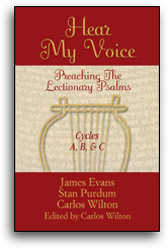
Preaching
Hear My Voice
Preaching The Lectionary Psalms for Cycles A, B, C
Object:
One day, back in the early years of computers, an engineer was asked to demonstrate to a group of reporters what his then "state-of-the-art" machine could do. His computer was one of those huge, room-sized machines -- complete with whirring reels of tape, flashing lights, and a great, clattering punch-card machine. It probably accomplished about as much work as the typical personal computer today -- and a lot more slowly, at that. Yet back then, its power seemed truly extraordinary.
The reporters were suitably impressed. As the engineer went on to boast of the amount of memory his machine had, one of the reporters in the back row was heard to mutter, in a loud stage whisper, "Yes -- but will it remember me?"
It was just a wisecrack -- but it carried within it a chilling question, one that's just as distressing today as it was back then. The more our culture becomes dependent on these remarkable machines -- the more high-tech seems to crowd out high-touch in our lives -- what is to become of us, who are made not of silicon chips but of living, breathing flesh?
One of the deepest longings of our race is to be assured that we will somehow be "remembered" -- that to someone out there, we are more than one in a few billion humanoid life forms, on the third planet of a medium-sized star, off to the edge of the Milky Way galaxy. Is there something, someone, at the heart of the universe -- someone who remembers?
Nearly 2,000 years ago, in an insignificant village in a far-off corner of the Roman Empire, a peasant girl was asking herself the very same question. It was the sort of question young people of any time or place can be counted upon to ask: Why am I here? What am I to do? Will my life make a difference?
The singular distinction of this young girl is that she got an answer. Whatever it was that Mary of Nazareth heard and saw that day -- that portentous day, known forever after as "the annunciation" -- it forever changed the course of human history.
Scripture tells of an angel named Gabriel who appears in Mary's presence, delivering to her the unexpected news that she will bear a son. This child "will be great," the angel announces, "and will be called Son of the Most High. Of his kingdom there will be no end."
And then, in the twinkling of an eye, Mary knows. She knows -- in a flash of insight so dazzling she could never forget it. Mary knows that someone remembers.
And what does she do, in response? She sings. Mary's response to this glorious news is to throw back her head and let loose a rousing song of God's love and power.
This song of Mary's is known as the "Magnificat" -- after the first word of her song in Latin: "My soul magnifies the Lord." And "magnify the Lord" Mary does -- recounting not only the marvelous deeds God has done for Israel, but the astounding things the Lord has yet to do, through this babe who has not even yet begun to stir in her womb. "The Mighty One has done great things for me," she sings; "holy is his name."
Mary sings not only of the love of God; she sings also of God's justice. The Magnificat is no syrupy ballad of private inspiration, no ode to personal religious experience. The God of Mary's praises is one who "has scattered the proud ... brought down the powerful ... and lifted up the lowly." As for the rich, Mary's God has sent them away empty.
What could Mary possibly have seen, that heaven-touched day long ago, of things that were to come? What could she have known of all the mighty works her baby boy would accomplish? Surely she could not have foreseen the cross he would bear, or the cold, dark tomb from which he would rise. But she saw enough to be able to sing -- and so can we, in these Advent days.
-- C. W.
The reporters were suitably impressed. As the engineer went on to boast of the amount of memory his machine had, one of the reporters in the back row was heard to mutter, in a loud stage whisper, "Yes -- but will it remember me?"
It was just a wisecrack -- but it carried within it a chilling question, one that's just as distressing today as it was back then. The more our culture becomes dependent on these remarkable machines -- the more high-tech seems to crowd out high-touch in our lives -- what is to become of us, who are made not of silicon chips but of living, breathing flesh?
One of the deepest longings of our race is to be assured that we will somehow be "remembered" -- that to someone out there, we are more than one in a few billion humanoid life forms, on the third planet of a medium-sized star, off to the edge of the Milky Way galaxy. Is there something, someone, at the heart of the universe -- someone who remembers?
Nearly 2,000 years ago, in an insignificant village in a far-off corner of the Roman Empire, a peasant girl was asking herself the very same question. It was the sort of question young people of any time or place can be counted upon to ask: Why am I here? What am I to do? Will my life make a difference?
The singular distinction of this young girl is that she got an answer. Whatever it was that Mary of Nazareth heard and saw that day -- that portentous day, known forever after as "the annunciation" -- it forever changed the course of human history.
Scripture tells of an angel named Gabriel who appears in Mary's presence, delivering to her the unexpected news that she will bear a son. This child "will be great," the angel announces, "and will be called Son of the Most High. Of his kingdom there will be no end."
And then, in the twinkling of an eye, Mary knows. She knows -- in a flash of insight so dazzling she could never forget it. Mary knows that someone remembers.
And what does she do, in response? She sings. Mary's response to this glorious news is to throw back her head and let loose a rousing song of God's love and power.
This song of Mary's is known as the "Magnificat" -- after the first word of her song in Latin: "My soul magnifies the Lord." And "magnify the Lord" Mary does -- recounting not only the marvelous deeds God has done for Israel, but the astounding things the Lord has yet to do, through this babe who has not even yet begun to stir in her womb. "The Mighty One has done great things for me," she sings; "holy is his name."
Mary sings not only of the love of God; she sings also of God's justice. The Magnificat is no syrupy ballad of private inspiration, no ode to personal religious experience. The God of Mary's praises is one who "has scattered the proud ... brought down the powerful ... and lifted up the lowly." As for the rich, Mary's God has sent them away empty.
What could Mary possibly have seen, that heaven-touched day long ago, of things that were to come? What could she have known of all the mighty works her baby boy would accomplish? Surely she could not have foreseen the cross he would bear, or the cold, dark tomb from which he would rise. But she saw enough to be able to sing -- and so can we, in these Advent days.
-- C. W.
