
All Saints' Sunday
Sermon
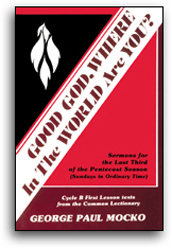
GOOD GOD, WHERE In The WORLD Are YOU?
Sermons for the Last Third of the Pentecost Season
A Book Misunderstood; Jerusalem the Great and Jerusalem the Golden; Away With the Sea and Tears and In With Love; and Faith in a God Who Can Do Anything.
One of the best comedy routines I've ever seen on TV took place in the waiting room of a veterinarian. Among those gathered was a man with a huge box which shuddered and lurched about from the struggles of the creature inside. Strange growls, fur, feathers, and dust all came belching out. At one point the top flew open. The owner grabbed an umbrella, jabbed, poked and slashed to keep the beast inside. When he got the umbrella back, it was nothing but rags and splinters. "What in the world is in there?" asked a mild mannered man holding a cocker spaniel. "Don't really know," responded the wild-eyed, frankly mad-looking owner. "I've consulted every encyclopedia and book of animal biology I could find with no success. But I think I finally found a book that describes him." "What book is that?" asked the owner of the cocker spaniel. With bug-eyed intensity, the man with the huge box responded, "The Book of Revelation."
That is how people normally conceive of Revelation - a wild, strange book that somehow predicts everything that will ever happen, if you could only figure it out. So wild and complicated does Revelation seem that Catholics were able to prove the anti-Christ beast was Luther, and Protestants that he was the Pope, the Allies that he was Hitler, and the Nazis, in their talk, a millenium in which the Third Reich would last 1,000 years. I heard one radio preacher who saw the cold war in the Book of Revelation and, of course, the drug-soaked, psychotic mind of Charles Manson found justification there for his grisly, unspeakable murders.
Certainly Revelation is heavy with allegory and poetic imagery. But it is not that impossible to understand, if you just step back from it a few paces. Far from a wild, chaotic outpouring, it is probably the most carefully constructed and organized book in the entire Bible. After the introductory letters to the seven churches, there are seven sections, each with exactly seven subsections.
The theme of the entire book is persecution - the persecution the church was then suffering, in roughly the year 95. The various visions speak of this persecution going on for forty-two months, or for 12,060 days, which is three and one-half years, and three and one-half is half of seven, which is the ancient number of fulfillment, thus saying the persecution is only half the story. History is still in God's hands, and after the persecution is spent, he will bring it all to a glorious fulfillment. That is the theme of Revelation: Persecution - persecution which will end, and the fulfillment beyond.
This morning's lesson is from one of the sections which describes that fulfillment. It is thus we connect it with All Saints' Sunday, that day on which we remember all those who have lived in faith and died in faith, those we have commended to God, reaching for those promises of his for that time and place of fulfillment beyond death, beyond this world, when we will be rejoined with all those who have gone before us. As we read of this fulfillment, we can see that the author was well versed in those Old Testament prophets who looked forward to Jerusalem being the capital city of the world. The writer of Revelation uses that Old Testament imagery as a jumping-off point.
It was the prophet Isaiah, the scribe Ezra and the governor Nehemiah who made Jerusalem so much the center of Jewish thinking. The Old Testament lesson for the day is typical of this. They had the mental picture of all the world looking one day to Jerusalem for guidance, wisdom and strength. The mental picture of the Judean king being looked upon as the arbiter of international conflict, their law as the standard of justice, Jerusalem's prophets as the conscience of the world, her temple as the focal point of the world's reverence. Jerusalem - the world's ideal and the world's center of peace, justice, prosperity and piety. That is what Isaiah, Ezra and Nehemiah looked forward to. A Jerusalem that would combine everything that today we think of with Geneva for peace, the Hague for international justice, New York's U.N. for deliberations, yes, and for holiness the Vatican, Mecca, Constantinople, Canterbury, the Ganges, all rolled into one. Yes, its beauty would even make it the world's center for the arts, it would be Venice, Paris and Vienna all rolled into one. That's what Isaiah, Ezra and Nehemiah looked forward to, and all that imagery is behind what the author of Revelation writes here.
But the author of Revelation knew a couple of other things. He knew that the Messiah had entered Jerusalem and that Jerusalem had killed him. And he knew that Jerusalem had then been sacked and put to the torch by Rome's armies and now lay in ruins. There was no way it could become that hub of the entire world envisioned by Isaiah, Ezra and Nehemiah, things the former prophets did not know.
And so John, the seer, gives us a yet more glorious fulfillment, described in this text. He gives us a Jerusalem come from heaven, a pure gift of God. The Christian faith thus does not see history merely moving toward some earthly golden age, come after thousands of generations, billions of individuals heap up their dead bodies on experiments that did not work, and thus, with all them, we poor slobs become merely manure for the harvest of those last fortunate generations in that golden age. Paul said that in his way. If, in this world only we have hope, we are of all men, the most to be pitied. (1 Corinthians 15:1a)
The final chapter, the chapter that never ends for our Christian faith, goes beyond history, is not merely for that last lucky people, but for all people. For you and me, for Peter and Paul and Abraham, and for Neanderthal man, your parents, grandparents, mates and children. All of us will share that fulfillment; God creates a new world - that is what John tells us.
Can this be, this glorious fulfillment beyond history, beyond this life? Can we really believe such a thing? I ask why not? is not this world with its vastness, incredible complexity and power and beauty, is not this world quite unbelievable? When you survey all that is, it is impossible that it should have come out of nothing. Impossible, yet surely it is here. It has been created by the God of power and might. So if this one obviously has been created out of nothing, why not another world beyond? That, to me, is not any more unbelievable than whet we have. "Write that down," God said to John, "for these words are trustworthy and true."
What is the nature of life in that new world God is to create and give to us? Let's see what we can pick up in this heavily poetic and symbolic vision John gives us.
Take a couple negatives first. "And there was no longer any sea." Do you like to take your vacations at the shore? Sorry about that. No sea. Actually, don't let it bother you. It's a symbol. The Jews, in all their history were "landlubbers," and never became a sea power. The reason is geography. Unlike Egypt, Greece and the italian peninsula, Palestine has no natural harbor. To the Jews, the sea thus remained that heaving, restless, crashing, unpredictable thing which could not be conquered or controlled. To them the sea became symbolic of chaos and disorder. They feared the sea and for a Jew to say "the sea is his and he made it," (Psalm 95:5) was a statement of brave faith, probably spoken with just a bit of trepidation.
So when John says "no sea," what he is saying is that anything that could even suggest disorder and defiance of God will be gone. There is order; there is harmony; there is peace.
"No more tears." Tears are for lubricating the eyeballs, but that is not the concern here. We weep because we are in pain. Chemical analysis of our tears has found traces of poisons. The body may well be expelling harmful substances at such times. No more tears. Everything is healed.
We weep in times of loss and disappointment. No more tears. It is a time of finding and the arrival of our hopes. No more tears.
We weep at times of parting and death. There will be no more parting. It is a time to rejoin. It is a time for love to be fulfilled. All those moments in your life that you can remember as times of deep sharing, times of joy that you found with another, for another, in another, those times you identified with another and that other's joys and triumphs were equally yours, those times when you found that the good fortune and joy of some certain other were somehow more joyous to you than if that good fortune and joy were yours. It is the fulfillment of love. No more loss, no more parting, no more tears.
And we shed tears when we laugh. Why do we do that? A year or so ago, there was a best seller on the physically healing effects of laughter. Maybe that's what's going on - part of that healing again. Or perhaps we cry when we laugh because we realize that our laughter is always short-lived in this world which Paul described as "groaning in travail." (Romans 8:22) No more tears. No more needing to fear that our joys will end. This time it is for good.
It's for good because, and this is the last point we'll take, because God becomes Alpha and Omega, beginning and ending. "All in all" as Paul put it. (1 Corinthians 15:28) It is the fulfillment of faith.
You've had those moments of faith. When our boys were ten and twelve years of age, in an overnight we climbed Mt. Marcy together. About half-way up we stopped along this mountain creek churning down. Around us the black-green trees, and the soft black-green moss on the rocks and banks. Out of the small brilliant blue patches of sky above came these shafts of white light which turned the splashing waters into showers of diamonds. We were silent. Then I said, "In a place like this, it is very easy to believe in God." They all nodded.
One Easter our choir sand the Hovhanes "Gloria." As the hushed sounds of the various parts intertwined with each other, built and rebuilt, it took my breath away. I felt as if heart, lungs and stomach had come into the physical grip of God. The Easter message was mine! God really did raise Jesus from the dead! He did that. He tore that rock door away from that tomb and called forth that Jesus of Nazareth and set him on high. I knew that. It really happened!
A couple of my moments of faith. You could write yours. Those moments which come to us only here and there in this life, perhaps because we couldn't really take them with much more frequency. Those moments with their exhilaration and their deep, deep peace will become the nature of, not moments, but eternity, because we will be his people and God himself, will be with us and be our God.
Isn't that what is revealed to us when we watch Jesus live and die, and know he was raised? It's just got to be, it's got to be. And, if it gives trouble, I think I can hear John saying "Wait and see; you just wait and see. God will do it. He will do it. He will bring this world with all its hopes and contradictions to a magnificent, glorious fulfillment." And then give it to us. God will do that with another world as easily and surely as he did it with this one.
Such is the vision John gives us of the heavenly Jerusalem. No sea; no tears. Just God, Alpha and Omega and us; all of us; together; with him. Forever. Sure he can do that. He is God.
One of the best comedy routines I've ever seen on TV took place in the waiting room of a veterinarian. Among those gathered was a man with a huge box which shuddered and lurched about from the struggles of the creature inside. Strange growls, fur, feathers, and dust all came belching out. At one point the top flew open. The owner grabbed an umbrella, jabbed, poked and slashed to keep the beast inside. When he got the umbrella back, it was nothing but rags and splinters. "What in the world is in there?" asked a mild mannered man holding a cocker spaniel. "Don't really know," responded the wild-eyed, frankly mad-looking owner. "I've consulted every encyclopedia and book of animal biology I could find with no success. But I think I finally found a book that describes him." "What book is that?" asked the owner of the cocker spaniel. With bug-eyed intensity, the man with the huge box responded, "The Book of Revelation."
That is how people normally conceive of Revelation - a wild, strange book that somehow predicts everything that will ever happen, if you could only figure it out. So wild and complicated does Revelation seem that Catholics were able to prove the anti-Christ beast was Luther, and Protestants that he was the Pope, the Allies that he was Hitler, and the Nazis, in their talk, a millenium in which the Third Reich would last 1,000 years. I heard one radio preacher who saw the cold war in the Book of Revelation and, of course, the drug-soaked, psychotic mind of Charles Manson found justification there for his grisly, unspeakable murders.
Certainly Revelation is heavy with allegory and poetic imagery. But it is not that impossible to understand, if you just step back from it a few paces. Far from a wild, chaotic outpouring, it is probably the most carefully constructed and organized book in the entire Bible. After the introductory letters to the seven churches, there are seven sections, each with exactly seven subsections.
The theme of the entire book is persecution - the persecution the church was then suffering, in roughly the year 95. The various visions speak of this persecution going on for forty-two months, or for 12,060 days, which is three and one-half years, and three and one-half is half of seven, which is the ancient number of fulfillment, thus saying the persecution is only half the story. History is still in God's hands, and after the persecution is spent, he will bring it all to a glorious fulfillment. That is the theme of Revelation: Persecution - persecution which will end, and the fulfillment beyond.
This morning's lesson is from one of the sections which describes that fulfillment. It is thus we connect it with All Saints' Sunday, that day on which we remember all those who have lived in faith and died in faith, those we have commended to God, reaching for those promises of his for that time and place of fulfillment beyond death, beyond this world, when we will be rejoined with all those who have gone before us. As we read of this fulfillment, we can see that the author was well versed in those Old Testament prophets who looked forward to Jerusalem being the capital city of the world. The writer of Revelation uses that Old Testament imagery as a jumping-off point.
It was the prophet Isaiah, the scribe Ezra and the governor Nehemiah who made Jerusalem so much the center of Jewish thinking. The Old Testament lesson for the day is typical of this. They had the mental picture of all the world looking one day to Jerusalem for guidance, wisdom and strength. The mental picture of the Judean king being looked upon as the arbiter of international conflict, their law as the standard of justice, Jerusalem's prophets as the conscience of the world, her temple as the focal point of the world's reverence. Jerusalem - the world's ideal and the world's center of peace, justice, prosperity and piety. That is what Isaiah, Ezra and Nehemiah looked forward to. A Jerusalem that would combine everything that today we think of with Geneva for peace, the Hague for international justice, New York's U.N. for deliberations, yes, and for holiness the Vatican, Mecca, Constantinople, Canterbury, the Ganges, all rolled into one. Yes, its beauty would even make it the world's center for the arts, it would be Venice, Paris and Vienna all rolled into one. That's what Isaiah, Ezra and Nehemiah looked forward to, and all that imagery is behind what the author of Revelation writes here.
But the author of Revelation knew a couple of other things. He knew that the Messiah had entered Jerusalem and that Jerusalem had killed him. And he knew that Jerusalem had then been sacked and put to the torch by Rome's armies and now lay in ruins. There was no way it could become that hub of the entire world envisioned by Isaiah, Ezra and Nehemiah, things the former prophets did not know.
And so John, the seer, gives us a yet more glorious fulfillment, described in this text. He gives us a Jerusalem come from heaven, a pure gift of God. The Christian faith thus does not see history merely moving toward some earthly golden age, come after thousands of generations, billions of individuals heap up their dead bodies on experiments that did not work, and thus, with all them, we poor slobs become merely manure for the harvest of those last fortunate generations in that golden age. Paul said that in his way. If, in this world only we have hope, we are of all men, the most to be pitied. (1 Corinthians 15:1a)
The final chapter, the chapter that never ends for our Christian faith, goes beyond history, is not merely for that last lucky people, but for all people. For you and me, for Peter and Paul and Abraham, and for Neanderthal man, your parents, grandparents, mates and children. All of us will share that fulfillment; God creates a new world - that is what John tells us.
Can this be, this glorious fulfillment beyond history, beyond this life? Can we really believe such a thing? I ask why not? is not this world with its vastness, incredible complexity and power and beauty, is not this world quite unbelievable? When you survey all that is, it is impossible that it should have come out of nothing. Impossible, yet surely it is here. It has been created by the God of power and might. So if this one obviously has been created out of nothing, why not another world beyond? That, to me, is not any more unbelievable than whet we have. "Write that down," God said to John, "for these words are trustworthy and true."
What is the nature of life in that new world God is to create and give to us? Let's see what we can pick up in this heavily poetic and symbolic vision John gives us.
Take a couple negatives first. "And there was no longer any sea." Do you like to take your vacations at the shore? Sorry about that. No sea. Actually, don't let it bother you. It's a symbol. The Jews, in all their history were "landlubbers," and never became a sea power. The reason is geography. Unlike Egypt, Greece and the italian peninsula, Palestine has no natural harbor. To the Jews, the sea thus remained that heaving, restless, crashing, unpredictable thing which could not be conquered or controlled. To them the sea became symbolic of chaos and disorder. They feared the sea and for a Jew to say "the sea is his and he made it," (Psalm 95:5) was a statement of brave faith, probably spoken with just a bit of trepidation.
So when John says "no sea," what he is saying is that anything that could even suggest disorder and defiance of God will be gone. There is order; there is harmony; there is peace.
"No more tears." Tears are for lubricating the eyeballs, but that is not the concern here. We weep because we are in pain. Chemical analysis of our tears has found traces of poisons. The body may well be expelling harmful substances at such times. No more tears. Everything is healed.
We weep in times of loss and disappointment. No more tears. It is a time of finding and the arrival of our hopes. No more tears.
We weep at times of parting and death. There will be no more parting. It is a time to rejoin. It is a time for love to be fulfilled. All those moments in your life that you can remember as times of deep sharing, times of joy that you found with another, for another, in another, those times you identified with another and that other's joys and triumphs were equally yours, those times when you found that the good fortune and joy of some certain other were somehow more joyous to you than if that good fortune and joy were yours. It is the fulfillment of love. No more loss, no more parting, no more tears.
And we shed tears when we laugh. Why do we do that? A year or so ago, there was a best seller on the physically healing effects of laughter. Maybe that's what's going on - part of that healing again. Or perhaps we cry when we laugh because we realize that our laughter is always short-lived in this world which Paul described as "groaning in travail." (Romans 8:22) No more tears. No more needing to fear that our joys will end. This time it is for good.
It's for good because, and this is the last point we'll take, because God becomes Alpha and Omega, beginning and ending. "All in all" as Paul put it. (1 Corinthians 15:28) It is the fulfillment of faith.
You've had those moments of faith. When our boys were ten and twelve years of age, in an overnight we climbed Mt. Marcy together. About half-way up we stopped along this mountain creek churning down. Around us the black-green trees, and the soft black-green moss on the rocks and banks. Out of the small brilliant blue patches of sky above came these shafts of white light which turned the splashing waters into showers of diamonds. We were silent. Then I said, "In a place like this, it is very easy to believe in God." They all nodded.
One Easter our choir sand the Hovhanes "Gloria." As the hushed sounds of the various parts intertwined with each other, built and rebuilt, it took my breath away. I felt as if heart, lungs and stomach had come into the physical grip of God. The Easter message was mine! God really did raise Jesus from the dead! He did that. He tore that rock door away from that tomb and called forth that Jesus of Nazareth and set him on high. I knew that. It really happened!
A couple of my moments of faith. You could write yours. Those moments which come to us only here and there in this life, perhaps because we couldn't really take them with much more frequency. Those moments with their exhilaration and their deep, deep peace will become the nature of, not moments, but eternity, because we will be his people and God himself, will be with us and be our God.
Isn't that what is revealed to us when we watch Jesus live and die, and know he was raised? It's just got to be, it's got to be. And, if it gives trouble, I think I can hear John saying "Wait and see; you just wait and see. God will do it. He will do it. He will bring this world with all its hopes and contradictions to a magnificent, glorious fulfillment." And then give it to us. God will do that with another world as easily and surely as he did it with this one.
Such is the vision John gives us of the heavenly Jerusalem. No sea; no tears. Just God, Alpha and Omega and us; all of us; together; with him. Forever. Sure he can do that. He is God.
