
America, Apple Pie, And The Disposable Mother
Self Help
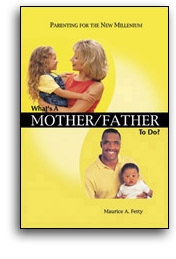
What's A Mother/Father To Do?
Parenting For The New Millennium
"If a man tells his father or his mother, what you would have gained from me is Corban (that is, given to God) -- then you no longer permit him to do anything for his father or mother, thus making void the word of God through your tradition...." -- Mark 7:11-12
Life has not always been easy for the women and mothers of the world. We had a vivid reminder of that fact in our visit to mainland China, where 1.2 billion people, or about one quarter of the world's population, make their home.
We saw women who lived in somewhat modern apartment buildings who hung their wash on the balcony to dry and we saw women living in hillside caves, who hand-washed their clothes in the nearby polluted streams, pounding them on the rocks to make them clean. For many Chinese families, the proverbial Chinese hand laundry was the Chinese mother and her hands.
We had the chance actually to visit the home of a Chinese peasant farmer family in the town of Qufu, birthplace of Confucius. In accordance with ancient custom, the home was within the town for protection and during the day the family went outside the town to farm the fields, returning at night.
While this peasant family did in fact have a television, they had little else. There were a few pieces of furniture, three rooms poorly furnished, a courtyard with a water faucet and sink where the woman of the house did much of her work. This young peasant family had three children -- two more than the allotted one per family. Farmers needing extra help in the fields sometimes get away with more than one child, but even then they often pay a fine from their earnings of little more than $400 a year.
That Chinese farmer's wife did not have an easy life nor, for that matter, did the farmer. It was a life of repetitive manual labor with few opportunities for leisure, travel, or entertainment.
But perhaps one of the more striking facts about Chinese culture is the strict law allowing one child per family. In their commendable effort to stem a bulging population which grows by seventeen to twenty million per year, the Chinese are determined to limit family size to one child. And the children we saw were indeed absolutely adorable. One wonders what the future holds for them.
However, here is the difficult aspect of their population control effort -- boy babies are much preferred over girls. Female fetuses are readily aborted and girl babies are readily exposed or abandoned, so much so, that Chinese orphanages are full of baby girls. Although our guide asserted that in many ways the Chinese family is matriarchal, especially when it comes to controlling the purse strings, in actual practice it is the females more than the males that are -- well -- disposable.
To say it another way, China is disposing of its future mothers -- so much so, that in the future there may be a high premium for females.
Disposable mothers in America may seem as unthinkable as disposable Americanism and disposable apple pie. After all, what three more important American traditions can there be than Americanism, apple pie, and motherhood? And yet, not only in China, but also in America, there is a danger that motherhood may be disposable. And surprisingly, it is men, women, and children who may be doing the disposing.
I.
Consider first men and our younger mothers.
The tragic fact is that many young American men are disposing of our young American mothers. In 1960, one in eleven American children lived in a single parent home; in 1980, it was one in five, and now it is close to one in four. Moreover, it is expected that fifty percent of all American children, by the time they are eighteen, will have lived part of their lives in a single-parent family.
And that single parent is most always the mother. Therefore, for every newborn American baby, there is a nearly fifty-fifty chance of being abandoned by his father, which is another way of saying his mother is abandoned by her husband, which is another way of saying the mother is disposable -- that is, disposable from the husband-father's life patterns, goals, aspirations, and emotional bonding.
If in China, female babies are aborted, in America, the mothers are aborted from the emotional and financial security of the nuclear family. If in ancient society a divorced or widowed mother was almost certain to experience exploitation, deprivation, and poverty, in modern America about one half of single mothers live at or below the poverty line. And if in former societies the child of a single mother could get out of hand and be a problem to society, so too in modern American society, children of single parents may experience emotional and behavioral problems which might have been avoided in a stable, two-parent family.
Therefore, men and fathers need to recommit themselves to the devoted women and mothers of our society and to the sanctity and viability of the family. Many American men are deadbeats when it comes to supporting their children. Others are so preoccupied with themselves they provide little emotional support for the wife and mother and children. And other men have allowed themselves to be elbowed out of significant authority and bonding opportunities by aggressive feminists and so-called family experts. The ancient command to "honor thy mother" surely can include honoring the mother of our children.
II.
However, it is not only the men who sometimes promote a disposable motherhood; it is the women and mothers themselves. Women need to reconsider what it is to honor mothers and motherhood.
In some circles it is not politically correct these days for a bright, young woman and college graduate to say she wants to be a mother and housewife. A prize-winning author, maybe. An actress or model or Wall Street lawyer would be great. So would being a corporate executive or brain surgeon or Supreme Court Justice. But a mother? Who would admit to it?
In her provocative book, Enemies Of Eros, Maggie Gallagher says that in the popular, politically correct literature, having a baby is regarded as a -- well -- selfish act. To stay at home is to guarantee plumpness, loss of intellectual vitality and sexual attractiveness, and inability to join in meaningful adult conversation. And so, as Gallagher whimsically asserts, Levittown becomes the first circle of Dante's Hell.
In this scenario, the maternal instinct is regarded as sentimental and the raising of children -- even her own -- as beneath her intelligence. Women of this persuasion would gasp in disbelief at an actress like Audrey Hepburn who gave up film stardom to devote herself to raising her children and affirming later in life, she would do it all over again without hesitation.
As Gallagher says, "I sometimes wonder how a movement devoted to the personhood of women can fail to notice how it has dehumanized our mothers." She adds, "The prevailing ideology defines the psychic structure of femininity as a psychological disorder, an emotional handicap, a set of impulses that society must attempt to recondition like worn out sofas, rather than accommodate" (pp. 56-57). "The family-oriented woman is hardly extinct. She's just culturally irreversible," says Gallagher. "Her needs are considered unworthy of public debate; her work unworthy of public recognition" (p. 63).
So girls and women themselves need to reaffirm motherhood as a noble calling and key social responsibility. Rather than disdain their unique and historic and crucial role, women can accept and affirm a new kind of motherhood in a culturally enlightened age where men can think more in terms of equality, and feminists can think as much of the intricate emotional and social structure of the family as they do of the blatant struggle for power and money and fame.
The commandment to honor thy father and mother urges women not only to honor their own mothers, but also their own motherhood. After all, women have been and always will be the origins of the future.
III.
But children need to heed this command as well. If men and women have tended to dispose of mothers, so have families and children. Children need to honor mothers.
In his best-selling, controversial book, The Closing of the American Mind, University of Chicago professor Alan Bloom lamented the decline of American families, the lack of family cohesiveness, and the absolute dreariness of the typical family spiritual landscape. He wondered if families were inculcating any values of any kind except the value of winning, winning big, and winning at any cost.
More than that, an immense selfishness has possessed not only the American parents, but perhaps even more the American child. The famous French sociologist-historian, Alexis de Tocqueville, once said that "in democratic societies, each citizen is habitually busy with the contemplation of a very petty object, which is himself" (quoted in Bloom, op. cit., p. 86). We might paraphrase him to say that in our families, each member is habitually busy with contemplation of a very petty object, which is himself.
The cement which bound many families together seems, in many cases, to have crumbled. If self-obsessed parents abandon their children, self-obsessed children also abandon their parents. Dr. Bloom maintains that his students have a "certain benign contempt for their parents, particularly for their mothers, who were sexually inexperienced and had no profession to be taken as seriously as their fathers" (op. cit., p. 107). Children often believe they have the right to the total attention and energy of their parents, who, in their view, should totally sacrifice their time and money and emotion for their benefit. The children of today, says Dr. Bloom, believe they should receive unquestionable benefits from their parents, while at the same time, feeling no reciprocal obligation to the parents. That attitude can be expected of a three-year-old, but alas it often continues to the thirty- and forty- and fifty-year-olds who snub their parents, ignore them, refuse to share their prosperity with them, and often abandon them to loneliness in retirement and nursing homes. At all ages, in our greedy, self-centered times, we seem all too ready to dispose of our mothers and motherhood.
Even in Jesus' time, they were doing it -- disposing of parents by making religious vows -- of all things -- saying the money they would have used to support them was "corban," that is, pledged or donated to the temple, where it would enhance their reputation and earn them notoriety and good connections.
Jesus denounced the hypocrisy that ignored the ancient command to honor father and mother for the sake of making a reputation for oneself, of making oneself famous or using money to secure the right connections.
China and the modern culture notwithstanding -- mothers and motherhood are not disposable. The society and nation which do so will suffer grave consequences. The ancient command still stands for men, women, and children. "Honor thy father and thy mother, that it may be well with you, and that you may live long in the land God has given you." Women and mothers, we honor you.
Prayer
Eternal God, within whose being resides all the dimensions of gender, and out of whose nature all masculinity and femininity, maleness and femaleness have come, we worship and adore you as the source of all we are and can become. It has been your pleasure to make all living things for courtship and love so that all the natural world is a dance between masculine and feminine. We give thanks and praise.
We especially give thanks for our mothers, who in the pangs of childbirth brought us into life, and who in the days of our childhood nurtured us more than we knew, and labored and sacrificed more than we ever appreciated. Deep within the heart of most mothers you have planted a desire to give, to share, to help, and to support. We thank you, God, for your love manifested in our mothers.
We pray this day for our aged mothers, some of whom struggle with infirmities of body and mind. We always pray for their good health and for their contentment of soul and peace of mind. Keep us from thoughtlessness and neglect. Cause us always in gratitude to shower them with affection and to sustain them in their needs.
We pray also for younger mothers, struggling with the challenge of the first or second child, balancing their demands against a career and a husband drifting out of focus. Give them wisdom and energy and insight in how best to structure their lives.
We pray especially for single mothers of whom there are so many today. Give them an extra measure of strength for the responsibilities they bear. Save them from the threats of poverty, and help them to cope in creative ways.
Bless all the families of the community and church and nation -- families stressed in the demands of work and school, sports and activities, families whose vital, spiritual center is fading, families torn apart by arguments and strife. Grant that this might be a day of healing and reconciliation, a day of spiritual refocusing and refreshment. Grant it in your mercy, O God. Through Jesus Christ our Lord. Amen.
Life has not always been easy for the women and mothers of the world. We had a vivid reminder of that fact in our visit to mainland China, where 1.2 billion people, or about one quarter of the world's population, make their home.
We saw women who lived in somewhat modern apartment buildings who hung their wash on the balcony to dry and we saw women living in hillside caves, who hand-washed their clothes in the nearby polluted streams, pounding them on the rocks to make them clean. For many Chinese families, the proverbial Chinese hand laundry was the Chinese mother and her hands.
We had the chance actually to visit the home of a Chinese peasant farmer family in the town of Qufu, birthplace of Confucius. In accordance with ancient custom, the home was within the town for protection and during the day the family went outside the town to farm the fields, returning at night.
While this peasant family did in fact have a television, they had little else. There were a few pieces of furniture, three rooms poorly furnished, a courtyard with a water faucet and sink where the woman of the house did much of her work. This young peasant family had three children -- two more than the allotted one per family. Farmers needing extra help in the fields sometimes get away with more than one child, but even then they often pay a fine from their earnings of little more than $400 a year.
That Chinese farmer's wife did not have an easy life nor, for that matter, did the farmer. It was a life of repetitive manual labor with few opportunities for leisure, travel, or entertainment.
But perhaps one of the more striking facts about Chinese culture is the strict law allowing one child per family. In their commendable effort to stem a bulging population which grows by seventeen to twenty million per year, the Chinese are determined to limit family size to one child. And the children we saw were indeed absolutely adorable. One wonders what the future holds for them.
However, here is the difficult aspect of their population control effort -- boy babies are much preferred over girls. Female fetuses are readily aborted and girl babies are readily exposed or abandoned, so much so, that Chinese orphanages are full of baby girls. Although our guide asserted that in many ways the Chinese family is matriarchal, especially when it comes to controlling the purse strings, in actual practice it is the females more than the males that are -- well -- disposable.
To say it another way, China is disposing of its future mothers -- so much so, that in the future there may be a high premium for females.
Disposable mothers in America may seem as unthinkable as disposable Americanism and disposable apple pie. After all, what three more important American traditions can there be than Americanism, apple pie, and motherhood? And yet, not only in China, but also in America, there is a danger that motherhood may be disposable. And surprisingly, it is men, women, and children who may be doing the disposing.
I.
Consider first men and our younger mothers.
The tragic fact is that many young American men are disposing of our young American mothers. In 1960, one in eleven American children lived in a single parent home; in 1980, it was one in five, and now it is close to one in four. Moreover, it is expected that fifty percent of all American children, by the time they are eighteen, will have lived part of their lives in a single-parent family.
And that single parent is most always the mother. Therefore, for every newborn American baby, there is a nearly fifty-fifty chance of being abandoned by his father, which is another way of saying his mother is abandoned by her husband, which is another way of saying the mother is disposable -- that is, disposable from the husband-father's life patterns, goals, aspirations, and emotional bonding.
If in China, female babies are aborted, in America, the mothers are aborted from the emotional and financial security of the nuclear family. If in ancient society a divorced or widowed mother was almost certain to experience exploitation, deprivation, and poverty, in modern America about one half of single mothers live at or below the poverty line. And if in former societies the child of a single mother could get out of hand and be a problem to society, so too in modern American society, children of single parents may experience emotional and behavioral problems which might have been avoided in a stable, two-parent family.
Therefore, men and fathers need to recommit themselves to the devoted women and mothers of our society and to the sanctity and viability of the family. Many American men are deadbeats when it comes to supporting their children. Others are so preoccupied with themselves they provide little emotional support for the wife and mother and children. And other men have allowed themselves to be elbowed out of significant authority and bonding opportunities by aggressive feminists and so-called family experts. The ancient command to "honor thy mother" surely can include honoring the mother of our children.
II.
However, it is not only the men who sometimes promote a disposable motherhood; it is the women and mothers themselves. Women need to reconsider what it is to honor mothers and motherhood.
In some circles it is not politically correct these days for a bright, young woman and college graduate to say she wants to be a mother and housewife. A prize-winning author, maybe. An actress or model or Wall Street lawyer would be great. So would being a corporate executive or brain surgeon or Supreme Court Justice. But a mother? Who would admit to it?
In her provocative book, Enemies Of Eros, Maggie Gallagher says that in the popular, politically correct literature, having a baby is regarded as a -- well -- selfish act. To stay at home is to guarantee plumpness, loss of intellectual vitality and sexual attractiveness, and inability to join in meaningful adult conversation. And so, as Gallagher whimsically asserts, Levittown becomes the first circle of Dante's Hell.
In this scenario, the maternal instinct is regarded as sentimental and the raising of children -- even her own -- as beneath her intelligence. Women of this persuasion would gasp in disbelief at an actress like Audrey Hepburn who gave up film stardom to devote herself to raising her children and affirming later in life, she would do it all over again without hesitation.
As Gallagher says, "I sometimes wonder how a movement devoted to the personhood of women can fail to notice how it has dehumanized our mothers." She adds, "The prevailing ideology defines the psychic structure of femininity as a psychological disorder, an emotional handicap, a set of impulses that society must attempt to recondition like worn out sofas, rather than accommodate" (pp. 56-57). "The family-oriented woman is hardly extinct. She's just culturally irreversible," says Gallagher. "Her needs are considered unworthy of public debate; her work unworthy of public recognition" (p. 63).
So girls and women themselves need to reaffirm motherhood as a noble calling and key social responsibility. Rather than disdain their unique and historic and crucial role, women can accept and affirm a new kind of motherhood in a culturally enlightened age where men can think more in terms of equality, and feminists can think as much of the intricate emotional and social structure of the family as they do of the blatant struggle for power and money and fame.
The commandment to honor thy father and mother urges women not only to honor their own mothers, but also their own motherhood. After all, women have been and always will be the origins of the future.
III.
But children need to heed this command as well. If men and women have tended to dispose of mothers, so have families and children. Children need to honor mothers.
In his best-selling, controversial book, The Closing of the American Mind, University of Chicago professor Alan Bloom lamented the decline of American families, the lack of family cohesiveness, and the absolute dreariness of the typical family spiritual landscape. He wondered if families were inculcating any values of any kind except the value of winning, winning big, and winning at any cost.
More than that, an immense selfishness has possessed not only the American parents, but perhaps even more the American child. The famous French sociologist-historian, Alexis de Tocqueville, once said that "in democratic societies, each citizen is habitually busy with the contemplation of a very petty object, which is himself" (quoted in Bloom, op. cit., p. 86). We might paraphrase him to say that in our families, each member is habitually busy with contemplation of a very petty object, which is himself.
The cement which bound many families together seems, in many cases, to have crumbled. If self-obsessed parents abandon their children, self-obsessed children also abandon their parents. Dr. Bloom maintains that his students have a "certain benign contempt for their parents, particularly for their mothers, who were sexually inexperienced and had no profession to be taken as seriously as their fathers" (op. cit., p. 107). Children often believe they have the right to the total attention and energy of their parents, who, in their view, should totally sacrifice their time and money and emotion for their benefit. The children of today, says Dr. Bloom, believe they should receive unquestionable benefits from their parents, while at the same time, feeling no reciprocal obligation to the parents. That attitude can be expected of a three-year-old, but alas it often continues to the thirty- and forty- and fifty-year-olds who snub their parents, ignore them, refuse to share their prosperity with them, and often abandon them to loneliness in retirement and nursing homes. At all ages, in our greedy, self-centered times, we seem all too ready to dispose of our mothers and motherhood.
Even in Jesus' time, they were doing it -- disposing of parents by making religious vows -- of all things -- saying the money they would have used to support them was "corban," that is, pledged or donated to the temple, where it would enhance their reputation and earn them notoriety and good connections.
Jesus denounced the hypocrisy that ignored the ancient command to honor father and mother for the sake of making a reputation for oneself, of making oneself famous or using money to secure the right connections.
China and the modern culture notwithstanding -- mothers and motherhood are not disposable. The society and nation which do so will suffer grave consequences. The ancient command still stands for men, women, and children. "Honor thy father and thy mother, that it may be well with you, and that you may live long in the land God has given you." Women and mothers, we honor you.
Prayer
Eternal God, within whose being resides all the dimensions of gender, and out of whose nature all masculinity and femininity, maleness and femaleness have come, we worship and adore you as the source of all we are and can become. It has been your pleasure to make all living things for courtship and love so that all the natural world is a dance between masculine and feminine. We give thanks and praise.
We especially give thanks for our mothers, who in the pangs of childbirth brought us into life, and who in the days of our childhood nurtured us more than we knew, and labored and sacrificed more than we ever appreciated. Deep within the heart of most mothers you have planted a desire to give, to share, to help, and to support. We thank you, God, for your love manifested in our mothers.
We pray this day for our aged mothers, some of whom struggle with infirmities of body and mind. We always pray for their good health and for their contentment of soul and peace of mind. Keep us from thoughtlessness and neglect. Cause us always in gratitude to shower them with affection and to sustain them in their needs.
We pray also for younger mothers, struggling with the challenge of the first or second child, balancing their demands against a career and a husband drifting out of focus. Give them wisdom and energy and insight in how best to structure their lives.
We pray especially for single mothers of whom there are so many today. Give them an extra measure of strength for the responsibilities they bear. Save them from the threats of poverty, and help them to cope in creative ways.
Bless all the families of the community and church and nation -- families stressed in the demands of work and school, sports and activities, families whose vital, spiritual center is fading, families torn apart by arguments and strife. Grant that this might be a day of healing and reconciliation, a day of spiritual refocusing and refreshment. Grant it in your mercy, O God. Through Jesus Christ our Lord. Amen.
