
The Ascension Of Our Lord
Preaching
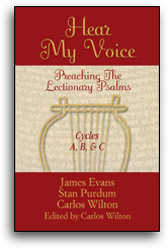
Hear My Voice
Preaching The Lectionary Psalms for Cycles A, B, C
Both Psalms 47 and 93 (the alternative psalm for this day) are enthronement psalms, praise hymns celebrating God's rule over the nations. They were most likely used on festal occasions when Israel again declared that God was its king.
While Psalm 47 was for Israel's celebration, verses 1-2 call all the nations of earth to recognize God as their monarch as well. Verses 3-4, however, return to the specific relationship between God and Israel.
Verse 5 ("God has gone up with a shout") may be the reason the lectionary committee designated this psalm as an Ascension reading -- although, to be true to the psalm, the ascension referred to here is that of God moving up to the heavenly throne. It is not a great stretch, of course, to see the similarity in Christ's movement "into heaven" (Acts 1:11).
Verses 6-9 repeat the call for all peoples to praise God as king of all nations.
There is an additional point of entry into this psalm in verse 2, which declares that God is "awesome." This may provide a way to speak to young people present in the worship service. Youth-speak changes fast, but it wasn't too long ago that "Awesome!" was the youth culture's exclamation of choice to express that the speaker was really impressed by something. The superlative was "Totally awesome!" Let's face it: "Awesome!" is at least an improvement on the earlier "Far out!" or the more recent "Sweet!"
It would be useful to explain that the word actually means "inspiring awe" or "worthy of awe." When the psalmist first used it of God, he knew no superlative could improve it, for God is all in all, and there is no word or words to convey that. So the sermon could proceed along the lines of how we picture God, and how none of the imagery we use to describe God is adequate. Perhaps this is a good time for a "Your God Is Too Small" discussion, following the still-timely J. B. Phillips book by that title.
-- S. P.
While Psalm 47 was for Israel's celebration, verses 1-2 call all the nations of earth to recognize God as their monarch as well. Verses 3-4, however, return to the specific relationship between God and Israel.
Verse 5 ("God has gone up with a shout") may be the reason the lectionary committee designated this psalm as an Ascension reading -- although, to be true to the psalm, the ascension referred to here is that of God moving up to the heavenly throne. It is not a great stretch, of course, to see the similarity in Christ's movement "into heaven" (Acts 1:11).
Verses 6-9 repeat the call for all peoples to praise God as king of all nations.
There is an additional point of entry into this psalm in verse 2, which declares that God is "awesome." This may provide a way to speak to young people present in the worship service. Youth-speak changes fast, but it wasn't too long ago that "Awesome!" was the youth culture's exclamation of choice to express that the speaker was really impressed by something. The superlative was "Totally awesome!" Let's face it: "Awesome!" is at least an improvement on the earlier "Far out!" or the more recent "Sweet!"
It would be useful to explain that the word actually means "inspiring awe" or "worthy of awe." When the psalmist first used it of God, he knew no superlative could improve it, for God is all in all, and there is no word or words to convey that. So the sermon could proceed along the lines of how we picture God, and how none of the imagery we use to describe God is adequate. Perhaps this is a good time for a "Your God Is Too Small" discussion, following the still-timely J. B. Phillips book by that title.
-- S. P.
