
The Attitude of Obedience
Preaching
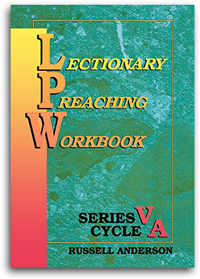
Lectionary Preaching Workbook
Series V, Cycle A
BRIEF COMMENTARY ON THE LESSONS
Lesson 1: Isaiah 7:10--16 (C); Isaiah 7:10--14 (RC); Isaiah 7:10--17 (E); Isaiah 7:10--14 (15--17) (L)
This selection contains a verse (v. 14) that rings musically in the Christian's ear at Christmas. It speaks of a virgin (almah actually means young woman) conceiving and bearing a son who will be called Immanuel. Beginning with Matthew, the church has baptized this as a messianic passage, even though it is not. Consider well the historical context of this saying. King Ahaz is being besieged by an alliance of Israel and Syria. The king intends to repel the threat by forming an alliance with Assyria, which Isaiah warns against. The prophet urges Ahaz rather to trust in the Lord, requesting that the king ask God for a sign of his promise of deliverance. Ahaz refuses to ask the Lord on a pious pretext because he has already decided to go the political route. God gives a sign anyway - the sign of a son. The promise is not of a righteous king for some future time but of a child who will be born in Ahaz's day; by the time this child is able to know what food he likes (age 2 or 3), those countries threatening Ahaz will be deserted.
How then do we handle this text? God gave Ahaz a sign of salvation through Isaiah - the birth of a child. God has given to the world a much more potent sign - the sign of God's Son. As in Isaiah's day, the sign of the son was unsolicited and undeserved. In the midst of a threatening world, the people of God can point to the living sign of hope and salvation, the Son who is Immanuel, God with us.
Lesson 2: Romans 1:1--7 (C, RC, E, L)
In this introduction to the epistle to the Romans, Paul identifies himself and his mission. The first title which he assumes is doulos, which can be translated as either servant or slave. The NRSV and the NIV prefer to translate this 'servant.'' Actually, 'slave'' conveys better Paul's sense of necessity and urgency in proclaiming the gospel. This identity is conferred by God through his call (v. 1). What is he called to? To be an apostle, one who is sent as an ambassador, whose authority resides not in himself but in the one who sent him, in God. What is the mission for which he is consecrated or set apart? The gospel concerning the One promised by the prophets; the One who is both human (Son of David) and divine (v. 4); the One through whom we have received grace and apostleship so that others might come to the obedience of faith in Christ, that they might call Christ Lord and experience the freedom of being his slave.
Gospel: Matthew 1:18--25 (C, E, L); Matthew 1:18--24 (RC)
The first 17 verses of Matthew's gospel consist of genealogy, to establish Jesus' human lineage as a descendent of Abraham and of King David. This week's Gospel seeks to reveal our Lord's divine source, that he was conceived on the Holy Spirit without benefit of human father.
The story is told from Joseph's vantage point, who, upon discovering that his betrothed was pregnant, was ready to quietly divorce her, until an angel revealed in a dream the true cause of her condition. To reinforce that this is not Joseph's child, the angel reveals the name of this special child. The name indicates role and mission; ''Jesus'' means ''he shall save.'' As always, Matthew attempts to show how these happenings were a fulfillment of scriptural prophecies.
A central fact that we must extract from this passage is the obedience of Joseph to the voice of God in the face of rather questionable outward circumstances.
Psalm Of The Day
Psalm 80:1--7, 17--19 (C) - ''Restore us, O God ...'' A Psalm of deliverance from national foes.
Psalm 23 (RC) - A Psalm expressing confidence in God's guidance.
Psalm 24 (E, L) - ''Lift up your head, O gates ....'' This Psalm was probably used in association with processions with the Ark of the Covenant.
Prayer Of The Day
God of glory, thank you for graciously taking on our humanity in the flesh of Jesus. As you revealed the sign of your Son to Mary and Joseph, who bowed in humble obedience to your word, so may we receive and nourish the gift of your Son, our Savior, Jesus the Christ. Amen.
THEOLOGICAL REFLECTION ON THE LESSONS
Lesson 1: Isaiah 7:10--17
Sign language. Human beings are very insecure creatures who continually need reassurance. Many wives complain that their husbands seldom, if ever, say the reassuring words: ''I love you.'' Words help but they must be reinforced by actions. The biblical narrative reveals numerous instances where anxious people sought a reassuring sign from God, but in this text, however, it is God who asks Ahaz if he would like a sign of God's presence. Ahaz refused but God gave the sign anyway - that of the young woman who would bear a son called Immanuel. Jesus chastised his generation for always seeking signs, yet the scriptures indicate that God has often granted signs of his saving presence. In the Noah story, it is the rainbow, and in the Abraham account, it is the sign of circumcision. Moses was granted the rod that transformed into a serpent and Gideon had his fleece. The miracles of Jesus were themselves signs of God's saving presence. The Lord's supper is a poignant sign of divine presence in the valley of the shadows and the cross is the foremost sign of God's triumph over sin and death.
In this holy season, we too are given a sign, the sign given the shepherds when they were informed of the special birth: ''And this will be a sign for you, you will find a babe wrapped in swaddling cloths and lying in a manger'' (Luke 2:12). The sign of the child is the sign of a new beginning for God, for humankind, for each of us who are willing to become as a little child in order to enter the kingdom of Heaven.
Lesson 2: Romans 1:1--7
Slaves Of Sin Or Of The Son? In his very first sentence to the church at Rome, Paul describes himself as the doulos, translated servant or slave, of Jesus Christ. It seems that 'slave'' would better fit Paul's sense of call. A servant is hired for wages and is free to quit at any time. A slave has no choice, receives no wages, and is not free to do as he likes. For Paul, being a servant and apostle of Jesus Christ is not an option but an absolute necessity. This does not mean that he served grudgingly; no, he found joy in his willingness to fulfill the mandates of the Master.
This business of freedom is something of an illusion. There are all kinds of forces which impinge on our lives. In the first three chapters of Romans, Paul establishes the truth that no person is free from the power of sin. There is choice but it is limited - to be a slave of God's Son or of sin. Jesus said it well: ''You cannot serve two masters ... You cannot serve God and mammon'' (Luke 6:24). The irony of it is that it is in this slavery to Christ that we find perfect freedom, the freedom to love and to give.
We are called, in our baptism, to become the slaves of Jesus Christ: his apostles, ambassadors, sent into the world to call others to embrace the obedience of the gospel. This message is the essential antidote for the false notion of freedom being touted today: the heresy that the way to fulfillment is to be free to do as you will. We must hold high the gospel paradox that we are only free when we willingly serve Christ as slave.
Gospel: Matthew 1:18--25
Just Joseph. When Joseph discovered Mary's untimely condition, he decided to divorce her quietly rather than humiliate her. Joseph might have looked at this apparent tragedy from his own selfish perspective but, to his credit, he still cared for Mary and wished to shield her from shame. For this attitude, he is judged as righteous or, as the RSV puts it, just.
Picture in your mind's eye the typical nativity scenes that you have witnessed. Mary often has a glazed--over look of glory on her face but Joseph is just standing there, rather expressionless. Joseph the Just has been transformed into just Joseph, the adopted father of Jesus. A nice guy but who needs him? Joseph is silent in the gospels. We don't know if Joseph ever enunciated any great truths but his actions speak volumes. Try to comprehend what a humbling experience this was for him. He's about to get married and finds out that his fianc is pregnant but not by him. An angel tells him to go ahead and wed Mary because this child is of the Holy Spirit. Out the window are any visions of connubial bliss. Instead, he's handed the embarrassment of a pregnant fianc and the thankless job of caring for another's child. Come on, folks, let's hear it once for Joseph the Just, who humbly obeyed the message from God and faithfully discharged his responsibility as husband and father, rather than sluff it off as a bad dream.
PREACHING APPROACHES WITH ILLUSTRATIONS
Lesson 1: Isaiah 7:10--17
Sermon Title: Sign Language
Sermon Angle: Since God is spirit, which cannot be apprehended through our senses, we must rely on signs which point to and convey his presence. Signs are concrete words or actions which convey the divine presence. The only way we can experience God is through sign language.
Outline:
1. At a time of national crisis, Ahaz was given the sign of God's saving presence, a child
2. In Christ, God has given us his special child as a sign of his saving presence
3. Christ comes to us in Word and sacrament
4. We are sent into the world as signs of God's love and forgiveness
Lesson 2: Romans 1:1--7
Sermon Title: Set Apart Saints Who Serve and Are Sent
Sermon Angle: Who are we as Christians? Paul defines his identity and that of other Christians as saints, those who are set apart by God for the gospel. As saints, our function is to serve God through the neighborhood and go out as apostles, re--presenting by word and deed the good news of salvation through Jesus the Christ.
Outline:
Introduction: Who are we, Christian friend?
1. We are God's saints
a. We are not sinless
b. We are set apart
2. Set apart for what?
a. For service
b. For sending (to proclaim the gospel)
Gospel: Matthew 1:18--25
Sermon Title: The Attitude of Obedience
Sermon Angle: When Joseph was told of Mary's miraculous conception by the angel, he did not hesitate to obey the message from God. He played out his lines in the first act of a drama containing a plot he could not have understood. In our era of individual aspirations and relativism, we need to hold up the virtue of obedience to the Word of God.
The Ron Dotzlers are in interracial couple residing in Omaha, Nebraska. Ron's chemical engineering job enabled them to enjoy a comfortable lifestyle but in the mid--1980s they became convinced that God was calling them as missionaries. They approached their congregation, Trinity Interdenominational Church of Omaha, with their plan, but were told that they were too old and that their family was too large. Nevertheless, they remained convinced of the Lord's call and moved to the near--north side of Omaha, a predominately poor black community, to await the Lord's direction. Some time later the Lord's directive came: They were already living in their mission field. Eventually, they formed Abide Network, a nondenominational Christian ministry whose purpose is to provide practical and spiritual help to churches and ministries in rural and inner--city communities. The word ''Abide'' stands for ''A Bible In Daily Experience.'' The ministry also aims to break down barriers between blacks and whites. So far, they have been successful in assisting area churches with construction projects, youth programs, and much more. Like Joseph and Mary, the Dotzlers obeyed the spiritual vision and heeded the voice of God, despite great obstacles.
Contrast the above with fallen television evangelist, Robert Tilton, who was caught trying to fleece the sheep rather than obey the voice of the Good Shepherd. Tilton spent 84 percent of his air time on promotion and fund raising. He did not blink at asking listeners to send in $1,000 and send it immediately. The television program, Prime Time Live, exposed Tilton's avarice along with allegations of wrongdoing, which led to his ministry's demise.
Some of the sublime actions of humankind as well as some of the most wicked and degrading have been done in the name of obedience. Thousands of people led millions of Jews to the slaughter, out of obedience to their lord and master, Adolf Hitler. At the same time, others risked their lives to save Jews out of obedience to the Lord of Life or, at least, to a transcendent moral imperative.
October 1993 marked the 50th anniversary of the rescue of the Danish Jews during the Nazi occupation. In late September 1943, word leaked out to the Jews of Denmark that they were in imminent danger of being rounded up by the Gestapo. Despite curfews, German patrols on land and sea and the threats of punishment, non--Jewish Danes enabled over 7,300 of the 7,800 Jewish Danes to escape. When the roundup came during Jewish New Year, October 1--2, 1943, most of the Jews were already in hiding in coastal towns, awaiting passage to Sweden. The people of Gilleleje, a small fishing village some 40 miles north of Copenhagen, succeeded in getting close to 1,300 of these Jews to safety by the end of October that year.
After the massacre/suicide of about 1,000 people in Jonestown, Guyana, Russell Baker, columnist for The New York Times wrote an article in which he compared freaks to zombies. The 1960s was the era of the freak. He defined a freak as a person who has turned individuality into social excess. The freak is so focused on doing his or her own thing that he/she sometimes makes individuality look like a type of insanity. The freak is totally self--involved and obeys only himself.
The zombie, on the other hand, has sacrificed his or her individuality and his or her mind to a master who demands and receives total and unquestioned obedience. In the Moonies cult, individual thought is labeled a ''tool of Satan.'' David Koresh was able to lay claim to the same kind of unblinking devotion from the members of his Branch Davidian cult in Waco, Texas. Most of them were willing to kill and be killed in the name of their leader/messiah and we all are aware of their tragic end. Zombies have no will of their own; their will is manipulated by the one they claim as their master.
There is no place for those who insist on being freaks or zombies in the kingdom of Christ. Christ seeks our obedience but it is certainly not unthinking devotion. To the contrary, he urges those who would follow him to first weigh the cost carefully. No place for wild and impulsive devotion in the kingdom of God. Christ does not seek to obliterate our will; rather, he gives us the grace to willingly subject our will to that of God's. Another distinction between Christian obedience and that of the zombie variety is that Christ does not seek power or control for self--aggrandizement. Rather, he seeks to focus and channel the power of obedience for the benefit of the neighbor. The mystery is that the way of willing obedience to Christ is also the means of self--fulfillment and happiness.
Lesson 1: Isaiah 7:10--16 (C); Isaiah 7:10--14 (RC); Isaiah 7:10--17 (E); Isaiah 7:10--14 (15--17) (L)
This selection contains a verse (v. 14) that rings musically in the Christian's ear at Christmas. It speaks of a virgin (almah actually means young woman) conceiving and bearing a son who will be called Immanuel. Beginning with Matthew, the church has baptized this as a messianic passage, even though it is not. Consider well the historical context of this saying. King Ahaz is being besieged by an alliance of Israel and Syria. The king intends to repel the threat by forming an alliance with Assyria, which Isaiah warns against. The prophet urges Ahaz rather to trust in the Lord, requesting that the king ask God for a sign of his promise of deliverance. Ahaz refuses to ask the Lord on a pious pretext because he has already decided to go the political route. God gives a sign anyway - the sign of a son. The promise is not of a righteous king for some future time but of a child who will be born in Ahaz's day; by the time this child is able to know what food he likes (age 2 or 3), those countries threatening Ahaz will be deserted.
How then do we handle this text? God gave Ahaz a sign of salvation through Isaiah - the birth of a child. God has given to the world a much more potent sign - the sign of God's Son. As in Isaiah's day, the sign of the son was unsolicited and undeserved. In the midst of a threatening world, the people of God can point to the living sign of hope and salvation, the Son who is Immanuel, God with us.
Lesson 2: Romans 1:1--7 (C, RC, E, L)
In this introduction to the epistle to the Romans, Paul identifies himself and his mission. The first title which he assumes is doulos, which can be translated as either servant or slave. The NRSV and the NIV prefer to translate this 'servant.'' Actually, 'slave'' conveys better Paul's sense of necessity and urgency in proclaiming the gospel. This identity is conferred by God through his call (v. 1). What is he called to? To be an apostle, one who is sent as an ambassador, whose authority resides not in himself but in the one who sent him, in God. What is the mission for which he is consecrated or set apart? The gospel concerning the One promised by the prophets; the One who is both human (Son of David) and divine (v. 4); the One through whom we have received grace and apostleship so that others might come to the obedience of faith in Christ, that they might call Christ Lord and experience the freedom of being his slave.
Gospel: Matthew 1:18--25 (C, E, L); Matthew 1:18--24 (RC)
The first 17 verses of Matthew's gospel consist of genealogy, to establish Jesus' human lineage as a descendent of Abraham and of King David. This week's Gospel seeks to reveal our Lord's divine source, that he was conceived on the Holy Spirit without benefit of human father.
The story is told from Joseph's vantage point, who, upon discovering that his betrothed was pregnant, was ready to quietly divorce her, until an angel revealed in a dream the true cause of her condition. To reinforce that this is not Joseph's child, the angel reveals the name of this special child. The name indicates role and mission; ''Jesus'' means ''he shall save.'' As always, Matthew attempts to show how these happenings were a fulfillment of scriptural prophecies.
A central fact that we must extract from this passage is the obedience of Joseph to the voice of God in the face of rather questionable outward circumstances.
Psalm Of The Day
Psalm 80:1--7, 17--19 (C) - ''Restore us, O God ...'' A Psalm of deliverance from national foes.
Psalm 23 (RC) - A Psalm expressing confidence in God's guidance.
Psalm 24 (E, L) - ''Lift up your head, O gates ....'' This Psalm was probably used in association with processions with the Ark of the Covenant.
Prayer Of The Day
God of glory, thank you for graciously taking on our humanity in the flesh of Jesus. As you revealed the sign of your Son to Mary and Joseph, who bowed in humble obedience to your word, so may we receive and nourish the gift of your Son, our Savior, Jesus the Christ. Amen.
THEOLOGICAL REFLECTION ON THE LESSONS
Lesson 1: Isaiah 7:10--17
Sign language. Human beings are very insecure creatures who continually need reassurance. Many wives complain that their husbands seldom, if ever, say the reassuring words: ''I love you.'' Words help but they must be reinforced by actions. The biblical narrative reveals numerous instances where anxious people sought a reassuring sign from God, but in this text, however, it is God who asks Ahaz if he would like a sign of God's presence. Ahaz refused but God gave the sign anyway - that of the young woman who would bear a son called Immanuel. Jesus chastised his generation for always seeking signs, yet the scriptures indicate that God has often granted signs of his saving presence. In the Noah story, it is the rainbow, and in the Abraham account, it is the sign of circumcision. Moses was granted the rod that transformed into a serpent and Gideon had his fleece. The miracles of Jesus were themselves signs of God's saving presence. The Lord's supper is a poignant sign of divine presence in the valley of the shadows and the cross is the foremost sign of God's triumph over sin and death.
In this holy season, we too are given a sign, the sign given the shepherds when they were informed of the special birth: ''And this will be a sign for you, you will find a babe wrapped in swaddling cloths and lying in a manger'' (Luke 2:12). The sign of the child is the sign of a new beginning for God, for humankind, for each of us who are willing to become as a little child in order to enter the kingdom of Heaven.
Lesson 2: Romans 1:1--7
Slaves Of Sin Or Of The Son? In his very first sentence to the church at Rome, Paul describes himself as the doulos, translated servant or slave, of Jesus Christ. It seems that 'slave'' would better fit Paul's sense of call. A servant is hired for wages and is free to quit at any time. A slave has no choice, receives no wages, and is not free to do as he likes. For Paul, being a servant and apostle of Jesus Christ is not an option but an absolute necessity. This does not mean that he served grudgingly; no, he found joy in his willingness to fulfill the mandates of the Master.
This business of freedom is something of an illusion. There are all kinds of forces which impinge on our lives. In the first three chapters of Romans, Paul establishes the truth that no person is free from the power of sin. There is choice but it is limited - to be a slave of God's Son or of sin. Jesus said it well: ''You cannot serve two masters ... You cannot serve God and mammon'' (Luke 6:24). The irony of it is that it is in this slavery to Christ that we find perfect freedom, the freedom to love and to give.
We are called, in our baptism, to become the slaves of Jesus Christ: his apostles, ambassadors, sent into the world to call others to embrace the obedience of the gospel. This message is the essential antidote for the false notion of freedom being touted today: the heresy that the way to fulfillment is to be free to do as you will. We must hold high the gospel paradox that we are only free when we willingly serve Christ as slave.
Gospel: Matthew 1:18--25
Just Joseph. When Joseph discovered Mary's untimely condition, he decided to divorce her quietly rather than humiliate her. Joseph might have looked at this apparent tragedy from his own selfish perspective but, to his credit, he still cared for Mary and wished to shield her from shame. For this attitude, he is judged as righteous or, as the RSV puts it, just.
Picture in your mind's eye the typical nativity scenes that you have witnessed. Mary often has a glazed--over look of glory on her face but Joseph is just standing there, rather expressionless. Joseph the Just has been transformed into just Joseph, the adopted father of Jesus. A nice guy but who needs him? Joseph is silent in the gospels. We don't know if Joseph ever enunciated any great truths but his actions speak volumes. Try to comprehend what a humbling experience this was for him. He's about to get married and finds out that his fianc is pregnant but not by him. An angel tells him to go ahead and wed Mary because this child is of the Holy Spirit. Out the window are any visions of connubial bliss. Instead, he's handed the embarrassment of a pregnant fianc and the thankless job of caring for another's child. Come on, folks, let's hear it once for Joseph the Just, who humbly obeyed the message from God and faithfully discharged his responsibility as husband and father, rather than sluff it off as a bad dream.
PREACHING APPROACHES WITH ILLUSTRATIONS
Lesson 1: Isaiah 7:10--17
Sermon Title: Sign Language
Sermon Angle: Since God is spirit, which cannot be apprehended through our senses, we must rely on signs which point to and convey his presence. Signs are concrete words or actions which convey the divine presence. The only way we can experience God is through sign language.
Outline:
1. At a time of national crisis, Ahaz was given the sign of God's saving presence, a child
2. In Christ, God has given us his special child as a sign of his saving presence
3. Christ comes to us in Word and sacrament
4. We are sent into the world as signs of God's love and forgiveness
Lesson 2: Romans 1:1--7
Sermon Title: Set Apart Saints Who Serve and Are Sent
Sermon Angle: Who are we as Christians? Paul defines his identity and that of other Christians as saints, those who are set apart by God for the gospel. As saints, our function is to serve God through the neighborhood and go out as apostles, re--presenting by word and deed the good news of salvation through Jesus the Christ.
Outline:
Introduction: Who are we, Christian friend?
1. We are God's saints
a. We are not sinless
b. We are set apart
2. Set apart for what?
a. For service
b. For sending (to proclaim the gospel)
Gospel: Matthew 1:18--25
Sermon Title: The Attitude of Obedience
Sermon Angle: When Joseph was told of Mary's miraculous conception by the angel, he did not hesitate to obey the message from God. He played out his lines in the first act of a drama containing a plot he could not have understood. In our era of individual aspirations and relativism, we need to hold up the virtue of obedience to the Word of God.
The Ron Dotzlers are in interracial couple residing in Omaha, Nebraska. Ron's chemical engineering job enabled them to enjoy a comfortable lifestyle but in the mid--1980s they became convinced that God was calling them as missionaries. They approached their congregation, Trinity Interdenominational Church of Omaha, with their plan, but were told that they were too old and that their family was too large. Nevertheless, they remained convinced of the Lord's call and moved to the near--north side of Omaha, a predominately poor black community, to await the Lord's direction. Some time later the Lord's directive came: They were already living in their mission field. Eventually, they formed Abide Network, a nondenominational Christian ministry whose purpose is to provide practical and spiritual help to churches and ministries in rural and inner--city communities. The word ''Abide'' stands for ''A Bible In Daily Experience.'' The ministry also aims to break down barriers between blacks and whites. So far, they have been successful in assisting area churches with construction projects, youth programs, and much more. Like Joseph and Mary, the Dotzlers obeyed the spiritual vision and heeded the voice of God, despite great obstacles.
Contrast the above with fallen television evangelist, Robert Tilton, who was caught trying to fleece the sheep rather than obey the voice of the Good Shepherd. Tilton spent 84 percent of his air time on promotion and fund raising. He did not blink at asking listeners to send in $1,000 and send it immediately. The television program, Prime Time Live, exposed Tilton's avarice along with allegations of wrongdoing, which led to his ministry's demise.
Some of the sublime actions of humankind as well as some of the most wicked and degrading have been done in the name of obedience. Thousands of people led millions of Jews to the slaughter, out of obedience to their lord and master, Adolf Hitler. At the same time, others risked their lives to save Jews out of obedience to the Lord of Life or, at least, to a transcendent moral imperative.
October 1993 marked the 50th anniversary of the rescue of the Danish Jews during the Nazi occupation. In late September 1943, word leaked out to the Jews of Denmark that they were in imminent danger of being rounded up by the Gestapo. Despite curfews, German patrols on land and sea and the threats of punishment, non--Jewish Danes enabled over 7,300 of the 7,800 Jewish Danes to escape. When the roundup came during Jewish New Year, October 1--2, 1943, most of the Jews were already in hiding in coastal towns, awaiting passage to Sweden. The people of Gilleleje, a small fishing village some 40 miles north of Copenhagen, succeeded in getting close to 1,300 of these Jews to safety by the end of October that year.
After the massacre/suicide of about 1,000 people in Jonestown, Guyana, Russell Baker, columnist for The New York Times wrote an article in which he compared freaks to zombies. The 1960s was the era of the freak. He defined a freak as a person who has turned individuality into social excess. The freak is so focused on doing his or her own thing that he/she sometimes makes individuality look like a type of insanity. The freak is totally self--involved and obeys only himself.
The zombie, on the other hand, has sacrificed his or her individuality and his or her mind to a master who demands and receives total and unquestioned obedience. In the Moonies cult, individual thought is labeled a ''tool of Satan.'' David Koresh was able to lay claim to the same kind of unblinking devotion from the members of his Branch Davidian cult in Waco, Texas. Most of them were willing to kill and be killed in the name of their leader/messiah and we all are aware of their tragic end. Zombies have no will of their own; their will is manipulated by the one they claim as their master.
There is no place for those who insist on being freaks or zombies in the kingdom of Christ. Christ seeks our obedience but it is certainly not unthinking devotion. To the contrary, he urges those who would follow him to first weigh the cost carefully. No place for wild and impulsive devotion in the kingdom of God. Christ does not seek to obliterate our will; rather, he gives us the grace to willingly subject our will to that of God's. Another distinction between Christian obedience and that of the zombie variety is that Christ does not seek power or control for self--aggrandizement. Rather, he seeks to focus and channel the power of obedience for the benefit of the neighbor. The mystery is that the way of willing obedience to Christ is also the means of self--fulfillment and happiness.
