
Authenticity vs. Showmanship
Sermon
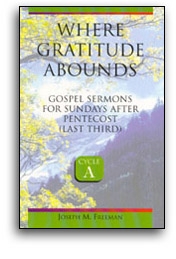
Where Gratitude Abounds
Gospel Sermons For Sundays After Pentecost (Last Third)
Maybe both the best and the worst of us in humanity are far better preachers than we are doers and deliverers of what we preach and teach. And maybe maturity has everything to do with our genuine willingness to bring a greater congruity between our esteemed words and those actions compatible with, not contradictory of, those words. Jesus, fully divine and fully human, loved and valued not just the right deeds, but also the right motives and attitudes. We, being fully human and ever spiritually in need of completion, will often settle for the right deeds and tolerate or overlook the improper attitudes and motives behind them. We do so, in part, because we ourselves are a contradiction in motion, either desiring to do right while we do wrong or overriding contrary emotions and attitudes and doing right anyway.
When one does what's right, but one's heart and mind are not fully in it, one is mastering showmanship. When one has matured enough to choose actions that are first of all very rooted in certain valued attitudes and motives, one is practicing and demonstrating authenticity. To think one thing and to do another might at times carry its own validity, if the doing proves preferable to what the thinking might have otherwise called into action. But to do something good because your mind and heart are greatly convinced and committed to it is not merely a sign of congruency. It's also an authentic witness of a fully persuaded person, with all parts of himself/herself headed in the right direction.
In the Matthew text we are studying, Jesus counsels all followers indeed to do/to follow the teaching of the scribes and the Pharisees (v. 3). That's an affirmative response, as far as it goes. But he also calls them,and all other religious types similarly minded in the centuries since, to be more than persons who preach and teach a good line but lack active follow-through (v. 3).
In verses 1 and 2, notice first the informal gathering of the crowds and disciples around Jesus. If you and I could imagine ourselves in the midst of such a gathering, I suspect we would consider Jesus being the only one in an esteemed position of authority. The rest of us, regardless of our life-stations before and after the gathering, are merely attentive spectators. Is it not our desire, may we safely say, to move Jesus out of his esteemed seat as teacher/rabbi/Lord? This is not so with the scribes and Pharisees. Verse 2 notes that they "sit on Moses' seat," that is, wherever they might travel, sit, or stand, they have an authoritative air about them that often also carries a kind of arrogance that wants to demote the stature of others nearby. Their humility before God is darkened by their pride and arrogance before others.
The scribes and Pharisees are an interesting mixture of personhood. They are the religious legalists of the day, knowing religious Law down to its every detail. They've trained their minds to carry a vast knowledge of the Law, and their hearts and wills reveal a very deep dedication or burning devotion to God. Could we call this mixture of personhood legalistic lovers of God?
What is it that incurs Jesus' anger, recognized in and between the lines of verses 3b-7? I think it has to do with his wise unwillingness to allow showmanship to pass for authenticity and congruency. Through much of the Gospels, we seldom see Jesus expressing anger and frequently see him teaching truth, sharing insights, expressing compassion, and performing miracles. When anger is expressed, its goal is not destruction of a person, but confrontation and correction of that person. For Jesus, anger is expressed from his mature love of God and others. In this particular passage, Jesus simultaneously counsels the crowds and the disciples not to be content with developing showmanship, but to be committed to walking one's talk truly.
In verse 4, the phrase "heavy burdens, hard to bear" more than likely has to do with the scribes' and Pharisees' rendition of the Law going well beyond reverence for God and respect for others, to tens of thousands of rules and regulations. People with conscience and religious sensitivities would no doubt feel a significant but unnecessary burden to being law-abiding, as they looked up to and endeavored to follow these religious authorities. I suspect that one of two things happened to those people who took the Pharisees and scribes very seriously: 1) They would eventually feel disheartened and discouraged by unending rules, and thereby discount and distance themselves from the religious enterprise; or 2) they would become the kind of devotees who would be a sort of sub-college or group, just a couple steps below the status and station of scribe and Pharisee. They would fashion their own sense of security, set their own level of life station, and thereby have their own airs of superiority over others Ironically, though all this Law-devotion was to bring people closer to God, it actually made it difficult for many to experience God. As Dr. Carl Jung, who was far more spiritual in his understanding of the human being than was Freud, once said, "One of the main functions of formalized religion is to protect people against a direct experience of God."1 Our means to God, whether it be Law or something else, must never become an end in itself, for God and loving Him must be our constant end. The Pharisees and scribes, in their teaching and keeping of the Law, caught a spiritual disease called pride. That pride blinded them and misled others who were well-meaning as well.
The phylacteries mentioned in verse 5, according to Barclay,
are like little leather boxes, strapped one on the wrist and one on the forehead ... inside ... there is a parchment roll with ... four passages of scripture on it -- Exodus 13:1-10 and 13:11-16 and Deuteronomy 6:4-9 and 11:13-21 ... The Pharisees, in order to draw attention to themselves ... wore especially big ones, so that they might demonstrate their exemplary obedience to the Law and their exemplary piety.2
The fringes or tassels referred to the borders of the Pharisees' garments, serving to remind them of God's commandments. They too could be made large enough to display piety all the more. Many a scholar will say that Jesus is concerned in these verses with the scribes and Pharisees drawing attention to themselves through the size of these objects, as well as the choosing of places of honor at banquets and synagogues (v. 6), expecting respect in the marketplaces (v. 7) and being called rabbi publicly (v. 8).
In response to this overgrown pride and pandering for public recognition through public acts of piety, Jesus reminds the crowds and disciples that there is only one true teacher, Christ, and one true Father, God (v. 10). In contrast to the Pharisees' predilection toward public show, Jesus teaches humility and privacy, so that the one glorified is not a person, but God.
Our Lord concludes in verses 11 and 12 that servanthood is not the same as ostentation, and humility is not the same as self-exaltation. Majoring in ostentation and self-exaltation reveals the play-actor, or hypocrite, in all of us. One pastor has written regarding this, "A hypocrite, then, is one whose character ultimately is determined not by what people see on the outside, but what God finds on the inside. Those two things don't always coincide."3
In the last analysis, what the people saw at times publicly in the Pharisees, they saw outwardly. Jesus' critique here reveals that -- whether one is a Pharisee of the first century, or a pastor and layleader of our concluding twentieth century -- what he sees inwardly is not congruent with the great outside show. Only genuine humility and authentic servanthood (vv. 11 and 12) can be the proper spiritual retardants to pride and ostentation.
One pastor tells of his excitement of bringing into parish membership a university professor. The pastor endeavored to prepare and to deliver better sermons from the pulpit, as this prospective member continued to attend worship. Later, while reflecting with the professor after he joined the parish, the pastor found that the professor's joining had less to do with the sermons he heard and more to do with an elderly woman who consistently made him feel so welcomed and valued. That was what moved him into Christian community.4 Imagine that: the Christian spirit of hospitality outdid erudition. Servanthood over showmanship wins hearts in many, many places.
____________
1. Stanislav Grof, "Spirituality, Addiction and Western Science," Revision 10:2 (Fall 1987), pp. 5-8.
2. William Barcley, Matthew, Volume II, Westminster Press, p. 286.
3. Evan Howard, "Ingenious Christians," Lection Aid, Volume 4, No. 4, year A and B, October-December, 1996, p. 23.
4. Dynamic Preaching, November-December, 1996, Volume XI, No. 9, p. 14.
When one does what's right, but one's heart and mind are not fully in it, one is mastering showmanship. When one has matured enough to choose actions that are first of all very rooted in certain valued attitudes and motives, one is practicing and demonstrating authenticity. To think one thing and to do another might at times carry its own validity, if the doing proves preferable to what the thinking might have otherwise called into action. But to do something good because your mind and heart are greatly convinced and committed to it is not merely a sign of congruency. It's also an authentic witness of a fully persuaded person, with all parts of himself/herself headed in the right direction.
In the Matthew text we are studying, Jesus counsels all followers indeed to do/to follow the teaching of the scribes and the Pharisees (v. 3). That's an affirmative response, as far as it goes. But he also calls them,and all other religious types similarly minded in the centuries since, to be more than persons who preach and teach a good line but lack active follow-through (v. 3).
In verses 1 and 2, notice first the informal gathering of the crowds and disciples around Jesus. If you and I could imagine ourselves in the midst of such a gathering, I suspect we would consider Jesus being the only one in an esteemed position of authority. The rest of us, regardless of our life-stations before and after the gathering, are merely attentive spectators. Is it not our desire, may we safely say, to move Jesus out of his esteemed seat as teacher/rabbi/Lord? This is not so with the scribes and Pharisees. Verse 2 notes that they "sit on Moses' seat," that is, wherever they might travel, sit, or stand, they have an authoritative air about them that often also carries a kind of arrogance that wants to demote the stature of others nearby. Their humility before God is darkened by their pride and arrogance before others.
The scribes and Pharisees are an interesting mixture of personhood. They are the religious legalists of the day, knowing religious Law down to its every detail. They've trained their minds to carry a vast knowledge of the Law, and their hearts and wills reveal a very deep dedication or burning devotion to God. Could we call this mixture of personhood legalistic lovers of God?
What is it that incurs Jesus' anger, recognized in and between the lines of verses 3b-7? I think it has to do with his wise unwillingness to allow showmanship to pass for authenticity and congruency. Through much of the Gospels, we seldom see Jesus expressing anger and frequently see him teaching truth, sharing insights, expressing compassion, and performing miracles. When anger is expressed, its goal is not destruction of a person, but confrontation and correction of that person. For Jesus, anger is expressed from his mature love of God and others. In this particular passage, Jesus simultaneously counsels the crowds and the disciples not to be content with developing showmanship, but to be committed to walking one's talk truly.
In verse 4, the phrase "heavy burdens, hard to bear" more than likely has to do with the scribes' and Pharisees' rendition of the Law going well beyond reverence for God and respect for others, to tens of thousands of rules and regulations. People with conscience and religious sensitivities would no doubt feel a significant but unnecessary burden to being law-abiding, as they looked up to and endeavored to follow these religious authorities. I suspect that one of two things happened to those people who took the Pharisees and scribes very seriously: 1) They would eventually feel disheartened and discouraged by unending rules, and thereby discount and distance themselves from the religious enterprise; or 2) they would become the kind of devotees who would be a sort of sub-college or group, just a couple steps below the status and station of scribe and Pharisee. They would fashion their own sense of security, set their own level of life station, and thereby have their own airs of superiority over others Ironically, though all this Law-devotion was to bring people closer to God, it actually made it difficult for many to experience God. As Dr. Carl Jung, who was far more spiritual in his understanding of the human being than was Freud, once said, "One of the main functions of formalized religion is to protect people against a direct experience of God."1 Our means to God, whether it be Law or something else, must never become an end in itself, for God and loving Him must be our constant end. The Pharisees and scribes, in their teaching and keeping of the Law, caught a spiritual disease called pride. That pride blinded them and misled others who were well-meaning as well.
The phylacteries mentioned in verse 5, according to Barclay,
are like little leather boxes, strapped one on the wrist and one on the forehead ... inside ... there is a parchment roll with ... four passages of scripture on it -- Exodus 13:1-10 and 13:11-16 and Deuteronomy 6:4-9 and 11:13-21 ... The Pharisees, in order to draw attention to themselves ... wore especially big ones, so that they might demonstrate their exemplary obedience to the Law and their exemplary piety.2
The fringes or tassels referred to the borders of the Pharisees' garments, serving to remind them of God's commandments. They too could be made large enough to display piety all the more. Many a scholar will say that Jesus is concerned in these verses with the scribes and Pharisees drawing attention to themselves through the size of these objects, as well as the choosing of places of honor at banquets and synagogues (v. 6), expecting respect in the marketplaces (v. 7) and being called rabbi publicly (v. 8).
In response to this overgrown pride and pandering for public recognition through public acts of piety, Jesus reminds the crowds and disciples that there is only one true teacher, Christ, and one true Father, God (v. 10). In contrast to the Pharisees' predilection toward public show, Jesus teaches humility and privacy, so that the one glorified is not a person, but God.
Our Lord concludes in verses 11 and 12 that servanthood is not the same as ostentation, and humility is not the same as self-exaltation. Majoring in ostentation and self-exaltation reveals the play-actor, or hypocrite, in all of us. One pastor has written regarding this, "A hypocrite, then, is one whose character ultimately is determined not by what people see on the outside, but what God finds on the inside. Those two things don't always coincide."3
In the last analysis, what the people saw at times publicly in the Pharisees, they saw outwardly. Jesus' critique here reveals that -- whether one is a Pharisee of the first century, or a pastor and layleader of our concluding twentieth century -- what he sees inwardly is not congruent with the great outside show. Only genuine humility and authentic servanthood (vv. 11 and 12) can be the proper spiritual retardants to pride and ostentation.
One pastor tells of his excitement of bringing into parish membership a university professor. The pastor endeavored to prepare and to deliver better sermons from the pulpit, as this prospective member continued to attend worship. Later, while reflecting with the professor after he joined the parish, the pastor found that the professor's joining had less to do with the sermons he heard and more to do with an elderly woman who consistently made him feel so welcomed and valued. That was what moved him into Christian community.4 Imagine that: the Christian spirit of hospitality outdid erudition. Servanthood over showmanship wins hearts in many, many places.
____________
1. Stanislav Grof, "Spirituality, Addiction and Western Science," Revision 10:2 (Fall 1987), pp. 5-8.
2. William Barcley, Matthew, Volume II, Westminster Press, p. 286.
3. Evan Howard, "Ingenious Christians," Lection Aid, Volume 4, No. 4, year A and B, October-December, 1996, p. 23.
4. Dynamic Preaching, November-December, 1996, Volume XI, No. 9, p. 14.
