
The Church is renewed
Preaching
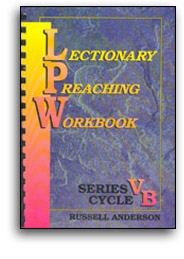
Lectionary Preaching Workbook
Series V, Cycle B
Theme For The Day: The Church is renewed as it opens itself to the transforming power of the gospel of grace, through faith in Jesus Christ.
BRIEF COMMENTARY ON THE LESSONS
Lesson 1: Jeremiah 31:31--35
In Jeremiah 17:1, the prophet speaks of the sin of Judah being etched in stone with a diamond--tipped pen of iron. In this lection, the prophet asserts that God will cut a new covenant with his people, not written on parchment or etched in stone, but written on the human heart. God will bestow not only the desire but the power to do his will. This new covenant will be intrinsic rather than external. It will not be a covenant of judgment but of grace (v. 34).
Lesson 2: Romans 3:19--28
Paul lifts out the purpose of the law: to make us cognizant of our sins and our need for grace. No person will be accounted righteous by keeping the law of God. Nobody can earn salvation from keeping the law, since no one can observe it completely. The person who breaks part of it, is deemed guilty of it all. The good news proclaims that the righteousness of God is available to all people as a gift of grace. This righteousness becomes possible through Christ's atoning sacrifice. Through faith, we are deemed righteous and acceptable to God. Paul is anxious to establish not only our righteousness through the gospel but God's righteousness. The sacrifice of Christ shows that God takes sin seriously and dealt with it decisively through the cross (vv. 25--26).
Gospel: John 8:31--36
Jesus tells the Jews that they shall know the truth which will make them free. They misunderstand and reply that they have never been in bondage to anyone. Their reply reveals a denial of their history. Jesus retorts that anyone who sins is in bondage to sin. Jesus, the Son, is the only one who can make people truly free from the bondage to sin and selfishness.
Psalm Of The Day
Psalm 46 - "God is our refuge and strength..." (v. 1).
Prayer Of The Day
Renewing Spirit, we have let the power of sin capture us and hold us in bondage but your Son came into the world to set us free. Liberate us from a religion of mere formality and set our souls ablaze with a living faith that sheds light and warmth in our world. In Jesus' powerful name. Amen.
THEOLOGICAL REFLECTION ON THE LESSONS
Lesson 1: Jeremiah 31:31--35
Cut a covenant (v. 31). The English translation has it that Yahweh will make a new covenant. The Hebrew means literally "to cut." The image here is the cutting asunder of the sacrifice, so that the worshippers could walk between the parts. The new covenant also involved cutting; the flesh of Jesus, God's own Son, was pierced.
New covenant. Jeremiah, the prophet of doom and gloom, the weeping prophet, declares that the Lord will do a new thing. It will not be an act of destruction but a creative act. God will establish a new covenant with his people, not like the old one which they were unable to fulfill. This time, God will inscribe it on the human heart. The old covenant had served its purpose, to make the people aware of the holiness of God and of their own sinfulness. Now they were ready for something new.
Hope. The concept of new covenant is a profound example of hope at a time of national despair. The source of Jeremiah's hope is the graciousness of God. Note the theocentric character of this hope. "I will make...I will put...I will write...." Though God was roundly punishing his people, he was not abandoning them.
Regeneration. Jeremiah was not placing his hopes in the possibility of human reformation but in regeneration. Reformation can be seen as something basically extrinsic. You take the same old elements and put them together in a new fashion. Jeremiah put his hope in the Lord's regeneration of his people from the inside out.
Lesson 2: Romans 3:19--28
Accountable (v. 19). Paul maintains that the law of God makes the world accountable for their actions by publishing his law. We cannot claim ignorance, which would let us off the hook. We attempt to avoid being made accountable by giving excuses, putting the blame on somebody else.
A house of mirrors (v. 20)."...through the law comes knowledge of sin." Living with the law is like living in a house of mirrors; wherever we turn we see ourselves, warts and all. The law makes us cognizant of our sins.
No distinction (vv. 22--23). The law makes distinctions - this crime is a felony, this crime is a misdemeanor. The distinctions are sometimes meted out in years of punishment. However, as far as God is concerned, there are no distinctions. All have sinned. Sin is the great leveler. Some people may judge themselves better than other sinners but God doesn't see it that way.
The gift of grace (v. 25). Salvation comes through the atoning sacrifice of Christ, not by keeping the law. This is a key concept of Pauline theology which Luther makes the centerpiece of his theology. Unfortunately, the notion of works righteousness dies hard because it's difficult on our ego to accept a free gift.
Gospel: John 8:31--36
To be continued (v. 31). Some of Jesus' disciples were ready to turn their backs to Christ and go back to their old ways. Jesus challenges them: "If you continue in my word, you are truly my disciples, and you will know the truth and the truth will make you free." Only those who continue with Jesus to the end of the journey establish that they are truly his disciples.
The quest for truth. The truth of which Jesus speaks is not all truth or truth in general but divine truth. However, no matter what kind of truth we are speaking of, it never comes easily. The truth about life comes to those who struggle to find it. Scientific truth often comes through experimentation and observation. The truth of God comes through experience in relating the wisdom of the word to the world. Experience takes time; that's why Jesus points to the necessity of continuing with him.
Truth frees. Sin, corruption and all forms of tyranny exist in an environment of lies and deceit. Psychological health, spiritual well--being, and sometimes physical health are dependent on discovering the truth. Jesus said, "I am the way, the TRUTH, and the Life, no one comes to the father but by me" (John 14:6).
SERMON APPROACHES WITH ILLUSTRATIONS
Lesson 1: Jeremiah 31:31--35
Sermon Title: Eden II
Sermon Angle: Jeremiah did not envision a new religion evolving from the old humanity and the old covenant. No, he was envisioning nothing short of the re--creation of mankind. He pictures something of a second Garden of Eden. Jeremiah saw that his people could not be saved through cosmetic surgery; they needed nothing less than a new heart, soul and mind. While sinful humans can never re--create themselves, God can and does in Christ.
Outline:
1. Jeremiah could see that his prophetic ministry of bringing his people back to the Lord had failed. They had not changed and their unwillingness to repent had brought judgment upon themselves.
2. God informed Jeremiah that he was going to recreate his people - a second Eden. He would inscribe his law upon their hearts.
3. Our hope is in God.
__________
On the television show 20/20, they featured a woman who had set out to refashion herself in her own image. Or, maybe I should say, in the image of Barbie. Yes, that's right, she decided to reform her body into the likeness of a Barbie doll. After more than 20 plastic surgery operations, she is near her goal. She made the decision to re--create herself after her father died and left her some money. She decided that rather than blow the money on clothes or travel, she would use it to cut a new image. She wasn't born ugly. In fact, she had a very pleasant appearance. However, she observed that plain people didn't get any respect, while the beautiful people got all the perks. This real--life Barbie doll lives in London, where she has a business advising other people on the ins and outs of plastic surgery. She is now forty and fabulously beautiful, claiming to enjoy being admired and being the center of attention. She has a new body, a new face but the same old heart. Only God can remake her heart.
Sermon Title: Prophets, One And All
Sermon Angle: Jeremiah places great importance on knowing the Lord personally. He predicts: "They shall all know me..." (v. 34). In the prophetic era, God usually only spoke personally and intimately to his prophets. The great mass of the people only knew the Lord through his laws and ordinances, passed on down through the generations. Jeremiah's revelation is that one day ALL of God's people would know the Lord personally, like the prophets. In a sense, all of the people would be prophets.
Outline:
1. The prophets were the only ones in Jeremiah's day who knew God directly. Other people knew of God through oral and written traditions.
2. Jeremiah envisions the time when all of God's people will know him like the prophets (v. 34).
3. In Christ, we have the new hearts Jeremiah foresaw. With these new hearts we know and love God intimately.
Lesson 2: Romans 3:19--28
Sermon Title: Not Guilty Is Not The Same As Being Righteous
Sermon Angle: After the O. J. Simpson verdict, some people stated: "He is judged 'not guilty' but that doesn't make him innocent." "Not guilty" may mean that the jurors did not feel that the evidence was sufficient to establish guilt. According to the law, O. J. is not guilty but that doesn't mean that he's righteous. The justification which God offers in Christ means more than being acquitted, though guilty. His justification actually works to make us righteous by giving us the will and the strength to do that which God requires, through faith (v. 28).
Outline:
1. The verdict of "not guilty" does not ensure innocence or righteousness.
2. God declares us "not guilty" through faith in Christ, though we are not innocent.
3. God's righteousness can more than acquit us, it can transform us.
Sermon Title: There Are No Braggarts In Heaven
Sermon Angle: In verse 27, Paul returns to the subject of boasting. He submits that boasting is excluded, not on the basis of works but on the principle of faith. If heaven were awarded to all those who surpassed a certain baseline of righteousness, we might have good reason to boast. Some make it, others do not. Some would far exceed the minimum requirements, while others might barely squeak by. When we compare levels of human achievement, boasting, though never gracious, might be somewhat justified. When it comes to salvation, no one can boast because redemption comes as a gift of God. How can we boast about that which we have not achieved? That's why there won't be any braggarts in heaven.
Outline:
1. Works righteousness leads to pride and pride leads to boasting.
2. Paul maintains that Christians have no right to boast because our salvation is a gift.
3. If we must boast, boast of God's great love and grace.
4. There will be no boasting in heaven, because heaven will be populated only by those who are humble enough to accept God's gift of salvation, by faith.
__________
Thomas Carlyle once referred to Martin Luther as "great, not as a hewn obelisk, but as an Alpine mountain, so simple, honest, spontaneous, not setting up to be great at all; there for another purpose than being great at all!" That "purpose" was, in Luther's mind, to preserve and proclaim God--given doctrine. The thought never rooted in Luther's mind that the doctrine for which he gave himself was his own creation. "It is not my doctrine, not my creation, but God's gift," he declared in a 1531 sermon. "Dear Lord God, it was not spun out of my head, nor grown in my garden. Nor did it flow out of my spring, nor was it born of me. It is God's gift, not a human discovery."
Gospel: John 8:31--36
Sermon Title: The Danger Of Turning Your Back On The Truth
Sermon Angle: Apparently, Jesus has more disciples at the height of his career than he did at the end. Some of them stopped believing. John refers to the Jews who HAD believed in him (v. 31). Jesus pleads with these disciples to continue in his word: "If you continue in my word, you are truly my disciples." Jesus pleads with them because their spiritual existence was in jeopardy. The danger, which Jesus wanted them to avert, was of losing their way in the darkness. They were about to turn their backs to the truth. Already they were living in an illusory world. They claimed that the Jews had never been in bondage. Jesus is talking about being in bondage to sin but their statement is a blatant denial of history. The danger of turning your back to the truth is that one is doomed to the land of shadows and illusions.
Outline:
1. Jesus pleaded with those who were about to leave him. Their souls were in grave danger.
2. The danger of turning away from the truth is that one is doomed to an illusory existence.
3. Martin Luther was grasped by the truth and then challenged a church riddled with illusory hopes for salvation (good works).
4. Let us cling to the truth of the gospel.
Sermon Title: I'm An Addict, You're An Addict
Sermon Angle: Jesus said: "Everyone who commits sin is the slave of sin." It sounds like an addiction to me. An addiction is a monster that has you by the throat and won't let go. The only way to gain the upper hand over an addiction is to, first of all, admit your weakness and your need for saving help. Sin is our addiction. We are all junkies. We want to be free from our addiction. Some of the time we're doing quite well and we think we have the monster on the run; then, he grabs us again with renewed vengeance. Our faith in Jesus probably won't free us from all desire to sin but it will give us the power to bind the dragon.
Outline:
1. Addiction is a huge problem.
2. We all know an addict - ourself! Our addiction is sin.
3. Talk about the "12 step" program.
4. Have you admitted to Jesus your inability to be free of your addiction?
Sermon Title: Truth Isn't Free
Sermon Angle: Truth makes us free, as Jesus stated, but truth is never free. The price is dear. It costs us our prejudices, our illusions, our secret sins, some of our traditions, and our view of history, to name a few. Not only that, the truth will lead us to actions and stands that may not be popular. Look what it cost the Lord! Because of the high cost of truth, many folks prefer to live in world of shadows. In order for Luther to encounter the truth, he had to be willing to challenge cherished traditions.
Outline:
1. Jesus challenges us to know the truth, saying that the truth will make us free.
2. Though the truth makes us free, it is not itself free.
3. Those who stood for the truth, like Luther, had to pay a price.
4. Certain disciples of Jesus were not willing to pay the price. Are you?
__________
Faith is not what some people think it is. Their human dream is a delusion. Because they observe that faith is not followed by good works or a better life, they fall into error, even though they speak and hear much about faith. "Faith is not enough," they say. "You must do good works, you must be pious to be saved." They think that, when you hear the gospel, you start working, creating by your own strength a thankful heart which says, "I believe." That is what they think true faith is. But, because this is a human idea, a dream, the heart never learns anything from it, so it does nothing and reform doesn't come from this "faith," either.
Instead, faith is God's work in us that changes us and gives new birth from God (John 1:13). It kills the Old Adam and makes us completely different people. It changes our hearts, our spirits, our thoughts and all our powers. It brings the Holy Spirit with it. Yes, it is a living, creative, active and powerful thing, this faith. Faith cannot help doing good works constantly. It doesn't stop to ask if good works ought to be done, but before anyone asks, it already has done them and continues to do them without ceasing. Anyone who does not do good works in this manner is an unbeliever. He stumbles around and looks for faith and good works, even though he does not know what faith or good works are. Yet he gossips and chatters about faith and good works with many words. (Martin Luther: "An Introduction To St. Paul's Letter To The Romans")
BRIEF COMMENTARY ON THE LESSONS
Lesson 1: Jeremiah 31:31--35
In Jeremiah 17:1, the prophet speaks of the sin of Judah being etched in stone with a diamond--tipped pen of iron. In this lection, the prophet asserts that God will cut a new covenant with his people, not written on parchment or etched in stone, but written on the human heart. God will bestow not only the desire but the power to do his will. This new covenant will be intrinsic rather than external. It will not be a covenant of judgment but of grace (v. 34).
Lesson 2: Romans 3:19--28
Paul lifts out the purpose of the law: to make us cognizant of our sins and our need for grace. No person will be accounted righteous by keeping the law of God. Nobody can earn salvation from keeping the law, since no one can observe it completely. The person who breaks part of it, is deemed guilty of it all. The good news proclaims that the righteousness of God is available to all people as a gift of grace. This righteousness becomes possible through Christ's atoning sacrifice. Through faith, we are deemed righteous and acceptable to God. Paul is anxious to establish not only our righteousness through the gospel but God's righteousness. The sacrifice of Christ shows that God takes sin seriously and dealt with it decisively through the cross (vv. 25--26).
Gospel: John 8:31--36
Jesus tells the Jews that they shall know the truth which will make them free. They misunderstand and reply that they have never been in bondage to anyone. Their reply reveals a denial of their history. Jesus retorts that anyone who sins is in bondage to sin. Jesus, the Son, is the only one who can make people truly free from the bondage to sin and selfishness.
Psalm Of The Day
Psalm 46 - "God is our refuge and strength..." (v. 1).
Prayer Of The Day
Renewing Spirit, we have let the power of sin capture us and hold us in bondage but your Son came into the world to set us free. Liberate us from a religion of mere formality and set our souls ablaze with a living faith that sheds light and warmth in our world. In Jesus' powerful name. Amen.
THEOLOGICAL REFLECTION ON THE LESSONS
Lesson 1: Jeremiah 31:31--35
Cut a covenant (v. 31). The English translation has it that Yahweh will make a new covenant. The Hebrew means literally "to cut." The image here is the cutting asunder of the sacrifice, so that the worshippers could walk between the parts. The new covenant also involved cutting; the flesh of Jesus, God's own Son, was pierced.
New covenant. Jeremiah, the prophet of doom and gloom, the weeping prophet, declares that the Lord will do a new thing. It will not be an act of destruction but a creative act. God will establish a new covenant with his people, not like the old one which they were unable to fulfill. This time, God will inscribe it on the human heart. The old covenant had served its purpose, to make the people aware of the holiness of God and of their own sinfulness. Now they were ready for something new.
Hope. The concept of new covenant is a profound example of hope at a time of national despair. The source of Jeremiah's hope is the graciousness of God. Note the theocentric character of this hope. "I will make...I will put...I will write...." Though God was roundly punishing his people, he was not abandoning them.
Regeneration. Jeremiah was not placing his hopes in the possibility of human reformation but in regeneration. Reformation can be seen as something basically extrinsic. You take the same old elements and put them together in a new fashion. Jeremiah put his hope in the Lord's regeneration of his people from the inside out.
Lesson 2: Romans 3:19--28
Accountable (v. 19). Paul maintains that the law of God makes the world accountable for their actions by publishing his law. We cannot claim ignorance, which would let us off the hook. We attempt to avoid being made accountable by giving excuses, putting the blame on somebody else.
A house of mirrors (v. 20)."...through the law comes knowledge of sin." Living with the law is like living in a house of mirrors; wherever we turn we see ourselves, warts and all. The law makes us cognizant of our sins.
No distinction (vv. 22--23). The law makes distinctions - this crime is a felony, this crime is a misdemeanor. The distinctions are sometimes meted out in years of punishment. However, as far as God is concerned, there are no distinctions. All have sinned. Sin is the great leveler. Some people may judge themselves better than other sinners but God doesn't see it that way.
The gift of grace (v. 25). Salvation comes through the atoning sacrifice of Christ, not by keeping the law. This is a key concept of Pauline theology which Luther makes the centerpiece of his theology. Unfortunately, the notion of works righteousness dies hard because it's difficult on our ego to accept a free gift.
Gospel: John 8:31--36
To be continued (v. 31). Some of Jesus' disciples were ready to turn their backs to Christ and go back to their old ways. Jesus challenges them: "If you continue in my word, you are truly my disciples, and you will know the truth and the truth will make you free." Only those who continue with Jesus to the end of the journey establish that they are truly his disciples.
The quest for truth. The truth of which Jesus speaks is not all truth or truth in general but divine truth. However, no matter what kind of truth we are speaking of, it never comes easily. The truth about life comes to those who struggle to find it. Scientific truth often comes through experimentation and observation. The truth of God comes through experience in relating the wisdom of the word to the world. Experience takes time; that's why Jesus points to the necessity of continuing with him.
Truth frees. Sin, corruption and all forms of tyranny exist in an environment of lies and deceit. Psychological health, spiritual well--being, and sometimes physical health are dependent on discovering the truth. Jesus said, "I am the way, the TRUTH, and the Life, no one comes to the father but by me" (John 14:6).
SERMON APPROACHES WITH ILLUSTRATIONS
Lesson 1: Jeremiah 31:31--35
Sermon Title: Eden II
Sermon Angle: Jeremiah did not envision a new religion evolving from the old humanity and the old covenant. No, he was envisioning nothing short of the re--creation of mankind. He pictures something of a second Garden of Eden. Jeremiah saw that his people could not be saved through cosmetic surgery; they needed nothing less than a new heart, soul and mind. While sinful humans can never re--create themselves, God can and does in Christ.
Outline:
1. Jeremiah could see that his prophetic ministry of bringing his people back to the Lord had failed. They had not changed and their unwillingness to repent had brought judgment upon themselves.
2. God informed Jeremiah that he was going to recreate his people - a second Eden. He would inscribe his law upon their hearts.
3. Our hope is in God.
__________
On the television show 20/20, they featured a woman who had set out to refashion herself in her own image. Or, maybe I should say, in the image of Barbie. Yes, that's right, she decided to reform her body into the likeness of a Barbie doll. After more than 20 plastic surgery operations, she is near her goal. She made the decision to re--create herself after her father died and left her some money. She decided that rather than blow the money on clothes or travel, she would use it to cut a new image. She wasn't born ugly. In fact, she had a very pleasant appearance. However, she observed that plain people didn't get any respect, while the beautiful people got all the perks. This real--life Barbie doll lives in London, where she has a business advising other people on the ins and outs of plastic surgery. She is now forty and fabulously beautiful, claiming to enjoy being admired and being the center of attention. She has a new body, a new face but the same old heart. Only God can remake her heart.
Sermon Title: Prophets, One And All
Sermon Angle: Jeremiah places great importance on knowing the Lord personally. He predicts: "They shall all know me..." (v. 34). In the prophetic era, God usually only spoke personally and intimately to his prophets. The great mass of the people only knew the Lord through his laws and ordinances, passed on down through the generations. Jeremiah's revelation is that one day ALL of God's people would know the Lord personally, like the prophets. In a sense, all of the people would be prophets.
Outline:
1. The prophets were the only ones in Jeremiah's day who knew God directly. Other people knew of God through oral and written traditions.
2. Jeremiah envisions the time when all of God's people will know him like the prophets (v. 34).
3. In Christ, we have the new hearts Jeremiah foresaw. With these new hearts we know and love God intimately.
Lesson 2: Romans 3:19--28
Sermon Title: Not Guilty Is Not The Same As Being Righteous
Sermon Angle: After the O. J. Simpson verdict, some people stated: "He is judged 'not guilty' but that doesn't make him innocent." "Not guilty" may mean that the jurors did not feel that the evidence was sufficient to establish guilt. According to the law, O. J. is not guilty but that doesn't mean that he's righteous. The justification which God offers in Christ means more than being acquitted, though guilty. His justification actually works to make us righteous by giving us the will and the strength to do that which God requires, through faith (v. 28).
Outline:
1. The verdict of "not guilty" does not ensure innocence or righteousness.
2. God declares us "not guilty" through faith in Christ, though we are not innocent.
3. God's righteousness can more than acquit us, it can transform us.
Sermon Title: There Are No Braggarts In Heaven
Sermon Angle: In verse 27, Paul returns to the subject of boasting. He submits that boasting is excluded, not on the basis of works but on the principle of faith. If heaven were awarded to all those who surpassed a certain baseline of righteousness, we might have good reason to boast. Some make it, others do not. Some would far exceed the minimum requirements, while others might barely squeak by. When we compare levels of human achievement, boasting, though never gracious, might be somewhat justified. When it comes to salvation, no one can boast because redemption comes as a gift of God. How can we boast about that which we have not achieved? That's why there won't be any braggarts in heaven.
Outline:
1. Works righteousness leads to pride and pride leads to boasting.
2. Paul maintains that Christians have no right to boast because our salvation is a gift.
3. If we must boast, boast of God's great love and grace.
4. There will be no boasting in heaven, because heaven will be populated only by those who are humble enough to accept God's gift of salvation, by faith.
__________
Thomas Carlyle once referred to Martin Luther as "great, not as a hewn obelisk, but as an Alpine mountain, so simple, honest, spontaneous, not setting up to be great at all; there for another purpose than being great at all!" That "purpose" was, in Luther's mind, to preserve and proclaim God--given doctrine. The thought never rooted in Luther's mind that the doctrine for which he gave himself was his own creation. "It is not my doctrine, not my creation, but God's gift," he declared in a 1531 sermon. "Dear Lord God, it was not spun out of my head, nor grown in my garden. Nor did it flow out of my spring, nor was it born of me. It is God's gift, not a human discovery."
Gospel: John 8:31--36
Sermon Title: The Danger Of Turning Your Back On The Truth
Sermon Angle: Apparently, Jesus has more disciples at the height of his career than he did at the end. Some of them stopped believing. John refers to the Jews who HAD believed in him (v. 31). Jesus pleads with these disciples to continue in his word: "If you continue in my word, you are truly my disciples." Jesus pleads with them because their spiritual existence was in jeopardy. The danger, which Jesus wanted them to avert, was of losing their way in the darkness. They were about to turn their backs to the truth. Already they were living in an illusory world. They claimed that the Jews had never been in bondage. Jesus is talking about being in bondage to sin but their statement is a blatant denial of history. The danger of turning your back to the truth is that one is doomed to the land of shadows and illusions.
Outline:
1. Jesus pleaded with those who were about to leave him. Their souls were in grave danger.
2. The danger of turning away from the truth is that one is doomed to an illusory existence.
3. Martin Luther was grasped by the truth and then challenged a church riddled with illusory hopes for salvation (good works).
4. Let us cling to the truth of the gospel.
Sermon Title: I'm An Addict, You're An Addict
Sermon Angle: Jesus said: "Everyone who commits sin is the slave of sin." It sounds like an addiction to me. An addiction is a monster that has you by the throat and won't let go. The only way to gain the upper hand over an addiction is to, first of all, admit your weakness and your need for saving help. Sin is our addiction. We are all junkies. We want to be free from our addiction. Some of the time we're doing quite well and we think we have the monster on the run; then, he grabs us again with renewed vengeance. Our faith in Jesus probably won't free us from all desire to sin but it will give us the power to bind the dragon.
Outline:
1. Addiction is a huge problem.
2. We all know an addict - ourself! Our addiction is sin.
3. Talk about the "12 step" program.
4. Have you admitted to Jesus your inability to be free of your addiction?
Sermon Title: Truth Isn't Free
Sermon Angle: Truth makes us free, as Jesus stated, but truth is never free. The price is dear. It costs us our prejudices, our illusions, our secret sins, some of our traditions, and our view of history, to name a few. Not only that, the truth will lead us to actions and stands that may not be popular. Look what it cost the Lord! Because of the high cost of truth, many folks prefer to live in world of shadows. In order for Luther to encounter the truth, he had to be willing to challenge cherished traditions.
Outline:
1. Jesus challenges us to know the truth, saying that the truth will make us free.
2. Though the truth makes us free, it is not itself free.
3. Those who stood for the truth, like Luther, had to pay a price.
4. Certain disciples of Jesus were not willing to pay the price. Are you?
__________
Faith is not what some people think it is. Their human dream is a delusion. Because they observe that faith is not followed by good works or a better life, they fall into error, even though they speak and hear much about faith. "Faith is not enough," they say. "You must do good works, you must be pious to be saved." They think that, when you hear the gospel, you start working, creating by your own strength a thankful heart which says, "I believe." That is what they think true faith is. But, because this is a human idea, a dream, the heart never learns anything from it, so it does nothing and reform doesn't come from this "faith," either.
Instead, faith is God's work in us that changes us and gives new birth from God (John 1:13). It kills the Old Adam and makes us completely different people. It changes our hearts, our spirits, our thoughts and all our powers. It brings the Holy Spirit with it. Yes, it is a living, creative, active and powerful thing, this faith. Faith cannot help doing good works constantly. It doesn't stop to ask if good works ought to be done, but before anyone asks, it already has done them and continues to do them without ceasing. Anyone who does not do good works in this manner is an unbeliever. He stumbles around and looks for faith and good works, even though he does not know what faith or good works are. Yet he gossips and chatters about faith and good works with many words. (Martin Luther: "An Introduction To St. Paul's Letter To The Romans")
