
Up Close And Personal
Preaching
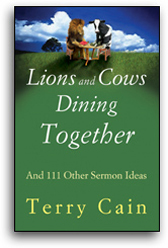
Lions And Cows Dining Together
And 111 Other Sermon Ideas
Object:
Purpose Statement: Unfortunately, until it affects us, we usually are not willing to get involved in issues.
What do Amos, Isaiah, Jeremiah, Hosea, Jesus, and a host of other biblical leaders have in common? Among many other things, they have in common the willingness to get involved even though they have nothing at stake, nothing personal to gain, and only a lot to lose. Some of us would ask, "What's in it for me?" before we commit ourselves. The motivation that finally caused Egypt to agree to release the Israelites is a good example of how many people respond to situations. After many plagues of boils, locusts, flies, frogs, hail, and so forth, it wasn't until the crisis became much too close to home that Egypt was moved to finally release their oppressed guests. We read in Exodus 12:29-32 how it took the death of the firstborn sons of every Egyptian family to finally move them to action. It reached every home (v. 30) and was critically personal and invasive. We are told that it was God's doing that killed these children, and conservatives will stick to that story. Liberal Christians will suggest that God had nothing to do with these deaths, but that it was some natural epidemic that was exaggerated in the telling of the details, and mistakenly attributed to God. Nevertheless, whatever happened was so close to home it stirred the people to do something. It seems this is an interesting parallel to the ways in which we so often operate. We get involved:
a. Only when we can identify personally with the cause. My wife and I have belonged to and supported many different organizations that deal with specific social issues. It has been our observation that many of the people who work with these organizations have decided to get involved because they have been personally connected. The following groups are ones we have not been involved with but have been familiar enough with them to observe the personal relationships. Many MADD members have had some tragic accident in their family. PFLAG workers often have a gay or lesbian in their family. Typically, persons working with cancer, alcohol, domestic abuse, and other programs have had a loved one affected, if not themselves. People naturally have more of a passion when their personal experience has caught their attention, but it also would be nice to see people volunteer for work even when they have no personal connection, except that of caring for others. How does this translate into the church? Similarly, we often don't take a sincere interest in God until it becomes personal. When a critical illness or other personal problem arises, we call on God, perhaps for the first time, seriously. When our own death is imminent, or that of a loved one, we become more interested in the prospects of salvation and eternal life.
b. Only when we are threatened. When issues arise in a community it may cause an outcry of protest. For example: school redistricting. Parents come out of the woodwork because their kids may not be going to the schools they want to attend. Or, it may be the location of group homes and businesses in neighborhoods which bring out the residents in force with the "not in my neighborhood" plea. To be very honest, most people will pay little attention to the community or national issues unless it directly affects their interests or pocketbook, and becomes personal. Often, whether it is right or wrong is not the issue, we don't want to be involved if it only touches others: "That is their problem." We tend to selfishly want what is the most convenient for us regardless of its affect on others. Again we can see the translation into the life of the church. "We've always done it this way. It's the way I am comfortable with. I don't like it that way." We need to begin considering the larger good. We mustn't live only in a world that revolves around us personally. "I don't want homeless derelicts in my church." But perhaps a soup kitchen is the kind of ministry this particular community needs desperately.
What do Amos, Isaiah, Jeremiah, Hosea, Jesus, and a host of other biblical leaders have in common? Among many other things, they have in common the willingness to get involved even though they have nothing at stake, nothing personal to gain, and only a lot to lose. Some of us would ask, "What's in it for me?" before we commit ourselves. The motivation that finally caused Egypt to agree to release the Israelites is a good example of how many people respond to situations. After many plagues of boils, locusts, flies, frogs, hail, and so forth, it wasn't until the crisis became much too close to home that Egypt was moved to finally release their oppressed guests. We read in Exodus 12:29-32 how it took the death of the firstborn sons of every Egyptian family to finally move them to action. It reached every home (v. 30) and was critically personal and invasive. We are told that it was God's doing that killed these children, and conservatives will stick to that story. Liberal Christians will suggest that God had nothing to do with these deaths, but that it was some natural epidemic that was exaggerated in the telling of the details, and mistakenly attributed to God. Nevertheless, whatever happened was so close to home it stirred the people to do something. It seems this is an interesting parallel to the ways in which we so often operate. We get involved:
a. Only when we can identify personally with the cause. My wife and I have belonged to and supported many different organizations that deal with specific social issues. It has been our observation that many of the people who work with these organizations have decided to get involved because they have been personally connected. The following groups are ones we have not been involved with but have been familiar enough with them to observe the personal relationships. Many MADD members have had some tragic accident in their family. PFLAG workers often have a gay or lesbian in their family. Typically, persons working with cancer, alcohol, domestic abuse, and other programs have had a loved one affected, if not themselves. People naturally have more of a passion when their personal experience has caught their attention, but it also would be nice to see people volunteer for work even when they have no personal connection, except that of caring for others. How does this translate into the church? Similarly, we often don't take a sincere interest in God until it becomes personal. When a critical illness or other personal problem arises, we call on God, perhaps for the first time, seriously. When our own death is imminent, or that of a loved one, we become more interested in the prospects of salvation and eternal life.
b. Only when we are threatened. When issues arise in a community it may cause an outcry of protest. For example: school redistricting. Parents come out of the woodwork because their kids may not be going to the schools they want to attend. Or, it may be the location of group homes and businesses in neighborhoods which bring out the residents in force with the "not in my neighborhood" plea. To be very honest, most people will pay little attention to the community or national issues unless it directly affects their interests or pocketbook, and becomes personal. Often, whether it is right or wrong is not the issue, we don't want to be involved if it only touches others: "That is their problem." We tend to selfishly want what is the most convenient for us regardless of its affect on others. Again we can see the translation into the life of the church. "We've always done it this way. It's the way I am comfortable with. I don't like it that way." We need to begin considering the larger good. We mustn't live only in a world that revolves around us personally. "I don't want homeless derelicts in my church." But perhaps a soup kitchen is the kind of ministry this particular community needs desperately.
