
Community Forms The Common Good
Sermon
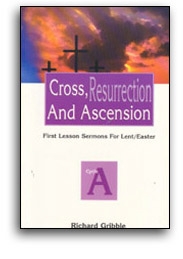
Cross, Resurrection, And Ascension
First Lesson Sermons For Lent/Easter
"Outlined against a blue-gray October sky, the Four Horsemen rode again. In dramatic lore they are known as pestilence, famine, destruction, and death. These are only aliases. There real names are Stuhldreher, Miller, Crowley, and Layden." Grantland Rice, a well-known sports columnist in an earlier era, wrote those memorable words one Saturday in October 1927. With these words a legend was started, for college football, for the immortal coach Knute Rockne and, that day especially, for the Four Horsemen of Notre Dame.
Who were the Four Horsemen? Elmer Layden, Harry Stuhldreher, Jim Crowley, and Don Miller were the talented offensive backfield for the Notre Dame football team in the late 1920s. There is no doubt that they were great players. Football fans then and now remember their names and their exploits on the gridiron. All four have been enshrined in the College Football Hall of Fame.
Most people know, however, that there are eleven players on a football team. What about the other seven? Who were they; what did they do? History knows them as the "Seven Mules." Few if anyone remembers their names; none of them are members of the College Football Hall of Fame. Still, I am certain that the Four Horsemen knew them. In fact, the same Grantland Rice who immortalized the Horsemen said that this talented backfield attributed all their success to the Mules. They were the ones who stood in front, did the blocking, ran interference, and cleared a path for the two halfbacks, the fullback, and the quarterback to run the plays, score touchdowns, and bring victory to Notre Dame.
The Four Horsemen and the Seven Mules were a team. They knew that they needed each other. Without the Mules the Horsemen probably would have been an ordinary college football backfield. But the combination of the Mules and the Horsemen brought greatness, fame, and legend to Miller, Layden, Crowley, and Stuhldreher and to Notre Dame football as well.
The lesson illustrated by the teamwork of the Four Horsemen and Seven Mules was learned and practiced by the first Christians from the outset. These disciples of Jesus were a very small minority who lived in a world which was quite hostile to their belief and way of life. Their new-found faith placed them at odds with most everyone in society, and thus they banded together to find the strength and the courage to do the work which was their commission as followers of the Lord. Jesus had been very specific as we remember, "Go therefore and make disciples of all nations, baptizing them in the name of the Father and of the Son and of the Holy Spirit, and teaching them to obey everything that I have commanded you" (Matthew 28:19). Acts today tells us that these Christians held all things in common, were devoted to the instructions of the apostles, and lived a communal life. They came to realize, possibly by experience or by revelation, that as individuals they would not go far, but as a group which pooled their unique and important gifts they could not only survive but expand and flourish. Thinking and acting for the group instead of the individual became a way of life for the people.
Today's society stresses the individual to the point, many times, of selfishness. We are trained, almost from birth, that we must get ahead, push in front of others, at almost any cost. We must do our best to beat the competition which becomes more intense day by day. The concept of the common good does not seem to be very popular these days; it certainly is not the priority of those who dominate our headlines. At every turn of life we encounter the individual triumphant over the whole. Teamwork in sports is utilized to enhance the possibilities of the individual. People in political life spend as much time working for re-election as they do for the constituents who elected them. Business aims to increase profits of a few at the expense of the majority whose efforts built the company. In short, we have rearranged our priorities and the common good has become the loser.
Our world needs a greater sense of community -- people living, working, and praying together. This transformation must begin with our attitudes. How can our actions and words benefit all and not just ourselves or a select few? When we begin to think along lines that go beyond ourselves then we can change our actions to be consistent with our new thought. Thinking of others might be perceived as self-sacrifice, but we will find that when each person contributes his or her special gift, the total is greater than the sum of the individual parts. There is no sacrifice; what we attain is greater than we could ever possibly accomplish alone.
Community as a form of teamwork will give us strength and bring us to victory and prosperity, as happened with the Four Horsemen and Seven Mules and with those first Christians in Jerusalem. We must build communities in our neighborhoods. In today's lifestyle we often do not even know our neighbors, but the trend can and must be reversed. Some communities organize to form neighborhood watch programs; others celebrate holidays with block parties. Christian community is also forming in beautiful ways. People gather to read and reflect upon the Scriptures or to form prayer circles. In Latin America base Christian communities (communidades de base) serve to bring people together so they can share their faith.
Today the world emphasizes the individual but at times to the detriment of the whole. As God's children we have been individually and uniquely created by God and thus possess a special dignity. But as important as our individual worth and dignity are, they will find their greatest value and usefulness when they are combined with the goodness and talent of others to form a joint effort. Community was the life blood of the early Christians; it must be the same for us today. Let us work as a team in our common vocation to holiness. Let us build our Christian community so that others may say of us as they said of those first followers of Jesus, "See how they love one another."
Who were the Four Horsemen? Elmer Layden, Harry Stuhldreher, Jim Crowley, and Don Miller were the talented offensive backfield for the Notre Dame football team in the late 1920s. There is no doubt that they were great players. Football fans then and now remember their names and their exploits on the gridiron. All four have been enshrined in the College Football Hall of Fame.
Most people know, however, that there are eleven players on a football team. What about the other seven? Who were they; what did they do? History knows them as the "Seven Mules." Few if anyone remembers their names; none of them are members of the College Football Hall of Fame. Still, I am certain that the Four Horsemen knew them. In fact, the same Grantland Rice who immortalized the Horsemen said that this talented backfield attributed all their success to the Mules. They were the ones who stood in front, did the blocking, ran interference, and cleared a path for the two halfbacks, the fullback, and the quarterback to run the plays, score touchdowns, and bring victory to Notre Dame.
The Four Horsemen and the Seven Mules were a team. They knew that they needed each other. Without the Mules the Horsemen probably would have been an ordinary college football backfield. But the combination of the Mules and the Horsemen brought greatness, fame, and legend to Miller, Layden, Crowley, and Stuhldreher and to Notre Dame football as well.
The lesson illustrated by the teamwork of the Four Horsemen and Seven Mules was learned and practiced by the first Christians from the outset. These disciples of Jesus were a very small minority who lived in a world which was quite hostile to their belief and way of life. Their new-found faith placed them at odds with most everyone in society, and thus they banded together to find the strength and the courage to do the work which was their commission as followers of the Lord. Jesus had been very specific as we remember, "Go therefore and make disciples of all nations, baptizing them in the name of the Father and of the Son and of the Holy Spirit, and teaching them to obey everything that I have commanded you" (Matthew 28:19). Acts today tells us that these Christians held all things in common, were devoted to the instructions of the apostles, and lived a communal life. They came to realize, possibly by experience or by revelation, that as individuals they would not go far, but as a group which pooled their unique and important gifts they could not only survive but expand and flourish. Thinking and acting for the group instead of the individual became a way of life for the people.
Today's society stresses the individual to the point, many times, of selfishness. We are trained, almost from birth, that we must get ahead, push in front of others, at almost any cost. We must do our best to beat the competition which becomes more intense day by day. The concept of the common good does not seem to be very popular these days; it certainly is not the priority of those who dominate our headlines. At every turn of life we encounter the individual triumphant over the whole. Teamwork in sports is utilized to enhance the possibilities of the individual. People in political life spend as much time working for re-election as they do for the constituents who elected them. Business aims to increase profits of a few at the expense of the majority whose efforts built the company. In short, we have rearranged our priorities and the common good has become the loser.
Our world needs a greater sense of community -- people living, working, and praying together. This transformation must begin with our attitudes. How can our actions and words benefit all and not just ourselves or a select few? When we begin to think along lines that go beyond ourselves then we can change our actions to be consistent with our new thought. Thinking of others might be perceived as self-sacrifice, but we will find that when each person contributes his or her special gift, the total is greater than the sum of the individual parts. There is no sacrifice; what we attain is greater than we could ever possibly accomplish alone.
Community as a form of teamwork will give us strength and bring us to victory and prosperity, as happened with the Four Horsemen and Seven Mules and with those first Christians in Jerusalem. We must build communities in our neighborhoods. In today's lifestyle we often do not even know our neighbors, but the trend can and must be reversed. Some communities organize to form neighborhood watch programs; others celebrate holidays with block parties. Christian community is also forming in beautiful ways. People gather to read and reflect upon the Scriptures or to form prayer circles. In Latin America base Christian communities (communidades de base) serve to bring people together so they can share their faith.
Today the world emphasizes the individual but at times to the detriment of the whole. As God's children we have been individually and uniquely created by God and thus possess a special dignity. But as important as our individual worth and dignity are, they will find their greatest value and usefulness when they are combined with the goodness and talent of others to form a joint effort. Community was the life blood of the early Christians; it must be the same for us today. Let us work as a team in our common vocation to holiness. Let us build our Christian community so that others may say of us as they said of those first followers of Jesus, "See how they love one another."
