
Crafting A Sermon
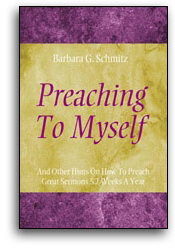
Preaching
Preaching To Myself
And Other Hints On How To Preach Great Sermons 52 Weeks A Year
1. Praying Monday Night
Often, if the sermon goes well, I come home Sunday afternoon all excited to start working on next Sunday's sermon immediately. At this point I impose a Sabbath rest. I have made it my practice not to think about the next Sunday's sermon until at least Monday evening. This gives a good solid break. As a Sabbath rest from sermon writing, it reminds me that my sermons are a God thing, and that I depend on God. At least one evening, and a continuous stretch off from doing anything with a sermon, will provide a good rebound and Sabbath time.
Usually on Monday evening I sit down to begin work on my next sermon. As a preacher in a church that uses a lectionary (appointed texts for each Sunday), the decision about what scriptures to use is already decided for me. But I do not look at the appointed scripture texts. Instead, I designate Monday evening as a time of preparation and prayer. I started doing this a few years ago when I began preaching in different churches every Sunday. Preaching in a different church every Sunday at first was very awkward, since I often did not know anyone but the person who called to arrange my coming to preach, and the treasurer who handed me a check for the service. How could I preach a sermon to people I didn't know? I would really have to seek God's heart for what I was supposed to preach. So that's when I started my sermon preparation on Monday night by praying. There was no other possible, conceivable way to have any assurance that I was preaching what they needed to hear, than to ask God. So this is basically my prayer: "God, show me what they need to hear this Sunday. Put your message for them on my heart. Direct me to the particular aspect of these scriptures that they need." So now, even though I may be preaching to a group I do know, this is still how I start my sermon preparation -- by praying.
2. Percolating
I think the best sermons are sermons that percolate over the course of the week. It is usually Tuesday morning when I sit down to look at the appointed lessons for the first time. This is like grinding up coffee beans and putting them in the filter basket, and turning the coffee machine on. It's the raw material, step one. Then all during the week, my thoughts, my experiences, conversations, books, world events -- are going to run through the scriptures like water through the coffee grounds. It is this percolating process that brings out the richness of the beans, and through the week my life will filter down through those scriptures and bring out their full flavor. It's a process of time. It's not a mental exercise I sit down to on Saturday night. A sermon is something I have lived with all week.
Part of the necessary percolating process for preachers is studying the appointed texts (or, in traditions without a lectionary, the scripture passages you have chosen). I assume you have text study resources and know how to use them. It is also great if you can be part of a text study group with other pastors. As you hone in on exactly what scripture passages you'll be using, doing the exegetical work is great preparation.
Another part of the percolating process is pulling the three or so most related files. As a preacher in a church that uses a set lectionary (appointed scripture readings for each Sunday), I usually pull the files for each appointed scripture, and at least one file from my subject file and/or seasonal file. As time goes on, these files are thicker and thicker, chock full of stories, possible themes, ideas, quotes, etc. Since old sermons are filed in there, I can also refresh my memory with what I have preached in the past and also avoid preaching the same sermon twice to the same group of people.
3. Drafting
Generally I start writing up the first draft of the sermon on Saturday morning. By that time, I usually have some thoughts in my head or on paper based on the percolating process through the week -- some preliminary things that struck me, a story from my files that I thought might go well with one of the scripture texts, an experience that seems related, etc. I sit down with a yellow legal pad and write down, if I haven't already, all the things I can possibly think of that are related to one or more of the lessons. It is important not internally to "edit" this list in my head -- I write down every thought I've had, whether it seems to be a piece I can use in my sermon or not. I stay away from trying to order, or sequence, the material until later.
Occasionally this list is very short and you know you are in big trouble! This may be a sign that you need to start over again. But time may be running out. What to do? First pray, then go back through the scriptures and ask yourself, "What is the good news here?"
Now for some more percolating -- are any themes emerging? Is there any sense of focus? Do you have a leading, a prompting from the Holy Spirit to go in this direction or that? It's like doing a jigsaw puzzle. You've got all the pieces; now is the time to begin to fit them together. The only difference is that unlike a puzzle, you are doing this usually without knowing what the picture on the box is. You are discerning it as you go. When you sense that you have a leading to go in a particular direction with a sermon, then you are ready for the next step.
Begin to order your material, that is, put it in sequence. I like to put things in a natural sequence, so that things flow. This is something you have to sense, to feel, just as when telling a story, you have to tell it in a certain sequence for it to make sense. So begin to put the items you jotted down in a sequence that makes sense to you. At this point you may discover that unlike the jigsaw puzzle, you have some pieces that belong to another puzzle, and you have to put them aside for another sermon another day. Don't try to make all your pieces fit. Usually about one-third to one-half of what I have jotted down is never used. Here is probably one of the most helpful hints I can give to someone who is struggling to draft the first outline of a sermon: Keep to one sermon! You probably have enough material jotted down to write two, three, or even more sermons. Once you realize that you may be stuck because you are torn between two or more sermons, pick one, and get on with it.
Also, at this point do not focus on your beginning and your ending. If you have something you think will work for a beginning and/or ending, fine, but if not, don't worry about it. If you've got good solid content for the vast middle of the sermon, then order and sequence that content. We'll come back to the beginning and ending later.
I usually struggle with the sequencing of the main content. A common mistake here is to switch back and forth too much from one item to another. While going back and forth works when something is written and people can go back and visually look at it, verbal material, such as a sermon, must be kept very straightforward and simple, or the hearers will get lost. For example, I try not to switch back and forth too much between a biblical story and the points I am making. It may make more verbal sense to tell the whole Bible story, then make five points, rather than tell a bit of the Bible story, make a point, tell more of the Bible story, make another point, etc. Similarly, try not to break up major thoughts with minor ones. Do one thing at a time in your sermon. Keep it simple.
4. Just Tell The Story!
An effective way to preach, particularly on major feast days when the story speaks for itself, is simply to tell the gospel story. The most effective example I ever heard was an Easter day sermon that simply told the story of the women walking to the tomb, with some embellishment of what they might have been thinking or talking about; their discovery, with all the color and details described with imagination and care; and Jesus' approach in the garden. If all else fails, and you can't come up with a sermon, just retell the story with all the imagery you can.
5. Telling Jokes
I like to use jokes in sermons. They are especially effective at the beginning of a sermon to gain people's attention. Listeners are much more likely to stay with you if you start with a joke, versus saying, "This morning my sermon is taken from the ninth chapter of Judges." Here are some rules for good old-fashioned joke-telling in church:
a. It should not be offensive (sexist, racist, classist, etc.).
b. The point of the joke should directly connect to the point you are making. If it doesn't, perhaps you are using the joke just for a laugh. Don't.
c. It should not offend sensitive consciences (avoid jokes involving sex, drugs, alcohol, sacred religious subjects such as the Virgin Birth, etc.).
d. It should not be funny at anyone's expense (no fat jokes, dumb blonde jokes, etc.).
By this time you might think there aren't many jokes left to tell. Well, there's always that great stock of jokes that begins, "This guy died and went to heaven and saw Saint Peter there at the pearly gates...." So get it out of your system and tell lots of jokes when preaching on heaven.
6. Telling Real Stories
Telling real stories is good. Every sermon should have at least two stories that actually happened, and at least one of those should be really good. Here are a few tips for telling stories:
a. If you are telling a story that happened to you, then tell it in the first person. Be clear this is your story -- besides they'll figure it out anyway if you don't. If there is something in the story that makes you look really bad, either take it out, clean it up a little, or, unless it's really, really bad, just tell it. People love to know that preachers are real people and they do stupid, dumb, and bad things. If it's a story that happens to make you look extra good, holy, and wonderful, then work in a little self-deprecating humor so they know you don't take yourself too seriously. I've even said, "I know you probably think I'm only telling this story because it makes me look good, but ..." and then smile. Many of us have the wrong-headed idea that we shouldn't preach using our own stories. While we do have to be careful that we don't get too self-oriented and bore people to death, most of us need to tell more good stories from our own experiences, not fewer.
b. If you are telling a true story about somebody else, be clear about that too. If that someone else is in the church, absolutely get that person's permission first. If it's about someone else whom the parishioners might possibly know, change enough of the details so that the person's identity is forever protected, or, again, get that person's permission first. If it's about someone the parishioners could not possibly ever know, tell the story straight, except maybe change the person's name just as an extra fail-safe measure. Be very careful about telling stories of people identified as members of former churches of yours though, especially if the story does not reflect well on that person, because it raises the question in people's minds, "Will the preacher ever tell a story like this about me? Will my personal life stories show up in the preacher's sermons ten years from now in some church?"
c. There are plenty of good "Once there was a little boy who ..." types of stories, stories that are cute, make people laugh, make a good point, are generic, and you don't have to worry about anyone thinking, "Hey, that's my story and the preacher didn't get my permission!" The only caution here is to be sensitive to your hearers. Over time, make sure you use some little girl stories, some young people stories, some middle-aged people stories, some married folk stories, some old people stories, white people, black people, rich people, poor people stories too. Mix 'em up and don't get stuck in one mode.
d. Stories are great especially because most of us can tell a story without writing out a complete manuscript. You can just jot a few key ideas down, and then telling a story will allow you to give great eye contact. Generally telling a story also brings back those minds that have wandered off during your sermon.
e. Don't make up a story that sounds true but isn't, in order to fit the point you want to make. People will see through it. If you really can't find any story to illustrate your point, your point may not be so good or so true.
7. How Not To Begin
One bad thing that inexperienced clergy tend to do is to apologize for their sermons. I advise that you think about never doing this, for two reasons. First, if you sought the Holy Spirit's guidance on the sermon throughout the week, you ought to trust that. Second, the actual experience of many preachers is that most of the sermons they thought were pretty awful actually receive a goodly number of compliments -- not that compliments are the measure of a sermon's worth. But preaching a sermon that you think is bad and getting compliments anyway does seem to be one way that God has devised to keep us preachers humble. If you didn't seek the Holy Spirit through the week, then deal with that between you and God, but trust that the sermon you came up with is the sermon the listeners need.
One exception might be if you were up all week with a sick spouse or child in the hospital. You are exhausted, and you basically have no sermon. Go ahead and apologize if that makes you feel better, but seriously, a short sermon, maybe even one relating how God ministered to you during that time, would be an incredibly effective sermon.
Another way not to begin is to take your listeners through all the ups and downs of writing your sermon. I simply remind you that you are not there to describe your process of sermon writing; you are there to preach the one sermon God gave you. When Michael Jordan shows up to play basketball, he shoots the ball; he doesn't stand around and describe to people how he practiced for hour upon hour. If you really labored on your sermon, talk about it with God. The people just aren't interested.
8. How Not To Close
If there is anything church people complain about, it is preachers who keep talking long after they should have stopped. So here are the basics to closing your sermon:
First, when you are done, stop talking.
Second, never lie about closing your sermon. There is the story of the little boy who went to a church where the pastor would say, "Now in closing ..." and proceed to preach for another half hour. One day the child asked his mom, "What does 'in closing' mean?" The mom answered: "Nothing."
Third, never introduce a new subject in your closing. Remember the old adage about public speaking: "Tell 'em what you're going to tell 'em, tell 'em, and then tell 'em what you told 'em." If you can't think of any other way to end your sermon, simply conclude by summarizing what you have been talking about for the last fifteen to twenty minutes.
Stay away from lettuce endings -- you know, "Let us do this; let us do that." Occasionally lettuce is okay for dessert but a better way to end is with a fudge brownie, something that goes down more smoothly. Get your lettuce points in earlier on.
9. Bookends
The beginning and ending of your sermon are like bookends -- they serve to hold up the content between them, and they are a matched set. Once you have your main content set, the last, and one of the most important things, to do is to put the beginning and the ending on the sermon. Work on them as a set. Just as a novel or a movie or a newspaper article signals the end is coming by referring to something (a phrase, an image, a musical interlude) from the beginning of the novel or movie or article, signal the upcoming end of your sermon by going back to something from the introduction. Sometimes early in the drafting process, you will have an idea for a story with which to begin or a quote with which to end, but put them aside until you are ready to work on them as matching bookends.
10. Practicing Out Loud
The best way to prepare is to tell the stories, either out loud or in your head, as many times as you like. Tell them to yourself until you've got all the pieces down -- all the nuances, all the places to pause, all the body language. Practice the beginning and the ending. Get the sermon off the page and into your body.
11. A Title For Your Sermon
The very last thing to do is to give the sermon a title. I find that giving any attention to the title before I am completely finished is distracting. If by the end of writing the sermon the title is not crystal clear, probably the sermon is not very clear either.
Since I seldom get my title before 6 p.m. on Saturday, it is definitely not going to get into the bulletin for Sunday. I know it looks like you are organized, efficient, and on top of things to have your sermon title on the sign out front and in the bulletin for Sunday morning, but I would advise against it. Be open to the Spirit to the last minute, and this means -- you don't have a title for anybody but yourself most of the time.
12. Finally, Number The Pages
If you have more than one page, number your pages so they can be easily read. More than once, due to an ill wind or an enthusiastic acolyte, my pages have gotten out of order, and I have been saved by having numbered the pages.
Also, upon occasion, a well-meaning layperson, straightening up the church, or picking up bulletins, will pick up your sermon and move it. Meanwhile some of the pages get shuffled. You go to preach at the second service, and you look down and your conclusion is on top. When the pages are numbered, you can easily rearrange them.
I have also heard that some clergy like to play tricks on other clergy and shuffle the sermon pages when the preacher is not looking.
13. Last Minute Changes
About twice a year, I go to bed on Saturday night with my sermon finished and ready to go on Sunday. And then God messes with my head. Sometimes God actually gives me, point by point, another sermon. Sometimes I have a dream and when I wake up, I know that I have to change the sermon in a major way. I do not fret about this. I trust it and I do it.
Other times, I go to bed with the sermon finished, but then I am restless about it, tossing and turning, fussing about the sermon. I pray that God would let me go to sleep. I can change the sermon in the morning if I have to.
Sometimes I preach the sermon at the early service and realize that it needs some work. Often this is minor -- it is usually a matter of sequence -- I see that this point needs to go before that one, or this story goes before that story. Other times, I have done major reconstructive surgery on the sermon between services. But I only do this if I feel absolutely sure of the changes I am making. Otherwise, it's best to trust the process, preach it as it is, and make changes afterwards.
It is usually not until I have preached a sermon that I see "what needs fixing." I will write these changes into the sermon in the margins after the service so that when I look at the sermon in the future, I have already written down what I think I need to do to make it more effective.
Often, if the sermon goes well, I come home Sunday afternoon all excited to start working on next Sunday's sermon immediately. At this point I impose a Sabbath rest. I have made it my practice not to think about the next Sunday's sermon until at least Monday evening. This gives a good solid break. As a Sabbath rest from sermon writing, it reminds me that my sermons are a God thing, and that I depend on God. At least one evening, and a continuous stretch off from doing anything with a sermon, will provide a good rebound and Sabbath time.
Usually on Monday evening I sit down to begin work on my next sermon. As a preacher in a church that uses a lectionary (appointed texts for each Sunday), the decision about what scriptures to use is already decided for me. But I do not look at the appointed scripture texts. Instead, I designate Monday evening as a time of preparation and prayer. I started doing this a few years ago when I began preaching in different churches every Sunday. Preaching in a different church every Sunday at first was very awkward, since I often did not know anyone but the person who called to arrange my coming to preach, and the treasurer who handed me a check for the service. How could I preach a sermon to people I didn't know? I would really have to seek God's heart for what I was supposed to preach. So that's when I started my sermon preparation on Monday night by praying. There was no other possible, conceivable way to have any assurance that I was preaching what they needed to hear, than to ask God. So this is basically my prayer: "God, show me what they need to hear this Sunday. Put your message for them on my heart. Direct me to the particular aspect of these scriptures that they need." So now, even though I may be preaching to a group I do know, this is still how I start my sermon preparation -- by praying.
2. Percolating
I think the best sermons are sermons that percolate over the course of the week. It is usually Tuesday morning when I sit down to look at the appointed lessons for the first time. This is like grinding up coffee beans and putting them in the filter basket, and turning the coffee machine on. It's the raw material, step one. Then all during the week, my thoughts, my experiences, conversations, books, world events -- are going to run through the scriptures like water through the coffee grounds. It is this percolating process that brings out the richness of the beans, and through the week my life will filter down through those scriptures and bring out their full flavor. It's a process of time. It's not a mental exercise I sit down to on Saturday night. A sermon is something I have lived with all week.
Part of the necessary percolating process for preachers is studying the appointed texts (or, in traditions without a lectionary, the scripture passages you have chosen). I assume you have text study resources and know how to use them. It is also great if you can be part of a text study group with other pastors. As you hone in on exactly what scripture passages you'll be using, doing the exegetical work is great preparation.
Another part of the percolating process is pulling the three or so most related files. As a preacher in a church that uses a set lectionary (appointed scripture readings for each Sunday), I usually pull the files for each appointed scripture, and at least one file from my subject file and/or seasonal file. As time goes on, these files are thicker and thicker, chock full of stories, possible themes, ideas, quotes, etc. Since old sermons are filed in there, I can also refresh my memory with what I have preached in the past and also avoid preaching the same sermon twice to the same group of people.
3. Drafting
Generally I start writing up the first draft of the sermon on Saturday morning. By that time, I usually have some thoughts in my head or on paper based on the percolating process through the week -- some preliminary things that struck me, a story from my files that I thought might go well with one of the scripture texts, an experience that seems related, etc. I sit down with a yellow legal pad and write down, if I haven't already, all the things I can possibly think of that are related to one or more of the lessons. It is important not internally to "edit" this list in my head -- I write down every thought I've had, whether it seems to be a piece I can use in my sermon or not. I stay away from trying to order, or sequence, the material until later.
Occasionally this list is very short and you know you are in big trouble! This may be a sign that you need to start over again. But time may be running out. What to do? First pray, then go back through the scriptures and ask yourself, "What is the good news here?"
Now for some more percolating -- are any themes emerging? Is there any sense of focus? Do you have a leading, a prompting from the Holy Spirit to go in this direction or that? It's like doing a jigsaw puzzle. You've got all the pieces; now is the time to begin to fit them together. The only difference is that unlike a puzzle, you are doing this usually without knowing what the picture on the box is. You are discerning it as you go. When you sense that you have a leading to go in a particular direction with a sermon, then you are ready for the next step.
Begin to order your material, that is, put it in sequence. I like to put things in a natural sequence, so that things flow. This is something you have to sense, to feel, just as when telling a story, you have to tell it in a certain sequence for it to make sense. So begin to put the items you jotted down in a sequence that makes sense to you. At this point you may discover that unlike the jigsaw puzzle, you have some pieces that belong to another puzzle, and you have to put them aside for another sermon another day. Don't try to make all your pieces fit. Usually about one-third to one-half of what I have jotted down is never used. Here is probably one of the most helpful hints I can give to someone who is struggling to draft the first outline of a sermon: Keep to one sermon! You probably have enough material jotted down to write two, three, or even more sermons. Once you realize that you may be stuck because you are torn between two or more sermons, pick one, and get on with it.
Also, at this point do not focus on your beginning and your ending. If you have something you think will work for a beginning and/or ending, fine, but if not, don't worry about it. If you've got good solid content for the vast middle of the sermon, then order and sequence that content. We'll come back to the beginning and ending later.
I usually struggle with the sequencing of the main content. A common mistake here is to switch back and forth too much from one item to another. While going back and forth works when something is written and people can go back and visually look at it, verbal material, such as a sermon, must be kept very straightforward and simple, or the hearers will get lost. For example, I try not to switch back and forth too much between a biblical story and the points I am making. It may make more verbal sense to tell the whole Bible story, then make five points, rather than tell a bit of the Bible story, make a point, tell more of the Bible story, make another point, etc. Similarly, try not to break up major thoughts with minor ones. Do one thing at a time in your sermon. Keep it simple.
4. Just Tell The Story!
An effective way to preach, particularly on major feast days when the story speaks for itself, is simply to tell the gospel story. The most effective example I ever heard was an Easter day sermon that simply told the story of the women walking to the tomb, with some embellishment of what they might have been thinking or talking about; their discovery, with all the color and details described with imagination and care; and Jesus' approach in the garden. If all else fails, and you can't come up with a sermon, just retell the story with all the imagery you can.
5. Telling Jokes
I like to use jokes in sermons. They are especially effective at the beginning of a sermon to gain people's attention. Listeners are much more likely to stay with you if you start with a joke, versus saying, "This morning my sermon is taken from the ninth chapter of Judges." Here are some rules for good old-fashioned joke-telling in church:
a. It should not be offensive (sexist, racist, classist, etc.).
b. The point of the joke should directly connect to the point you are making. If it doesn't, perhaps you are using the joke just for a laugh. Don't.
c. It should not offend sensitive consciences (avoid jokes involving sex, drugs, alcohol, sacred religious subjects such as the Virgin Birth, etc.).
d. It should not be funny at anyone's expense (no fat jokes, dumb blonde jokes, etc.).
By this time you might think there aren't many jokes left to tell. Well, there's always that great stock of jokes that begins, "This guy died and went to heaven and saw Saint Peter there at the pearly gates...." So get it out of your system and tell lots of jokes when preaching on heaven.
6. Telling Real Stories
Telling real stories is good. Every sermon should have at least two stories that actually happened, and at least one of those should be really good. Here are a few tips for telling stories:
a. If you are telling a story that happened to you, then tell it in the first person. Be clear this is your story -- besides they'll figure it out anyway if you don't. If there is something in the story that makes you look really bad, either take it out, clean it up a little, or, unless it's really, really bad, just tell it. People love to know that preachers are real people and they do stupid, dumb, and bad things. If it's a story that happens to make you look extra good, holy, and wonderful, then work in a little self-deprecating humor so they know you don't take yourself too seriously. I've even said, "I know you probably think I'm only telling this story because it makes me look good, but ..." and then smile. Many of us have the wrong-headed idea that we shouldn't preach using our own stories. While we do have to be careful that we don't get too self-oriented and bore people to death, most of us need to tell more good stories from our own experiences, not fewer.
b. If you are telling a true story about somebody else, be clear about that too. If that someone else is in the church, absolutely get that person's permission first. If it's about someone else whom the parishioners might possibly know, change enough of the details so that the person's identity is forever protected, or, again, get that person's permission first. If it's about someone the parishioners could not possibly ever know, tell the story straight, except maybe change the person's name just as an extra fail-safe measure. Be very careful about telling stories of people identified as members of former churches of yours though, especially if the story does not reflect well on that person, because it raises the question in people's minds, "Will the preacher ever tell a story like this about me? Will my personal life stories show up in the preacher's sermons ten years from now in some church?"
c. There are plenty of good "Once there was a little boy who ..." types of stories, stories that are cute, make people laugh, make a good point, are generic, and you don't have to worry about anyone thinking, "Hey, that's my story and the preacher didn't get my permission!" The only caution here is to be sensitive to your hearers. Over time, make sure you use some little girl stories, some young people stories, some middle-aged people stories, some married folk stories, some old people stories, white people, black people, rich people, poor people stories too. Mix 'em up and don't get stuck in one mode.
d. Stories are great especially because most of us can tell a story without writing out a complete manuscript. You can just jot a few key ideas down, and then telling a story will allow you to give great eye contact. Generally telling a story also brings back those minds that have wandered off during your sermon.
e. Don't make up a story that sounds true but isn't, in order to fit the point you want to make. People will see through it. If you really can't find any story to illustrate your point, your point may not be so good or so true.
7. How Not To Begin
One bad thing that inexperienced clergy tend to do is to apologize for their sermons. I advise that you think about never doing this, for two reasons. First, if you sought the Holy Spirit's guidance on the sermon throughout the week, you ought to trust that. Second, the actual experience of many preachers is that most of the sermons they thought were pretty awful actually receive a goodly number of compliments -- not that compliments are the measure of a sermon's worth. But preaching a sermon that you think is bad and getting compliments anyway does seem to be one way that God has devised to keep us preachers humble. If you didn't seek the Holy Spirit through the week, then deal with that between you and God, but trust that the sermon you came up with is the sermon the listeners need.
One exception might be if you were up all week with a sick spouse or child in the hospital. You are exhausted, and you basically have no sermon. Go ahead and apologize if that makes you feel better, but seriously, a short sermon, maybe even one relating how God ministered to you during that time, would be an incredibly effective sermon.
Another way not to begin is to take your listeners through all the ups and downs of writing your sermon. I simply remind you that you are not there to describe your process of sermon writing; you are there to preach the one sermon God gave you. When Michael Jordan shows up to play basketball, he shoots the ball; he doesn't stand around and describe to people how he practiced for hour upon hour. If you really labored on your sermon, talk about it with God. The people just aren't interested.
8. How Not To Close
If there is anything church people complain about, it is preachers who keep talking long after they should have stopped. So here are the basics to closing your sermon:
First, when you are done, stop talking.
Second, never lie about closing your sermon. There is the story of the little boy who went to a church where the pastor would say, "Now in closing ..." and proceed to preach for another half hour. One day the child asked his mom, "What does 'in closing' mean?" The mom answered: "Nothing."
Third, never introduce a new subject in your closing. Remember the old adage about public speaking: "Tell 'em what you're going to tell 'em, tell 'em, and then tell 'em what you told 'em." If you can't think of any other way to end your sermon, simply conclude by summarizing what you have been talking about for the last fifteen to twenty minutes.
Stay away from lettuce endings -- you know, "Let us do this; let us do that." Occasionally lettuce is okay for dessert but a better way to end is with a fudge brownie, something that goes down more smoothly. Get your lettuce points in earlier on.
9. Bookends
The beginning and ending of your sermon are like bookends -- they serve to hold up the content between them, and they are a matched set. Once you have your main content set, the last, and one of the most important things, to do is to put the beginning and the ending on the sermon. Work on them as a set. Just as a novel or a movie or a newspaper article signals the end is coming by referring to something (a phrase, an image, a musical interlude) from the beginning of the novel or movie or article, signal the upcoming end of your sermon by going back to something from the introduction. Sometimes early in the drafting process, you will have an idea for a story with which to begin or a quote with which to end, but put them aside until you are ready to work on them as matching bookends.
10. Practicing Out Loud
The best way to prepare is to tell the stories, either out loud or in your head, as many times as you like. Tell them to yourself until you've got all the pieces down -- all the nuances, all the places to pause, all the body language. Practice the beginning and the ending. Get the sermon off the page and into your body.
11. A Title For Your Sermon
The very last thing to do is to give the sermon a title. I find that giving any attention to the title before I am completely finished is distracting. If by the end of writing the sermon the title is not crystal clear, probably the sermon is not very clear either.
Since I seldom get my title before 6 p.m. on Saturday, it is definitely not going to get into the bulletin for Sunday. I know it looks like you are organized, efficient, and on top of things to have your sermon title on the sign out front and in the bulletin for Sunday morning, but I would advise against it. Be open to the Spirit to the last minute, and this means -- you don't have a title for anybody but yourself most of the time.
12. Finally, Number The Pages
If you have more than one page, number your pages so they can be easily read. More than once, due to an ill wind or an enthusiastic acolyte, my pages have gotten out of order, and I have been saved by having numbered the pages.
Also, upon occasion, a well-meaning layperson, straightening up the church, or picking up bulletins, will pick up your sermon and move it. Meanwhile some of the pages get shuffled. You go to preach at the second service, and you look down and your conclusion is on top. When the pages are numbered, you can easily rearrange them.
I have also heard that some clergy like to play tricks on other clergy and shuffle the sermon pages when the preacher is not looking.
13. Last Minute Changes
About twice a year, I go to bed on Saturday night with my sermon finished and ready to go on Sunday. And then God messes with my head. Sometimes God actually gives me, point by point, another sermon. Sometimes I have a dream and when I wake up, I know that I have to change the sermon in a major way. I do not fret about this. I trust it and I do it.
Other times, I go to bed with the sermon finished, but then I am restless about it, tossing and turning, fussing about the sermon. I pray that God would let me go to sleep. I can change the sermon in the morning if I have to.
Sometimes I preach the sermon at the early service and realize that it needs some work. Often this is minor -- it is usually a matter of sequence -- I see that this point needs to go before that one, or this story goes before that story. Other times, I have done major reconstructive surgery on the sermon between services. But I only do this if I feel absolutely sure of the changes I am making. Otherwise, it's best to trust the process, preach it as it is, and make changes afterwards.
It is usually not until I have preached a sermon that I see "what needs fixing." I will write these changes into the sermon in the margins after the service so that when I look at the sermon in the future, I have already written down what I think I need to do to make it more effective.
