
The Day of Pentecost
Devotional
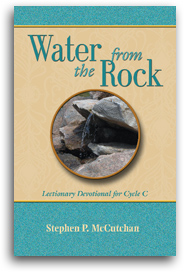
Water From the Rock
Lectionary Devotional for Cycle C
Object:
When you send forth your spirit, they are created; and you renew the face of the ground.
-- Psalm 104:30
On Pentecost, the focus of our attention is on the Spirit of God. While our understanding of the Spirit of God is more fully developed in the New Testament, God's Spirit is fully present in the Hebrew scriptures as well. Remembering that in Hebrew the word for breath and spirit are the same, these verses recall the creation story in Genesis 2:7 where God was forming the earthling. When all of the parts had been created from the clay or elements of the earth, it was still not a living human being until God "breathed into his nostrils the breath of life; and the man became a living being." This same breath or spirit is spoken of in this psalm in a reversal of creation. "When you hide your face, they are dismayed; when you take away their breath, they die and return to their dust." However, the reference here is much broader. The psalmist was recognizing that all of creation was dependent on the breath or Spirit of God. Our entire creation, in ways that we choose to ignore, is a dependent creation.
As scientists explore other planets that have been incapable of producing life, we are made more and more aware of how fragile and exacting the conditions are that permitted life to emerge on this planet. For the believer, the miracle of life itself is cause for great awe. "O Lord, how manifold are your works! In wisdom you have made them all; the earth is full of your creatures." There is an ecological aspect to our celebration of the Spirit of God. "When you send forth your Spirit, they are created; and you renew the face of the ground." When we celebrate Pentecost, we are not only celebrating the birthday of the church but also the birth of creation. Our stewardship of the ecology of our planet is lifted up when we recognize how dependent the entire creation is on a mystery that is beyond our control. For the psalmist, such awareness could only result in songs of praise. "I will sing to the Lord as long as I live; I will sing praise to my God while I have being." For us it may result in a new respect for the sacredness of our creation.
-- Psalm 104:30
On Pentecost, the focus of our attention is on the Spirit of God. While our understanding of the Spirit of God is more fully developed in the New Testament, God's Spirit is fully present in the Hebrew scriptures as well. Remembering that in Hebrew the word for breath and spirit are the same, these verses recall the creation story in Genesis 2:7 where God was forming the earthling. When all of the parts had been created from the clay or elements of the earth, it was still not a living human being until God "breathed into his nostrils the breath of life; and the man became a living being." This same breath or spirit is spoken of in this psalm in a reversal of creation. "When you hide your face, they are dismayed; when you take away their breath, they die and return to their dust." However, the reference here is much broader. The psalmist was recognizing that all of creation was dependent on the breath or Spirit of God. Our entire creation, in ways that we choose to ignore, is a dependent creation.
As scientists explore other planets that have been incapable of producing life, we are made more and more aware of how fragile and exacting the conditions are that permitted life to emerge on this planet. For the believer, the miracle of life itself is cause for great awe. "O Lord, how manifold are your works! In wisdom you have made them all; the earth is full of your creatures." There is an ecological aspect to our celebration of the Spirit of God. "When you send forth your Spirit, they are created; and you renew the face of the ground." When we celebrate Pentecost, we are not only celebrating the birthday of the church but also the birth of creation. Our stewardship of the ecology of our planet is lifted up when we recognize how dependent the entire creation is on a mystery that is beyond our control. For the psalmist, such awareness could only result in songs of praise. "I will sing to the Lord as long as I live; I will sing praise to my God while I have being." For us it may result in a new respect for the sacredness of our creation.
