
The Day Of Pentecost
Devotional
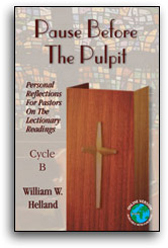
Pause Before The Pulpit
Personal Reflections For Pastors On The Lectionary Readings
John 15:26-27; 16:4b-15
The setting in which the words of our text were spoken was a difficult one for the disciples. Perhaps something we could compare it to would be a pastor's announcement of his or her resignation or new appointment. So far, in my years of ministry, I have had to announce my resignation to three separate congregations. I'm blessed that in each case the reaction was sadness and grief -- indicating that they didn't want me to go. I'm always humbled and honored by that.
But what those congregations lost and what the disciples lost can't even be compared. I'm nothing compared to Christ. Can we even begin to imagine what the disciples were facing? Our congregations can find replacement pastors. They might even find someone who is more gifted and talented than we are! But who would replace Jesus? Who could do better than he did? How would they possibly get by without him? Obviously, no human could replace him and they certainly wouldn't get along without him, so he promised to send them someone who would be as good as him; in fact better, for he would never leave them. I'm referring, of course, to the Holy Spirit.
How thankful we can be for this wise arrangement that God planned from the beginning. How thankful we can be that Jesus is no longer on this earth in the form of the God/man who, though being infinite in his divine nature was finite in his human nature. While ministering on earth, Jesus was always located in one place at any given time. He could not be everywhere at once, as he now is through the power of the Holy Spirit. How much greater it is for the church that Jesus now locates himself in our hearts rather than in the Middle East. How thankful we can be that he shares his wisdom with each of us individually as we read and prayerfully reflect on his word. We don't have to take a pilgrimage to Jerusalem to sit under his teaching in the temple.
In this text, see at least two things which the Spirit does that ought to take some pressure off of us as we preach the Word of God week after week. First, it is the Holy Spirit who will prove the world wrong about sin and righteousness and judgment. It is our role to preach about sin, righteousness, and judgment, but it is not our role to prove the world wrong. I think some pastors feel it is their mission and calling in life to prove the world wrong. If that is our approach, we will unnecessarily agitate people and make enemies. Our role is to faithfully proclaim God's Law and grace, and then allow the Spirit space and freedom to do the convicting (or proving) about sin.
Secondly, it is not ultimately up to us to guide people into all truth. Again, we have the God-given responsibility to faithfully preach and teach his word, but it is ultimately the Holy Spirit who -- through the word -- guides people into all truth. Don't both of these truths remove a lot of pressure from us? Not so we can be lazy and careless in our sermon preparation and delivery, but so we keep in mind that the actual moving of people to act upon God's truths and to bring them to salvation and spiritual maturity is a work of the Holy Spirit.
Our text began with these words of Jesus in the end of chapter 15: When the Advocate comes, whom I will send to you from the Father, the Spirit of truth who comes from the Father, he will testify on my behalf. You also are to testify because you have been with me from the beginning.
In Pentecost, we celebrate the good news of God's mercy and grace toward us in the sending of his Holy Spirit. It is he who ultimately testifies on Christ's behalf, but notice how we are drawn into this mission: You also are to testify. For whatever reason, God has chosen to involve us in the process of testifying. The Holy Spirit could show up on earth visibly and speak to people on his own, but he doesn't. He speaks to and through us. May we take that responsibility seriously and serve him faithfully as his mouthpiece.
A Pastor's Prayer:
Dear Lord,
Thank you for sending your Holy Spirit. Thank you that it is his work to prove people wrong about sin and to guide them into all truth. Since you have called me to be a part of this process, by being your mouthpiece, please help me to do it faithfully and effectively for your honor and glory. Amen.
Acts 2:1-21
I'm so thankful that this account of the Holy Spirit coming upon the apostles is not the "formula" for how he comes upon the church and individual believers today. There are elements of Christianity which believe that. They feel this is a model of what the experience of every Christian and every church should be when the Holy Spirit comes upon them and their places of worship. I recently heard a song in a church that was basically begging for this to happen. The plea was made over and over again. That is not what the apostles had to do to receive the Holy Spirit. They simply waited, in obedience to their Lord's command, until the promised gift arrived in his time and in his way.
We cannot conjure up the Holy Spirit in songs and incantations, as may be the case with spirits of darkness and evil. I believe that to be completely obsessed with what happened to the disciples, and to try replicate that today, is to miss the point of the text. What we should take note of is the reactions of the bystanders.
Some of them were amazed and perplexed. It doesn't matter if an unbeliever sees fire coming down on the head of a believer and hears them speaking in a different language, or if they see that believer loving and forgiving others, selfless and self-controlled, the reaction is going to be about the same. They will be amazed and perplexed. You see, it is as much a miracle and evidence of the indwelling Holy Spirit if someone lives out one or more fruits of the Spirit, as it is if they speak in tongues. In fact it may well be easier to speak in tongues than to forgive someone who has sinned against you repeatedly, for you can fake speaking in tongues and fool some people for a long time, but it is really hard to fake forgiveness for any amount of time and have people believe it is genuine.
Another reaction was that of asking questions. When unbelievers see and experience pastors and parishioners living a genuine, Christ-like life, that prompts questions, such as: "How come you always seem so happy? How are you able to be so patient with that obnoxious person? I don't see how or why you forgave that individual who has hurt you repeatedly and still does." The life of a Christian ought to stand out in stark contrast to that of the world around us; not in odd, offensive ways, but in ways that grab people's attention so they ask questions.
Last of all, if we are going to replicate anything at all in this text, it would be what Peter did. He didn't brush off what had happened to them, nor did he ignore the criticism. He stood up and proclaimed the Word of God and pointed out the fulfillment of scripture.
When God is at work in us and our congregations, we ought to be the first to stand up and explain what is happening. And we should not be ignorant of what is happening. How sad if God were working mightily in your church, but you hadn't studied his word well enough to recognize his activity. This has happened in more than one church, to be sure; and what was really the activity of God, was labeled as fanaticism, obsession with experience, or emotional foolishness. The work of God's Spirit was stifled, possibly by the one person who above all should have known what was going on.
Do you have a grasp of how the Holy Spirit works? Is he being allowed to manifest himself and his fruits through you? Would you be able to recognize the activity of the Spirit of God if it were suddenly at work in one or more individuals in your church? If you are not sure, don't start buying and reading books on the Holy Spirit, but rather pick up and study intently the best source of information there is on the Holy Spirit -- the Bible. For he authored it, helps us understand it, reveals himself and his work in it, and does his marvelous work of convicting and saving people through it.
A Pastor's Prayer:
Dear Lord,
Thank you for the gift of your Holy Spirit. Help me, Lord, to better understand how you are at work in me and my church. May I readily recognize your work, and be able to not only explain it but give you all the credit and glory for it. Thank you. Amen.
The setting in which the words of our text were spoken was a difficult one for the disciples. Perhaps something we could compare it to would be a pastor's announcement of his or her resignation or new appointment. So far, in my years of ministry, I have had to announce my resignation to three separate congregations. I'm blessed that in each case the reaction was sadness and grief -- indicating that they didn't want me to go. I'm always humbled and honored by that.
But what those congregations lost and what the disciples lost can't even be compared. I'm nothing compared to Christ. Can we even begin to imagine what the disciples were facing? Our congregations can find replacement pastors. They might even find someone who is more gifted and talented than we are! But who would replace Jesus? Who could do better than he did? How would they possibly get by without him? Obviously, no human could replace him and they certainly wouldn't get along without him, so he promised to send them someone who would be as good as him; in fact better, for he would never leave them. I'm referring, of course, to the Holy Spirit.
How thankful we can be for this wise arrangement that God planned from the beginning. How thankful we can be that Jesus is no longer on this earth in the form of the God/man who, though being infinite in his divine nature was finite in his human nature. While ministering on earth, Jesus was always located in one place at any given time. He could not be everywhere at once, as he now is through the power of the Holy Spirit. How much greater it is for the church that Jesus now locates himself in our hearts rather than in the Middle East. How thankful we can be that he shares his wisdom with each of us individually as we read and prayerfully reflect on his word. We don't have to take a pilgrimage to Jerusalem to sit under his teaching in the temple.
In this text, see at least two things which the Spirit does that ought to take some pressure off of us as we preach the Word of God week after week. First, it is the Holy Spirit who will prove the world wrong about sin and righteousness and judgment. It is our role to preach about sin, righteousness, and judgment, but it is not our role to prove the world wrong. I think some pastors feel it is their mission and calling in life to prove the world wrong. If that is our approach, we will unnecessarily agitate people and make enemies. Our role is to faithfully proclaim God's Law and grace, and then allow the Spirit space and freedom to do the convicting (or proving) about sin.
Secondly, it is not ultimately up to us to guide people into all truth. Again, we have the God-given responsibility to faithfully preach and teach his word, but it is ultimately the Holy Spirit who -- through the word -- guides people into all truth. Don't both of these truths remove a lot of pressure from us? Not so we can be lazy and careless in our sermon preparation and delivery, but so we keep in mind that the actual moving of people to act upon God's truths and to bring them to salvation and spiritual maturity is a work of the Holy Spirit.
Our text began with these words of Jesus in the end of chapter 15: When the Advocate comes, whom I will send to you from the Father, the Spirit of truth who comes from the Father, he will testify on my behalf. You also are to testify because you have been with me from the beginning.
In Pentecost, we celebrate the good news of God's mercy and grace toward us in the sending of his Holy Spirit. It is he who ultimately testifies on Christ's behalf, but notice how we are drawn into this mission: You also are to testify. For whatever reason, God has chosen to involve us in the process of testifying. The Holy Spirit could show up on earth visibly and speak to people on his own, but he doesn't. He speaks to and through us. May we take that responsibility seriously and serve him faithfully as his mouthpiece.
A Pastor's Prayer:
Dear Lord,
Thank you for sending your Holy Spirit. Thank you that it is his work to prove people wrong about sin and to guide them into all truth. Since you have called me to be a part of this process, by being your mouthpiece, please help me to do it faithfully and effectively for your honor and glory. Amen.
Acts 2:1-21
I'm so thankful that this account of the Holy Spirit coming upon the apostles is not the "formula" for how he comes upon the church and individual believers today. There are elements of Christianity which believe that. They feel this is a model of what the experience of every Christian and every church should be when the Holy Spirit comes upon them and their places of worship. I recently heard a song in a church that was basically begging for this to happen. The plea was made over and over again. That is not what the apostles had to do to receive the Holy Spirit. They simply waited, in obedience to their Lord's command, until the promised gift arrived in his time and in his way.
We cannot conjure up the Holy Spirit in songs and incantations, as may be the case with spirits of darkness and evil. I believe that to be completely obsessed with what happened to the disciples, and to try replicate that today, is to miss the point of the text. What we should take note of is the reactions of the bystanders.
Some of them were amazed and perplexed. It doesn't matter if an unbeliever sees fire coming down on the head of a believer and hears them speaking in a different language, or if they see that believer loving and forgiving others, selfless and self-controlled, the reaction is going to be about the same. They will be amazed and perplexed. You see, it is as much a miracle and evidence of the indwelling Holy Spirit if someone lives out one or more fruits of the Spirit, as it is if they speak in tongues. In fact it may well be easier to speak in tongues than to forgive someone who has sinned against you repeatedly, for you can fake speaking in tongues and fool some people for a long time, but it is really hard to fake forgiveness for any amount of time and have people believe it is genuine.
Another reaction was that of asking questions. When unbelievers see and experience pastors and parishioners living a genuine, Christ-like life, that prompts questions, such as: "How come you always seem so happy? How are you able to be so patient with that obnoxious person? I don't see how or why you forgave that individual who has hurt you repeatedly and still does." The life of a Christian ought to stand out in stark contrast to that of the world around us; not in odd, offensive ways, but in ways that grab people's attention so they ask questions.
Last of all, if we are going to replicate anything at all in this text, it would be what Peter did. He didn't brush off what had happened to them, nor did he ignore the criticism. He stood up and proclaimed the Word of God and pointed out the fulfillment of scripture.
When God is at work in us and our congregations, we ought to be the first to stand up and explain what is happening. And we should not be ignorant of what is happening. How sad if God were working mightily in your church, but you hadn't studied his word well enough to recognize his activity. This has happened in more than one church, to be sure; and what was really the activity of God, was labeled as fanaticism, obsession with experience, or emotional foolishness. The work of God's Spirit was stifled, possibly by the one person who above all should have known what was going on.
Do you have a grasp of how the Holy Spirit works? Is he being allowed to manifest himself and his fruits through you? Would you be able to recognize the activity of the Spirit of God if it were suddenly at work in one or more individuals in your church? If you are not sure, don't start buying and reading books on the Holy Spirit, but rather pick up and study intently the best source of information there is on the Holy Spirit -- the Bible. For he authored it, helps us understand it, reveals himself and his work in it, and does his marvelous work of convicting and saving people through it.
A Pastor's Prayer:
Dear Lord,
Thank you for the gift of your Holy Spirit. Help me, Lord, to better understand how you are at work in me and my church. May I readily recognize your work, and be able to not only explain it but give you all the credit and glory for it. Thank you. Amen.
