
Dog Song
Sermon
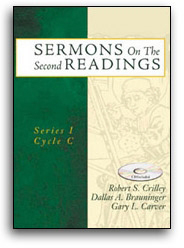
Sermons On The Second Readings
Series I, Cycle C
What is it about the inner song that sings us? Is it a connecting with the singing of angels? Songs come from out of somewhere. Slave songs gave rhythm to the extended day of crop workers, girding them as they moved through long hours. Songs keep alive the souls of sweatshop workers in our day. You and I sing while engaged in tedious activity.
Some persons poke the radio button upon awakening in the morning and leave on the sound until nightfall. The sound could be anything -- talk, music, whatever -- to fill the space of silence and let us avoid listening to our thoughts. Just let the rhythm draw us into its charm.
You may yearn for a particular song. The ritual of your selection may necessitate a CD collection. The music we choose answers an inner calling. It accompanies the project undertaken. It counters the moment's mood. Such music becomes acceptable, tolerable sound that distracts us from the extraneous or from the unthinkable so we can concentrate.
What are the songs that have sung you through significant stages of your life? Was it a Mozart's "Alleluia" when you found your life mate or an "Agnus Dei" during a tragedy? Was it "For Unto Us A Child Is Given" for the adopted baby? Did it come as Brahm's "Lullaby" at another birth? Was it finding yourself a-hum when grandchildren came for a visit?
Inner songs sing us without prompting. Hymns come to mind when we need comfort and encouragement: "Be Still My Soul," "On Eagle's Wings," "There's A Bulb In Every Flower," "Joyful, Joyful, We Adore You." Every cell within vibrates with song.
One month after Dee's first dog guide, Dolley, came, a bittersweet song emerged from deep within. The dog became ill, the stress response of an immature dog guide who took her work more seriously than her puppy nature could manage.
Knowing the dog might not make it as a guide, Dee gentled and encouraged her. Between the necessary work commands of travel, she sang to Dolley. "Du, Du, Liebst Mir Im Hertzen" ("You, you, whom I love in my heart") sang itself as their song. "It spoke soul to soul," the woman said, "much as a parent lullabies a fretful baby."
The love song that had come from somewhere sang itself, crooning through woman to dog. The young dog took courage from Dee's tone of voice. Its warmth helped to strengthen Dolley's acceptability to herself. It coaxed her to carry out what became a long working partnership.
Neither the title nor the type of song that sings us matters. Song is the art form of the soul. Song is symbol. Song, even worded song, expresses the "beyond words" level of our being. Song shortcuts the communion connection with another time and another place.
Sometimes, no song comes. As the author of Revelation says, "[T]here was silence in heaven for about half an hour" (8:1). A half hour is long. Long, silent songless stretches, when we are struggling to hold on to life, seem to stop all movement of time. Is this difficult time also the time the angel begins to sing and to infuse us with new hope?
Do you believe in angel songs? Angels are as intangible as the sound of an idea entering the mind. They are as palpable as the sense of God's presence.
If angelic symbols of God's interest in our lives were the products only of the book of Revelation, we might be concerned. However, these messengers of God, these imparters of instruction, these doers of deeds, and these singers of song span both testaments of the Bible.
There are more than 225 references to angels, from the Genesis angel who found Hagar to the angel Gabriel who came first to Zechariah then visited Mary. The Gethsemane angel brought Jesus strength. An angel reassured the women at the Tomb.
For the ancients, angels spoke through music. Angels sang praises in the Psalms. A whole, heavenly host of angels sang the announcement of the birth of Jesus.
Must the angels sing to ensure and to assure that our spirit will survive? Our generic troubles, while wearing a unique face on each person, also existed in an earlier day. Reread Psalm 33, 40, 98, or 144. When life events squelch our inner song, these Psalms remind us that God "puts [a] new song into the mouths" of the angels. They announce another birth. This birth is within us this time. It is the rebirth of hope.
The song the angels sing in Revelation is no whispered song. We will not miss it. John describes the grand angelic choir of Revelation as "myriads of myriads" and "thousands of thousands" of angels gathered to sing "with full voice" (vv. 11-12).
This choir stirs "every creature in heaven and on earth and under the earth and in the sea, and all that is in them" to sing the song of "blessing and honor and glory and might" (v. 13). Stand back. This music rivals Handel's "Hallelujah Chorus."
Is the angels' song mania? Is it a button that John pokes, the in-language of his day? John's emphasis in Revelation on the angels' song is his way of summoning the seven churches of Asia. It is his way of calling us back to the birth, to the holy night of rejoicing throughout the heavens, to the star, to Christ. Is this choir of angels not also God's calling us back to hope through Christ after we have come through the Lenten days of turmoil and through the Good Friday of national emergencies? It calls us toward the Easter of our own life.
Each age sings its innate and unique expression of rich emotion. Listen to a contented child sing at play. Each era delivers its own song. The angels' songs in Revelation may have been the healing jazz of John's day. Who can read the contagious songs of joy in today's passage without an inner stirring of song? How fully John grasped that music is a response of the whole being. He knew well, also, the silence that precedes a new song.
The Revelation song stretches back to the Exodus Song of Moses: "I will sing to the Lord, for he has triumphed gloriously ... the Lord is my strength and my might, and he has become my salvation; this is my God, and I will praise him" (15:1-2).
John also knew Psalm 33. In fact, one might rename the book of Revelation, "John's Fantasy on the Theme of Psalm 33." Reread Psalm 33 in light of today's Revelation passage. Hear its promises that all waiting people, those from the seven churches of Asia and we, have hoped for all these years.
We can hear in Revelation other Psalms, also songs of both lament and praise. Hear Psalm 40:2-3: "He drew me up from the pit, out of the miry bog, and set my feet upon a rock, making my steps secure. He put a new song in my mouth, a song of praise to our God." From Psalm 96:6: "Honor and majesty are before him; strength and beauty are in his sanctuary." And from Psalm 144:9: "I will sing a new song to you, O God."
The Revelation song is a love song sung to Christ. This Song of the Lamb affirms and empowers. Its first word, "Worthy," is as reaffirming as the blessing, "My Son, my Chosen," the words on the brink of Jesus' first going forward with hope and blessing at his transfiguration. Jesus was alone at the transfiguration. Here, the whole crowd of angels affirms him. All bless him as not just generally worthy but worthy of it all, "power and wealth and wisdom and might" (vv. 12, 13).
Reminiscent of Job, the Revelation song sings, all of your effort, Jesus, your suffering, your life, was worth it. Your suffering and your faithfulness too, you people of the seven Asian churches, and ours too, sing this song.
Our inner song has a reason for us to discover. Our inner song draws us closer to God, bringing us strength as certain as that the angel's brought Jesus at Gethsemane. The words of our inner song may differ from the Song of Moses and the Song of the Lamb, but they return us to our own center. Our inner song reminds us of a still powerful, still worthy, still triumphing, and still present God, who still elicits from us in this new millennium a sense of awesome response, worship, and hope.
When we leave behind the classroom, the office work, the day job, the long professional hours, or the day's stress of whatever to spend time for ourselves, and get some rest, what happens? The "Song of You" slips in. Just like that, it hums. It whistles. It outright sings. Listen this week as your song begins to sing you.
Some persons poke the radio button upon awakening in the morning and leave on the sound until nightfall. The sound could be anything -- talk, music, whatever -- to fill the space of silence and let us avoid listening to our thoughts. Just let the rhythm draw us into its charm.
You may yearn for a particular song. The ritual of your selection may necessitate a CD collection. The music we choose answers an inner calling. It accompanies the project undertaken. It counters the moment's mood. Such music becomes acceptable, tolerable sound that distracts us from the extraneous or from the unthinkable so we can concentrate.
What are the songs that have sung you through significant stages of your life? Was it a Mozart's "Alleluia" when you found your life mate or an "Agnus Dei" during a tragedy? Was it "For Unto Us A Child Is Given" for the adopted baby? Did it come as Brahm's "Lullaby" at another birth? Was it finding yourself a-hum when grandchildren came for a visit?
Inner songs sing us without prompting. Hymns come to mind when we need comfort and encouragement: "Be Still My Soul," "On Eagle's Wings," "There's A Bulb In Every Flower," "Joyful, Joyful, We Adore You." Every cell within vibrates with song.
One month after Dee's first dog guide, Dolley, came, a bittersweet song emerged from deep within. The dog became ill, the stress response of an immature dog guide who took her work more seriously than her puppy nature could manage.
Knowing the dog might not make it as a guide, Dee gentled and encouraged her. Between the necessary work commands of travel, she sang to Dolley. "Du, Du, Liebst Mir Im Hertzen" ("You, you, whom I love in my heart") sang itself as their song. "It spoke soul to soul," the woman said, "much as a parent lullabies a fretful baby."
The love song that had come from somewhere sang itself, crooning through woman to dog. The young dog took courage from Dee's tone of voice. Its warmth helped to strengthen Dolley's acceptability to herself. It coaxed her to carry out what became a long working partnership.
Neither the title nor the type of song that sings us matters. Song is the art form of the soul. Song is symbol. Song, even worded song, expresses the "beyond words" level of our being. Song shortcuts the communion connection with another time and another place.
Sometimes, no song comes. As the author of Revelation says, "[T]here was silence in heaven for about half an hour" (8:1). A half hour is long. Long, silent songless stretches, when we are struggling to hold on to life, seem to stop all movement of time. Is this difficult time also the time the angel begins to sing and to infuse us with new hope?
Do you believe in angel songs? Angels are as intangible as the sound of an idea entering the mind. They are as palpable as the sense of God's presence.
If angelic symbols of God's interest in our lives were the products only of the book of Revelation, we might be concerned. However, these messengers of God, these imparters of instruction, these doers of deeds, and these singers of song span both testaments of the Bible.
There are more than 225 references to angels, from the Genesis angel who found Hagar to the angel Gabriel who came first to Zechariah then visited Mary. The Gethsemane angel brought Jesus strength. An angel reassured the women at the Tomb.
For the ancients, angels spoke through music. Angels sang praises in the Psalms. A whole, heavenly host of angels sang the announcement of the birth of Jesus.
Must the angels sing to ensure and to assure that our spirit will survive? Our generic troubles, while wearing a unique face on each person, also existed in an earlier day. Reread Psalm 33, 40, 98, or 144. When life events squelch our inner song, these Psalms remind us that God "puts [a] new song into the mouths" of the angels. They announce another birth. This birth is within us this time. It is the rebirth of hope.
The song the angels sing in Revelation is no whispered song. We will not miss it. John describes the grand angelic choir of Revelation as "myriads of myriads" and "thousands of thousands" of angels gathered to sing "with full voice" (vv. 11-12).
This choir stirs "every creature in heaven and on earth and under the earth and in the sea, and all that is in them" to sing the song of "blessing and honor and glory and might" (v. 13). Stand back. This music rivals Handel's "Hallelujah Chorus."
Is the angels' song mania? Is it a button that John pokes, the in-language of his day? John's emphasis in Revelation on the angels' song is his way of summoning the seven churches of Asia. It is his way of calling us back to the birth, to the holy night of rejoicing throughout the heavens, to the star, to Christ. Is this choir of angels not also God's calling us back to hope through Christ after we have come through the Lenten days of turmoil and through the Good Friday of national emergencies? It calls us toward the Easter of our own life.
Each age sings its innate and unique expression of rich emotion. Listen to a contented child sing at play. Each era delivers its own song. The angels' songs in Revelation may have been the healing jazz of John's day. Who can read the contagious songs of joy in today's passage without an inner stirring of song? How fully John grasped that music is a response of the whole being. He knew well, also, the silence that precedes a new song.
The Revelation song stretches back to the Exodus Song of Moses: "I will sing to the Lord, for he has triumphed gloriously ... the Lord is my strength and my might, and he has become my salvation; this is my God, and I will praise him" (15:1-2).
John also knew Psalm 33. In fact, one might rename the book of Revelation, "John's Fantasy on the Theme of Psalm 33." Reread Psalm 33 in light of today's Revelation passage. Hear its promises that all waiting people, those from the seven churches of Asia and we, have hoped for all these years.
We can hear in Revelation other Psalms, also songs of both lament and praise. Hear Psalm 40:2-3: "He drew me up from the pit, out of the miry bog, and set my feet upon a rock, making my steps secure. He put a new song in my mouth, a song of praise to our God." From Psalm 96:6: "Honor and majesty are before him; strength and beauty are in his sanctuary." And from Psalm 144:9: "I will sing a new song to you, O God."
The Revelation song is a love song sung to Christ. This Song of the Lamb affirms and empowers. Its first word, "Worthy," is as reaffirming as the blessing, "My Son, my Chosen," the words on the brink of Jesus' first going forward with hope and blessing at his transfiguration. Jesus was alone at the transfiguration. Here, the whole crowd of angels affirms him. All bless him as not just generally worthy but worthy of it all, "power and wealth and wisdom and might" (vv. 12, 13).
Reminiscent of Job, the Revelation song sings, all of your effort, Jesus, your suffering, your life, was worth it. Your suffering and your faithfulness too, you people of the seven Asian churches, and ours too, sing this song.
Our inner song has a reason for us to discover. Our inner song draws us closer to God, bringing us strength as certain as that the angel's brought Jesus at Gethsemane. The words of our inner song may differ from the Song of Moses and the Song of the Lamb, but they return us to our own center. Our inner song reminds us of a still powerful, still worthy, still triumphing, and still present God, who still elicits from us in this new millennium a sense of awesome response, worship, and hope.
When we leave behind the classroom, the office work, the day job, the long professional hours, or the day's stress of whatever to spend time for ourselves, and get some rest, what happens? The "Song of You" slips in. Just like that, it hums. It whistles. It outright sings. Listen this week as your song begins to sing you.
