
Don't Be A Turkey!
Sermon
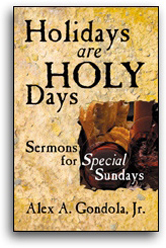
Holidays Are Holy Days
Sermons For Special Sundays
There is little question that the commercially grown turkey is, pound for pound, one of nature's less intelligent creatures, at least according to an article I once read. In that article, author Fred McGuiness calls the domesticated turkey "as brainless as a baseball," and describes how turkeys can have trouble doing even simple things.
For example, your average turkey can get into trouble doing something as simple as eating. Turkeys have been known to starve to death right next to a mountain of food. But other times they will eat so much so quickly that grain will fill their gullets and they die by choking. Drinking water can be a problem for turkeys, too. Farmers frequently find them drowned in shallow troughs. If a turkey is outdoors, looking up at the sky when it starts to rain, and it's mouth is open, it can die. They're often not smart enough to close their mouths in the rain, and so they can drown standing up. Eating and drinking can put a strain on turkey intelligence. No wonder, a few years back, when teenagers wanted to insult each other, they would call each other a "Turkey."
But at least the turkey has an excuse for being "bird-brained." It has a bird's brain! There is less excuse for human beings. Take the nine lepers Luke writes about in the lesson I read. Didn't that group include some pretty big turkeys?! Jesus had given them a tremendous, free gift. He had healed all ten from a disgusting, painful, and unsightly skin disease. Even more important, he had made it possible for them to re-enter society and to be reunited with their families. Ten lepers were healed. But only one leper, and a Samaritan at that, came back and said "Thanks."
There are relatively few things in the gospel accounts that actually surprise Jesus. In most situations, he seems to know what's going to happen before it occurs. But in this case, even Jesus registers surprise. "Were not ten healed?" he asks incredulously. "Where are the other nine?" Jesus was astonished by their ingratitude. Ten received God's blessing, but only one in ten stopped to say thanks.
What about us? Thanksgiving Day is approaching, and among which group will we be found? Among the nine who forget? Or with the one who came back to thank God?
No one wants to be a turkey. If we want to avoid being "turkeys" this Thanksgiving, the behavior of that tenth leper in Luke's lesson might prove instructive. What was there about this one man that set him apart? First, it says in verse 15 that when the man saw that he was healed, he came back and gave thanks. So, a first step in thanks-giving is perceiving, seeing the ways we've been blessed.
God has given different creatures different ways of seeing. I once read that a hawk, perched on top of the Empire State building, could locate a dime on the sidewalk below. Of course, I don't know why a hawk would care about a dime located on the sidewalk below the Empire State Building! But, if a dime were there, the hawk could spot it. The hawk's vision is eight times more acute than ours.
A bee has a different kind of vision. Its eyes have 15,000 facets that enable it to see the sun as a single dot and to navigate long distances with the sun as a reference. A kingfisher has two kinds of vision: one for spotting fish as it flies overhead and another for seeing fish underwater.
There are different ways of seeing, and we may need to see things in different ways if we are to experience the full measure of our blessings. Of course, some of our blessings ought to be easy to see. Maybe some of us here this morning, like the leper in the story, have been healed from a terrible illness. Maybe there have been other dramatic good things that have happened for us or for our family in the past year. All of us here this morning are profoundly lucky to be living where we are: in America and not in Bosnia or Iraq or the Gaza Strip or some other troubled location. We're all blessed that we have plenty to eat: sometimes maybe even too much. We are blessed that we can go home to warm, comfortable houses or apartments and don't have to sleep in a shelter or on a heating grate in the sidewalk of some city street. Some of our blessings ought to be completely obvious.
Maybe other blessings require another kind of "seeing" because they're more subtle. Can we thank God this Thanksgiving not only for the good things that happened, but also for the bad things that didn't happen? The problems and disasters we worried about which did not come about?
Can we look in a different way still and see some sort of blessing even in the problems that we do face? As George Matheson, the beloved Scottish preacher once put it, "I've thanked God a thousand times for my 'roses.' Now I've got to learn to thank God for my 'thorns.' " George Matheson happened to be blind -- which is a pretty significant "thorn."
In the end, Matheson was able to see, with his spiritual eye, some "hidden" blessings in his blindness. He found his lack of sight forced him to become a better listener, to be more patient with others, to be more willing to receive the help and care of others, to be more sensitive to other people's suffering. It also helped Matheson identify with the Apostle Paul, who had his own "thorn in the flesh." Most importantly, it helped Matheson better to appreciate the sufferings and sacrifices of Jesus, who not only had a thorn, but who wore a crown of thorns.
A first step in the tenth leper's journey to thanks-giving was simply seeing. Maybe, if we think about it a bit, we can find different ways of seeing our blessings, too.
We notice, secondly, that this leper went beyond just seeing to saying. Luke writes, continuing on in verse 15, "When he (the leper) saw that he was healed, (he) turned back, praising God with a loud voice." The leper's thanks-giving began with perception but then moved to proclamation. He took time to actually say "thank you" to God.
There's an old proverb that goes, "The thankful person tastes his joy twice." She or he tastes it when it happens and tastes it again in speaking about it. If we go to an art gallery and view a beautiful work of art, or go to the movies and watch a movie that really moves us, part of the joy and wonder of those experiences is expressing our gratitude and appreciation for the gifts of the artist.
We're not meant to keep gratitude and appreciation bottled up inside! This Thanksgiving, if we have things to be thankful about, we need to say our thanks to God!
Let me suggest some practical applications for this Thanksgiving. Make plans in your household to say "thank you" to God. You may want to write down what you're thankful for on a slip of paper. You may want to share your thanks, round-robin fashion, around the Thanksgiving table. Perhaps the children could be asked to draw a picture of what they're grateful for this Thanksgiving, and share it. Maybe your family could join in a Thanksgiving hymn or in a brief Thanksgiving service, like we will be using at our church dinners this evening. Perhaps you might want to look for and raise up some of the wonderful Psalms of thanks-giving. To properly thank God, we must not only see what we're thankful for but also to say it. That's the second lesson we learn from the leper who returned.
The third lesson is not in scripture. But it is in tradition. Tradition has it that this tenth leper was the one who spread the good news about Jesus Christ throughout Samaria. Tradition has it that he, a healed leper, paid particular attention to telling other lepers how Jesus had made him whole. Is it true? I don't know. It's a tradition. But he also shared.
"Thanks," after all, is only half of the word "Thanksgiving." "Giving" is the other half of the word. Herbert Hoover was not the most notable or quotable of our American presidents. But he did say, "Give for the joy of giving, and sing hymns of thankfulness that you have (something) to give."
We are all very fortunate to have something to give. In the West Virginia hills they have a custom of setting an extra place setting and an extra chair at the Thanksgiving table. It's a reminder that there will always be people in need -- and we need to make room in our hearts and in our giving for people in need.
Leonard Sweet, writing in Homiletics magazine, has some perceptive things to say about the holiday that is before us. He writes:
(Thanksgiving) itself is becoming a kind of great divide separating ... the "haves" from the "have nots." For the ƒ"haves," Thanksgiving is the starting gun for the first frenetic round of holiday shopping. Isn't this the biggest shopping day with the biggest sales in your community? Those who "have" even more may use this long weekend as time for the first skiing vacation of the winter ... with enough time and enough money (you) can find snow somewhere.
For the "have nots," Thanksgiving marks a new beginning as well. In the "have not" culture, Thanksgiving is the first disappointment of the ... holiday season. For the lucky ones, it's a ... meal served cafeteria-style at a church or mission. The food is nourishing, the spirit welcoming. But it is surely not the Thanksgiving of anyone's dreams.
One of the most disappointing things about the "have not" Thanksgiving is there are no leftovers ... no leftover goodies ... no leftover family members to spend the long weekend with ... no leftover feelings of security ...1
I suspect all of us here this morning are fortunate enough to be among the "haves." Will we make generous giving a part of our thanks-giving? Remember, every time we feed the hungry, give drink to the thirsty, clothe the naked, visit the sick or the prisoner, it's the same thing as doing it for Jesus (see Matthew 25:31-46). The tenth leper may not have had much. But, according to tradition, in his gratitude, he shared what he had to give.
This Thanksgiving, don't be a turkey. In English, the word "think" and the word "thank" both come from the same root. Nine out of ten forgot to think and forgot to thank God for their blessings. But the tenth leper saw his blessings, said thanks for his blessings and shared his blessings. And so can we.
____________
1.
Leonard Sweet, writing in Homiletics magazine (Canton, Ohio: Communications Resources, Inc., October-December, 1996). p 34, used by permission.
Thanksgiving
To Be A Pilgrim
Hebrews 11:1-3, 13-16
What do you think of when you hear the word "Pilgrim"? Most of us -- especially around Thanksgiving -- hear the word "Pilgrim" and think of the English Separatists who crossed the Atlantic on the Mayflower, landed on Cape Cod, and settled in Plymouth. We hear "Pilgrim" and think "Thanksgiving."
But, when you think of that kind of Pilgrim, what do you think? Some consider the Pilgrims stained-glass saints. A church in Utica, New York, was designed as a shrine to the Pilgrims. Three tall stained-glass windows behind the altar, the center of worship, depict the Pilgrims landing at Plymouth Rock. Another entire wall is covered with magnificent Tiffany windows, thirty feet high. They portray William Brewster delivering the first sermon in New England. His kneeling congregation is dressed somberly in gray and brown. Several men stand guard with muskets. Or maybe they are on the lookout for turkeys. At the top, Tiffany angels smile approvingly from heaven.
Nowhere in that huge sanctuary (it seats 600) nowhere was there a picture of Jesus! Nowhere! Plymouth Congregational Church seemed to have been built to beatify the Pilgrims! Some folks do revere the Pilgrims like that.
Others depict them more darkly. Most of the Mayflower Pilgrims were Puritans, and "Puritanical" is not a happy word. Some depict the Puritans as severe, austere, rigid, religious fanatics. Historian George Willison writes, they were "fond of controversy, and sharp of tongue, engaging in many a high-pitched quarrel with friends and foes alike...." H. L. Mencken defines Puritanism as "the haunting fear that someone, somewhere, may be happy."
But they weren't sullen and sour. They wore bright clothing. They loved to listen to music: just not in church. The Pilgrims thought the organ was the "voice of the devil." They found choirs "distracting."
Still, they weren't monks or nuns. They married early, often, and late; and produced lots of children. They loved to drink -- especially beer. That's what they used their pumpkins for, by the way, not pumpkin pies. The Pilgrims mixed pumpkins, parsnips, and walnut chips and brewed pumpkin beer. I don't think that's going to catch on in any microbrewery anytime soon!
The Pilgrims were neither rigid fanatics nor stained-glass saints. They were ordinary people with extraordinary faith. They were, like most of us, on a pilgrimage, searching for truth and a closer connection to God. Let's take a few moments to think about what it means "to be a Pilgrim," both in the 1620s and today.
To be a Pilgrim means having the courage to act on your commitments. The Mayflower Pilgrims' courage was clear when they left Holland. This little band, described by William Bradford as "seventy menfolk and women, 32 good children, a handful of cocks and hens, and two dogs" had no illusions about the dangers that lay ahead of them.
In his historical book, Of Plymouth Plantation, Bradford discloses the colonists' worst fears. They expected "famine, nakedness, continual danger from the savage people, who are cruel, barbarous, and most treacherous, being most ferocious in their rage and merciless when they overcome."
Their chances for survival seemed slim. It was too late in the year for an easy Atlantic crossing, and too late to plant crops. They had scanty supplies. The men knew little about hunting or fishing -- and less about fighting. Still, as one of their spokesmen put it, "It is not with us as with other men, whom small things discourage."1 The Pilgrims had the courage to go forward, no matter what it might cost.
It took even greater courage to stay in Plymouth after they landed. During the first winter, conditions were worse than they imagined. There were great gray wolves, whose howls terrorized the colonists at night. There was "The Great Sickness." Over half the Pilgrims died. They buried their dead at night in unmarked graves so the Native Americans wouldn't know how weak they were getting. At one time only seven Pilgrims were well enough to tend the sick.
Yet, in spite of that terrible winter, none of the survivors returned to England on the Mayflower in the spring, when they had the opportunity. As the Mayflower sailed over the horizon, the Pilgrims stood on the shore and wept. Few expected to live until the ship returned.
The Pilgrims had the courage to act on their commitments, no matter what. Do we?
Sociologist Robert Bellah, author of Habits of the Heart, is impressed by the power of religion. He once said, "We should not underestimate the significance of the small group of people who have a new vision of a just and gentle world. The quality of a culture may be changed when two percent of its people have a new vision (and act on it)."2
Christians make up far more than two percent of our town, far more than two percent of Massachusetts, far more than two percent of Americans. So, why don't we have a greater effect: on issues of the environment, on justice for the needy, on the quality of life on Cape Cod? Could it be we need more courage to act on our commitments? To be a Pilgrim means to stand up for what you believe, no matter what.
To be a Pilgrim also means sharing what you have, and turning thanks into giving. The Pilgrim colonists willingly shared all they had. During their first three years, all property was held in common. At one point, they were down to five kernels of corn per day for food. Still, they divided the corn kernels up equally. And, the original group of fifty that survived the first winter shared their limited food with the sixty newcomers who arrived in the spring.
One of their finest moments came in 1623, at the first real Thanksgiving. The small colony hosted over ninety Native American braves for three days. There was eating and drinking, wrestling, footraces, and gun and arrow-shooting competitions. It was the Pilgrims' way of saying "Thank you" to God, and to the Native Americans who had helped them survive. To be a Pilgrim means sharing and turning thanks into giving. How thankful and giving are we?
We have a lot to be thankful for -- much more than the Pilgrims -- don't we? They originally rejected Cape Cod as unsuitable for living. Today the Cape is the seventh most popular retirement location in America, and the fastest growing region in the state. The Pilgrims so suffered from inadequate health care that half of them died. Today their local hospital is one of America's 100 best. The Pilgrims depended on their fall harvest for survival. Today, many depend on stocks and bonds.
We have much to be thankful for. But we could do more. The World Bank has estimated that if only two percent of the world's food -- only two percent of the world's food -- was diverted from wealthy nations (like ours) to poor nations, everyone on the planet would have an adequate diet! Isn't that incredible: a two-percent shift in foods would wipe out world hunger! Most of us waste more than two percent of our food every day.
If we could change, and encourage our government to change, maybe 33,000 children a day wouldn't die from hunger. Maybe there wouldn't be four and one-half million homeless people on America's streets. Maybe 30,000,000 Americans wouldn't be malnourished.
To be a Pilgrim is to share and to turn thanks into giving, recognizing what God has already given us.
Finally, to be a Pilgrim is to travel hopefully toward the future, trusting God to fulfill God's promises. The Plymouth colonists saw themselves on a pilgrimage. Like the heroes of faith listed in the eleventh chapter of Hebrews, they knew they were "strangers and foreigners on ... earth ... seeking a homeland" assured by God (11:13-14). The Pilgrims were not prisoners of the past. They looked forward with hope to the future, believing that, through God's goodness, the best was yet to come.
They gave up the familiarity of England, for Holland, because the English church resisted reformation. They left comfortable Holland for the New World because their children were assimilating to Dutch ways. They sought a homeland in what Cotton Mather called "this howling wilderness" of New England, believing that God would fulfill God's promises, and somehow use their pain and suffering to produce good. They believed, as William Bradford put it, "Their condition was not ordinary, their ends were good and honorable, their calling lawful and urgent" and therefore they would receive "the blessings of God." Which they did.
The Pilgrims traveled hopefully, with faith in the future. Do we? Do we believe that if we work and struggle and sacrifice, this church can be even better than it is already (and it's pretty darned good)? Do we believe that we, as individuals, are heading for a Homeland, too: a glorious homeland we cannot earn, but can only receive through faith? There is power when we live, not tied to the past, but as "strangers and foreigners" passing through life as Pilgrims, looking forward to, and struggling for, the homeland God has promised.
To be a Pilgrim is to have the courage of our convictions, to turn thanks into giving, and to cling to God's promise that the best is yet ahead of us.
There's power in that kind of Pilgrim faith. Power to build a new society. With that kind of faith, I wonder, what might you and I do?
____________
1.aWilliam Bradford, Of Plymouth Plantation: The Pilgrims In America, edited by Harvey Wish (New York: Capricorn Books, 1962).
2.aJohn R. W. Stott (quoting Robert Bellah), "Christians, Salt, And Light" (Preaching Today Audio Series, Tape No. 109, 1992).
For example, your average turkey can get into trouble doing something as simple as eating. Turkeys have been known to starve to death right next to a mountain of food. But other times they will eat so much so quickly that grain will fill their gullets and they die by choking. Drinking water can be a problem for turkeys, too. Farmers frequently find them drowned in shallow troughs. If a turkey is outdoors, looking up at the sky when it starts to rain, and it's mouth is open, it can die. They're often not smart enough to close their mouths in the rain, and so they can drown standing up. Eating and drinking can put a strain on turkey intelligence. No wonder, a few years back, when teenagers wanted to insult each other, they would call each other a "Turkey."
But at least the turkey has an excuse for being "bird-brained." It has a bird's brain! There is less excuse for human beings. Take the nine lepers Luke writes about in the lesson I read. Didn't that group include some pretty big turkeys?! Jesus had given them a tremendous, free gift. He had healed all ten from a disgusting, painful, and unsightly skin disease. Even more important, he had made it possible for them to re-enter society and to be reunited with their families. Ten lepers were healed. But only one leper, and a Samaritan at that, came back and said "Thanks."
There are relatively few things in the gospel accounts that actually surprise Jesus. In most situations, he seems to know what's going to happen before it occurs. But in this case, even Jesus registers surprise. "Were not ten healed?" he asks incredulously. "Where are the other nine?" Jesus was astonished by their ingratitude. Ten received God's blessing, but only one in ten stopped to say thanks.
What about us? Thanksgiving Day is approaching, and among which group will we be found? Among the nine who forget? Or with the one who came back to thank God?
No one wants to be a turkey. If we want to avoid being "turkeys" this Thanksgiving, the behavior of that tenth leper in Luke's lesson might prove instructive. What was there about this one man that set him apart? First, it says in verse 15 that when the man saw that he was healed, he came back and gave thanks. So, a first step in thanks-giving is perceiving, seeing the ways we've been blessed.
God has given different creatures different ways of seeing. I once read that a hawk, perched on top of the Empire State building, could locate a dime on the sidewalk below. Of course, I don't know why a hawk would care about a dime located on the sidewalk below the Empire State Building! But, if a dime were there, the hawk could spot it. The hawk's vision is eight times more acute than ours.
A bee has a different kind of vision. Its eyes have 15,000 facets that enable it to see the sun as a single dot and to navigate long distances with the sun as a reference. A kingfisher has two kinds of vision: one for spotting fish as it flies overhead and another for seeing fish underwater.
There are different ways of seeing, and we may need to see things in different ways if we are to experience the full measure of our blessings. Of course, some of our blessings ought to be easy to see. Maybe some of us here this morning, like the leper in the story, have been healed from a terrible illness. Maybe there have been other dramatic good things that have happened for us or for our family in the past year. All of us here this morning are profoundly lucky to be living where we are: in America and not in Bosnia or Iraq or the Gaza Strip or some other troubled location. We're all blessed that we have plenty to eat: sometimes maybe even too much. We are blessed that we can go home to warm, comfortable houses or apartments and don't have to sleep in a shelter or on a heating grate in the sidewalk of some city street. Some of our blessings ought to be completely obvious.
Maybe other blessings require another kind of "seeing" because they're more subtle. Can we thank God this Thanksgiving not only for the good things that happened, but also for the bad things that didn't happen? The problems and disasters we worried about which did not come about?
Can we look in a different way still and see some sort of blessing even in the problems that we do face? As George Matheson, the beloved Scottish preacher once put it, "I've thanked God a thousand times for my 'roses.' Now I've got to learn to thank God for my 'thorns.' " George Matheson happened to be blind -- which is a pretty significant "thorn."
In the end, Matheson was able to see, with his spiritual eye, some "hidden" blessings in his blindness. He found his lack of sight forced him to become a better listener, to be more patient with others, to be more willing to receive the help and care of others, to be more sensitive to other people's suffering. It also helped Matheson identify with the Apostle Paul, who had his own "thorn in the flesh." Most importantly, it helped Matheson better to appreciate the sufferings and sacrifices of Jesus, who not only had a thorn, but who wore a crown of thorns.
A first step in the tenth leper's journey to thanks-giving was simply seeing. Maybe, if we think about it a bit, we can find different ways of seeing our blessings, too.
We notice, secondly, that this leper went beyond just seeing to saying. Luke writes, continuing on in verse 15, "When he (the leper) saw that he was healed, (he) turned back, praising God with a loud voice." The leper's thanks-giving began with perception but then moved to proclamation. He took time to actually say "thank you" to God.
There's an old proverb that goes, "The thankful person tastes his joy twice." She or he tastes it when it happens and tastes it again in speaking about it. If we go to an art gallery and view a beautiful work of art, or go to the movies and watch a movie that really moves us, part of the joy and wonder of those experiences is expressing our gratitude and appreciation for the gifts of the artist.
We're not meant to keep gratitude and appreciation bottled up inside! This Thanksgiving, if we have things to be thankful about, we need to say our thanks to God!
Let me suggest some practical applications for this Thanksgiving. Make plans in your household to say "thank you" to God. You may want to write down what you're thankful for on a slip of paper. You may want to share your thanks, round-robin fashion, around the Thanksgiving table. Perhaps the children could be asked to draw a picture of what they're grateful for this Thanksgiving, and share it. Maybe your family could join in a Thanksgiving hymn or in a brief Thanksgiving service, like we will be using at our church dinners this evening. Perhaps you might want to look for and raise up some of the wonderful Psalms of thanks-giving. To properly thank God, we must not only see what we're thankful for but also to say it. That's the second lesson we learn from the leper who returned.
The third lesson is not in scripture. But it is in tradition. Tradition has it that this tenth leper was the one who spread the good news about Jesus Christ throughout Samaria. Tradition has it that he, a healed leper, paid particular attention to telling other lepers how Jesus had made him whole. Is it true? I don't know. It's a tradition. But he also shared.
"Thanks," after all, is only half of the word "Thanksgiving." "Giving" is the other half of the word. Herbert Hoover was not the most notable or quotable of our American presidents. But he did say, "Give for the joy of giving, and sing hymns of thankfulness that you have (something) to give."
We are all very fortunate to have something to give. In the West Virginia hills they have a custom of setting an extra place setting and an extra chair at the Thanksgiving table. It's a reminder that there will always be people in need -- and we need to make room in our hearts and in our giving for people in need.
Leonard Sweet, writing in Homiletics magazine, has some perceptive things to say about the holiday that is before us. He writes:
(Thanksgiving) itself is becoming a kind of great divide separating ... the "haves" from the "have nots." For the ƒ"haves," Thanksgiving is the starting gun for the first frenetic round of holiday shopping. Isn't this the biggest shopping day with the biggest sales in your community? Those who "have" even more may use this long weekend as time for the first skiing vacation of the winter ... with enough time and enough money (you) can find snow somewhere.
For the "have nots," Thanksgiving marks a new beginning as well. In the "have not" culture, Thanksgiving is the first disappointment of the ... holiday season. For the lucky ones, it's a ... meal served cafeteria-style at a church or mission. The food is nourishing, the spirit welcoming. But it is surely not the Thanksgiving of anyone's dreams.
One of the most disappointing things about the "have not" Thanksgiving is there are no leftovers ... no leftover goodies ... no leftover family members to spend the long weekend with ... no leftover feelings of security ...1
I suspect all of us here this morning are fortunate enough to be among the "haves." Will we make generous giving a part of our thanks-giving? Remember, every time we feed the hungry, give drink to the thirsty, clothe the naked, visit the sick or the prisoner, it's the same thing as doing it for Jesus (see Matthew 25:31-46). The tenth leper may not have had much. But, according to tradition, in his gratitude, he shared what he had to give.
This Thanksgiving, don't be a turkey. In English, the word "think" and the word "thank" both come from the same root. Nine out of ten forgot to think and forgot to thank God for their blessings. But the tenth leper saw his blessings, said thanks for his blessings and shared his blessings. And so can we.
____________
1.
Leonard Sweet, writing in Homiletics magazine (Canton, Ohio: Communications Resources, Inc., October-December, 1996). p 34, used by permission.
Thanksgiving
To Be A Pilgrim
Hebrews 11:1-3, 13-16
What do you think of when you hear the word "Pilgrim"? Most of us -- especially around Thanksgiving -- hear the word "Pilgrim" and think of the English Separatists who crossed the Atlantic on the Mayflower, landed on Cape Cod, and settled in Plymouth. We hear "Pilgrim" and think "Thanksgiving."
But, when you think of that kind of Pilgrim, what do you think? Some consider the Pilgrims stained-glass saints. A church in Utica, New York, was designed as a shrine to the Pilgrims. Three tall stained-glass windows behind the altar, the center of worship, depict the Pilgrims landing at Plymouth Rock. Another entire wall is covered with magnificent Tiffany windows, thirty feet high. They portray William Brewster delivering the first sermon in New England. His kneeling congregation is dressed somberly in gray and brown. Several men stand guard with muskets. Or maybe they are on the lookout for turkeys. At the top, Tiffany angels smile approvingly from heaven.
Nowhere in that huge sanctuary (it seats 600) nowhere was there a picture of Jesus! Nowhere! Plymouth Congregational Church seemed to have been built to beatify the Pilgrims! Some folks do revere the Pilgrims like that.
Others depict them more darkly. Most of the Mayflower Pilgrims were Puritans, and "Puritanical" is not a happy word. Some depict the Puritans as severe, austere, rigid, religious fanatics. Historian George Willison writes, they were "fond of controversy, and sharp of tongue, engaging in many a high-pitched quarrel with friends and foes alike...." H. L. Mencken defines Puritanism as "the haunting fear that someone, somewhere, may be happy."
But they weren't sullen and sour. They wore bright clothing. They loved to listen to music: just not in church. The Pilgrims thought the organ was the "voice of the devil." They found choirs "distracting."
Still, they weren't monks or nuns. They married early, often, and late; and produced lots of children. They loved to drink -- especially beer. That's what they used their pumpkins for, by the way, not pumpkin pies. The Pilgrims mixed pumpkins, parsnips, and walnut chips and brewed pumpkin beer. I don't think that's going to catch on in any microbrewery anytime soon!
The Pilgrims were neither rigid fanatics nor stained-glass saints. They were ordinary people with extraordinary faith. They were, like most of us, on a pilgrimage, searching for truth and a closer connection to God. Let's take a few moments to think about what it means "to be a Pilgrim," both in the 1620s and today.
To be a Pilgrim means having the courage to act on your commitments. The Mayflower Pilgrims' courage was clear when they left Holland. This little band, described by William Bradford as "seventy menfolk and women, 32 good children, a handful of cocks and hens, and two dogs" had no illusions about the dangers that lay ahead of them.
In his historical book, Of Plymouth Plantation, Bradford discloses the colonists' worst fears. They expected "famine, nakedness, continual danger from the savage people, who are cruel, barbarous, and most treacherous, being most ferocious in their rage and merciless when they overcome."
Their chances for survival seemed slim. It was too late in the year for an easy Atlantic crossing, and too late to plant crops. They had scanty supplies. The men knew little about hunting or fishing -- and less about fighting. Still, as one of their spokesmen put it, "It is not with us as with other men, whom small things discourage."1 The Pilgrims had the courage to go forward, no matter what it might cost.
It took even greater courage to stay in Plymouth after they landed. During the first winter, conditions were worse than they imagined. There were great gray wolves, whose howls terrorized the colonists at night. There was "The Great Sickness." Over half the Pilgrims died. They buried their dead at night in unmarked graves so the Native Americans wouldn't know how weak they were getting. At one time only seven Pilgrims were well enough to tend the sick.
Yet, in spite of that terrible winter, none of the survivors returned to England on the Mayflower in the spring, when they had the opportunity. As the Mayflower sailed over the horizon, the Pilgrims stood on the shore and wept. Few expected to live until the ship returned.
The Pilgrims had the courage to act on their commitments, no matter what. Do we?
Sociologist Robert Bellah, author of Habits of the Heart, is impressed by the power of religion. He once said, "We should not underestimate the significance of the small group of people who have a new vision of a just and gentle world. The quality of a culture may be changed when two percent of its people have a new vision (and act on it)."2
Christians make up far more than two percent of our town, far more than two percent of Massachusetts, far more than two percent of Americans. So, why don't we have a greater effect: on issues of the environment, on justice for the needy, on the quality of life on Cape Cod? Could it be we need more courage to act on our commitments? To be a Pilgrim means to stand up for what you believe, no matter what.
To be a Pilgrim also means sharing what you have, and turning thanks into giving. The Pilgrim colonists willingly shared all they had. During their first three years, all property was held in common. At one point, they were down to five kernels of corn per day for food. Still, they divided the corn kernels up equally. And, the original group of fifty that survived the first winter shared their limited food with the sixty newcomers who arrived in the spring.
One of their finest moments came in 1623, at the first real Thanksgiving. The small colony hosted over ninety Native American braves for three days. There was eating and drinking, wrestling, footraces, and gun and arrow-shooting competitions. It was the Pilgrims' way of saying "Thank you" to God, and to the Native Americans who had helped them survive. To be a Pilgrim means sharing and turning thanks into giving. How thankful and giving are we?
We have a lot to be thankful for -- much more than the Pilgrims -- don't we? They originally rejected Cape Cod as unsuitable for living. Today the Cape is the seventh most popular retirement location in America, and the fastest growing region in the state. The Pilgrims so suffered from inadequate health care that half of them died. Today their local hospital is one of America's 100 best. The Pilgrims depended on their fall harvest for survival. Today, many depend on stocks and bonds.
We have much to be thankful for. But we could do more. The World Bank has estimated that if only two percent of the world's food -- only two percent of the world's food -- was diverted from wealthy nations (like ours) to poor nations, everyone on the planet would have an adequate diet! Isn't that incredible: a two-percent shift in foods would wipe out world hunger! Most of us waste more than two percent of our food every day.
If we could change, and encourage our government to change, maybe 33,000 children a day wouldn't die from hunger. Maybe there wouldn't be four and one-half million homeless people on America's streets. Maybe 30,000,000 Americans wouldn't be malnourished.
To be a Pilgrim is to share and to turn thanks into giving, recognizing what God has already given us.
Finally, to be a Pilgrim is to travel hopefully toward the future, trusting God to fulfill God's promises. The Plymouth colonists saw themselves on a pilgrimage. Like the heroes of faith listed in the eleventh chapter of Hebrews, they knew they were "strangers and foreigners on ... earth ... seeking a homeland" assured by God (11:13-14). The Pilgrims were not prisoners of the past. They looked forward with hope to the future, believing that, through God's goodness, the best was yet to come.
They gave up the familiarity of England, for Holland, because the English church resisted reformation. They left comfortable Holland for the New World because their children were assimilating to Dutch ways. They sought a homeland in what Cotton Mather called "this howling wilderness" of New England, believing that God would fulfill God's promises, and somehow use their pain and suffering to produce good. They believed, as William Bradford put it, "Their condition was not ordinary, their ends were good and honorable, their calling lawful and urgent" and therefore they would receive "the blessings of God." Which they did.
The Pilgrims traveled hopefully, with faith in the future. Do we? Do we believe that if we work and struggle and sacrifice, this church can be even better than it is already (and it's pretty darned good)? Do we believe that we, as individuals, are heading for a Homeland, too: a glorious homeland we cannot earn, but can only receive through faith? There is power when we live, not tied to the past, but as "strangers and foreigners" passing through life as Pilgrims, looking forward to, and struggling for, the homeland God has promised.
To be a Pilgrim is to have the courage of our convictions, to turn thanks into giving, and to cling to God's promise that the best is yet ahead of us.
There's power in that kind of Pilgrim faith. Power to build a new society. With that kind of faith, I wonder, what might you and I do?
____________
1.aWilliam Bradford, Of Plymouth Plantation: The Pilgrims In America, edited by Harvey Wish (New York: Capricorn Books, 1962).
2.aJohn R. W. Stott (quoting Robert Bellah), "Christians, Salt, And Light" (Preaching Today Audio Series, Tape No. 109, 1992).
