
Dying To Live
Sermon
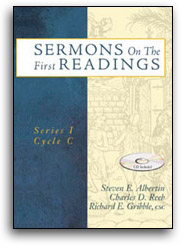
Sermons On The First Readings
Series I, Cycle C
In his book The Mustard Seed Conspiracy, Tom Sine shares the story of his parents' friends and their love for gathering wild mushrooms. One weekend this couple came home with several baskets of mushrooms. Realizing the impossibility of being able to consume all the mushrooms by themselves, they decided to invite others over to their house for a mushroom party. The turn-out was terrific, and they had a wonderful time eating mushroom crepes, omelets, and soufflés. They ate until they could not eat another bite and then scraped the leftover mushrooms into the cat's dish.
Around midnight, as the guests were getting ready to leave, someone went into the kitchen and noticed the cat sprawled out on the floor in convulsions. Next to the cat was an overturned dish of mushrooms. The guest screamed, "The cat!" Everyone ran into the kitchen to see what was causing all the commotion and, after seeing the cat, decided to call the doctor, fearing they would meet the same doom. The doctor informed them that they should not take any chances and should immediately drive to the hospital to get their stomachs pumped.
About 1:30 in the morning, they dragged back into the host's house to get their belongings. They were sick and exhausted. As they sarcastically thanked the hostess and made their way to the front door, someone asked, "What happened to the cat?" The group tip-toed to the kitchen, quietly opened the door, and found the cat asleep on the floor ... with eight kittens.1
At times, it is difficult to distinguish between dying and giving birth. You would think it would be easy to tell the difference. However, experience shows us that the distance between death and birth is not very far. The unavoidable truth is that death must precede birth. Experiencing something new, even when it is positive, can be as painful as dying. Just listen to newborns scream as they make their miraculous move from the familiar womb into a foreign world. Ask a teenager how painful it is to move away and be separated from old friends. Ask a recent graduate how difficult it is to leave college and enter a new world of responsibility. Ask a couple how challenging it is to leave a self-centered life in order to raise a child. The truth is that all of us must die in order to give birth to something new. A bad habit must die to provide room for a good one. Certain ways of thinking must change in order to get the desired action. A place of comfort must be left in order to move to a healthier one. All such radical changes must occur in order for something new to be born.
Given the truth of death before birth, we should not be surprised by Isaiah's description of doom in the middle of chapter 43. For Second Isaiah describes a birthing process that begins with remarkable death and destruction. The sea is split in two. Armies, warriors, and the horses and chariots they came in on are disintegrated, and we are commanded to erase from our minds any memories of the past, killing any thoughts of the glory days. It appears that God is finally fed up with the world and is initiating some sort of holocaust to wipe everything out. But all of this death and destruction is prelude to God's creation of something new.
It would seem that destruction would defeat the virtue of creation. Perhaps we ask, "Is this the only way for God to create something new?" And Isaiah rises up from this text and shouts, "Yes!" For Isaiah vividly explains for us that what God is up against demands a permanent eradication. It was literally the sea, warriors, armies, chariots, and horses which had kept the people of God in bondage. But today these oppressive images represent all the things in our lives and in our world which keep us in bondage. The sea of indifference drowns much of the compassion in this world. The warriors of sin come and seize and destroy that which brings life. The chariots of evil trample over God-inspired dreams. Armies of hate march right into our hearts and claim ownership of the deepest part of us. Memories, at times, are like an impenetrable wall towering between who we are and who God has called us to be. Therefore, when God creates change, it is more like surgery than a "Flintstone" band-aid. Tumors must be extracted before healing can take place. If left alone, they will grow, unchecked, to life-threatening proportions. The fatal nature of our bondage demands nothing less than divine surgery to make us whole.
However, God's revolution is not what most of us expect. For God's revolution does not involve weapons, a consuming fire, or even a rod of lightning. It does not involve divine wrath obliterating the wicked and lifting up the righteous. In fact, God's action against our chains of bondage involves no outward force whatsoever. God's force is symbolized with three things: a tree, some nails, and sacrifice. God used them to conquer sin, bondage, and death, because used together they epitomized sacrificial love. The incredible irony is that instead of allowing us to die in our sin, God in Christ lovingly decided to die on a tree with our sin. As the fatal bullet of sin raced towards us, God put skin on, and in sacrificial love jumped in front of us and took the blistering bullet for us.
God's one desire for us is that we allow our sins to die in him. Do you remember what Paul said? "How can we who died to sin go on living in it? Do you not know that all of us who have been baptized into Christ Jesus were baptized into his death?" (Romans 6:2-3). In short, Saint Paul is saying, "You must die in order to live!" For the cause of death, which is sin, must die in order for the source of life, who is God, to live within us. Just as Christ died to redeem the world, so we must die to our sins in Christ in order to become a new creation.
It is difficult to swallow such bitter-tasting truth. We live in a world that likes to be inclusive. We don't like to give up what we want in order to have what we need. After all, who says you cannot have your cake and eat it too? But bondage cannot co-exist with freedom, especially the freedom which God desires to initiate in our lives. The gifted writer Urban T. Holmes III makes this clear for us:
Any good gardener knows that beautiful roses require careful pruning. Pieces of living plant have to die. It cannot just grow wild. [Likewise] pieces of us ... need to die if we are to become the person that is in God's vision.2
If this is really what it takes to experience something new, most of us would rather settle for the way things are. We may be aware of our sinful habits and unhealthy lifestyle, but we are comfortable and don't want to give anything up. Therefore, we plant our feet against the threshold of death and go kicking and screaming into change, even when it is for our own good.
Barbara Brown Taylor remembers the time she witnessed a protest to death. She was attending an Easter Vigil at Christ Church in New Haven, Connecticut, and the time came for a three-year-old named Ellen to be baptized. Nothing unusual about it except that the three-year-old's parents wanted her to be baptized by immersion. This is a problem with a church which only has a birdbath baptismal font. Still, the priest agreed and came up with a 36-gallon garbage can decorated with ivy. It was not pretty, but it suited the purpose. When the priest bent down to pick Ellen up, she screamed, "Don't do it!" She planted her feet against the garbage can, causing the water to spill on the floor. Again, she screamed, "Don't do it!" Taylor does not remember whether or not Ellen did it, but she can still hear that child's protest ringing through the rafters of the church. Though only three years old, Ellen believed she would die and wanted no part of it.3
All of us resonate with those three words: "Don't do it!" We express them in one way or another. When we feel God leading us to leave sin behind, we shout, "I don't want to do it!" When we hear God calling us out of our comfort zones, we scream, "I don't want to do it!" When we feel God pulling us away from our past, we hang on with tooth and nail and scream, "I won't do it!" Most of us go kicking and screaming into redemptive change. Ironically, we favor bondage over freedom. We feel more at home in Egypt than the Promised Land!
Yet every human being must choose between two deaths. We can die in our sin, or allow our sin to die. One is a horrific death, the other is a glorious one. If we are honest with ourselves and search the depths of our being, I believe we would all find a homesickness which yearns for the glorious death which leads to genuine freedom. The poet Louisa Tarkington expresses this yearning:
I wish there was some wonderful place;
In the Land of beginning again;
Where all our mistakes and all our heartaches;
And all of our poor selfish grief;
Could be dropped like a shabby old coat at the door;
And never put on again!4
There is a wonderful place to begin again: at the foot of the cross. Jesus says, "You can begin again. For I have died for all your shameful stuff. All you have to do is relinquish those seething and suffocating sins, and I will nail them to me on the cross and make sure they never have dominion over you again. Come and die to your old self and experience a new beginning. Come and die to sin and move from darkness to light. Come and die and receive the new life which only I can give to you."
When the Impressionist Movement emerged, the traditional artists were appalled. They were upset with how and where the Impressionists painted natural light. Until the Impressionist Movement, artists had painted indoors, never looking at an outside scene. But the Impressionists came along and began painting outside, and the result was a richer perspective of what they were painting. And so, because of people like Monet and Cezanne, who were willing to begin something new, to come out from the inside, to come out of the darkness and into the light, we are able to experience a beauty beyond words.
It is difficult for us to come out from the inside. We are more comfortable in the dark, in our sins, in our past. It is easier to stay inside our doors of shame and only daydream about what life would be like outside the door. But what would happen if we would open the door and experience the light of a new beginning? What would happen if we were willing to come out of the darkness and see the beauty of God's light reflecting on the canvas of our souls? What would happen? I know. God would come to us in Christ and gently take off our old, shabby, dirty, ugly coat and say, "Bring to me the family robe of righteousness, for my child has come home." All we have to do is shed our sin and claim our inheritance as children of God!
A beggar sat every day on a street corner across from an art studio. For days, an artist had seen him and decided to paint his portrait. When the artist completed the portrait, he invited the beggar into the studio. The artist said, "I've got something I want you to see."
Inside the studio, the artist unveiled the portrait. At first, the beggar did not recognize himself. He kept saying, "Who is it?" The artist just smiled and said nothing. Then suddenly the man saw himself in the portrait -- not as he was in his dejected state, but as he could be. Then the beggar asked, "Is that me? Is that really me?" The artist replied, "That's who I see in you." Then the beggar said, "If that's who you see in me, then that's who I'll be."5 Have you ever wondered who God sees in you?
God wants to do something new with you. Do you not perceive it? It springs forth, where the screaming jackals of your nature are silenced. Do you not perceive it? Your sins being forgiven. Do you not perceive it? A life free from bondage. Do you not perceive it? God's refreshing Spirit quenching every dry, deserted corner of your soul. Do you not perceive it? A beautiful death birthing a life of love, joy, peace, and hope. Do you not perceive it? Come and die an invigorating death. Your life is waiting.
____________
1. Tom Sine, The Mustard Seed Conspiracy (Waco, Texas: Word Books, 1981), pp. 15-16.
2. Quoted in A Guide to Prayer: For Ministers and Other Servants, ed. by Rueben P. Job and Norman Shawchuck (Nashville: The Upper Room, 1983), p. 203.
3. Barbara Brown Taylor, God in Pain: Teaching Sermons on Suffering (Nashville: Abingdon Press, 1998), p. 49.
4. Exact source unknown.
5. David C. Cooper, The Seven Spiritual Laws of Success (Atlanta: Discover Life Ministries, 2000), pp. 102-103. Used by permission.
Around midnight, as the guests were getting ready to leave, someone went into the kitchen and noticed the cat sprawled out on the floor in convulsions. Next to the cat was an overturned dish of mushrooms. The guest screamed, "The cat!" Everyone ran into the kitchen to see what was causing all the commotion and, after seeing the cat, decided to call the doctor, fearing they would meet the same doom. The doctor informed them that they should not take any chances and should immediately drive to the hospital to get their stomachs pumped.
About 1:30 in the morning, they dragged back into the host's house to get their belongings. They were sick and exhausted. As they sarcastically thanked the hostess and made their way to the front door, someone asked, "What happened to the cat?" The group tip-toed to the kitchen, quietly opened the door, and found the cat asleep on the floor ... with eight kittens.1
At times, it is difficult to distinguish between dying and giving birth. You would think it would be easy to tell the difference. However, experience shows us that the distance between death and birth is not very far. The unavoidable truth is that death must precede birth. Experiencing something new, even when it is positive, can be as painful as dying. Just listen to newborns scream as they make their miraculous move from the familiar womb into a foreign world. Ask a teenager how painful it is to move away and be separated from old friends. Ask a recent graduate how difficult it is to leave college and enter a new world of responsibility. Ask a couple how challenging it is to leave a self-centered life in order to raise a child. The truth is that all of us must die in order to give birth to something new. A bad habit must die to provide room for a good one. Certain ways of thinking must change in order to get the desired action. A place of comfort must be left in order to move to a healthier one. All such radical changes must occur in order for something new to be born.
Given the truth of death before birth, we should not be surprised by Isaiah's description of doom in the middle of chapter 43. For Second Isaiah describes a birthing process that begins with remarkable death and destruction. The sea is split in two. Armies, warriors, and the horses and chariots they came in on are disintegrated, and we are commanded to erase from our minds any memories of the past, killing any thoughts of the glory days. It appears that God is finally fed up with the world and is initiating some sort of holocaust to wipe everything out. But all of this death and destruction is prelude to God's creation of something new.
It would seem that destruction would defeat the virtue of creation. Perhaps we ask, "Is this the only way for God to create something new?" And Isaiah rises up from this text and shouts, "Yes!" For Isaiah vividly explains for us that what God is up against demands a permanent eradication. It was literally the sea, warriors, armies, chariots, and horses which had kept the people of God in bondage. But today these oppressive images represent all the things in our lives and in our world which keep us in bondage. The sea of indifference drowns much of the compassion in this world. The warriors of sin come and seize and destroy that which brings life. The chariots of evil trample over God-inspired dreams. Armies of hate march right into our hearts and claim ownership of the deepest part of us. Memories, at times, are like an impenetrable wall towering between who we are and who God has called us to be. Therefore, when God creates change, it is more like surgery than a "Flintstone" band-aid. Tumors must be extracted before healing can take place. If left alone, they will grow, unchecked, to life-threatening proportions. The fatal nature of our bondage demands nothing less than divine surgery to make us whole.
However, God's revolution is not what most of us expect. For God's revolution does not involve weapons, a consuming fire, or even a rod of lightning. It does not involve divine wrath obliterating the wicked and lifting up the righteous. In fact, God's action against our chains of bondage involves no outward force whatsoever. God's force is symbolized with three things: a tree, some nails, and sacrifice. God used them to conquer sin, bondage, and death, because used together they epitomized sacrificial love. The incredible irony is that instead of allowing us to die in our sin, God in Christ lovingly decided to die on a tree with our sin. As the fatal bullet of sin raced towards us, God put skin on, and in sacrificial love jumped in front of us and took the blistering bullet for us.
God's one desire for us is that we allow our sins to die in him. Do you remember what Paul said? "How can we who died to sin go on living in it? Do you not know that all of us who have been baptized into Christ Jesus were baptized into his death?" (Romans 6:2-3). In short, Saint Paul is saying, "You must die in order to live!" For the cause of death, which is sin, must die in order for the source of life, who is God, to live within us. Just as Christ died to redeem the world, so we must die to our sins in Christ in order to become a new creation.
It is difficult to swallow such bitter-tasting truth. We live in a world that likes to be inclusive. We don't like to give up what we want in order to have what we need. After all, who says you cannot have your cake and eat it too? But bondage cannot co-exist with freedom, especially the freedom which God desires to initiate in our lives. The gifted writer Urban T. Holmes III makes this clear for us:
Any good gardener knows that beautiful roses require careful pruning. Pieces of living plant have to die. It cannot just grow wild. [Likewise] pieces of us ... need to die if we are to become the person that is in God's vision.2
If this is really what it takes to experience something new, most of us would rather settle for the way things are. We may be aware of our sinful habits and unhealthy lifestyle, but we are comfortable and don't want to give anything up. Therefore, we plant our feet against the threshold of death and go kicking and screaming into change, even when it is for our own good.
Barbara Brown Taylor remembers the time she witnessed a protest to death. She was attending an Easter Vigil at Christ Church in New Haven, Connecticut, and the time came for a three-year-old named Ellen to be baptized. Nothing unusual about it except that the three-year-old's parents wanted her to be baptized by immersion. This is a problem with a church which only has a birdbath baptismal font. Still, the priest agreed and came up with a 36-gallon garbage can decorated with ivy. It was not pretty, but it suited the purpose. When the priest bent down to pick Ellen up, she screamed, "Don't do it!" She planted her feet against the garbage can, causing the water to spill on the floor. Again, she screamed, "Don't do it!" Taylor does not remember whether or not Ellen did it, but she can still hear that child's protest ringing through the rafters of the church. Though only three years old, Ellen believed she would die and wanted no part of it.3
All of us resonate with those three words: "Don't do it!" We express them in one way or another. When we feel God leading us to leave sin behind, we shout, "I don't want to do it!" When we hear God calling us out of our comfort zones, we scream, "I don't want to do it!" When we feel God pulling us away from our past, we hang on with tooth and nail and scream, "I won't do it!" Most of us go kicking and screaming into redemptive change. Ironically, we favor bondage over freedom. We feel more at home in Egypt than the Promised Land!
Yet every human being must choose between two deaths. We can die in our sin, or allow our sin to die. One is a horrific death, the other is a glorious one. If we are honest with ourselves and search the depths of our being, I believe we would all find a homesickness which yearns for the glorious death which leads to genuine freedom. The poet Louisa Tarkington expresses this yearning:
I wish there was some wonderful place;
In the Land of beginning again;
Where all our mistakes and all our heartaches;
And all of our poor selfish grief;
Could be dropped like a shabby old coat at the door;
And never put on again!4
There is a wonderful place to begin again: at the foot of the cross. Jesus says, "You can begin again. For I have died for all your shameful stuff. All you have to do is relinquish those seething and suffocating sins, and I will nail them to me on the cross and make sure they never have dominion over you again. Come and die to your old self and experience a new beginning. Come and die to sin and move from darkness to light. Come and die and receive the new life which only I can give to you."
When the Impressionist Movement emerged, the traditional artists were appalled. They were upset with how and where the Impressionists painted natural light. Until the Impressionist Movement, artists had painted indoors, never looking at an outside scene. But the Impressionists came along and began painting outside, and the result was a richer perspective of what they were painting. And so, because of people like Monet and Cezanne, who were willing to begin something new, to come out from the inside, to come out of the darkness and into the light, we are able to experience a beauty beyond words.
It is difficult for us to come out from the inside. We are more comfortable in the dark, in our sins, in our past. It is easier to stay inside our doors of shame and only daydream about what life would be like outside the door. But what would happen if we would open the door and experience the light of a new beginning? What would happen if we were willing to come out of the darkness and see the beauty of God's light reflecting on the canvas of our souls? What would happen? I know. God would come to us in Christ and gently take off our old, shabby, dirty, ugly coat and say, "Bring to me the family robe of righteousness, for my child has come home." All we have to do is shed our sin and claim our inheritance as children of God!
A beggar sat every day on a street corner across from an art studio. For days, an artist had seen him and decided to paint his portrait. When the artist completed the portrait, he invited the beggar into the studio. The artist said, "I've got something I want you to see."
Inside the studio, the artist unveiled the portrait. At first, the beggar did not recognize himself. He kept saying, "Who is it?" The artist just smiled and said nothing. Then suddenly the man saw himself in the portrait -- not as he was in his dejected state, but as he could be. Then the beggar asked, "Is that me? Is that really me?" The artist replied, "That's who I see in you." Then the beggar said, "If that's who you see in me, then that's who I'll be."5 Have you ever wondered who God sees in you?
God wants to do something new with you. Do you not perceive it? It springs forth, where the screaming jackals of your nature are silenced. Do you not perceive it? Your sins being forgiven. Do you not perceive it? A life free from bondage. Do you not perceive it? God's refreshing Spirit quenching every dry, deserted corner of your soul. Do you not perceive it? A beautiful death birthing a life of love, joy, peace, and hope. Do you not perceive it? Come and die an invigorating death. Your life is waiting.
____________
1. Tom Sine, The Mustard Seed Conspiracy (Waco, Texas: Word Books, 1981), pp. 15-16.
2. Quoted in A Guide to Prayer: For Ministers and Other Servants, ed. by Rueben P. Job and Norman Shawchuck (Nashville: The Upper Room, 1983), p. 203.
3. Barbara Brown Taylor, God in Pain: Teaching Sermons on Suffering (Nashville: Abingdon Press, 1998), p. 49.
4. Exact source unknown.
5. David C. Cooper, The Seven Spiritual Laws of Success (Atlanta: Discover Life Ministries, 2000), pp. 102-103. Used by permission.
