
Easter 3
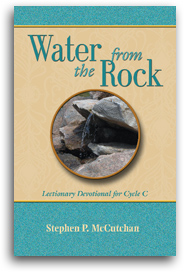
Devotional
Water From the Rock
Lectionary Devotional for Cycle C
Object:
Worthy is the Lamb that was slaughtered to receive power and wealth and wisdom and might and honor and glory and blessing!
-- Revelation 5:12b
The history of the violent fringe of the church indicates the extreme difficulty for even the church, let alone the nations, to receive the truth of this passage. The context is John's vision of the scroll that contained God's secret plan for the unfolding of the kingdom of God on earth. This was the scroll that unveiled the future and tells us how it will all turn out. The problem for John was that at first no one was able to open the scroll so that he could see it. When he was about to give up in despair, an elder said to him, "Do not weep. See, the Lion of the tribe of Judah, the Root of David, has conquered, so that he can open the scroll and its seven seals" (Revelation 5:5). Here was the image of the militant messiah that believers had longed for. The world was convinced that history was controlled by the powerful and that only the conquering messiah could overcome evil in this world. But then came the surprise.
The lion of Judah was celebrated as the Lamb that was slaughtered. The one who was able to open up the future was the one who was willing to sacrifice himself for the sake of the world. This same Christ that Matthew recorded as being able to call upon God to bring twelve legions of angels to his rescue if necessary (Matthew 26:53), chose instead to willingly go to the cross. The future would unfold not in the hands of those who sought to use force but to those who recognized the power of sacrificial love. The early Christians lived out this truth in their life together. In a world that often excluded the diseased and crippled out of fear, they went willingly into the streets to minister to them. In a world that sought to control the world through achieving status, they lived an equality that overcame the divisions of the world. They faced down an empire that used the fear of death, even crucifixion, to control the populace by being unafraid to offer their lives on behalf of others.
It is a haunting challenge to the church that often is seduced into measuring its worth by its size and strength, to realize that the most powerful witness of the church throughout history has been a witness in which God's power was made perfect in our weakness (2 Corinthians 12:9).
-- Revelation 5:12b
The history of the violent fringe of the church indicates the extreme difficulty for even the church, let alone the nations, to receive the truth of this passage. The context is John's vision of the scroll that contained God's secret plan for the unfolding of the kingdom of God on earth. This was the scroll that unveiled the future and tells us how it will all turn out. The problem for John was that at first no one was able to open the scroll so that he could see it. When he was about to give up in despair, an elder said to him, "Do not weep. See, the Lion of the tribe of Judah, the Root of David, has conquered, so that he can open the scroll and its seven seals" (Revelation 5:5). Here was the image of the militant messiah that believers had longed for. The world was convinced that history was controlled by the powerful and that only the conquering messiah could overcome evil in this world. But then came the surprise.
The lion of Judah was celebrated as the Lamb that was slaughtered. The one who was able to open up the future was the one who was willing to sacrifice himself for the sake of the world. This same Christ that Matthew recorded as being able to call upon God to bring twelve legions of angels to his rescue if necessary (Matthew 26:53), chose instead to willingly go to the cross. The future would unfold not in the hands of those who sought to use force but to those who recognized the power of sacrificial love. The early Christians lived out this truth in their life together. In a world that often excluded the diseased and crippled out of fear, they went willingly into the streets to minister to them. In a world that sought to control the world through achieving status, they lived an equality that overcame the divisions of the world. They faced down an empire that used the fear of death, even crucifixion, to control the populace by being unafraid to offer their lives on behalf of others.
It is a haunting challenge to the church that often is seduced into measuring its worth by its size and strength, to realize that the most powerful witness of the church throughout history has been a witness in which God's power was made perfect in our weakness (2 Corinthians 12:9).
