
Easter 3
Preaching
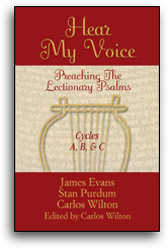
Hear My Voice
Preaching The Lectionary Psalms for Cycles A, B, C
(See Maundy Thursday, Cycle A, and Maundy Thursday, Cycle B, for alternative approaches to vv. 1-2, 12-19.)
Classed as a song of thanksgiving, Psalm 116 both celebrates God's answer to the psalmist's prayers for help (vv. 1-2) and declares the psalmist's intention to now go to the temple and "return to the Lord" those things the psalmist had promised while praying the prayers (vv. 12-14). Admittedly that does give a bit of a quid pro quo feel to the psalm, but the psalmist can hardly be faulted for following through on what he had promised to do.
In the Greek and Latin Bibles, this psalm is divided into two, with verses 1-9 comprising Psalm 114 and 10-19 being Psalm 115, but the bargaining plot suggested above does give a unity to the whole passage. The Revised Common Lectionary cut of the psalm to verses 1-4 and 12-19 at least avoids the necessity of dealing with the difficult verse 11, "I said in my consternation, 'Everyone is a liar.' "
Some sermonic directions:
1. These same verses, minus 3 and 4, make up the responsorial psalm for Maundy Thursday. Although that is not our focus here, the psalmist's intention to "lift up the cup of salvation" is certainly an appropriate starting point for any communion sermon. It should be noted, of course, that as an Old Testament text, the cup here may have referred to one of those used in the Passover observance. Still, appropriated for the Eucharist, does not the cup become emblematic of our salvation, of the blood, "shed for you"?
2. Verse 15, "Precious in the sight of the Lord is the death of his faithful ones," deserves some attention. Some read the Hebrew word behind "precious" as "peculiar," as if the death of a faithful one were a unique event, something out of the ordinary. This suggests perhaps that long life was the normal expectation for the righteous, which is a concept that does not wear well today. But others read the word as "costly," denoting that when a righteous person dies, God loses something. The deceased's praise is silenced and his or her witness to the living is no more. What indeed does it cost God when a faithful mortal passes from this world? Maybe it is a help for the grieving to know that their loved one's death grieves God, too.
3. Vows (vv. 14, 18) provide a good opportunity to preach about promise-keeping, but the idea needs to be larger than those promises literally called "vows," as in the marriage or baptismal promises. The righteous life simply cannot exist on any level without an intentional effort to live by promises made.
4. Verse 16, where the psalmist refers to himself as the child of "your serving girl," may have simply been a stock phrase meaning something like, "your trusted servant," but may also have reference to devoutness of the psalmist's mother. Here is a good chance to talk about the influence of upbringing on one's faith -- although it should be pointed out that a simple claim to having a godly parent does not excuse one from the personal spiritual quest. God has children, it is said, but no grandchildren.
-- S. P.
Classed as a song of thanksgiving, Psalm 116 both celebrates God's answer to the psalmist's prayers for help (vv. 1-2) and declares the psalmist's intention to now go to the temple and "return to the Lord" those things the psalmist had promised while praying the prayers (vv. 12-14). Admittedly that does give a bit of a quid pro quo feel to the psalm, but the psalmist can hardly be faulted for following through on what he had promised to do.
In the Greek and Latin Bibles, this psalm is divided into two, with verses 1-9 comprising Psalm 114 and 10-19 being Psalm 115, but the bargaining plot suggested above does give a unity to the whole passage. The Revised Common Lectionary cut of the psalm to verses 1-4 and 12-19 at least avoids the necessity of dealing with the difficult verse 11, "I said in my consternation, 'Everyone is a liar.' "
Some sermonic directions:
1. These same verses, minus 3 and 4, make up the responsorial psalm for Maundy Thursday. Although that is not our focus here, the psalmist's intention to "lift up the cup of salvation" is certainly an appropriate starting point for any communion sermon. It should be noted, of course, that as an Old Testament text, the cup here may have referred to one of those used in the Passover observance. Still, appropriated for the Eucharist, does not the cup become emblematic of our salvation, of the blood, "shed for you"?
2. Verse 15, "Precious in the sight of the Lord is the death of his faithful ones," deserves some attention. Some read the Hebrew word behind "precious" as "peculiar," as if the death of a faithful one were a unique event, something out of the ordinary. This suggests perhaps that long life was the normal expectation for the righteous, which is a concept that does not wear well today. But others read the word as "costly," denoting that when a righteous person dies, God loses something. The deceased's praise is silenced and his or her witness to the living is no more. What indeed does it cost God when a faithful mortal passes from this world? Maybe it is a help for the grieving to know that their loved one's death grieves God, too.
3. Vows (vv. 14, 18) provide a good opportunity to preach about promise-keeping, but the idea needs to be larger than those promises literally called "vows," as in the marriage or baptismal promises. The righteous life simply cannot exist on any level without an intentional effort to live by promises made.
4. Verse 16, where the psalmist refers to himself as the child of "your serving girl," may have simply been a stock phrase meaning something like, "your trusted servant," but may also have reference to devoutness of the psalmist's mother. Here is a good chance to talk about the influence of upbringing on one's faith -- although it should be pointed out that a simple claim to having a godly parent does not excuse one from the personal spiritual quest. God has children, it is said, but no grandchildren.
-- S. P.
