
Easter 7
Preaching
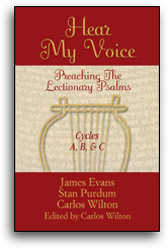
Hear My Voice
Preaching The Lectionary Psalms for Cycles A, B, C
Object:
Psalm 1 has long been considered as a possible prologue to the rest of the psalter. In fact, in several ancient Hebrew manuscripts, this psalm is not numbered as are the others in the collection. The content of the psalm also has something of a "foreword" quality about it. Many of the themes that are developed at length in the rest of the psalms are touched upon in this first one.
As for type, Psalm 1 belongs to a group of poems referred to by scholars as "wisdom psalms." These psalms adopt an instructional tone and seek to encourage obedience to God's Law, the Torah.
The psalm begins with a blessing on those who "do not follow the advice of the wicked." These blessed ones do not stand in the path of sinners nor linger near the dwelling place of scorners. All of these images -- lingering, standing, dwelling -- are metaphors for learning. The blessed ones have one source for their wisdom: God's Law.
A life lived in commitment to God's truth results in a stable and vital existence. The psalmist compares this existence to a tree that is planted near a sustaining source of water. The tree lives and flourishes because it is rooted near the source of its nourishment.
Those the psalmist identifies as "the wicked" have exactly the opposite life experiences. They are unstable in all their ways. Instead of being like trees nourished by God's truth, the wicked are like the dry chaff that is left after the grain has been removed from a stalk of wheat. So light and airy are these chaff-like people that even the slightest breeze can blow them away.
There are many possible applications of the principles of this psalm. Our culture's preoccupation with wealth, power, and success offer a stark contrast to the simple virtue suggested by the psalm.
The issue of where these values come from is also critiqued by this psalm. What is the water that feeds our souls? Do we dip from the well of greed, or are we refreshed and made strong by the moving water of God's truth? Like the strong tree in the psalm, a faithful life is rooted in serving others. The quest for glory and honor is a fickle dream that is easily blown away with a passing wind.
The psalmist brings the poem to a close, making explicit what was implied in the opening line: The Lord watches over the righteous while the wicked perish. It is not necessary to resort to eschatology to interpret the meaning of this idea. There is a practical truth revealed here that does not require end-time scenarios to understand.
In general terms, those who seek to live meaningful lives of industry and generosity can expect to find great satisfaction in life. This does not mean they will never fall or experience disappointment. It does mean that when those situations do occur, the same resources that fill life with meaning in ordinary times will help them get through the extraordinary.
On the other hand, those whose lives are marked by poor choices and bad habits often find themselves miserable. This happens all along the socioeconomic scale. These people struggle with daily normalcy, and really struggle when something unexpected happens. God does not have to throw them down; the decisions they make and the values they follow often carry their own sorrow with them.
-- J. E.
As for type, Psalm 1 belongs to a group of poems referred to by scholars as "wisdom psalms." These psalms adopt an instructional tone and seek to encourage obedience to God's Law, the Torah.
The psalm begins with a blessing on those who "do not follow the advice of the wicked." These blessed ones do not stand in the path of sinners nor linger near the dwelling place of scorners. All of these images -- lingering, standing, dwelling -- are metaphors for learning. The blessed ones have one source for their wisdom: God's Law.
A life lived in commitment to God's truth results in a stable and vital existence. The psalmist compares this existence to a tree that is planted near a sustaining source of water. The tree lives and flourishes because it is rooted near the source of its nourishment.
Those the psalmist identifies as "the wicked" have exactly the opposite life experiences. They are unstable in all their ways. Instead of being like trees nourished by God's truth, the wicked are like the dry chaff that is left after the grain has been removed from a stalk of wheat. So light and airy are these chaff-like people that even the slightest breeze can blow them away.
There are many possible applications of the principles of this psalm. Our culture's preoccupation with wealth, power, and success offer a stark contrast to the simple virtue suggested by the psalm.
The issue of where these values come from is also critiqued by this psalm. What is the water that feeds our souls? Do we dip from the well of greed, or are we refreshed and made strong by the moving water of God's truth? Like the strong tree in the psalm, a faithful life is rooted in serving others. The quest for glory and honor is a fickle dream that is easily blown away with a passing wind.
The psalmist brings the poem to a close, making explicit what was implied in the opening line: The Lord watches over the righteous while the wicked perish. It is not necessary to resort to eschatology to interpret the meaning of this idea. There is a practical truth revealed here that does not require end-time scenarios to understand.
In general terms, those who seek to live meaningful lives of industry and generosity can expect to find great satisfaction in life. This does not mean they will never fall or experience disappointment. It does mean that when those situations do occur, the same resources that fill life with meaning in ordinary times will help them get through the extraordinary.
On the other hand, those whose lives are marked by poor choices and bad habits often find themselves miserable. This happens all along the socioeconomic scale. These people struggle with daily normalcy, and really struggle when something unexpected happens. God does not have to throw them down; the decisions they make and the values they follow often carry their own sorrow with them.
-- J. E.
