
Epiphany 4
Devotional
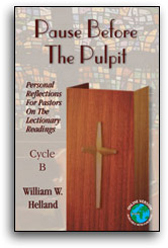
Pause Before The Pulpit
Personal Reflections For Pastors On The Lectionary Readings
Mark 1:21-28
Do you find it difficult to preach with authority? If so, you are not alone. Many pastors do. Some are timid in their preaching because they are not fully convinced of what they are preaching. If we lack conviction and passion for what we are preaching, it will be evident to those who are listening.
Some pastors find it hard to preach with authority because they are afraid of people. They know there are issues that should be addressed, such as lying, gossip, adultery, and so on, but they are afraid of offending the big givers, or the visitors who could be potential members, or their church leaders who have cautioned them to avoid certain topics. How sad!
Some pastors find it hard to preach with authority because they've embraced the political correctness and relativism of today's culture. They truly believe it is better to withhold the truth of God's Word than run the risk of offending any one individual or group of people. In some cases they believe that all truth is relative. Much of God's Word is true for them, but they don't want to offend those who disagree, so they avoid preaching it as universal truth for all people. Again, how sad, for in so doing, the authority of God's Word has been smothered and the proclamation of it has no power, rendering it basically useless. Perhaps this is why the thirty-minute sermon, which was more common in the past, has been reduced to a mere homily that often is little more than a nice story.
This Gospel Lesson helps us understand why Jesus spoke with authority, what the effect of that preaching was, and why it is so important for us to preach with authority as well.
First of all, notice that Jesus spoke with authority because he was (and is) the Son of God. It took a man with an unclean spirit to point that out! What a tragedy. Not even the scribes recognized who Jesus was, and they were regarded as the upholders of truth! Jesus also spoke with authority because nobody else did. The scribes were merely teaching people their traditions and passing on stories. They were telling the people what they wanted to hear instead of what they needed to hear. Jesus was not going to stand idly by when there were truths that needed to be spoken, and spoken with authority, lest the people perish.
The effect of his authoritative preaching was amazing! First of all, it stirred up an unclean spirit. This spirit was afraid, for suddenly someone posed a threat to him. Dear friends, think about it. What a sad state of spiritual affairs, when the preaching is so weak and pathetic in our churches that the unclean spirits are not even threatened or challenged! Could that be happening today? It surely could be.
In addition to the spirit's reaction, there was the reaction of the people who were listening. We read that the people were astounded and amazed at his teaching. When was the last time people filed out of your church astounded and amazed at the authority with which you spoke? If anything, some are amazed that more people didn't fall asleep! This goes for me, too. I grieve over my own failure to stir people's hearts with God's Word. Most certainly the stirring of the heart is a work of the Holy Spirit, and God can do that with a less-gifted preacher as well as he can with a dynamic one, for the Word of God has an authority all its own. However, when we preach it boldly, with conviction and passion that were first stirred deep within our own hearts, and preach it as well as we know how with the gifts God has given us, things are going to happen. Unclean spirits will be threatened, people will be amazed, some will come to faith in Christ, others might leave and never come back, but all in all, God will be glorified and people will be changed.
Remember, Jesus' fame wasn't all glorious popularity and back-slapping. Some of it was outright hatred and death threats. Hopefully none of us experience that, but we shouldn't let the risk of unpopularity keep us from preaching with Christ's authority. So let's preach God's Word the best we can for his honor and glory.
A Pastor's Prayer:
Dear Lord,
You know what keeps me from preaching with authority. Please forgive me for when I have failed you in this way. Give me a deep conviction and passion for the truths of your word and boldness to preach them with authority to all who listen. Thank you. Amen.
1 Corinthians 8:1-13
Deep convictions, based on wrong or faulty information, have split many churches over the years. In this text, the Apostle Paul was addressing a very real issue for the Corinthian Christians, which was threatening to divide them. On one side of the issue were those people who were adamantly opposed to eating food that had been offered to idols. On the other side of the issue were those (including Paul) who believed it wasn't wrong to eat this food, for no idol in the world really exists, and therefore they believed the food was acceptable to eat.
However, Paul knew that simply defending his position was not going to make the issue go away. In addition to trying to help people be better informed about the reality of the issue, Paul knew that sensitivity toward the convictions of others must be exercised or they could be harmed spiritually.
In our churches today we face issues all the time that people strongly disagree on. We, as well, have our own convictions on some of these issues, like Paul did. To make matters worse, people often want us to choose sides, but this is dangerous and can severely damage our effectiveness as a pastor. I'm speaking now, of course, about those "gray" areas that Christians disagree on -- issues that are not clearly spelled out in scripture.
During my childhood, I was raised in a pietistic home that had very strict guidelines about what could or could not be done, and what would or would not come into our home. The television was regarded to be about as pagan as food offered to idols. In other words, there would never be a television in our home, and we were seldom allowed to go to the homes of friends (or even cousins) that had televisions. Granted, there is little on television that is of much mental and spiritual value, but the programming of the sixties was a whole lot better than it is today!
When I came to the realization that I was not putting my salvation in jeopardy by having a television, I adopted a different set of convictions, based on new and, I believe, more accurate information. However, from time to time, I come across people who do not have a television in their home. Rather than criticize them for that or try to change their mind, I make sure I sympathize with their concerns and avoid putting them in an awkward position whereby they feel pressured to watch my television.
So the whole point of this text was not to settle, once and for all, what was right or wrong about eating food that had been offered to idols (or any other biblically unclear issue), but rather, what was the right way to relate to those who had different convictions. Paul pointed out one aspect of the answer in verse 1: Knowledge puffs up, but love builds up.
One of the mistakes many Christians make (pastors included) is to show off their knowledge and to insist that the knowledge they have, on any given controversial issue, is the best knowledge there is and therefore ought to be the final answer. I've been guilty of this, and when I have, I have pushed people away from me. I've seen others in the church do the same, and in so doing they have run people out of the church. It grieves me deeply, because these were issues that I (and others) could have held personally without imposing them on others. If we would have shown love and respect for them and their views, though they may have differed greatly from ours, we could have continued to worship and fellowship together. But because I, or someone else, insisted that we were right and everyone else was wrong, the "walls" went up and the relationships broke down.
Brothers and sisters in ministry, let us follow Paul's advice. Love builds up, so may we be quick to love and slow to judge. In addition to this, we will want to avoid eating, saying, or doing anything in the presence of others that would be a stumbling block to them, even though we are truly convinced God has given us freedom in that area.
A Pastor's Prayer:
Dear Lord,
Thank you for the freedom of the gospel that sets us free from legalism and observance to rules. Please show me if there is any area in my life where my thinking is wrong, due to faulty information, so that I may live fully in your freedom. Help me to be sensitive to what others believe and careful not to hinder their faith with my freedom. Amen.
Do you find it difficult to preach with authority? If so, you are not alone. Many pastors do. Some are timid in their preaching because they are not fully convinced of what they are preaching. If we lack conviction and passion for what we are preaching, it will be evident to those who are listening.
Some pastors find it hard to preach with authority because they are afraid of people. They know there are issues that should be addressed, such as lying, gossip, adultery, and so on, but they are afraid of offending the big givers, or the visitors who could be potential members, or their church leaders who have cautioned them to avoid certain topics. How sad!
Some pastors find it hard to preach with authority because they've embraced the political correctness and relativism of today's culture. They truly believe it is better to withhold the truth of God's Word than run the risk of offending any one individual or group of people. In some cases they believe that all truth is relative. Much of God's Word is true for them, but they don't want to offend those who disagree, so they avoid preaching it as universal truth for all people. Again, how sad, for in so doing, the authority of God's Word has been smothered and the proclamation of it has no power, rendering it basically useless. Perhaps this is why the thirty-minute sermon, which was more common in the past, has been reduced to a mere homily that often is little more than a nice story.
This Gospel Lesson helps us understand why Jesus spoke with authority, what the effect of that preaching was, and why it is so important for us to preach with authority as well.
First of all, notice that Jesus spoke with authority because he was (and is) the Son of God. It took a man with an unclean spirit to point that out! What a tragedy. Not even the scribes recognized who Jesus was, and they were regarded as the upholders of truth! Jesus also spoke with authority because nobody else did. The scribes were merely teaching people their traditions and passing on stories. They were telling the people what they wanted to hear instead of what they needed to hear. Jesus was not going to stand idly by when there were truths that needed to be spoken, and spoken with authority, lest the people perish.
The effect of his authoritative preaching was amazing! First of all, it stirred up an unclean spirit. This spirit was afraid, for suddenly someone posed a threat to him. Dear friends, think about it. What a sad state of spiritual affairs, when the preaching is so weak and pathetic in our churches that the unclean spirits are not even threatened or challenged! Could that be happening today? It surely could be.
In addition to the spirit's reaction, there was the reaction of the people who were listening. We read that the people were astounded and amazed at his teaching. When was the last time people filed out of your church astounded and amazed at the authority with which you spoke? If anything, some are amazed that more people didn't fall asleep! This goes for me, too. I grieve over my own failure to stir people's hearts with God's Word. Most certainly the stirring of the heart is a work of the Holy Spirit, and God can do that with a less-gifted preacher as well as he can with a dynamic one, for the Word of God has an authority all its own. However, when we preach it boldly, with conviction and passion that were first stirred deep within our own hearts, and preach it as well as we know how with the gifts God has given us, things are going to happen. Unclean spirits will be threatened, people will be amazed, some will come to faith in Christ, others might leave and never come back, but all in all, God will be glorified and people will be changed.
Remember, Jesus' fame wasn't all glorious popularity and back-slapping. Some of it was outright hatred and death threats. Hopefully none of us experience that, but we shouldn't let the risk of unpopularity keep us from preaching with Christ's authority. So let's preach God's Word the best we can for his honor and glory.
A Pastor's Prayer:
Dear Lord,
You know what keeps me from preaching with authority. Please forgive me for when I have failed you in this way. Give me a deep conviction and passion for the truths of your word and boldness to preach them with authority to all who listen. Thank you. Amen.
1 Corinthians 8:1-13
Deep convictions, based on wrong or faulty information, have split many churches over the years. In this text, the Apostle Paul was addressing a very real issue for the Corinthian Christians, which was threatening to divide them. On one side of the issue were those people who were adamantly opposed to eating food that had been offered to idols. On the other side of the issue were those (including Paul) who believed it wasn't wrong to eat this food, for no idol in the world really exists, and therefore they believed the food was acceptable to eat.
However, Paul knew that simply defending his position was not going to make the issue go away. In addition to trying to help people be better informed about the reality of the issue, Paul knew that sensitivity toward the convictions of others must be exercised or they could be harmed spiritually.
In our churches today we face issues all the time that people strongly disagree on. We, as well, have our own convictions on some of these issues, like Paul did. To make matters worse, people often want us to choose sides, but this is dangerous and can severely damage our effectiveness as a pastor. I'm speaking now, of course, about those "gray" areas that Christians disagree on -- issues that are not clearly spelled out in scripture.
During my childhood, I was raised in a pietistic home that had very strict guidelines about what could or could not be done, and what would or would not come into our home. The television was regarded to be about as pagan as food offered to idols. In other words, there would never be a television in our home, and we were seldom allowed to go to the homes of friends (or even cousins) that had televisions. Granted, there is little on television that is of much mental and spiritual value, but the programming of the sixties was a whole lot better than it is today!
When I came to the realization that I was not putting my salvation in jeopardy by having a television, I adopted a different set of convictions, based on new and, I believe, more accurate information. However, from time to time, I come across people who do not have a television in their home. Rather than criticize them for that or try to change their mind, I make sure I sympathize with their concerns and avoid putting them in an awkward position whereby they feel pressured to watch my television.
So the whole point of this text was not to settle, once and for all, what was right or wrong about eating food that had been offered to idols (or any other biblically unclear issue), but rather, what was the right way to relate to those who had different convictions. Paul pointed out one aspect of the answer in verse 1: Knowledge puffs up, but love builds up.
One of the mistakes many Christians make (pastors included) is to show off their knowledge and to insist that the knowledge they have, on any given controversial issue, is the best knowledge there is and therefore ought to be the final answer. I've been guilty of this, and when I have, I have pushed people away from me. I've seen others in the church do the same, and in so doing they have run people out of the church. It grieves me deeply, because these were issues that I (and others) could have held personally without imposing them on others. If we would have shown love and respect for them and their views, though they may have differed greatly from ours, we could have continued to worship and fellowship together. But because I, or someone else, insisted that we were right and everyone else was wrong, the "walls" went up and the relationships broke down.
Brothers and sisters in ministry, let us follow Paul's advice. Love builds up, so may we be quick to love and slow to judge. In addition to this, we will want to avoid eating, saying, or doing anything in the presence of others that would be a stumbling block to them, even though we are truly convinced God has given us freedom in that area.
A Pastor's Prayer:
Dear Lord,
Thank you for the freedom of the gospel that sets us free from legalism and observance to rules. Please show me if there is any area in my life where my thinking is wrong, due to faulty information, so that I may live fully in your freedom. Help me to be sensitive to what others believe and careful not to hinder their faith with my freedom. Amen.
