
Epiphany 4/Ordinary Time 4
Preaching
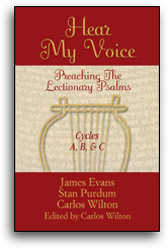
Hear My Voice
Preaching The Lectionary Psalms for Cycles A, B, C
"There's Jackson, standing like a stone wall." Those words, spoken at the First Battle of Bull Run (Manassas), secured the reputation of Confederate officer Thomas Jonathan Jackson. Forever after, he has been known as Stonewall Jackson -- the courageous general who could not be moved, even as the bullets whistled by him.
Jackson, a Presbyterian elder, was a man of deep personal piety. While some today may fault him for his choice of sides in the Civil War, he saw himself as defending his Virginia homeland against invaders. In Ted Turner's epic film, Gods and Generals, a fellow officer asks Jackson, following a battle, how he can remain so "serene" in the midst of the fray. "My religious belief," Jackson replies, "teaches me to feel as safe in battle as in bed. God has fixed the time for my death; I do not concern myself with that. But to be always ready, whenever it may overtake me -- that is the way all men should live. Then all men would be equally brave."
Psalm 15 concludes with these words: "Those who do these things shall never be moved." What things? We need to return to the early verses of the psalm to find out....
The question posed in verse 1 is: "O Lord, who may abide in your tent? Who may dwell on your holy hill?"
Those words refer to the tent of meeting, the temporary worship place of Israel -- that later, during the reign of King Solomon, would gain a permanent location as the temple (see 1 Kings 8). Who is worthy to ascend the temple mount, to enter into the presence of the Most High? Only those who walk blamelessly, who do what is right, who speak truth and do not engage in slander. So disciplined are these holy ones that they will honor the terms of an oath "even to their hurt." They do not exploit the poor by lending money at interest.
What do such faithful ones fear? Only the Lord (v. 4). Truly, those who fear the Lord and seek to fulfill God's purposes cannot be moved.
The story is told of an Oxford student who was sitting for a difficult philosophy exam. Normally, an eight-page essay was expected. The exam that day had a single question: "What is courage?"
One minute into the exam, the student wrote three words in his examination book, presented it to the professor, and left the room. His answer gained a perfect score. What he had written was: "This is courage."
Courage may be discussed at great length in philosophy classes, but at the end of the day, it comes down to character. What the author of Psalm 15 is saying is that those who cultivate a deep and abiding personal faith in good times will be able to stand like a stone wall when bad times come.
-- C. W.
Jackson, a Presbyterian elder, was a man of deep personal piety. While some today may fault him for his choice of sides in the Civil War, he saw himself as defending his Virginia homeland against invaders. In Ted Turner's epic film, Gods and Generals, a fellow officer asks Jackson, following a battle, how he can remain so "serene" in the midst of the fray. "My religious belief," Jackson replies, "teaches me to feel as safe in battle as in bed. God has fixed the time for my death; I do not concern myself with that. But to be always ready, whenever it may overtake me -- that is the way all men should live. Then all men would be equally brave."
Psalm 15 concludes with these words: "Those who do these things shall never be moved." What things? We need to return to the early verses of the psalm to find out....
The question posed in verse 1 is: "O Lord, who may abide in your tent? Who may dwell on your holy hill?"
Those words refer to the tent of meeting, the temporary worship place of Israel -- that later, during the reign of King Solomon, would gain a permanent location as the temple (see 1 Kings 8). Who is worthy to ascend the temple mount, to enter into the presence of the Most High? Only those who walk blamelessly, who do what is right, who speak truth and do not engage in slander. So disciplined are these holy ones that they will honor the terms of an oath "even to their hurt." They do not exploit the poor by lending money at interest.
What do such faithful ones fear? Only the Lord (v. 4). Truly, those who fear the Lord and seek to fulfill God's purposes cannot be moved.
The story is told of an Oxford student who was sitting for a difficult philosophy exam. Normally, an eight-page essay was expected. The exam that day had a single question: "What is courage?"
One minute into the exam, the student wrote three words in his examination book, presented it to the professor, and left the room. His answer gained a perfect score. What he had written was: "This is courage."
Courage may be discussed at great length in philosophy classes, but at the end of the day, it comes down to character. What the author of Psalm 15 is saying is that those who cultivate a deep and abiding personal faith in good times will be able to stand like a stone wall when bad times come.
-- C. W.
