
Epiphany 5/Ordinary Time 5
Preaching
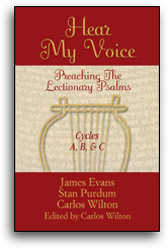
Hear My Voice
Preaching The Lectionary Psalms for Cycles A, B, C
Attempting to use mere language to discuss and describe the workings of God is not an easy task. God, for all the obvious reasons, quickly exhausts our meager language. But that doesn't keep us from trying. The writers of the psalms were constantly using extreme language, pushing words and syntax to their limits, in an effort to describe their awareness or experiences of God.
Psalm 138 is a good example. Set in the context of praises to God for answered prayer, the psalmist takes us far beyond the realm of his personal situation. The God he knows has a name "above everything" (v. 2).
The psalmist wastes no time in getting to the point of his poem. "I give you thanks" are the first words he writes. The expression of thanks becomes the overriding theme for everything else that is offered. As the psalmist pours out praises from a grateful heart, his imagination soars with the wonder of God's greatness.
God is greater than all other gods. God is greater than kings. God's presence, God's name, God's Word are all greater -- "above everything."
We have all heard people say they would like to find and commit themselves to something "bigger than they are," or "larger than life." Although saying these things has a certain clichéd quality about it, the sentiment nevertheless describes a common human need and aspiration. We sense intuitively that human life is about more than just personal survival. We were made for greater things, for more lofty purposes. We sense that we will only find the true meaning of our lives by giving ourselves to something larger than ourselves.
This desire to connect with something larger than ourselves becomes particularly important in times of suffering and distress (v. 7). If we have as the focus of our lives the preservation of our lives, then death becomes our constant fear. We live only to stay alive. And any threat of death, such as illness or calamity, serves not only to increase our fear, but also raises the specter of meaningless. In other words, the fulfillment of our aspiring need to connect to something larger than life is also the remedy for the fear that accompanies a life that we know is short.
If all this is true, then the psalmist has us on the right path. He seems to have found something not just larger than life, but larger than kings and even other deities. Meaning for him has been found in the name that is above every name. With that as his reason for living, the psalmist declares, "The Lord will fulfill his purpose for me" (v. 8).
-- J. E.
Psalm 138 is a good example. Set in the context of praises to God for answered prayer, the psalmist takes us far beyond the realm of his personal situation. The God he knows has a name "above everything" (v. 2).
The psalmist wastes no time in getting to the point of his poem. "I give you thanks" are the first words he writes. The expression of thanks becomes the overriding theme for everything else that is offered. As the psalmist pours out praises from a grateful heart, his imagination soars with the wonder of God's greatness.
God is greater than all other gods. God is greater than kings. God's presence, God's name, God's Word are all greater -- "above everything."
We have all heard people say they would like to find and commit themselves to something "bigger than they are," or "larger than life." Although saying these things has a certain clichéd quality about it, the sentiment nevertheless describes a common human need and aspiration. We sense intuitively that human life is about more than just personal survival. We were made for greater things, for more lofty purposes. We sense that we will only find the true meaning of our lives by giving ourselves to something larger than ourselves.
This desire to connect with something larger than ourselves becomes particularly important in times of suffering and distress (v. 7). If we have as the focus of our lives the preservation of our lives, then death becomes our constant fear. We live only to stay alive. And any threat of death, such as illness or calamity, serves not only to increase our fear, but also raises the specter of meaningless. In other words, the fulfillment of our aspiring need to connect to something larger than life is also the remedy for the fear that accompanies a life that we know is short.
If all this is true, then the psalmist has us on the right path. He seems to have found something not just larger than life, but larger than kings and even other deities. Meaning for him has been found in the name that is above every name. With that as his reason for living, the psalmist declares, "The Lord will fulfill his purpose for me" (v. 8).
-- J. E.
