
In Fact
Sermon
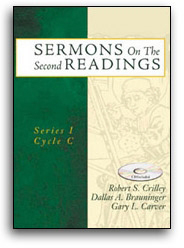
Sermons On The Second Readings
Series I, Cycle C
On first reading of Paul's message to the Corinthians, two parts stand out: The first is a phrase, "In fact." Paul said, "But in fact Christ has been raised from the dead, the first fruits of those who have died" (v. 20). The second is his comment, "The last enemy to be destroyed is death" (v. 26).
First, "In fact." Fact is information presented as objectively real, a real occurrence, something having demonstrable existence. So says the American Heritage Talking Dictionary. Factual information has reality and actuality. Something authentic and certain grabs us about it. The idiom, in fact, means in reality or in truth.
In fact is a surprising choice of words to preface resurrection talk. In fact leaves little room for the every day doubt that invites us to wonder about life after death.
With similar characteristic directness, Paul also tells the Corinthian Christians, "The last enemy to be destroyed is death." Three days ago, our thoughts centered on Jesus' death. By natural progression, when we think of his death, we resume cogitation about our own death. Most of us, however, prefer to skip over Good Friday and jump straight to Easter.
Nevertheless, Easter thoughts lift us to the resurrection and then to our own life after death, that is, if in fact we allow ourselves to think about death at all. As the years and changes gain on us, we may try harder to keep pushing death back farther in the mind while, death in fact finds more opportunity to peck at our vulnerability.
The proximity of Good Friday to Easter reminds us that, unlike the first followers of Christ, we have the benefit of knowing on Good Friday that Easter will come. Still, resurrection is a stumbling block for new pilgrims and for some continuing Christians.
We can stretch enough, maybe, to allow for one or two miracle stories. We, maybe, can even accept most of them, saying God has reasons for that sort of intervention. However, the miracle of the resurrection is different. We do not have that last piece to the puzzle. The jump seems too great for something deep within us to dare. Yet something equally deep within us yearns for resurrection to be in fact.
Let us approach death and resurrection in a more palatable fashion. I want to tell you about a family and a dog guide. We know the dog guide as the black Labrador/border collie named Leader Dog Treasure. The family, however, is an unusual gathering of men and women. With the exception of two folk who are age 58, they are between the ages of 80 and 97.
Picture a long, rather narrow room at the end of a hallway, like the crosspiece of a capital T. This room is known as the chapel to these care center residents. They also visit this space for small groups and exercise classes, but on Saturday mornings they come to play.
For an hour, five card tables are arranged in a line between the large windows at either end of the crosspiece. To these tables come about a dozen men and women. Most use wheelchairs. A couple use walkers. Occasionally someone enters on the arm of a caregiver.
Upon first glance, one might label these people as engaged in various stages of dying. If one listens for long, however, one notices that while their bodies or minds are in decline, all are also participants in resurrection.
They are readers of good poetry downloaded from web sites of libraries and universities and printed in type large enough for several to read. These folk are creators of poetry and stories. They engage in the creation of imaginative trips that take them far from the chapel room and return them refreshed in spirit. They speak always within the metaphor of living, dying, and new life but rarely address these themes directly.
Amid a myriad of "can no longer do" conditions, they have found the freedom of being who they are right now and doing what they can do on any given Saturday. Come meet these folk and discover how they became acquainted with resurrection.
Lorraine is keen minded, but the osteoporosis that has crumbled her spine keeps her in acute discomfort. Her curiosity to find out what the group will create with words each week temporarily uproots her pain and draws her to Saturday chapel.
Ernie, 58, lives with Huntington's disease. His listening is keen and, occasionally, he can utter a word distinct enough to be understood. As the result of a stroke, Lacy communicates only with her eyes.
With supplemental oxygen, a woman named Rowena finds enough energy for clarity of both speech and thought. She has found reasons to extend the capacity of her failing heart to its limit. She reads for the group. She relays to the nonvisual group leader the yes and no eye movements that are Lacy's responses to the facilitator's carefully worded questions. Lacy laughs aloud with the satisfaction of being understood. Rowena rejoices in understanding.
Rowena also interprets Ernie's garbled speech well enough to coax his continued trying. She colors her own contributions with a vivid imagination.
Their persistence rewards the tolerant patience of the rest of this family. Ernie has regained his sense of being a gentleman by remaining in the chapel until the leader has taken down all the card tables. With great concentration, he summons her dog guide, then hands the leader the dog's leash. His final responsibility is to turn off the lights.
Meet a few more of this family. The speech of Marian, who lives with multiple sclerosis, has become increasingly slower throughout the five years she has participated in the Saturday morning group. Sometimes her head becomes too heavy as she reads a passage of the group's writing. Her forehead bangs against the card table. Everything pauses until she has up righted herself.
Four other participants reflect various stages of cognitive exhaustion. With the leader's attentiveness to their moments of clarity, they also enjoy contributing.
Homer, Olive, and Vera are too fragile of body to remain in their homes, but they revel in the stimulation and challenge of the Saturday morning group. Homer exercises his once-thought-gone sense of fun and his belly laugh. Olive and Vera enjoy reading and the sense of community. In their words, "We wouldn't miss a single time. Sometimes we are thoughtful and sometimes we are silly. We never know what she is going to do next."
This resurrection began with Leader Dog Treasure. Given the option of watching for squirrels, he chose instead to relate to the folk sitting around the card tables. Moving quietly beneath the row of tables, Treasure sensed who especially needed him on a particular morning.
His quiet presence comforted new residents in the grief of transition. His refusal to leave the side of one woman who was beside herself with grouchiness melted her mood into calm. His docile but insistent nose nudging aroused sounds of enjoyment from deep within those who could barely hold a thought.
His sauntering down the hall to greet and escort some participants into the chapel room assured them they still count. His loving and accepting snuggles reawakened a warmth of spirit that had gone to sleep.
The tender attention of this sensitive dog altered the flat-lined voices of those who were drowning in boredom. He prompted the transposition of tones of isolation to the colorful voices of those who feel lovable.
Treasure clearly accepted each person regardless of capacity to think or move. He drew all of them from a living death of only waiting to restorative Saturday morning anticipation.
As this little group of individuals began to thrive on acceptance, they began to perceive each other as partners and trusted friends. The group became acquainted with the freedom of knowing that all were acceptable as they were. They practiced the art of escaping themselves while returning more fully to themselves.
Each again had a reason to be. Regular attendance was important. Someone needed to be there to read the large type transcriptions of last week's tape recordings of their work. Reading aloud for as long as the eye energy held out was acceptable even if it were only for two lines.
No matter what form Good Friday took in their lives, something of the brokenness took a break for an hour. The last enemy to be destroyed was death.
This family, whose composition and capability change over time, began its play with words by creating a poem using words that rhyme with dog. As a result of their rebirth of interest and vigor, the group recently completed a 16-chapter children's book about (what else but) a metaphor of life, death, and resurrection. They wrote the biography of a snowman. Many times during its writing, their laughter and good humor seeped through the crack between the closed doors at the end of the hall and coursed into the rooms of other residents. It was the sound of resurrection, in fact.
First, "In fact." Fact is information presented as objectively real, a real occurrence, something having demonstrable existence. So says the American Heritage Talking Dictionary. Factual information has reality and actuality. Something authentic and certain grabs us about it. The idiom, in fact, means in reality or in truth.
In fact is a surprising choice of words to preface resurrection talk. In fact leaves little room for the every day doubt that invites us to wonder about life after death.
With similar characteristic directness, Paul also tells the Corinthian Christians, "The last enemy to be destroyed is death." Three days ago, our thoughts centered on Jesus' death. By natural progression, when we think of his death, we resume cogitation about our own death. Most of us, however, prefer to skip over Good Friday and jump straight to Easter.
Nevertheless, Easter thoughts lift us to the resurrection and then to our own life after death, that is, if in fact we allow ourselves to think about death at all. As the years and changes gain on us, we may try harder to keep pushing death back farther in the mind while, death in fact finds more opportunity to peck at our vulnerability.
The proximity of Good Friday to Easter reminds us that, unlike the first followers of Christ, we have the benefit of knowing on Good Friday that Easter will come. Still, resurrection is a stumbling block for new pilgrims and for some continuing Christians.
We can stretch enough, maybe, to allow for one or two miracle stories. We, maybe, can even accept most of them, saying God has reasons for that sort of intervention. However, the miracle of the resurrection is different. We do not have that last piece to the puzzle. The jump seems too great for something deep within us to dare. Yet something equally deep within us yearns for resurrection to be in fact.
Let us approach death and resurrection in a more palatable fashion. I want to tell you about a family and a dog guide. We know the dog guide as the black Labrador/border collie named Leader Dog Treasure. The family, however, is an unusual gathering of men and women. With the exception of two folk who are age 58, they are between the ages of 80 and 97.
Picture a long, rather narrow room at the end of a hallway, like the crosspiece of a capital T. This room is known as the chapel to these care center residents. They also visit this space for small groups and exercise classes, but on Saturday mornings they come to play.
For an hour, five card tables are arranged in a line between the large windows at either end of the crosspiece. To these tables come about a dozen men and women. Most use wheelchairs. A couple use walkers. Occasionally someone enters on the arm of a caregiver.
Upon first glance, one might label these people as engaged in various stages of dying. If one listens for long, however, one notices that while their bodies or minds are in decline, all are also participants in resurrection.
They are readers of good poetry downloaded from web sites of libraries and universities and printed in type large enough for several to read. These folk are creators of poetry and stories. They engage in the creation of imaginative trips that take them far from the chapel room and return them refreshed in spirit. They speak always within the metaphor of living, dying, and new life but rarely address these themes directly.
Amid a myriad of "can no longer do" conditions, they have found the freedom of being who they are right now and doing what they can do on any given Saturday. Come meet these folk and discover how they became acquainted with resurrection.
Lorraine is keen minded, but the osteoporosis that has crumbled her spine keeps her in acute discomfort. Her curiosity to find out what the group will create with words each week temporarily uproots her pain and draws her to Saturday chapel.
Ernie, 58, lives with Huntington's disease. His listening is keen and, occasionally, he can utter a word distinct enough to be understood. As the result of a stroke, Lacy communicates only with her eyes.
With supplemental oxygen, a woman named Rowena finds enough energy for clarity of both speech and thought. She has found reasons to extend the capacity of her failing heart to its limit. She reads for the group. She relays to the nonvisual group leader the yes and no eye movements that are Lacy's responses to the facilitator's carefully worded questions. Lacy laughs aloud with the satisfaction of being understood. Rowena rejoices in understanding.
Rowena also interprets Ernie's garbled speech well enough to coax his continued trying. She colors her own contributions with a vivid imagination.
Their persistence rewards the tolerant patience of the rest of this family. Ernie has regained his sense of being a gentleman by remaining in the chapel until the leader has taken down all the card tables. With great concentration, he summons her dog guide, then hands the leader the dog's leash. His final responsibility is to turn off the lights.
Meet a few more of this family. The speech of Marian, who lives with multiple sclerosis, has become increasingly slower throughout the five years she has participated in the Saturday morning group. Sometimes her head becomes too heavy as she reads a passage of the group's writing. Her forehead bangs against the card table. Everything pauses until she has up righted herself.
Four other participants reflect various stages of cognitive exhaustion. With the leader's attentiveness to their moments of clarity, they also enjoy contributing.
Homer, Olive, and Vera are too fragile of body to remain in their homes, but they revel in the stimulation and challenge of the Saturday morning group. Homer exercises his once-thought-gone sense of fun and his belly laugh. Olive and Vera enjoy reading and the sense of community. In their words, "We wouldn't miss a single time. Sometimes we are thoughtful and sometimes we are silly. We never know what she is going to do next."
This resurrection began with Leader Dog Treasure. Given the option of watching for squirrels, he chose instead to relate to the folk sitting around the card tables. Moving quietly beneath the row of tables, Treasure sensed who especially needed him on a particular morning.
His quiet presence comforted new residents in the grief of transition. His refusal to leave the side of one woman who was beside herself with grouchiness melted her mood into calm. His docile but insistent nose nudging aroused sounds of enjoyment from deep within those who could barely hold a thought.
His sauntering down the hall to greet and escort some participants into the chapel room assured them they still count. His loving and accepting snuggles reawakened a warmth of spirit that had gone to sleep.
The tender attention of this sensitive dog altered the flat-lined voices of those who were drowning in boredom. He prompted the transposition of tones of isolation to the colorful voices of those who feel lovable.
Treasure clearly accepted each person regardless of capacity to think or move. He drew all of them from a living death of only waiting to restorative Saturday morning anticipation.
As this little group of individuals began to thrive on acceptance, they began to perceive each other as partners and trusted friends. The group became acquainted with the freedom of knowing that all were acceptable as they were. They practiced the art of escaping themselves while returning more fully to themselves.
Each again had a reason to be. Regular attendance was important. Someone needed to be there to read the large type transcriptions of last week's tape recordings of their work. Reading aloud for as long as the eye energy held out was acceptable even if it were only for two lines.
No matter what form Good Friday took in their lives, something of the brokenness took a break for an hour. The last enemy to be destroyed was death.
This family, whose composition and capability change over time, began its play with words by creating a poem using words that rhyme with dog. As a result of their rebirth of interest and vigor, the group recently completed a 16-chapter children's book about (what else but) a metaphor of life, death, and resurrection. They wrote the biography of a snowman. Many times during its writing, their laughter and good humor seeped through the crack between the closed doors at the end of the hall and coursed into the rooms of other residents. It was the sound of resurrection, in fact.
