
Fade To Black
Sermon
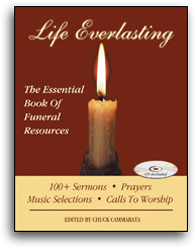
Life Everlasting
The Essential Book of Funeral Resources
Object:
A thought piece
Fade To Black
James 1:10-11
... because he will pass away like a wild flower. For the sun rises with scorching heat and withers the plant; its blossom falls and its beauty is destroyed. In the same way, the rich man will fade away even while he goes about his business.
-- James 1:10-11
My memories of my great-grandmother are very vague. I was a young lad when my parents took my older sister and I to see her at a retirement home in Willmar, Minnesota. I can remember the strange and mildly irritating smell of the place, and the dim incandescence of the corridor with its waxed linoleum. We tried unsuccessfully to turn down the volume of our clattering steps and shuffled into the room quietly, nervously afraid of arousing death before its time.
"Grandma," reclined in an oversized lounger, was barely aware of us. Her mouth hung open and she wore wrinkled skin several sizes too big over a shrinking frame. A musty afghan draped her carelessly. She couldn't quite catch what my mom tried to tell her in a stage-whisper shout. We touched her hands and she seemed to fumble for ours with fingers gnarled and cold.
I can only recall this single visit to see her, and I know I didn't like it. At the time she was an alien to me, even though I know now that a good deal of her DNA lives on in my own body. When Grandma died, my parents didn't take me to the funeral because I was supposedly too young to understand death. Now, some forty years later, I weep inside. I never knew the best of my great-grandmother. I wasn't there when she played as a child with boys like me. I never watched her giggle with friends or flirt with my great-grandfather. I never experienced the changing moods of her face, a barometer of her passions and fears and faith. I never heard her sing in church, though I was told she loved the hymns. All I carry with me is the one scary visit of my childhood.
I am old enough now to attend funerals, and I have gotten well past my early aversion to assisted care centers. What frightens me now is the thought that there are probably fewer than 25 people alive today who remember my great-grandmother at all. When those couple dozen die she will be truly forgotten -- a near-century of living, breathing, loving, toiling, memorizing, cooking, knitting, talking, aching, laughing, holding, washing, befriending vapored and vanished like a 6 o'clock morning mist.
Nicholas Wolterstorff reflected on the death of his son with these words: "There's a hole in the world now. In the place where he was, there's now just nothing ... There's nobody now who saw just what he saw, knows what he knew, remembers what he remembered, loves what he loved ... The world is emptier" (Lament for a Son [Eerdmans, 1987], p. 33). That's true, as well, of my great-grandmother. True, too, of a host of good people whose gravestone legacies weather to indecipherable under time's polishing.
It won't be long before I join them, erased from life's hard drive by the reprogrammers of a new generation. Several weeks ago we were comparing ages in our family and one of my daughters remarked to another, "Dad has probably lived half his life already." The words shivered through me and robbed me of the fun of the moment. It's true -- I have probably lived half my life already. In the not-so-distant future I will be my great-grandmother, and only 25 minds will retain vague images of a wasted has-been.
In my times of great energy and passionate success I never think about death. I was born to live! I entered this world to conquer! I am a child of greatness, and the stars need do my bidding!
But now and again I see my mortality clinging to my steps like a lengthening shadow, and I am caught wondering why I am here at all. A question chiseled in stone over the grave of a child recycles in my brain: "If I am so quickly done for, what on earth was I begun for?"
James feeds my cynicism. Is he morbid for emphasizing all of this so early in his letter? Perhaps. It may be, however, that he is applying the shock therapy necessary for us to make the most of our run for the roses. Because we are psychosomatic creatures, spirits expressing ourselves through bodies, we often think that the inner self grows in significance as the material self struts with pride and fine fashion. Since no one can touch the soul inside except by way of the material stuff with which we surround it, we are often beguiled into amassing possessions and accomplishments as a means to identify our worth.
Yet, all of these things will be stripped away from us before we can blink against the wind of time. Just today I cried with a thirty-something fellow who is a glowing testimony of success in our community. He grew up in a close-knit family, wears an athletic body and a movie-star's face, married a beautiful and intelligent woman, lives in a luxurious home and is buying a multi-million dollar business that could become a multi-billion dollar corporation before he retires. He was the envy of the neighborhood, but today it means nothing. A crippling disease, a foolish action, and a disintegrating marriage have tripped him on the run. "I would trade everything to have my wife and children back," he said. "Two weeks ago I thought I had it all. Now I don't know if I have anything."
James is not a killjoy. He is perceptive. He knows that God meant for us to live and to enjoy the marvelous beauty and material riches of our world and universe. But he also understands that we can't truly enjoy them until we know who we are. It isn't until we begin to die that we begin to live. It isn't until we cry out to heaven that 90 or 75 or 50 or 13 years aren't enough that we begin to understand what 13 or 50 or 75 or 90 years of human life really mean.
If James can whet our appetite for what really matters, we will find out that the God who taught our cells to divide in our mothers' wombs won't let the sun set forever. After all, it was James' own brother Jesus who rolled back the stone of death on Easter morning. Amen.
Fade To Black
James 1:10-11
... because he will pass away like a wild flower. For the sun rises with scorching heat and withers the plant; its blossom falls and its beauty is destroyed. In the same way, the rich man will fade away even while he goes about his business.
-- James 1:10-11
My memories of my great-grandmother are very vague. I was a young lad when my parents took my older sister and I to see her at a retirement home in Willmar, Minnesota. I can remember the strange and mildly irritating smell of the place, and the dim incandescence of the corridor with its waxed linoleum. We tried unsuccessfully to turn down the volume of our clattering steps and shuffled into the room quietly, nervously afraid of arousing death before its time.
"Grandma," reclined in an oversized lounger, was barely aware of us. Her mouth hung open and she wore wrinkled skin several sizes too big over a shrinking frame. A musty afghan draped her carelessly. She couldn't quite catch what my mom tried to tell her in a stage-whisper shout. We touched her hands and she seemed to fumble for ours with fingers gnarled and cold.
I can only recall this single visit to see her, and I know I didn't like it. At the time she was an alien to me, even though I know now that a good deal of her DNA lives on in my own body. When Grandma died, my parents didn't take me to the funeral because I was supposedly too young to understand death. Now, some forty years later, I weep inside. I never knew the best of my great-grandmother. I wasn't there when she played as a child with boys like me. I never watched her giggle with friends or flirt with my great-grandfather. I never experienced the changing moods of her face, a barometer of her passions and fears and faith. I never heard her sing in church, though I was told she loved the hymns. All I carry with me is the one scary visit of my childhood.
I am old enough now to attend funerals, and I have gotten well past my early aversion to assisted care centers. What frightens me now is the thought that there are probably fewer than 25 people alive today who remember my great-grandmother at all. When those couple dozen die she will be truly forgotten -- a near-century of living, breathing, loving, toiling, memorizing, cooking, knitting, talking, aching, laughing, holding, washing, befriending vapored and vanished like a 6 o'clock morning mist.
Nicholas Wolterstorff reflected on the death of his son with these words: "There's a hole in the world now. In the place where he was, there's now just nothing ... There's nobody now who saw just what he saw, knows what he knew, remembers what he remembered, loves what he loved ... The world is emptier" (Lament for a Son [Eerdmans, 1987], p. 33). That's true, as well, of my great-grandmother. True, too, of a host of good people whose gravestone legacies weather to indecipherable under time's polishing.
It won't be long before I join them, erased from life's hard drive by the reprogrammers of a new generation. Several weeks ago we were comparing ages in our family and one of my daughters remarked to another, "Dad has probably lived half his life already." The words shivered through me and robbed me of the fun of the moment. It's true -- I have probably lived half my life already. In the not-so-distant future I will be my great-grandmother, and only 25 minds will retain vague images of a wasted has-been.
In my times of great energy and passionate success I never think about death. I was born to live! I entered this world to conquer! I am a child of greatness, and the stars need do my bidding!
But now and again I see my mortality clinging to my steps like a lengthening shadow, and I am caught wondering why I am here at all. A question chiseled in stone over the grave of a child recycles in my brain: "If I am so quickly done for, what on earth was I begun for?"
James feeds my cynicism. Is he morbid for emphasizing all of this so early in his letter? Perhaps. It may be, however, that he is applying the shock therapy necessary for us to make the most of our run for the roses. Because we are psychosomatic creatures, spirits expressing ourselves through bodies, we often think that the inner self grows in significance as the material self struts with pride and fine fashion. Since no one can touch the soul inside except by way of the material stuff with which we surround it, we are often beguiled into amassing possessions and accomplishments as a means to identify our worth.
Yet, all of these things will be stripped away from us before we can blink against the wind of time. Just today I cried with a thirty-something fellow who is a glowing testimony of success in our community. He grew up in a close-knit family, wears an athletic body and a movie-star's face, married a beautiful and intelligent woman, lives in a luxurious home and is buying a multi-million dollar business that could become a multi-billion dollar corporation before he retires. He was the envy of the neighborhood, but today it means nothing. A crippling disease, a foolish action, and a disintegrating marriage have tripped him on the run. "I would trade everything to have my wife and children back," he said. "Two weeks ago I thought I had it all. Now I don't know if I have anything."
James is not a killjoy. He is perceptive. He knows that God meant for us to live and to enjoy the marvelous beauty and material riches of our world and universe. But he also understands that we can't truly enjoy them until we know who we are. It isn't until we begin to die that we begin to live. It isn't until we cry out to heaven that 90 or 75 or 50 or 13 years aren't enough that we begin to understand what 13 or 50 or 75 or 90 years of human life really mean.
If James can whet our appetite for what really matters, we will find out that the God who taught our cells to divide in our mothers' wombs won't let the sun set forever. After all, it was James' own brother Jesus who rolled back the stone of death on Easter morning. Amen.
