
Fathering In Feminist Times
Self Help
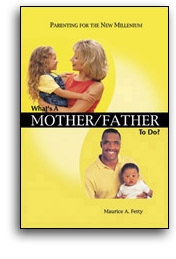
What's A Mother/Father To Do?
Parenting For The New Millennium
Children, obey your parents in everything, for this pleases the Lord. Fathers, do not provoke your children, lest they become discouraged. -- Colossians 3:20-21
"Honor your father and mother" (this is the first commandment, with a promise), "that it may be well with you and that you may live long on the earth."
-- Ephesians 6:2-3
It is a truism to say that we have been in the midst of a feminist revolution. And contrary to the historic gender meaning of feminine, feminist may or may not have a lot to do with traditional femininity. For many it means equal opportunity for a job without regard to sex. It suggests being treated as a person rather than as a sex object. Feminism today means equal pay with men for equal work.
But the feminist movement goes much deeper to cut into the social, psychological, and religious structure of society. For some, feminism means a reversal of roles, with women becoming breadwinners and men becoming househusbands. Moderate feminists propose equal responsibility in cooking, diaper-changing, housecleaning, and laundry. I have a daughter-in-law like that who has yet to assume equality in snow shoveling, lawn work, garage cleaning, and tree trimming!
Manners, customs, and courtesies are in a state of flux. Should a man rise when a woman enters the room? Should he shake her hand, kiss her, or ignore her? Should he hold the door for her, fix the flat tire in the rain while she sits high and dry, drive her to the door while he parks the car and walks back in the snow? And should she pay the check for lunch or dinner? In answer to the last question, I answer a hearty yes!
But beyond equality of roles or reversal of roles, feminism for some means disdain of men. It is well-known that many leading feminists are lesbians. Women's studies departments in universities frequently are dominated by lesbians. Consequently, considerable amounts of feminist rhetoric and literature are decidedly anti-male.
Very few revolutions are rational, including the feminist revolution. Consequently, revolutions often get caught up in shrill sloganeering which mitigates against more careful study, analysis, and change. Any criticism of feminism may draw a harsh and emotional attack. Just as in the '60s, one could criticize minorities only at the risk of being labeled racist, and just as now one can criticize the political philosophy of Zionism only at the risk of being labeled anti-Semite, so now one can criticize the feminist rhetoric only at the risk of being called a male-chauvinist pig. You can see I am in a precarious situation, walking on thin ice.
Therefore, that men and fathers are confused, frustrated, and angry in these times should come as no surprise. They sometimes wonder if they are being "had." When talking with some labor attorneys recently, they noted somewhat whimsically that everyone had special rights under labor laws except Caucasian males!
When everyone insists on rights, it implies somewhere, someone must be taking the responsibility to provide those rights. Margaret Thatcher of Great Britain says that a welfare state implies that someone, somewhere is providing the wealth to pay the welfare. Paraphrasing her, we might say that people who insist on rights are implying someone, somewhere has the responsibility to give them those rights. Since white men are perceived to hold much of the power and wealth (although women own more capital wealth than men), many groups, including feminists, are attacking white men for a share of what they presumably possess.
Thus, men and fathers are confused about their roles. Bewilderment, anger, hostility, loneliness, longing, and confusion are common. Some are belligerent and defensive. Others are sincere in seeking appropriate ways to relate to women and children, creative ways to structure family and society. Many are determined to try to love in courageous and positive ways. Therefore, as Christians, we appropriately turn to the scriptures for guidance and inspiration for fathering in feminist times.
I.
Our text advises that husbands are to love their wives and not be harsh with them.
But that may be difficult in these feminist times when the husband and father sees himself under attack even by his wife as she struggles with her identity and role. Besides, many women struggle with the scriptural notion of wives being subject to their husbands as to the Lord. They see in them a throwback to an oppressive, exploitative, patriarchal society. They suggest images of subservience, second-class citizenship, and even servility for women.
However, in the parallel passage in Ephesians, mutual subjection is emphasized out of reverence for Christ. More than that, a husband is encouraged to love his wife as Christ loved the church and gave himself up for it.
Husbands are to love as Christ loved -- seeking to serve rather than insisting on always being served, giving instead of always taking, helping instead of always demanding help, being willing to "father" a wife instead of always expecting to be "mothered" by a wife, stepping up to the responsibility of wholesome partnership, rather than regarding a wife as a second-class citizen to be taken for granted.
In this context, fathering and husbanding are much different from patriarchy. Patriarchy, "father-rule," often is associated with male dominance, arbitrariness, and oppression. Patriarchy suggests to many feminists force without feeling, authority without authenticity, and exploitation without equality.
Recently, I was talking with a man who works in a battered wife clinic. He says they have 1,000 cases with hundreds more coming in. And that is in only one medium-sized town in California. How sad! Our text says to husbands, "Husbands love your wives; do not be harsh with them."
We Christian fathers are being asked to use the serving, caring, courteous Christ as our role model. In these abrasive times, we need to encourage one another to love our wives as Christ loved the church.
II.
Our text also advises that children should obey their parents. The parallel passage in Ephesians suggests children should honor their father and mother, reflecting the sixth commandment.
If ours has been a time of the feminist revolution and the liberation of women, it also is a time which urges the liberation of children. If women have been insisting on their rights, children and their advocates have begun to do the same. Once again, the emphasis, as with most liberation groups, is on rights, rarely on responsibilities. Our national education secretary once did a study of students' manuals and found that they were comprised of 99 percent rights and only one percent responsibilities. Whoever heard of a civil responsibilities movement? Or a women's responsibilities movement? Or a students' or children's or men's responsibilities movement? Everybody wants rights; nobody wants responsibilities.
However, the biblical tradition supports the integrity of the family and suggests that the family is a responsibilities movement. Contrary to the selfishness of the "me" generation, our sacred teachings advise us that we are to be responsible for one another. Children are to be responsible to their parents. They are to honor father and mother, whether they be 49 or 89. The family is to be regarded as a basic unit of society.
Communism often challenges that concept and makes the family subservient to the state and expendable by the state. And capitalism does much the same. In his classic study of power, The Power Elite, sociologist C. Wright Mills says that in America, churches, schools, and families adjust to big business, big labor, big military, and big government and adapt themselves to their dictates.
In their provocative book, War Over The Family, sociologists Peter and Brigitte Berger warn that increasingly the government is encroaching upon the family, entering in, removing children from homes, conducting investigations, and usurping increasing authority in areas traditionally left to parents. And, says Mrs. Berger of Wellesley College, not only is the middle class family influenced unduly by the government, it is increasingly perceived as "ancillary to the professional child-rearing establishment" (p. 14).
The cult of motherhood has been stronger than that of fatherhood. Few men or women would consider fatherhood as the most important role in a man's life. One survey showed women regarded "breadwinner" as the most important role for men. They were expected to work hard and to give unreservedly with little say in family life or children's futures. That is illustrated by the Father's Day card I received from our youngest daughter. It shows a beleaguered father showering money over his delighted daughter. On the front it says, "You have devoted your entire life and spent every cent of your money trying to find ways to make me happy." On the inside the card says, "I like that in a guy." After putting six children through college it has seemed like a money shower!
Fathers see their children shaped more by schools, coaches, teachers, mothers, peer groups, and youth culture than by themselves. Yet they are expected to exhibit a wide range of fatherly responses.
In a recent telephone commercial, the daughter calls her parents long distance. The father answers and volunteers to call the mother immediately to the phone, whereupon the daughter says, "Wait, Dad, I called to talk to you." One way to honor fathers, says psychologist Samuel Osherson of Harvard University Health Services, is for grown children to listen to their fathers, to share feelings, and to build mutual respect as adults. One of the best gifts to give on Father's Day might be ready ears and an open heart ready to listen and to be there for our fathers.
III.
Our text also suggests that in these feminist times (or any other time) we fathers should not provoke our children, lest they be discouraged.
One way many fathers provoke their children is to abandon them. Thousands of children are today born out of wedlock. Many are put up for adoption. Others are raised by the mother alone and perhaps eventually a stepfather. Still others live with their mothers because of divorce and some fathers tend to "abandon" their children because child custody laws still overwhelmingly favor the woman.
John Rossler of the National Congress For Men says that today twenty percent of children will be born into fatherless homes. He says fifty percent of children will live significant periods of their formative years without a father. In ten years the number may be as high as sixty percent. The United States Census Bureau reports the number of children living in a single parent household in 1986, increased by nine million since 1980. Of those, 89 percent lived with mothers, eleven percent with fathers. I worry about our society years hence.
To be sure, many fathers are troubled with marriage and family life. Yet we need to be encouraged to hang in there to work things out. Our children need us as role models and male images. Our sons need us to help them develop their sexual identity especially at ages four to six and then again in adolescence.
We fathers need to give our children opportunity to know us, to see what we do for a living. Surveys have shown many children have only the vaguest notion what their fathers do at their jobs. Why not take our children to our offices or hospitals or factories or job sites to have them spend a day or two periodically? Perhaps we can give them a job. Why not explain the court case, the contract, the big sale, the surgical procedure, and even some of the office politics? Why not tell our child how much we are paid for a case or operation or sale? Since our self-identity is so much connected to our work, we need to help our children understand our work.
But life is more than work and fathering is more than handing out money. Former New York Governor Mario Cuomo wrote movingly about his father who came over from the old country to work around the clock to support his family. Said Cuomo, "The overwhelming impression we got was that this man was offering us his life; he didn't have to put his arm around you." Perhaps, but perhaps not. Often our children associate affection and feeling only with the feminine side of gender. We men tend to equate money and things with love. We need to learn to share our feelings more.
If shared feelings will help diminish provocation of our children, so will controlled expectations. We fathers want our children to do well. Sometimes in our highly competitive community we want them to do too well, to succeed where we never succeeded, to be the actors, athletes, students, or musicians we never were.
Recently a woman told me about how their son disappointed their expectations for them. They sent him to college and he entered business for a while. He finally decided to change directions and enter a trade -- a direction his parents didn't like at first. But, said his mother, we have come to accept the fact that he must live the way that best suits him. He is happy and fulfilled and we are happy for him.
Fathering in feminist times is not easy. The roles for fathers often are ambiguous if not demeaning. In a time when so many in this "me" generation are out to seek their own pleasure, we fathers are advised by the scriptures to give ourselves in love to wife and children. For after all is said and done, the real question will not be how much did we make or achieve, but how much did we love?
Prayer
Almighty God, Father of our Lord Jesus Christ and our Father, origin of all masculinity and femininity who has chosen to express your image in maleness and femaleness, we praise you for the glory of human life and for the opportunity to be your loving sons and daughters. You have designed us to be one family under heaven, diverse and yet united; unique, but committed to a common Father; free, but responsible to learn your will and do it so that all might be well in the world. We thank you for bringing us into life.
But if life has its grandeur, it has also its misery. If you have made us for ecstasy, you have not made us immune to agony. So we come to you, Divine Father of us all, beseeching your help for the fathers of our time. Some have been rejected or betrayed by rebellious sons and daughters who, learning always to take, never learn to give. Forgive these fathers their failures and give them strength toward the day when they might see their prodigal children return from the far country.
Some fathers, newly divorced, have felt cheated in the courts, where child custody almost automatically went to the mother, deserving or not. Strengthen these fathers that in their visitations, they shall be a good example and loving influence for their children. Give them resolve toward the day when the courts shall be more fair and equitable.
We pray for fathers lately widowed, whether early or late in life, that they might be given balance and solace not alone by your loving Spirit, but by family and friends who reach out in healthy sympathy. Give guidance to grandfathers who from the counsels of wisdom may say neither too little nor too much.
We pray for would-be fathers wanting children but unable; and for fathers having children who wish they did not; that the one might be given surrogate children, and that the other might be newly awakened to the privilege and miracle of new life from his loins.
We ask your blessing upon husbands and fathers of robust families, that in the give and take of life, they may always be generous to give the love and discipline their children so sorely need. Save them from undue impatience; keep them from neglecting your will by succumbing to serve the fad or fancy of the times. Help them always to live with the knowledge of your love and grace and sustain them for moral and ethical integrity. And when all is said and done, may their children rise up and call them blessed. In Christ's name we pray. Amen.
"Honor your father and mother" (this is the first commandment, with a promise), "that it may be well with you and that you may live long on the earth."
-- Ephesians 6:2-3
It is a truism to say that we have been in the midst of a feminist revolution. And contrary to the historic gender meaning of feminine, feminist may or may not have a lot to do with traditional femininity. For many it means equal opportunity for a job without regard to sex. It suggests being treated as a person rather than as a sex object. Feminism today means equal pay with men for equal work.
But the feminist movement goes much deeper to cut into the social, psychological, and religious structure of society. For some, feminism means a reversal of roles, with women becoming breadwinners and men becoming househusbands. Moderate feminists propose equal responsibility in cooking, diaper-changing, housecleaning, and laundry. I have a daughter-in-law like that who has yet to assume equality in snow shoveling, lawn work, garage cleaning, and tree trimming!
Manners, customs, and courtesies are in a state of flux. Should a man rise when a woman enters the room? Should he shake her hand, kiss her, or ignore her? Should he hold the door for her, fix the flat tire in the rain while she sits high and dry, drive her to the door while he parks the car and walks back in the snow? And should she pay the check for lunch or dinner? In answer to the last question, I answer a hearty yes!
But beyond equality of roles or reversal of roles, feminism for some means disdain of men. It is well-known that many leading feminists are lesbians. Women's studies departments in universities frequently are dominated by lesbians. Consequently, considerable amounts of feminist rhetoric and literature are decidedly anti-male.
Very few revolutions are rational, including the feminist revolution. Consequently, revolutions often get caught up in shrill sloganeering which mitigates against more careful study, analysis, and change. Any criticism of feminism may draw a harsh and emotional attack. Just as in the '60s, one could criticize minorities only at the risk of being labeled racist, and just as now one can criticize the political philosophy of Zionism only at the risk of being labeled anti-Semite, so now one can criticize the feminist rhetoric only at the risk of being called a male-chauvinist pig. You can see I am in a precarious situation, walking on thin ice.
Therefore, that men and fathers are confused, frustrated, and angry in these times should come as no surprise. They sometimes wonder if they are being "had." When talking with some labor attorneys recently, they noted somewhat whimsically that everyone had special rights under labor laws except Caucasian males!
When everyone insists on rights, it implies somewhere, someone must be taking the responsibility to provide those rights. Margaret Thatcher of Great Britain says that a welfare state implies that someone, somewhere is providing the wealth to pay the welfare. Paraphrasing her, we might say that people who insist on rights are implying someone, somewhere has the responsibility to give them those rights. Since white men are perceived to hold much of the power and wealth (although women own more capital wealth than men), many groups, including feminists, are attacking white men for a share of what they presumably possess.
Thus, men and fathers are confused about their roles. Bewilderment, anger, hostility, loneliness, longing, and confusion are common. Some are belligerent and defensive. Others are sincere in seeking appropriate ways to relate to women and children, creative ways to structure family and society. Many are determined to try to love in courageous and positive ways. Therefore, as Christians, we appropriately turn to the scriptures for guidance and inspiration for fathering in feminist times.
I.
Our text advises that husbands are to love their wives and not be harsh with them.
But that may be difficult in these feminist times when the husband and father sees himself under attack even by his wife as she struggles with her identity and role. Besides, many women struggle with the scriptural notion of wives being subject to their husbands as to the Lord. They see in them a throwback to an oppressive, exploitative, patriarchal society. They suggest images of subservience, second-class citizenship, and even servility for women.
However, in the parallel passage in Ephesians, mutual subjection is emphasized out of reverence for Christ. More than that, a husband is encouraged to love his wife as Christ loved the church and gave himself up for it.
Husbands are to love as Christ loved -- seeking to serve rather than insisting on always being served, giving instead of always taking, helping instead of always demanding help, being willing to "father" a wife instead of always expecting to be "mothered" by a wife, stepping up to the responsibility of wholesome partnership, rather than regarding a wife as a second-class citizen to be taken for granted.
In this context, fathering and husbanding are much different from patriarchy. Patriarchy, "father-rule," often is associated with male dominance, arbitrariness, and oppression. Patriarchy suggests to many feminists force without feeling, authority without authenticity, and exploitation without equality.
Recently, I was talking with a man who works in a battered wife clinic. He says they have 1,000 cases with hundreds more coming in. And that is in only one medium-sized town in California. How sad! Our text says to husbands, "Husbands love your wives; do not be harsh with them."
We Christian fathers are being asked to use the serving, caring, courteous Christ as our role model. In these abrasive times, we need to encourage one another to love our wives as Christ loved the church.
II.
Our text also advises that children should obey their parents. The parallel passage in Ephesians suggests children should honor their father and mother, reflecting the sixth commandment.
If ours has been a time of the feminist revolution and the liberation of women, it also is a time which urges the liberation of children. If women have been insisting on their rights, children and their advocates have begun to do the same. Once again, the emphasis, as with most liberation groups, is on rights, rarely on responsibilities. Our national education secretary once did a study of students' manuals and found that they were comprised of 99 percent rights and only one percent responsibilities. Whoever heard of a civil responsibilities movement? Or a women's responsibilities movement? Or a students' or children's or men's responsibilities movement? Everybody wants rights; nobody wants responsibilities.
However, the biblical tradition supports the integrity of the family and suggests that the family is a responsibilities movement. Contrary to the selfishness of the "me" generation, our sacred teachings advise us that we are to be responsible for one another. Children are to be responsible to their parents. They are to honor father and mother, whether they be 49 or 89. The family is to be regarded as a basic unit of society.
Communism often challenges that concept and makes the family subservient to the state and expendable by the state. And capitalism does much the same. In his classic study of power, The Power Elite, sociologist C. Wright Mills says that in America, churches, schools, and families adjust to big business, big labor, big military, and big government and adapt themselves to their dictates.
In their provocative book, War Over The Family, sociologists Peter and Brigitte Berger warn that increasingly the government is encroaching upon the family, entering in, removing children from homes, conducting investigations, and usurping increasing authority in areas traditionally left to parents. And, says Mrs. Berger of Wellesley College, not only is the middle class family influenced unduly by the government, it is increasingly perceived as "ancillary to the professional child-rearing establishment" (p. 14).
The cult of motherhood has been stronger than that of fatherhood. Few men or women would consider fatherhood as the most important role in a man's life. One survey showed women regarded "breadwinner" as the most important role for men. They were expected to work hard and to give unreservedly with little say in family life or children's futures. That is illustrated by the Father's Day card I received from our youngest daughter. It shows a beleaguered father showering money over his delighted daughter. On the front it says, "You have devoted your entire life and spent every cent of your money trying to find ways to make me happy." On the inside the card says, "I like that in a guy." After putting six children through college it has seemed like a money shower!
Fathers see their children shaped more by schools, coaches, teachers, mothers, peer groups, and youth culture than by themselves. Yet they are expected to exhibit a wide range of fatherly responses.
In a recent telephone commercial, the daughter calls her parents long distance. The father answers and volunteers to call the mother immediately to the phone, whereupon the daughter says, "Wait, Dad, I called to talk to you." One way to honor fathers, says psychologist Samuel Osherson of Harvard University Health Services, is for grown children to listen to their fathers, to share feelings, and to build mutual respect as adults. One of the best gifts to give on Father's Day might be ready ears and an open heart ready to listen and to be there for our fathers.
III.
Our text also suggests that in these feminist times (or any other time) we fathers should not provoke our children, lest they be discouraged.
One way many fathers provoke their children is to abandon them. Thousands of children are today born out of wedlock. Many are put up for adoption. Others are raised by the mother alone and perhaps eventually a stepfather. Still others live with their mothers because of divorce and some fathers tend to "abandon" their children because child custody laws still overwhelmingly favor the woman.
John Rossler of the National Congress For Men says that today twenty percent of children will be born into fatherless homes. He says fifty percent of children will live significant periods of their formative years without a father. In ten years the number may be as high as sixty percent. The United States Census Bureau reports the number of children living in a single parent household in 1986, increased by nine million since 1980. Of those, 89 percent lived with mothers, eleven percent with fathers. I worry about our society years hence.
To be sure, many fathers are troubled with marriage and family life. Yet we need to be encouraged to hang in there to work things out. Our children need us as role models and male images. Our sons need us to help them develop their sexual identity especially at ages four to six and then again in adolescence.
We fathers need to give our children opportunity to know us, to see what we do for a living. Surveys have shown many children have only the vaguest notion what their fathers do at their jobs. Why not take our children to our offices or hospitals or factories or job sites to have them spend a day or two periodically? Perhaps we can give them a job. Why not explain the court case, the contract, the big sale, the surgical procedure, and even some of the office politics? Why not tell our child how much we are paid for a case or operation or sale? Since our self-identity is so much connected to our work, we need to help our children understand our work.
But life is more than work and fathering is more than handing out money. Former New York Governor Mario Cuomo wrote movingly about his father who came over from the old country to work around the clock to support his family. Said Cuomo, "The overwhelming impression we got was that this man was offering us his life; he didn't have to put his arm around you." Perhaps, but perhaps not. Often our children associate affection and feeling only with the feminine side of gender. We men tend to equate money and things with love. We need to learn to share our feelings more.
If shared feelings will help diminish provocation of our children, so will controlled expectations. We fathers want our children to do well. Sometimes in our highly competitive community we want them to do too well, to succeed where we never succeeded, to be the actors, athletes, students, or musicians we never were.
Recently a woman told me about how their son disappointed their expectations for them. They sent him to college and he entered business for a while. He finally decided to change directions and enter a trade -- a direction his parents didn't like at first. But, said his mother, we have come to accept the fact that he must live the way that best suits him. He is happy and fulfilled and we are happy for him.
Fathering in feminist times is not easy. The roles for fathers often are ambiguous if not demeaning. In a time when so many in this "me" generation are out to seek their own pleasure, we fathers are advised by the scriptures to give ourselves in love to wife and children. For after all is said and done, the real question will not be how much did we make or achieve, but how much did we love?
Prayer
Almighty God, Father of our Lord Jesus Christ and our Father, origin of all masculinity and femininity who has chosen to express your image in maleness and femaleness, we praise you for the glory of human life and for the opportunity to be your loving sons and daughters. You have designed us to be one family under heaven, diverse and yet united; unique, but committed to a common Father; free, but responsible to learn your will and do it so that all might be well in the world. We thank you for bringing us into life.
But if life has its grandeur, it has also its misery. If you have made us for ecstasy, you have not made us immune to agony. So we come to you, Divine Father of us all, beseeching your help for the fathers of our time. Some have been rejected or betrayed by rebellious sons and daughters who, learning always to take, never learn to give. Forgive these fathers their failures and give them strength toward the day when they might see their prodigal children return from the far country.
Some fathers, newly divorced, have felt cheated in the courts, where child custody almost automatically went to the mother, deserving or not. Strengthen these fathers that in their visitations, they shall be a good example and loving influence for their children. Give them resolve toward the day when the courts shall be more fair and equitable.
We pray for fathers lately widowed, whether early or late in life, that they might be given balance and solace not alone by your loving Spirit, but by family and friends who reach out in healthy sympathy. Give guidance to grandfathers who from the counsels of wisdom may say neither too little nor too much.
We pray for would-be fathers wanting children but unable; and for fathers having children who wish they did not; that the one might be given surrogate children, and that the other might be newly awakened to the privilege and miracle of new life from his loins.
We ask your blessing upon husbands and fathers of robust families, that in the give and take of life, they may always be generous to give the love and discipline their children so sorely need. Save them from undue impatience; keep them from neglecting your will by succumbing to serve the fad or fancy of the times. Help them always to live with the knowledge of your love and grace and sustain them for moral and ethical integrity. And when all is said and done, may their children rise up and call them blessed. In Christ's name we pray. Amen.
