
The Feast Of Expectation
Sermon
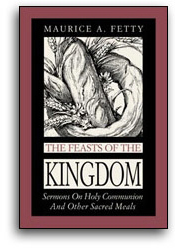
The Feasts Of The Kingdom
Sermons On Holy Communion And Other Sacred Meals
Some of my fondest memories of years past are of family reunions at holidays and anniversaries. During college years or the early years of marriage, it was fun to anticipate returning to my parents' home for family gatherings. Not the least of my expectations was the sharing of good food around the dining room table. We could count on Mom to come forth with some of her excellent dishes, of which we would eat more than we should. But we could always diet later, we told ourselves.
As time has passed and our own family has grown, the focus has shifted somewhat. If once we looked forward to Grandmother's house and good food, now our own children, thank God, look forward to returning home to us on holidays and anniversaries. For them and us, it is a time of anticipation and expectancy, not the least of which is the expectancy of my wife's excellent food. One Christmas we were fortunate to have all our children home. We had a bonus day when our out-of-towners were snowed in. So after dinner, we sat around the table for almost two hours, singing and talking. It doesn't get much better than that.
Family gatherings can be those great occasions of re-grouping and re-thinking who we are. If Robert Frost whimsically observed that home is where, when you go there, they have to take you in, most of us would jubilantly affirm home as a place where we remember who we are and from whence we came. And if in the vicissitudes and defeats of life we often feel exhausted and depressed, home and family meals can be those occasions of refreshment where love is made real and where meaning and purpose are restored.
So it is the Church is a family -- the family of God and Christ. And we too have our homecomings and holidays, our festival meals and reunions. Communion is just such an occasion, especially World Communion Sunday, when Christians a billion strong go home again to remember who they are and from whence they came. It is a time of refreshment and encouragement, where the wounds of life are healed, a time for nourishment for the pilgrimage of faith, a time for recovery of purpose and meaning.
I.
But if World Communion Sunday brings us together in time and space, it also brings us together to transcend time and space, to point us to a glad triumphal reunion beyond life and death, to the marriage supper of the Lamb, to the great banquet of heaven, the wonderful homecoming of all Christ's people. Not only do we come around the temporal table in expectation of sustenance and renewal; we are there infused with a transcendent expectation for the everlasting table of God.
Lovers of good food and drink that most of us are, we do have to be reminded of the transitoriness of all our human feasting. If cookbooks sell nearly as well as Bibles, and infinitely better than books of sermons or prayers, we do need to hear again the Apostle Paul's words that the Kingdom of God does not consist of food and drink, but of righteousness and peace and joy in the Holy Spirit (Romans 14:17). Meaningful and fun as our family meals can be, they are, in a sense, a foretaste of the eternal feast of God, where we partake of the eternal bread and the water from the fountains of life.
This leads us then to the other side of family occasions --those times when the family circle is broken. As we often say, families seem only to get together for weddings and funerals. And it is only natural food and drink should be a part of the occasion to sustain us in both joy and sorrow. But in the sorrow we are made aware of the limitations of temporal food against the powers of death.
Thus, around the Communion table we are reminded not to give our ultimate labor for the food which perishes, but for the bread which gives life eternal. If in our earthly striving we long for the best feasts and the gourmet dinner parties, let the Communion arouse us to the transitoriness of the passing scene, and awaken us to the eternal banquet which the Lord is preparing for those who love him and are called according to his purpose.
II.
However, there is another side to the feast of expectancy. If it serves as a warning to those of us rich enough to enjoy the sumptuous feasts of this life, it is a sign of hope for those whose existence is from hand to mouth, for those who go to bed hungry every night, whose hunger pains never stop and for whom disease and devastation are the victors because of malnutrition.
John's Revelation was written about 96 A.D., during a time of great persecution. The Emperor Domitian demanded that Christians bow the knee to him, burn incense to him, and proclaim him as Lord. Since Christians of integrity could worship no man as Lord, they often were exiled (as was the case with John), or had their property confiscated by the state, or were imprisoned or beaten or killed. John's entire book is written to encourage Christians to keep the faith in the terrible time of crisis. Do not give up allegiance to the Eternal King for a few years of safety with a temporal king, said John. You may be devastated now, but you will be given the eternal bread and water so you will never hunger or thirst again.
And what causes world hunger for daily bread? Ignorance, to be sure. Poor agricultural methods and overpopulation contribute. But one of the main causes is corrupt political regimes which are fueled by greed and lust for power. The famine and plagues and wars of which John speaks are usually the result of oppressive, totalitarian regimes. In the lust for power, a king or dictator attacks, thousands are displaced or killed, crops are ruined, and the balance of nature is disturbed and food production is interrupted.
Consider Ethiopia. Much of their problem is related to the deforestation of the country, which in turn led to erosion of the topsoil, which in turn led to poor productivity which led to hunger. Loss of the forests also affected the ecological cycle contributing to draught which leads to famine. The trees were cut in the first place, as the result of wholesale greed, as often they were in America.
Further, Ethiopia devoted itself to cash crops such as cotton, coffee, and tobacco in place of life-sustaining wheat and barley and corn. It devoted itself to cash crops so that military leaders could have cash to buy military weaponry to keep themselves in power. Thus, thousands upon thousands starved to death because of demonic greed and lust for power.
While Holy Communion is not meant to be a feast for escaping economic and political problems, it is a feast of reassurance. For the oppressed of the earth, it is a feast of hope that someday justice will be done, that someday the poor shall inherit the Kingdom, that someday those who hunger and thirst after righteousness shall be filled.
Of course, this does not release us from works of compassion and justice in striving toward a more equitable world. But it does say that for probably the majority of the world's people, that day will not come before their death. Therefore, we share the temporal bread and wine in the expectation they shall share the eternal bread and wine in heaven's great welcome-home banquet.
So it is we go to the Communion table in expectation. If we are rich and full with this world's food and wine, we are at the table awakened to the transitoriness of wealth and power and of life itself. And if we are empty and powerless, we are assured the injustice of man will be corrected by the justice of God. All this is to say we are in the world having as having not. It is to say with Paul that we are citizens of heaven from which we expect Christ to return to transform us into spiritual glory to participate in the grand, eternal homecoming party.
Or it is to say with John, "They shall hunger no more, neither thirst anymore. The sun shall not strike them nor any scorching heat. For the Lamb in the midst of the throne will be their shepherd, and he will guide them to springs of living water; and God will wipe away every tear from their eyes" (Revelation 7:16-17). Let us eat and drink together with that expectation.
Prayer
Eternal God, who dwells in the effulgence of light unapproachable, far beyond the grasp of time and space, and yet who makes yourself known in the light of conscience and the acts of love; we creatures of time and sense worship and adore you. In our late night dreams and early morning visions, we catch glimpses of realities beyond the mundane. By the power of your Spirit through the holy scriptures, we are aroused again to faith and hope and love, made ready again for your Kingdom coming -- ever coming to those ready to receive it. Thank you for pursuing us through victory and tragedy to claim us as your own.
O God, you have brought us into the world for freedom and love, but we only can confess the tragic misuse of our freedom and our frequent participation in wrong and evil. More than that, we acknowledge our submission to powerful forces seemingly beyond our control -- forces of greed and lust, fear and revenge, and the craving for power and glory. So we come to you, O Lord, for inward power to choose the good and to resist evil. Infuse us with your Spirit, that we shall be able to stand faithfully in the evil day. Forgive us those times we have failed you, and create a new heart within us, we pray.
Merciful Father, loving and compassionate, who has promised to bind up the wounds of the broken-hearted, we bring to you the tears and grief of life. See what bitter disappointments often are ours. Some of us struggle with a debilitating disease that just will not let go; some of us are in constant physical pain; some of us have hearts pierced through with many sorrows; some of us are embittered within marriage and others lonely in divorce; some of us are in financial straits or have experienced financial defeat and unemployment; some of us have lost friends; some have lost loved ones to death itself; and perhaps many of us, in a sometimes cruel and evil world, have lost faith itself, and hope and love.
O Eternal God, who has sent us to school in this sometimes strange life of ours, renew us, we pray. Heal us with the balm of Gilead and lift our eyes to your larger horizon where even now a new sun is rising for a new day. In Christ's name we pray. Amen.
As time has passed and our own family has grown, the focus has shifted somewhat. If once we looked forward to Grandmother's house and good food, now our own children, thank God, look forward to returning home to us on holidays and anniversaries. For them and us, it is a time of anticipation and expectancy, not the least of which is the expectancy of my wife's excellent food. One Christmas we were fortunate to have all our children home. We had a bonus day when our out-of-towners were snowed in. So after dinner, we sat around the table for almost two hours, singing and talking. It doesn't get much better than that.
Family gatherings can be those great occasions of re-grouping and re-thinking who we are. If Robert Frost whimsically observed that home is where, when you go there, they have to take you in, most of us would jubilantly affirm home as a place where we remember who we are and from whence we came. And if in the vicissitudes and defeats of life we often feel exhausted and depressed, home and family meals can be those occasions of refreshment where love is made real and where meaning and purpose are restored.
So it is the Church is a family -- the family of God and Christ. And we too have our homecomings and holidays, our festival meals and reunions. Communion is just such an occasion, especially World Communion Sunday, when Christians a billion strong go home again to remember who they are and from whence they came. It is a time of refreshment and encouragement, where the wounds of life are healed, a time for nourishment for the pilgrimage of faith, a time for recovery of purpose and meaning.
I.
But if World Communion Sunday brings us together in time and space, it also brings us together to transcend time and space, to point us to a glad triumphal reunion beyond life and death, to the marriage supper of the Lamb, to the great banquet of heaven, the wonderful homecoming of all Christ's people. Not only do we come around the temporal table in expectation of sustenance and renewal; we are there infused with a transcendent expectation for the everlasting table of God.
Lovers of good food and drink that most of us are, we do have to be reminded of the transitoriness of all our human feasting. If cookbooks sell nearly as well as Bibles, and infinitely better than books of sermons or prayers, we do need to hear again the Apostle Paul's words that the Kingdom of God does not consist of food and drink, but of righteousness and peace and joy in the Holy Spirit (Romans 14:17). Meaningful and fun as our family meals can be, they are, in a sense, a foretaste of the eternal feast of God, where we partake of the eternal bread and the water from the fountains of life.
This leads us then to the other side of family occasions --those times when the family circle is broken. As we often say, families seem only to get together for weddings and funerals. And it is only natural food and drink should be a part of the occasion to sustain us in both joy and sorrow. But in the sorrow we are made aware of the limitations of temporal food against the powers of death.
Thus, around the Communion table we are reminded not to give our ultimate labor for the food which perishes, but for the bread which gives life eternal. If in our earthly striving we long for the best feasts and the gourmet dinner parties, let the Communion arouse us to the transitoriness of the passing scene, and awaken us to the eternal banquet which the Lord is preparing for those who love him and are called according to his purpose.
II.
However, there is another side to the feast of expectancy. If it serves as a warning to those of us rich enough to enjoy the sumptuous feasts of this life, it is a sign of hope for those whose existence is from hand to mouth, for those who go to bed hungry every night, whose hunger pains never stop and for whom disease and devastation are the victors because of malnutrition.
John's Revelation was written about 96 A.D., during a time of great persecution. The Emperor Domitian demanded that Christians bow the knee to him, burn incense to him, and proclaim him as Lord. Since Christians of integrity could worship no man as Lord, they often were exiled (as was the case with John), or had their property confiscated by the state, or were imprisoned or beaten or killed. John's entire book is written to encourage Christians to keep the faith in the terrible time of crisis. Do not give up allegiance to the Eternal King for a few years of safety with a temporal king, said John. You may be devastated now, but you will be given the eternal bread and water so you will never hunger or thirst again.
And what causes world hunger for daily bread? Ignorance, to be sure. Poor agricultural methods and overpopulation contribute. But one of the main causes is corrupt political regimes which are fueled by greed and lust for power. The famine and plagues and wars of which John speaks are usually the result of oppressive, totalitarian regimes. In the lust for power, a king or dictator attacks, thousands are displaced or killed, crops are ruined, and the balance of nature is disturbed and food production is interrupted.
Consider Ethiopia. Much of their problem is related to the deforestation of the country, which in turn led to erosion of the topsoil, which in turn led to poor productivity which led to hunger. Loss of the forests also affected the ecological cycle contributing to draught which leads to famine. The trees were cut in the first place, as the result of wholesale greed, as often they were in America.
Further, Ethiopia devoted itself to cash crops such as cotton, coffee, and tobacco in place of life-sustaining wheat and barley and corn. It devoted itself to cash crops so that military leaders could have cash to buy military weaponry to keep themselves in power. Thus, thousands upon thousands starved to death because of demonic greed and lust for power.
While Holy Communion is not meant to be a feast for escaping economic and political problems, it is a feast of reassurance. For the oppressed of the earth, it is a feast of hope that someday justice will be done, that someday the poor shall inherit the Kingdom, that someday those who hunger and thirst after righteousness shall be filled.
Of course, this does not release us from works of compassion and justice in striving toward a more equitable world. But it does say that for probably the majority of the world's people, that day will not come before their death. Therefore, we share the temporal bread and wine in the expectation they shall share the eternal bread and wine in heaven's great welcome-home banquet.
So it is we go to the Communion table in expectation. If we are rich and full with this world's food and wine, we are at the table awakened to the transitoriness of wealth and power and of life itself. And if we are empty and powerless, we are assured the injustice of man will be corrected by the justice of God. All this is to say we are in the world having as having not. It is to say with Paul that we are citizens of heaven from which we expect Christ to return to transform us into spiritual glory to participate in the grand, eternal homecoming party.
Or it is to say with John, "They shall hunger no more, neither thirst anymore. The sun shall not strike them nor any scorching heat. For the Lamb in the midst of the throne will be their shepherd, and he will guide them to springs of living water; and God will wipe away every tear from their eyes" (Revelation 7:16-17). Let us eat and drink together with that expectation.
Prayer
Eternal God, who dwells in the effulgence of light unapproachable, far beyond the grasp of time and space, and yet who makes yourself known in the light of conscience and the acts of love; we creatures of time and sense worship and adore you. In our late night dreams and early morning visions, we catch glimpses of realities beyond the mundane. By the power of your Spirit through the holy scriptures, we are aroused again to faith and hope and love, made ready again for your Kingdom coming -- ever coming to those ready to receive it. Thank you for pursuing us through victory and tragedy to claim us as your own.
O God, you have brought us into the world for freedom and love, but we only can confess the tragic misuse of our freedom and our frequent participation in wrong and evil. More than that, we acknowledge our submission to powerful forces seemingly beyond our control -- forces of greed and lust, fear and revenge, and the craving for power and glory. So we come to you, O Lord, for inward power to choose the good and to resist evil. Infuse us with your Spirit, that we shall be able to stand faithfully in the evil day. Forgive us those times we have failed you, and create a new heart within us, we pray.
Merciful Father, loving and compassionate, who has promised to bind up the wounds of the broken-hearted, we bring to you the tears and grief of life. See what bitter disappointments often are ours. Some of us struggle with a debilitating disease that just will not let go; some of us are in constant physical pain; some of us have hearts pierced through with many sorrows; some of us are embittered within marriage and others lonely in divorce; some of us are in financial straits or have experienced financial defeat and unemployment; some of us have lost friends; some have lost loved ones to death itself; and perhaps many of us, in a sometimes cruel and evil world, have lost faith itself, and hope and love.
O Eternal God, who has sent us to school in this sometimes strange life of ours, renew us, we pray. Heal us with the balm of Gilead and lift our eyes to your larger horizon where even now a new sun is rising for a new day. In Christ's name we pray. Amen.
