
First Sunday After Christmas/Holy Family
Preaching
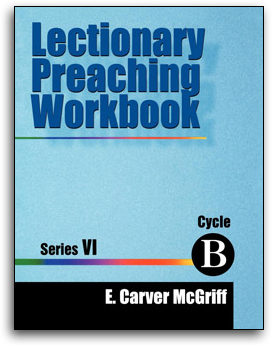
Lectionary Preaching Workbook
Series VI, Cycle B
COMMENTARY ON THE LESSONS
Lesson 1: Isaiah 61:10„62:3 (C, E)
Isaiah first bespeaks the expectations of the community, that God will soon bring his promised salvation into glorious new life, like the springing up of a new garden, or the grand apparel of a bridegroom, for this suffering, heroic people. Then, speaking as their evangelist, he promises to remain faithful in prayerful urging of God to get on with it. He pledges that at last, God will vindicate the Jewish people, will see to it that the other nations recognize their ñglory,'' and that they will be able to see themselves as a ñcrown of beauty.''
One may have several reactions to this passage. It is exalted poetry. It bespeaks a fiery faith which, despite almost continual disappointment and suffering, continues to look forward with unflinching expectation to the intervention of God on his peopleÍs behalf. We cannot know, of course, what the man on the street had in mind back then. We can only guess what devoted mothers thought in regard to their children as they tried to fall asleep at night, aware of the warlike history of their nationÍs existence. Little boys may very well have fantasized themselves as noble warriors. I donÍt think women had yet begun to think in such terms, but given the political climate of the times, it is likely that the average Jew was fairly certain that while prayer is powerful, meanwhile, one should keep oneÍs sword and shield close at hand.
As we think about our own world today, perhaps IsaiahÍs promise that in the midst of national crisis and personal privation he will persevere in prayer could be the focal point of a sermon. ñI will not keep silent,'' he pledged. So Jesus would tell of the householder who goes next door to borrow food for a late night visitor and refuses to be turned away, and so Isaiah also refuses to turn from his urgent supplication to God for deliverance. And so we, in times of personal or national difficulty, are wise to persevere in prayer as well, what George Buttrick once called ñpounding on the gates of heaven with bruised knuckles.''
Lesson 1: Sirach 3:2-6, 12-14 (RC)
One is to honor oneÍs parents and so be blessed.
Lesson 2: Galatians 4:4-7 (C); Galatians 3:23-25; 4:4-7 (E)
Paul thought of the law as a temporary means by which God kept people on the straight and narrow until such time as he would reveal himself in his own Son. From that point on, faith would be the means by which we are to live as God would have us live. The role of the law was comparable to that of a slave whose job it was to accompany children on their way to school to see that they got into no mischief. Henceforth, once we accept Christ into our lives „ once we receive the gift of faith „ we become trustworthy. We act properly and lovingly, not any longer because we are required to do so, but now because we wish to. And in this new attitude, we are ñadopted'' as sons (or today, we can say ñchildren'') of God. We are, in the sense of this analogy, like adopted children today who are loved by parents just as their own natural son or daughter is loved.
This is a somewhat idealized expectation. In reality, we still need law as a means of knowing what is ñright.'' When we drive to work, we may have a variety of ideas about proper speed, whether we have to wait out those pesky red lights when nothing is coming the other way, and so on. But there are laws which inform each of us how fast to drive and when to remain right where we are. Speaking as one who has paid a few speeding tickets, I admit to driving more slowly than my instincts would lead me to do because I know thereÍs a person out there somewhere with a radar gun keeping track of me. However, IÍm glad about that as it keeps me somewhat safer from others who also like to speed yet donÍt drive quite as well as, of course, I do.
This passage raises many difficult questions. In 1966, a book was published which shook the foundations of the Christian world. It rattled the windows and unsettled the resident preachers, and sent many a sincere but not necessarily bright clergy person off, as one author put the matter, ñin all directions.'' That book was Situation Ethics by Joseph Fletcher. He argued that there are three ways a moral decision is made. One, legalistically, like the Pharisees. Two, the antinomian way (without any scruples). Three, the situational way. He argued that if one truly loves, then one will always do what is right even though he may violate a rule as seen legalistically. Fletcher then proceeded to give convincing examples of situations in which each of the ten commandments might be broken in the service of love. This thesis opened floodgates which few expected. Suddenly, everyone was a lover, which translated meant they could break all sorts of moral ñrules'' by contending that they were serving the higher ethic of ñlove.'' It took a long time for some clergy to get their act back together enough to realize there must be limits to which we all agree. This was all happening within the Christian community precisely as the social revolution exploded on the campuses and in many cities like Boston, San Francisco, Los Angeles, and elsewhere. There were many excesses which resulted from all this. I recall waiting with some friends to buy a ticket to a movie in Evanston, Illinois, when several young female students from Northwestern walked by, calling out to each other, shouting every obscene word I have ever heard. They were nice-looking people too. I believe the theory of the day was that ñobscenity'' referred to Vietnam, racism, homelessness, not to dirty words. This was their way of making the point.
Paul would have said that while there was much merit in all of this, it was being done largely without love. ñIn your face'' radicalism is never loving, no matter how righteous the cause. We are to do what is right, we are to correct societal wrongs, we are to spend ourselves in worthy causes, all to be sure. But we are never to hurt other people needlessly in the process. ThatÍs where love must stand above all else, and remember something Bishop Fulton Sheen said: ñThere are three characteristics of a loving Christian „ kindness, kindness, and kindness.'' Meanwhile, we still need laws in order to know what the right and kind thing is in a given situation. PaulÍs point here seems to me to be that when we accept Christ in our lives, we go beyond law, we sacrifice and act in love because we want to.
Lesson 2: Colossians 3:12-21 (RC)
Gospel: Luke 2:22-40 (C, RC)
Take notice that Simeon was influenced by the Holy Spirit. This passage seems to put to rest the contention of some that the Holy Spirit was only given to us following the death of Jesus. This also calls to mind that faith is a gift, not an act of affirmation on the part of an individual. Here we see Simeon recognizing who Jesus was at the very beginning of the life of Jesus. Nunc Dimittus „ ñMine eyes have seen thy salvation.'' So Jesus was dedicated according to Jewish tradition.
There might be a sermon possibility in the parenthetically reported words: ñand a sword will pierce through your own soul also,'' a warning to Mary and Joseph that before the victory there would be much suffering. But my choice would be to preach here on the fact that faith is a gift, freely given. We canÍt be like the Queen in Alice Through The Looking Glass, who bragged, ñWhy, sometimes IÍve believed as many as six impossible things before breakfast.ñ The wind blows as it will, Jesus would tell us, and God will see to it that we receive faith at the right time. So much for those obnoxious if well-meaning folks who chastise friends and relatives for not believing as they do. What we can do is present ourselves in worship, raise our voices in prayer, and read our Bibles. The results of all this will be as God decides.
Gospel: John 1:1-18 (E)
(See Second Sunday After Christmas)
SERMON SUGGESTIONS
Title: ñPrayer Will Change Things''
Text: Isaiah 62:1
Theme: In the passage from Isaiah, we see the prophet promising his people a constant effort to persuade God to grant them their ñsalvation.'' ñI will not keep silent,'' he pledged. Here we encounter a fundamental of the faith, both Old and New Testament, that prayers will eventually be answered.
1. Prayer will change things. Illustrations of this are numerous.
2. We are to persevere in prayer. Jesus told of the fellow who pounded on his neighborÍs door, refusing to leave until his request was granted. He also used a figure of speech readily understandable to his audience, when he said that a father would not give his child a stone when the child asks for bread. All of this in the context of urging perseverance in prayer.
3. God will answer in ways which may not be our choice as we see things, yet which would have been had we known what God knows. I wanted roller skates in the worst way when I was about six. My parents, of course, knew IÍd end up skating in the street and I was too young. Two years later I got the skates. God is like that. WhatÍs best for us is well-known to God.
4. Faith teaches the way of patience. The New Testament repeatedly reminds us that our troubles are the means by which we mature and grow. Kierkegaard spoke of being ñsanctified by prayer, matured in conflict.'' There are lessons we must learn. All of us who have suffered at all can look back and see that it was thus that we became better men and women.
Title: ñSpirit Of The Son''
Text: Galatians 4:4-7
Theme: In the ideal, best of all possible worlds, there would be no need for laws and legalism, because we would all be motivated by love and would therefore, presumably, do what is good and right at all times. Actually, though, we would also need to be all-wise, and none of this is likely in this life. However, Paul has set before us an ideal toward which the Spirit would have us strive: perfect love.
Paul also was familiar with the distinction between law and legalism. I just read in todayÍs paper of a middle school girl from around here who received a Swiss army knife with all sorts of neat tools on it from one of her teachers. The gift was in appreciation for the work she did during the summer in helping him, along with other students, in some kind of archeological dig. She took her prize to school to show her friends. A teacher saw it, and now the kid has been suspended from school for three months because the school has a ñzero-tolerance'' rule about weapons and drugs. That strikes me as legalism.
1. Authentic faith produces unfailing kindness. We might all benefit by reading 1 Corinthians 13:4-7 every morning as we start our day. In this sense, many of our laws are unnecessary if we sincerely try to practice the faith.
2. However, weÍre still sinners. I had lunch with a man this past week whose twenty-something daughter began attending a very conservative church. She was happy there until a ñtrue believer'' warned her that her mother and father were doomed to Hell. Now I happen to know those people well. They are marvelous people and devout Christians. Hearing this, they went the second mile and invited those church members from their daughterÍs church to dinner. They hoped to show that theyÍre good people. After a pleasant enough evening, the visitors left. The next day they called the daughter and told her that their opinion was the same: the parents were doomed to Hell (because they didnÍt attend the right church). Forgive me, friends, but that is hateful religion. No matter how correct the theology of such people, their hateful lack of kindly love tells all (IÍm glad to report the daughter quickly left that church). Yet all of us are, in one way or another, sinners.
3. Laws are, therefore, necessary. ñRender unto Caesar,'' said Jesus. Surely he meant by that that there is a place for governments with all their necessary regulations. One requirement is that we either obey our community laws, or we change them through lawful means.
4. Love as a Christian, the product of faith, means we go beyond the law. Whatever we do is done with respect for those around us. We accept the challenge to make this world a better place for others. When our Bishop, Woodie White, first gathered some of us together after he was appointed, he said: ñIÍm not interested in your theology. IÍm interested in how you treat me, and how you treat other people.''
There are things which need to be changed. But the monster who blew up an abortion clinic, and the heartless radicals who sprayed paint all over a nice ladyÍs fur coat, are certainly the worst form of loving change. Kindness. If itÍs missing, nothing else makes up for that.
Title: ñPrecious Gift''
Text: Luke 2:25
Theme: Simeon recognized that Jesus was the Son of God because ñthe Holy Spirit was upon him.'' Faith is a gift of the Spirit. IÍm not talking about belief. One may accept the logic of another personÍs contention about the existence, the nature, and the activities of God. Faith is that more profound level of conviction that leads one to bet oneÍs life on its truth.
1. Faith is a gift. God will give it when the time is right for us. We can create conditions in which God can best work „ worship, prayer, Bible reading. However, many a person receives faith in the midst of some terrible trial. I remember Eddie RickenbackerÍs wonderful story of a month on a life raft with half a dozen men and only a couple fish and a bottle of water. Yet as they prayed, wonders happened. They survived. Most of them also received faith in the process.
2. Each of us is unique. Because of this, faith manifests itself in different ways in different people. Some folks become very emotional about their faith. Some are highly intellectual people who donÍt feel a faster pulse, yet their lives are changed. Still others quietly express their emotionality to God in private, yet remain outwardly composed to the world. We canÍt judge another personÍs faith except by that personÍs words and deeds (strike that word ñjudge'' „ but we do form opinions, like it or not).
3. Faith will always come to us if we are open to it. But God will decide how, when, and where. As preachers, we can sow the seed, but God will give the growth.
4. We are not to judge one another. I know a dear lady who was recently divorced. She had been very active in her church, a leader among the women, a servant to the congregation. Her pastor asked her to give up her offices, as he felt a divorced woman was a bad example for the congregation. Forgive me, folks, but it seems to me that when her church needed her most it let her down. There was no kindness in that. She found another church and now she feels loved again.
ADDITIONAL ILLUSTRATIONS
ñYour edict, King, was strong,
But all your strength is weakness itself against
The immortal unrecorded laws of God.
They are not merely now: they were, and shall be,
Operative for ever, beyond man utterly.''
„ Antigone (by Sophocles)
____________
A lady called the SPCA to report that there was a skunk in her basement. The expert suggested that she place bread crumbs on the basement steps and out the door. Then when the skunk was outside, she could close the door. The lady thanked the expert and did as suggested. An hour later, she called back and the expert asked if the skunk was gone. ñNo,'' she said. ñNow I have two skunks in my basement.'' (Re: How, when we give in to a small temptation, we often find it easier the next time.)
____________
Joseph Fletcher told of the taxi driver a friend met in a major city who said he was a Republican like his father before him. This was during a presidential campaign, and since the driver said he always voted a straight ticket, the friend said, ñThen I presume youÍll be voting for Senator so-and-so.'' ñNo,'' said the driver. ñSometimes you have to set aside your principles and do the right thing.'' Fletcher used this in the foreword to his book, then said this story would ñset the tone'' of the book.
____________
In a television play, The Bitter Choice, a nurse in an army hospital purposely made wounded men hate her so they would be motivated to get back on their feet and out of there as soon as possible. This story illustrates how sometimes love can require us to do something which appears unloving in the short run for the sake of the ultimate result.
____________
Psalm Of The Day
Psalm 148 (C) „ ñPraise the Lord!''
Psalm 127:1-5 (RC) „ ñUnless the Lord builds the house ...''
Psalm 147 (E) „ ñPraise the Lord!''
Prayer Of The Day
Thank you, Father, for the precious gift „ for prayer, for courage, for joy, for optimism, for anticipation, for laughter „ all of which are ours through that gift: thy Son. Amen.
Lesson 1: Isaiah 61:10„62:3 (C, E)
Isaiah first bespeaks the expectations of the community, that God will soon bring his promised salvation into glorious new life, like the springing up of a new garden, or the grand apparel of a bridegroom, for this suffering, heroic people. Then, speaking as their evangelist, he promises to remain faithful in prayerful urging of God to get on with it. He pledges that at last, God will vindicate the Jewish people, will see to it that the other nations recognize their ñglory,'' and that they will be able to see themselves as a ñcrown of beauty.''
One may have several reactions to this passage. It is exalted poetry. It bespeaks a fiery faith which, despite almost continual disappointment and suffering, continues to look forward with unflinching expectation to the intervention of God on his peopleÍs behalf. We cannot know, of course, what the man on the street had in mind back then. We can only guess what devoted mothers thought in regard to their children as they tried to fall asleep at night, aware of the warlike history of their nationÍs existence. Little boys may very well have fantasized themselves as noble warriors. I donÍt think women had yet begun to think in such terms, but given the political climate of the times, it is likely that the average Jew was fairly certain that while prayer is powerful, meanwhile, one should keep oneÍs sword and shield close at hand.
As we think about our own world today, perhaps IsaiahÍs promise that in the midst of national crisis and personal privation he will persevere in prayer could be the focal point of a sermon. ñI will not keep silent,'' he pledged. So Jesus would tell of the householder who goes next door to borrow food for a late night visitor and refuses to be turned away, and so Isaiah also refuses to turn from his urgent supplication to God for deliverance. And so we, in times of personal or national difficulty, are wise to persevere in prayer as well, what George Buttrick once called ñpounding on the gates of heaven with bruised knuckles.''
Lesson 1: Sirach 3:2-6, 12-14 (RC)
One is to honor oneÍs parents and so be blessed.
Lesson 2: Galatians 4:4-7 (C); Galatians 3:23-25; 4:4-7 (E)
Paul thought of the law as a temporary means by which God kept people on the straight and narrow until such time as he would reveal himself in his own Son. From that point on, faith would be the means by which we are to live as God would have us live. The role of the law was comparable to that of a slave whose job it was to accompany children on their way to school to see that they got into no mischief. Henceforth, once we accept Christ into our lives „ once we receive the gift of faith „ we become trustworthy. We act properly and lovingly, not any longer because we are required to do so, but now because we wish to. And in this new attitude, we are ñadopted'' as sons (or today, we can say ñchildren'') of God. We are, in the sense of this analogy, like adopted children today who are loved by parents just as their own natural son or daughter is loved.
This is a somewhat idealized expectation. In reality, we still need law as a means of knowing what is ñright.'' When we drive to work, we may have a variety of ideas about proper speed, whether we have to wait out those pesky red lights when nothing is coming the other way, and so on. But there are laws which inform each of us how fast to drive and when to remain right where we are. Speaking as one who has paid a few speeding tickets, I admit to driving more slowly than my instincts would lead me to do because I know thereÍs a person out there somewhere with a radar gun keeping track of me. However, IÍm glad about that as it keeps me somewhat safer from others who also like to speed yet donÍt drive quite as well as, of course, I do.
This passage raises many difficult questions. In 1966, a book was published which shook the foundations of the Christian world. It rattled the windows and unsettled the resident preachers, and sent many a sincere but not necessarily bright clergy person off, as one author put the matter, ñin all directions.'' That book was Situation Ethics by Joseph Fletcher. He argued that there are three ways a moral decision is made. One, legalistically, like the Pharisees. Two, the antinomian way (without any scruples). Three, the situational way. He argued that if one truly loves, then one will always do what is right even though he may violate a rule as seen legalistically. Fletcher then proceeded to give convincing examples of situations in which each of the ten commandments might be broken in the service of love. This thesis opened floodgates which few expected. Suddenly, everyone was a lover, which translated meant they could break all sorts of moral ñrules'' by contending that they were serving the higher ethic of ñlove.'' It took a long time for some clergy to get their act back together enough to realize there must be limits to which we all agree. This was all happening within the Christian community precisely as the social revolution exploded on the campuses and in many cities like Boston, San Francisco, Los Angeles, and elsewhere. There were many excesses which resulted from all this. I recall waiting with some friends to buy a ticket to a movie in Evanston, Illinois, when several young female students from Northwestern walked by, calling out to each other, shouting every obscene word I have ever heard. They were nice-looking people too. I believe the theory of the day was that ñobscenity'' referred to Vietnam, racism, homelessness, not to dirty words. This was their way of making the point.
Paul would have said that while there was much merit in all of this, it was being done largely without love. ñIn your face'' radicalism is never loving, no matter how righteous the cause. We are to do what is right, we are to correct societal wrongs, we are to spend ourselves in worthy causes, all to be sure. But we are never to hurt other people needlessly in the process. ThatÍs where love must stand above all else, and remember something Bishop Fulton Sheen said: ñThere are three characteristics of a loving Christian „ kindness, kindness, and kindness.'' Meanwhile, we still need laws in order to know what the right and kind thing is in a given situation. PaulÍs point here seems to me to be that when we accept Christ in our lives, we go beyond law, we sacrifice and act in love because we want to.
Lesson 2: Colossians 3:12-21 (RC)
Gospel: Luke 2:22-40 (C, RC)
Take notice that Simeon was influenced by the Holy Spirit. This passage seems to put to rest the contention of some that the Holy Spirit was only given to us following the death of Jesus. This also calls to mind that faith is a gift, not an act of affirmation on the part of an individual. Here we see Simeon recognizing who Jesus was at the very beginning of the life of Jesus. Nunc Dimittus „ ñMine eyes have seen thy salvation.'' So Jesus was dedicated according to Jewish tradition.
There might be a sermon possibility in the parenthetically reported words: ñand a sword will pierce through your own soul also,'' a warning to Mary and Joseph that before the victory there would be much suffering. But my choice would be to preach here on the fact that faith is a gift, freely given. We canÍt be like the Queen in Alice Through The Looking Glass, who bragged, ñWhy, sometimes IÍve believed as many as six impossible things before breakfast.ñ The wind blows as it will, Jesus would tell us, and God will see to it that we receive faith at the right time. So much for those obnoxious if well-meaning folks who chastise friends and relatives for not believing as they do. What we can do is present ourselves in worship, raise our voices in prayer, and read our Bibles. The results of all this will be as God decides.
Gospel: John 1:1-18 (E)
(See Second Sunday After Christmas)
SERMON SUGGESTIONS
Title: ñPrayer Will Change Things''
Text: Isaiah 62:1
Theme: In the passage from Isaiah, we see the prophet promising his people a constant effort to persuade God to grant them their ñsalvation.'' ñI will not keep silent,'' he pledged. Here we encounter a fundamental of the faith, both Old and New Testament, that prayers will eventually be answered.
1. Prayer will change things. Illustrations of this are numerous.
2. We are to persevere in prayer. Jesus told of the fellow who pounded on his neighborÍs door, refusing to leave until his request was granted. He also used a figure of speech readily understandable to his audience, when he said that a father would not give his child a stone when the child asks for bread. All of this in the context of urging perseverance in prayer.
3. God will answer in ways which may not be our choice as we see things, yet which would have been had we known what God knows. I wanted roller skates in the worst way when I was about six. My parents, of course, knew IÍd end up skating in the street and I was too young. Two years later I got the skates. God is like that. WhatÍs best for us is well-known to God.
4. Faith teaches the way of patience. The New Testament repeatedly reminds us that our troubles are the means by which we mature and grow. Kierkegaard spoke of being ñsanctified by prayer, matured in conflict.'' There are lessons we must learn. All of us who have suffered at all can look back and see that it was thus that we became better men and women.
Title: ñSpirit Of The Son''
Text: Galatians 4:4-7
Theme: In the ideal, best of all possible worlds, there would be no need for laws and legalism, because we would all be motivated by love and would therefore, presumably, do what is good and right at all times. Actually, though, we would also need to be all-wise, and none of this is likely in this life. However, Paul has set before us an ideal toward which the Spirit would have us strive: perfect love.
Paul also was familiar with the distinction between law and legalism. I just read in todayÍs paper of a middle school girl from around here who received a Swiss army knife with all sorts of neat tools on it from one of her teachers. The gift was in appreciation for the work she did during the summer in helping him, along with other students, in some kind of archeological dig. She took her prize to school to show her friends. A teacher saw it, and now the kid has been suspended from school for three months because the school has a ñzero-tolerance'' rule about weapons and drugs. That strikes me as legalism.
1. Authentic faith produces unfailing kindness. We might all benefit by reading 1 Corinthians 13:4-7 every morning as we start our day. In this sense, many of our laws are unnecessary if we sincerely try to practice the faith.
2. However, weÍre still sinners. I had lunch with a man this past week whose twenty-something daughter began attending a very conservative church. She was happy there until a ñtrue believer'' warned her that her mother and father were doomed to Hell. Now I happen to know those people well. They are marvelous people and devout Christians. Hearing this, they went the second mile and invited those church members from their daughterÍs church to dinner. They hoped to show that theyÍre good people. After a pleasant enough evening, the visitors left. The next day they called the daughter and told her that their opinion was the same: the parents were doomed to Hell (because they didnÍt attend the right church). Forgive me, friends, but that is hateful religion. No matter how correct the theology of such people, their hateful lack of kindly love tells all (IÍm glad to report the daughter quickly left that church). Yet all of us are, in one way or another, sinners.
3. Laws are, therefore, necessary. ñRender unto Caesar,'' said Jesus. Surely he meant by that that there is a place for governments with all their necessary regulations. One requirement is that we either obey our community laws, or we change them through lawful means.
4. Love as a Christian, the product of faith, means we go beyond the law. Whatever we do is done with respect for those around us. We accept the challenge to make this world a better place for others. When our Bishop, Woodie White, first gathered some of us together after he was appointed, he said: ñIÍm not interested in your theology. IÍm interested in how you treat me, and how you treat other people.''
There are things which need to be changed. But the monster who blew up an abortion clinic, and the heartless radicals who sprayed paint all over a nice ladyÍs fur coat, are certainly the worst form of loving change. Kindness. If itÍs missing, nothing else makes up for that.
Title: ñPrecious Gift''
Text: Luke 2:25
Theme: Simeon recognized that Jesus was the Son of God because ñthe Holy Spirit was upon him.'' Faith is a gift of the Spirit. IÍm not talking about belief. One may accept the logic of another personÍs contention about the existence, the nature, and the activities of God. Faith is that more profound level of conviction that leads one to bet oneÍs life on its truth.
1. Faith is a gift. God will give it when the time is right for us. We can create conditions in which God can best work „ worship, prayer, Bible reading. However, many a person receives faith in the midst of some terrible trial. I remember Eddie RickenbackerÍs wonderful story of a month on a life raft with half a dozen men and only a couple fish and a bottle of water. Yet as they prayed, wonders happened. They survived. Most of them also received faith in the process.
2. Each of us is unique. Because of this, faith manifests itself in different ways in different people. Some folks become very emotional about their faith. Some are highly intellectual people who donÍt feel a faster pulse, yet their lives are changed. Still others quietly express their emotionality to God in private, yet remain outwardly composed to the world. We canÍt judge another personÍs faith except by that personÍs words and deeds (strike that word ñjudge'' „ but we do form opinions, like it or not).
3. Faith will always come to us if we are open to it. But God will decide how, when, and where. As preachers, we can sow the seed, but God will give the growth.
4. We are not to judge one another. I know a dear lady who was recently divorced. She had been very active in her church, a leader among the women, a servant to the congregation. Her pastor asked her to give up her offices, as he felt a divorced woman was a bad example for the congregation. Forgive me, folks, but it seems to me that when her church needed her most it let her down. There was no kindness in that. She found another church and now she feels loved again.
ADDITIONAL ILLUSTRATIONS
ñYour edict, King, was strong,
But all your strength is weakness itself against
The immortal unrecorded laws of God.
They are not merely now: they were, and shall be,
Operative for ever, beyond man utterly.''
„ Antigone (by Sophocles)
____________
A lady called the SPCA to report that there was a skunk in her basement. The expert suggested that she place bread crumbs on the basement steps and out the door. Then when the skunk was outside, she could close the door. The lady thanked the expert and did as suggested. An hour later, she called back and the expert asked if the skunk was gone. ñNo,'' she said. ñNow I have two skunks in my basement.'' (Re: How, when we give in to a small temptation, we often find it easier the next time.)
____________
Joseph Fletcher told of the taxi driver a friend met in a major city who said he was a Republican like his father before him. This was during a presidential campaign, and since the driver said he always voted a straight ticket, the friend said, ñThen I presume youÍll be voting for Senator so-and-so.'' ñNo,'' said the driver. ñSometimes you have to set aside your principles and do the right thing.'' Fletcher used this in the foreword to his book, then said this story would ñset the tone'' of the book.
____________
In a television play, The Bitter Choice, a nurse in an army hospital purposely made wounded men hate her so they would be motivated to get back on their feet and out of there as soon as possible. This story illustrates how sometimes love can require us to do something which appears unloving in the short run for the sake of the ultimate result.
____________
Psalm Of The Day
Psalm 148 (C) „ ñPraise the Lord!''
Psalm 127:1-5 (RC) „ ñUnless the Lord builds the house ...''
Psalm 147 (E) „ ñPraise the Lord!''
Prayer Of The Day
Thank you, Father, for the precious gift „ for prayer, for courage, for joy, for optimism, for anticipation, for laughter „ all of which are ours through that gift: thy Son. Amen.
