
Forgiveness
Sermon
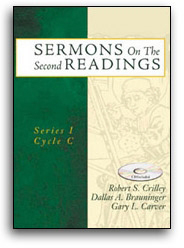
Sermons On The Second Readings
Series I, Cycle C
In his book What's So Amazing About Grace? Philip Yancey tells of a conversation he once had with two scientists who had just emerged from the biosphere near Tucson, Arizona.1 For those of you who aren't familiar with what that is -- several years ago, an isolation experiment was conducted, in which a team of four men and four women lived inside a glass-enclosed structure, entirely shut off from the outer world. The general idea was to see if humankind might one day be able to exist on another planet by recreating a portion of the earth. Consequently, the scientists were expected to be self-reliant, producing everything they would need for survival -- including their own oxygen.
Within the biosphere, they had access to fields and forests, jungles and deserts. There was even an ocean (on a much smaller scale, of course). I guess you could think of it as a second attempt at the Garden of Eden. And actually, that may not be such a bad analogy, because they ended up encountering some of the same difficulties that Adam and Eve ran into the first time around. What these scientists admitted to Yancey is that, within a matter of months, the team had splintered into two factions. A minor misunderstanding led to mistrust, which quickly spiraled into accusations of misconduct, and before long, the two groups weren't even speaking. Eventually, the situation became so tense that the experiment had to be called off. In the final report, it was concluded that unless we learn how to forgive each other, it's not likely that we'll survive on this planet much less any other.
One of the guiding principles of economics is that when demand is high and supply low, value increases. If you ask me, that ought to make forgiveness the most precious commodity in the world. I recently heard, for example, of an Apology Sound-Off Line, operated by an organization in Southern California. From what I was able to gather, it offers callers the chance to confess their wrongdoing and express contrition -- albeit to an answering machine. And while that may strike you as being rather artificial, apparently business is booming. The service receives an average of 200 calls a day, seven days a week.
Obviously, the demand for forgiveness is exceedingly high. As Paul reminded the Romans, "All have sinned and fall short of the glory of God" (Romans 3:23). That being the case, you would think we'd be doing a better job on the supply side of the equation, by extending forgiveness to one another. After all, if practice makes perfect, this is certainly an area where we're given plenty of opportunities to practice. But you know as well as I, that it's not that simple. Somehow, turning the other cheek has come to mean looking the other way, which is liable to give the impression that we're ignoring the offense or, worse yet, condoning it. Despite hundreds of thousands of sermons on the subject down through the centuries, most of us still find forgiveness to be awkward, painful, and in a word -- difficult.
Indeed, at times, it doesn't even feel natural. And maybe that's because it isn't! Like it or not, we live in a world that is very ungracious. It's dog-eat-dog out there, not dog-forgive-dog. Society seems insistent on forever pointing out our shortcomings. When exam papers are handed back in school, it's never the correct answers that are highlighted, only the mistakes. When advertisers make their sales pitch on television, invariably the message is that something is lacking in our lives. We're not popular enough, or powerful enough, or prosperous enough. It's no wonder we are so quick to find fault with one another -- that's precisely where we're all taught to focus.
But even more troublesome is the fact that unilateral forgiveness often strikes us as being blatantly unfair. No one wants to be taken advantage of, and excusing a grievous wrong simply because the other person happens to stammer out the words, "I'm sorry," tends to make us feel weak and capitulant, like some mousy Caspar Milquetoast, who is always being pushed around. As a result, whenever we've been injured, we can usually come up with a host of what we think are perfectly legitimate reasons for standing our ground. They need to learn a lesson, we'll say. Letting them off the hook now will only encourage more irresponsible behavior in the future. I'm the one who was hurt here -- it's not up to me to make the first move.
Let's face it. Unconditional forgiveness is not just a difficult act to embrace; it's a hard concept even to swallow. Which is why we may flinch a bit when we hear a scripture passage like this one. Notice that Paul doesn't mention that the other person is remorseful or repentant. He simply says, "Bear with one another and, if anyone has a complaint against another, forgive each other" (v. 13a). Easier said than done, to be sure. But then again, Paul never claims that it will be easy. Nor does he promise that it will be completely satisfying. He knows that the nagging memory of the offense still remains, and that when the wounds run deep, the healing will be slow. The reason he keeps preaching forgiveness is not because it's easy, but because it is essential for our survival. And I'd like to offer a few observations as to why this is the case.
The first is theological; the other two more practical. When it comes to forgiveness, most of us believe that a mere apology without any further consequences just doesn't cut it. Frankly, that's part of what continues to baffle us about grace. It goes against the intuitive sense we all possess that, in the face of a heinous crime, the guilty party cannot be allowed to walk away unpunished. We may debate the appropriate level of that punishment and the means by which it is applied. However, we all agree that, one way or another, a price must be paid. The Apostle Paul wholeheartedly concurs. Only the way he sees it, the price has already been paid -- by Jesus Christ. On the cross, God offered up the only Son rather than give up on all of us.
Some of you may be remember the movie The Last Emperor, which tells the story of the young boy who became the final emperor of China, prior to the Communist revolution. As you might imagine, he lived a life of luxurious splendor, surrounded by a multitude of servants ready to fulfill his every desire. At one point in the film, his brother ventures the question, "What happens when you misbehave?" Giggling with delight, the boy emperor explains, "Someone else gets punished." His brother is skeptical. So the boy emperor breaks a nearby vase, and sure enough, one of the servants is promptly beaten. According to Paul, just the opposite happened with Christ. The servants misbehaved, and the King was punished.
Exactly how this resulted in our being forgiven is a mystery we will never fully comprehend. Paul readily admits that the cross seems absurd to some, and abhorrent to others. But there's no denying that it cost God something very dear, and that's precisely why Paul is so insistent that we forgive each other. "Just as the Lord has forgiven you," he tells the Colossians, "so you also must forgive" (v. 13b). He's not suggesting that God will forgive us only to the extent that we forgive others. If God's forgiveness operated under those conditions, we couldn't very well call it grace. What Paul is saying is that if we can't open our hearts to those around us, then our hearts are likely to remain closed to God as well. In other words, the same stubborn pride that keeps us from extending forgiveness may also keep us from experiencing it. We have to be willing to reach out in order to reach up.
My second observation concerning forgiveness is that, given the alternatives, it's the one thing that truly works. The other options, of course, are resentment and revenge -- neither of which offers an escape from the pain that we're dealing with in the first place. In fact, our word "resentment" literally means "to feel again." It's like picking at a scab. The wound never heals, because we never allow it to. We keep reliving the event in our minds, traveling back to the source of the suffering and being hurt by it all over again. However, since none of us can change the past, why would we want to remain imprisoned there?
Revenge is likewise a trap -- only instead of imprisoning us in the past, it locks us into a future of forever trying to even the score. And therein lies the primary flaw with the law of revenge. It never gets what it's after. Fairness and parity are never achieved. On the contrary, it ties the injured and injurer together in a never-ending cycle, which usually spins out of the control of both and takes on a life of it own. The taste of revenge may seem sweet, but when dinner is served, we're the ones who end up being eaten alive. That's why it's called an all-consuming passion.
Forgiveness is a way to be released from the self-inflicted punishment of resentment and the self-destructive path of revenge. It's not an easy way out. We don't automatically forget the wrong that was done to us. But at least we're now free to move forward, because it's no longer setting the agenda for our lives.
Which brings me to my final observation: Often the person who is most healed by forgiveness is the one actually doing the forgiving. Frederick Buechner put it like this, "When somebody you've wronged forgives you, you're spared the dull and self-diminishing throb of a guilty conscience. When you forgive somebody who has wronged you, you're spared the dismal corrosion of bitterness and wounded pride. For both parties, forgiveness means the freedom again to be at peace inside their own skin and to be glad in each other's presence."2
Several years ago, a fifth-grade boy named Jacob was killed just a few blocks from the church. He was riding his bike, lost his balance, and fell in front of a passing car. There were no charges filed, because the accident was deemed unavoidable. However, the tragedy was compounded by the fact that the driver was a high school student.
Since Jacob's family had no church of their own, I went to the house the following day and offered the use of our sanctuary for a memorial service. Needless to say, it was a very emotional meeting. We wept together over what had happened, and wondered together about what might have been and now never would. Their desire was for the service to be a celebration of Jacob's life. "He was such a happy child," his mother explained, "that I can't imagine having one of those dreary, somber funerals. It just wouldn't be right."
His father asked if he could have a moment to speak during the service. My initial impression was that he simply wanted to share some personal thoughts, and to thank the community for the outpouring of support that the family had received. However, when he came forward, he brought with him a small potted plant. He talked of the pain that he had been dealing with, and the wide range of emotions he continued to experience. "They say that time heals all wounds," he observed, "but I can't wait that long. I need to begin the healing process now. There is a young man here this morning who is hurting every bit as much as we are."
Jacob's father walked out into the sanctuary carrying the plant and presented it to the driver of the car which had killed his son. The two embraced, and between tears, briefly spoke. I have no idea what was said, but as far as I'm concerned, the sermon that day had already been preached. It was an act of such courage and compassion that a lot of us didn't want to leave the church, even after the service was over. It was as if we had witnessed something very precious -- something we all yearn for, but that the world doesn't supply very often. Forgiveness. It's not easy, of course. Nor do we suddenly stop hurting once we forgive. However, it is the surest way to survive the pain, and ultimately, to be set free from it.
____________
1. Philip Yancey, What's So Amazing About Grace? (Grand Rapids: Zondervan Publishing, 1997), p. 83.
2. Frederick Buechner, Wishful Thinking: A Theological ABC (New York: Harper & Row, Publishers), p. 29.
Within the biosphere, they had access to fields and forests, jungles and deserts. There was even an ocean (on a much smaller scale, of course). I guess you could think of it as a second attempt at the Garden of Eden. And actually, that may not be such a bad analogy, because they ended up encountering some of the same difficulties that Adam and Eve ran into the first time around. What these scientists admitted to Yancey is that, within a matter of months, the team had splintered into two factions. A minor misunderstanding led to mistrust, which quickly spiraled into accusations of misconduct, and before long, the two groups weren't even speaking. Eventually, the situation became so tense that the experiment had to be called off. In the final report, it was concluded that unless we learn how to forgive each other, it's not likely that we'll survive on this planet much less any other.
One of the guiding principles of economics is that when demand is high and supply low, value increases. If you ask me, that ought to make forgiveness the most precious commodity in the world. I recently heard, for example, of an Apology Sound-Off Line, operated by an organization in Southern California. From what I was able to gather, it offers callers the chance to confess their wrongdoing and express contrition -- albeit to an answering machine. And while that may strike you as being rather artificial, apparently business is booming. The service receives an average of 200 calls a day, seven days a week.
Obviously, the demand for forgiveness is exceedingly high. As Paul reminded the Romans, "All have sinned and fall short of the glory of God" (Romans 3:23). That being the case, you would think we'd be doing a better job on the supply side of the equation, by extending forgiveness to one another. After all, if practice makes perfect, this is certainly an area where we're given plenty of opportunities to practice. But you know as well as I, that it's not that simple. Somehow, turning the other cheek has come to mean looking the other way, which is liable to give the impression that we're ignoring the offense or, worse yet, condoning it. Despite hundreds of thousands of sermons on the subject down through the centuries, most of us still find forgiveness to be awkward, painful, and in a word -- difficult.
Indeed, at times, it doesn't even feel natural. And maybe that's because it isn't! Like it or not, we live in a world that is very ungracious. It's dog-eat-dog out there, not dog-forgive-dog. Society seems insistent on forever pointing out our shortcomings. When exam papers are handed back in school, it's never the correct answers that are highlighted, only the mistakes. When advertisers make their sales pitch on television, invariably the message is that something is lacking in our lives. We're not popular enough, or powerful enough, or prosperous enough. It's no wonder we are so quick to find fault with one another -- that's precisely where we're all taught to focus.
But even more troublesome is the fact that unilateral forgiveness often strikes us as being blatantly unfair. No one wants to be taken advantage of, and excusing a grievous wrong simply because the other person happens to stammer out the words, "I'm sorry," tends to make us feel weak and capitulant, like some mousy Caspar Milquetoast, who is always being pushed around. As a result, whenever we've been injured, we can usually come up with a host of what we think are perfectly legitimate reasons for standing our ground. They need to learn a lesson, we'll say. Letting them off the hook now will only encourage more irresponsible behavior in the future. I'm the one who was hurt here -- it's not up to me to make the first move.
Let's face it. Unconditional forgiveness is not just a difficult act to embrace; it's a hard concept even to swallow. Which is why we may flinch a bit when we hear a scripture passage like this one. Notice that Paul doesn't mention that the other person is remorseful or repentant. He simply says, "Bear with one another and, if anyone has a complaint against another, forgive each other" (v. 13a). Easier said than done, to be sure. But then again, Paul never claims that it will be easy. Nor does he promise that it will be completely satisfying. He knows that the nagging memory of the offense still remains, and that when the wounds run deep, the healing will be slow. The reason he keeps preaching forgiveness is not because it's easy, but because it is essential for our survival. And I'd like to offer a few observations as to why this is the case.
The first is theological; the other two more practical. When it comes to forgiveness, most of us believe that a mere apology without any further consequences just doesn't cut it. Frankly, that's part of what continues to baffle us about grace. It goes against the intuitive sense we all possess that, in the face of a heinous crime, the guilty party cannot be allowed to walk away unpunished. We may debate the appropriate level of that punishment and the means by which it is applied. However, we all agree that, one way or another, a price must be paid. The Apostle Paul wholeheartedly concurs. Only the way he sees it, the price has already been paid -- by Jesus Christ. On the cross, God offered up the only Son rather than give up on all of us.
Some of you may be remember the movie The Last Emperor, which tells the story of the young boy who became the final emperor of China, prior to the Communist revolution. As you might imagine, he lived a life of luxurious splendor, surrounded by a multitude of servants ready to fulfill his every desire. At one point in the film, his brother ventures the question, "What happens when you misbehave?" Giggling with delight, the boy emperor explains, "Someone else gets punished." His brother is skeptical. So the boy emperor breaks a nearby vase, and sure enough, one of the servants is promptly beaten. According to Paul, just the opposite happened with Christ. The servants misbehaved, and the King was punished.
Exactly how this resulted in our being forgiven is a mystery we will never fully comprehend. Paul readily admits that the cross seems absurd to some, and abhorrent to others. But there's no denying that it cost God something very dear, and that's precisely why Paul is so insistent that we forgive each other. "Just as the Lord has forgiven you," he tells the Colossians, "so you also must forgive" (v. 13b). He's not suggesting that God will forgive us only to the extent that we forgive others. If God's forgiveness operated under those conditions, we couldn't very well call it grace. What Paul is saying is that if we can't open our hearts to those around us, then our hearts are likely to remain closed to God as well. In other words, the same stubborn pride that keeps us from extending forgiveness may also keep us from experiencing it. We have to be willing to reach out in order to reach up.
My second observation concerning forgiveness is that, given the alternatives, it's the one thing that truly works. The other options, of course, are resentment and revenge -- neither of which offers an escape from the pain that we're dealing with in the first place. In fact, our word "resentment" literally means "to feel again." It's like picking at a scab. The wound never heals, because we never allow it to. We keep reliving the event in our minds, traveling back to the source of the suffering and being hurt by it all over again. However, since none of us can change the past, why would we want to remain imprisoned there?
Revenge is likewise a trap -- only instead of imprisoning us in the past, it locks us into a future of forever trying to even the score. And therein lies the primary flaw with the law of revenge. It never gets what it's after. Fairness and parity are never achieved. On the contrary, it ties the injured and injurer together in a never-ending cycle, which usually spins out of the control of both and takes on a life of it own. The taste of revenge may seem sweet, but when dinner is served, we're the ones who end up being eaten alive. That's why it's called an all-consuming passion.
Forgiveness is a way to be released from the self-inflicted punishment of resentment and the self-destructive path of revenge. It's not an easy way out. We don't automatically forget the wrong that was done to us. But at least we're now free to move forward, because it's no longer setting the agenda for our lives.
Which brings me to my final observation: Often the person who is most healed by forgiveness is the one actually doing the forgiving. Frederick Buechner put it like this, "When somebody you've wronged forgives you, you're spared the dull and self-diminishing throb of a guilty conscience. When you forgive somebody who has wronged you, you're spared the dismal corrosion of bitterness and wounded pride. For both parties, forgiveness means the freedom again to be at peace inside their own skin and to be glad in each other's presence."2
Several years ago, a fifth-grade boy named Jacob was killed just a few blocks from the church. He was riding his bike, lost his balance, and fell in front of a passing car. There were no charges filed, because the accident was deemed unavoidable. However, the tragedy was compounded by the fact that the driver was a high school student.
Since Jacob's family had no church of their own, I went to the house the following day and offered the use of our sanctuary for a memorial service. Needless to say, it was a very emotional meeting. We wept together over what had happened, and wondered together about what might have been and now never would. Their desire was for the service to be a celebration of Jacob's life. "He was such a happy child," his mother explained, "that I can't imagine having one of those dreary, somber funerals. It just wouldn't be right."
His father asked if he could have a moment to speak during the service. My initial impression was that he simply wanted to share some personal thoughts, and to thank the community for the outpouring of support that the family had received. However, when he came forward, he brought with him a small potted plant. He talked of the pain that he had been dealing with, and the wide range of emotions he continued to experience. "They say that time heals all wounds," he observed, "but I can't wait that long. I need to begin the healing process now. There is a young man here this morning who is hurting every bit as much as we are."
Jacob's father walked out into the sanctuary carrying the plant and presented it to the driver of the car which had killed his son. The two embraced, and between tears, briefly spoke. I have no idea what was said, but as far as I'm concerned, the sermon that day had already been preached. It was an act of such courage and compassion that a lot of us didn't want to leave the church, even after the service was over. It was as if we had witnessed something very precious -- something we all yearn for, but that the world doesn't supply very often. Forgiveness. It's not easy, of course. Nor do we suddenly stop hurting once we forgive. However, it is the surest way to survive the pain, and ultimately, to be set free from it.
____________
1. Philip Yancey, What's So Amazing About Grace? (Grand Rapids: Zondervan Publishing, 1997), p. 83.
2. Frederick Buechner, Wishful Thinking: A Theological ABC (New York: Harper & Row, Publishers), p. 29.
