
Fourth Sunday Of Advent
Preaching
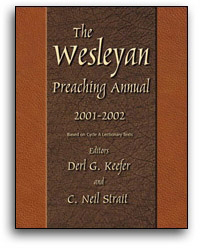
THE WESLEYAN PREACHING ANNUAL 2001--2002
WORSHIP HELPS
CALL TO WORSHIP
Leader: The Virgin Mary has given birth to a child.
People: And His name is Jesus.
Leader: He is God with us!
People: He has brought good news to Jerusalem.
Leader: And to the world.
People: Let us lift up our voices with a shout.
All: He is our God!
OFFERING THOUGHT
"Make vows to the Lord your God and fulfill them; let all the neighboring lands bring gifts to the One to be feared." (Psalm 76:11)
BENEDICTION
Christmas Child wrapped in salvation's robes, accept our gift of love. May we bow our knees before Your throne of glory.
SERMON BRIEFS
Begin At The Center!
Romans 1:1--7
Beginning is always the hardest. If you can get those first few words down on paper, the rest somehow seems to follow. But how to begin? That is the question that has puzzled and frustrated writers across the ages. We can't know if the Apostle ever struggled with this common problem, but if he did, this particular piece of writing must have presented the "How do I begin?" challenge in the extreme. The Epistle to the Romans is arguably the most complete statement of Christian doctrine in all of scripture. Just how does one begin such a treatise? Apparently, Paul's answer is that you go to the heart - to the center of it all.
Paul begins this greatest of all expositions of Christian doctrine by focusing everything that is to come squarely in the person of Jesus Christ. It is, after all, the doctrines of Christianity that Paul will be teaching and explaining in this epistle. The person and work of Jesus is the absolute bottom line of the Christian religion. If you're going to talk about Christianity, you necessarily begin by talking about Him.
Paul begins. This Christ--centered reality is related first of all to Paul's life itself. Throughout his writings it is evident that Christ has become the starting point from which Paul interprets all of life. Here in Romans 1, Paul is self--described as a "servant of Christ Jesus." Paul's self--understanding flows directly out of his relationship to Christ. He confesses his vocation, his calling, to be that of an "apostle," and as one "set apart for the gospel of God." Paul views the purpose for his life, his reason for being, through the prism of his affirmation about Jesus Christ. Such unwavering certainty about the meaning and purpose of his life enables Paul to endure the hardships and unforeseen circumstances that so characterized his apostolic service.
Second, Paul claims that the gospel itself, the good news, is essentially about Jesus. The Old Testament scriptures unfold the drama of His place in salvation history. The phrase, "a descendant of David," locates Jesus in the midst of Israel's story. He is the promised Messiah. The Spirit Himself bears witness that Jesus is the centerpiece of God's dramatic plan to reveal Himself to the world. The entire history of revelation culminates in His appearance on this earth as the long awaited son of David and is eternally affirmed in His resurrection from the dead. What Paul asserts here is nothing less than the fact that human history really is His Story! It all centers around Him. His is the main character in the human drama.
Third, Paul insists that Jesus Christ is the centerpiece of human redemption. It is "through Him" that grace is given. Jesus is the means, the channel through which the amazing grace of God will be poured out on humankind. It is through Him, and for the sake of bringing honor to His name, that apostleship, commissioned ministry, is employed as a means of heralding the good news. It is through Him, that all people, including even the citizens of Rome have been called to the glories of sainthood - set apart for God and God alone. It all centers in Him. And throughout the rest of this doctrinal text called Romans, Paul will never venture far from the person and work of Christ, because He is Christianity!
In the Advent/Christmas season, we typically hear many sincere and well--intentioned pleas to "keep Christ in Christmas!" Such messages testify eloquently as to how far we have ventured from the center of reality. Keep Christ in Christmas indeed! The Apostle would argue that you can't keep Him out of anything! The fact that we even suggest such betrays our divorce from reality as Paul understands it. For Christians, Christ is always at the center ... of everything! To think or act otherwise is to be completely out of step with how things really are. He is the reason behind it all. As this apostle said elsewhere "in Him all things hold together" (Colossians 1:17). You must necessarily start at the center. Christ is the center of it all. He is the alpha and the omega. He is the beginning and the end.
J. Michael Walters
The Wesleyan tradition combines the "optimism of grace" with the clarion call to "social holiness" to provide a balanced, wholistic approach to vital Christian faith.
The Birth Of Jesus
Matthew 1:18--25
Introduction
On the front cover of a Christmas card were the words "History is crowded with men who would be gods." On the inside of the card were the pictures of some of the well known leaders of history: Alexander the Great, Tutankhamen (King Tut), Julius Caesar, Maharishi Mahesh Yogi, Adolf Hitler, Vladimir Lenin, Napoleon Bonaparte, Buddha and Mao Tse Tung. The last page of the card had the words under the picture of the Christ Child, "But only one God who would be man." The birth of Jesus was unparalleled by any other birth in all of history.
I. The birth of Jesus told of a miraculous origin. (vv. 18, 20, 22)
A. Prophecies predicted His coming (v. 22). Hundreds of years before the birth of Christ the Scriptures told many of the details of His birth (city, Herod's cruel treatment of the children, fleeing to Egypt, His life and ministry, His death, etc.).
B. Angels confirmed His coming (v. 20). The angels confirmed the message not only to Joseph, but also to Elizabeth, Mary, and the shepherds.
C. It was a virgin birth (v. 18). This was truly a miracle of God. The Holy Spirit planted the seed of life in the womb of Mary who gave birth to the only person born without a biological father. Non--believers stumble over this mighty act of God, but the virgin birth is critical to the Christian faith. It is an absolutely necessary doctrine.
When Adam sinned in the Garden of Eden, his sin nature was transferred to every person born through a biological father. The sin nature does not come through the mother, but is passed through the father. Therefore, it was essential for Christ to have a "sinless Father" in order to be the perfect sacrifice for the sins of the world. We all have sinned by nature and actions, but Christ was born free of sin because of His sinless birth.
II. The birth of Jesus presents majestic opportunities. (v. 21)
A. We see the Father (John 14:6--11).
B. We experience Emmanuel - "God with us" (v. 23).
C. We can know our Savior (v. 21). God's law decreed that we should die for our sin, but God's love declared that we could receive a free pardon. Truly we received a marvelous message.
III. The birth of Jesus provides a marvelous offer. (v. 21b)
A little boy was involved in the annual children's play in the Christmas service. As one of the angels he was simply to announce, "Behold I bring you good tidings of great joy." Forgetting his lines he blurted out, "Hey, have I got good news for you."
A. Forgives our sins when we ask (1 John 1:9). The thief on the cross received salvation immediately just for the asking. Time nor opportunity provided anything for the thief to do. We talk a lot about God's grace, but in too many minds, salvation is still tied up in our works. If salvation can be provided by anything other than the sacrifice on the cross, it is not all of Christ.
B. Jesus wants to help us live abundantly while we are alive (John 10:10b; 14:27; Galatians 5:22, 23).
C. All of heaven rejoices when our name is added to the roll book of heaven (Luke 10:20; Luke 15:7, 10, 32).
D. Jesus is preparing an eternal home for us with Him (John 14:1--4).
Conclusion
The birth of Jesus can only be described by superlatives. It was miraculous, majestic and marvelous.
One morning as I was walking down by the river, I walked toward a host of sea gulls and ducks. As I approached these birds they slowly and hesitantly began to move or fly away. They could have stayed right where they were; I intended them no harm. But they were frightened away by my intrusion. My size was too threatening and I wasn't one of them. I wondered if there was any way I could have been accepted by these birds.
Of necessity, I would need to become one of them in order to be fully accepted by them. I would need to take on their looks, characteristics, habits and practices. I would need to become a bird. Therein is the marvel of Christmas. God became like the ones He wanted to help. He became like one of us. Jesus came as God in the flesh.
God was seen as too powerful and holy to walk freely among us. Man was afraid of Him. Man ran for cover and cowered in fear when God drew close, much like the birds did when I walked into their midst.
God knew He would need to become like us before we would truly get to know Him. The Old Testament prophet Isaiah said, "... [she] will call his name Immanuel" (Isaiah 7:14). The name means "God with us." So much did God identify with us that Jesus said, "If you have seen me, you have seen what God is like."
Bill Hossler
CALL TO WORSHIP
Leader: The Virgin Mary has given birth to a child.
People: And His name is Jesus.
Leader: He is God with us!
People: He has brought good news to Jerusalem.
Leader: And to the world.
People: Let us lift up our voices with a shout.
All: He is our God!
OFFERING THOUGHT
"Make vows to the Lord your God and fulfill them; let all the neighboring lands bring gifts to the One to be feared." (Psalm 76:11)
BENEDICTION
Christmas Child wrapped in salvation's robes, accept our gift of love. May we bow our knees before Your throne of glory.
SERMON BRIEFS
Begin At The Center!
Romans 1:1--7
Beginning is always the hardest. If you can get those first few words down on paper, the rest somehow seems to follow. But how to begin? That is the question that has puzzled and frustrated writers across the ages. We can't know if the Apostle ever struggled with this common problem, but if he did, this particular piece of writing must have presented the "How do I begin?" challenge in the extreme. The Epistle to the Romans is arguably the most complete statement of Christian doctrine in all of scripture. Just how does one begin such a treatise? Apparently, Paul's answer is that you go to the heart - to the center of it all.
Paul begins this greatest of all expositions of Christian doctrine by focusing everything that is to come squarely in the person of Jesus Christ. It is, after all, the doctrines of Christianity that Paul will be teaching and explaining in this epistle. The person and work of Jesus is the absolute bottom line of the Christian religion. If you're going to talk about Christianity, you necessarily begin by talking about Him.
Paul begins. This Christ--centered reality is related first of all to Paul's life itself. Throughout his writings it is evident that Christ has become the starting point from which Paul interprets all of life. Here in Romans 1, Paul is self--described as a "servant of Christ Jesus." Paul's self--understanding flows directly out of his relationship to Christ. He confesses his vocation, his calling, to be that of an "apostle," and as one "set apart for the gospel of God." Paul views the purpose for his life, his reason for being, through the prism of his affirmation about Jesus Christ. Such unwavering certainty about the meaning and purpose of his life enables Paul to endure the hardships and unforeseen circumstances that so characterized his apostolic service.
Second, Paul claims that the gospel itself, the good news, is essentially about Jesus. The Old Testament scriptures unfold the drama of His place in salvation history. The phrase, "a descendant of David," locates Jesus in the midst of Israel's story. He is the promised Messiah. The Spirit Himself bears witness that Jesus is the centerpiece of God's dramatic plan to reveal Himself to the world. The entire history of revelation culminates in His appearance on this earth as the long awaited son of David and is eternally affirmed in His resurrection from the dead. What Paul asserts here is nothing less than the fact that human history really is His Story! It all centers around Him. His is the main character in the human drama.
Third, Paul insists that Jesus Christ is the centerpiece of human redemption. It is "through Him" that grace is given. Jesus is the means, the channel through which the amazing grace of God will be poured out on humankind. It is through Him, and for the sake of bringing honor to His name, that apostleship, commissioned ministry, is employed as a means of heralding the good news. It is through Him, that all people, including even the citizens of Rome have been called to the glories of sainthood - set apart for God and God alone. It all centers in Him. And throughout the rest of this doctrinal text called Romans, Paul will never venture far from the person and work of Christ, because He is Christianity!
In the Advent/Christmas season, we typically hear many sincere and well--intentioned pleas to "keep Christ in Christmas!" Such messages testify eloquently as to how far we have ventured from the center of reality. Keep Christ in Christmas indeed! The Apostle would argue that you can't keep Him out of anything! The fact that we even suggest such betrays our divorce from reality as Paul understands it. For Christians, Christ is always at the center ... of everything! To think or act otherwise is to be completely out of step with how things really are. He is the reason behind it all. As this apostle said elsewhere "in Him all things hold together" (Colossians 1:17). You must necessarily start at the center. Christ is the center of it all. He is the alpha and the omega. He is the beginning and the end.
J. Michael Walters
The Wesleyan tradition combines the "optimism of grace" with the clarion call to "social holiness" to provide a balanced, wholistic approach to vital Christian faith.
The Birth Of Jesus
Matthew 1:18--25
Introduction
On the front cover of a Christmas card were the words "History is crowded with men who would be gods." On the inside of the card were the pictures of some of the well known leaders of history: Alexander the Great, Tutankhamen (King Tut), Julius Caesar, Maharishi Mahesh Yogi, Adolf Hitler, Vladimir Lenin, Napoleon Bonaparte, Buddha and Mao Tse Tung. The last page of the card had the words under the picture of the Christ Child, "But only one God who would be man." The birth of Jesus was unparalleled by any other birth in all of history.
I. The birth of Jesus told of a miraculous origin. (vv. 18, 20, 22)
A. Prophecies predicted His coming (v. 22). Hundreds of years before the birth of Christ the Scriptures told many of the details of His birth (city, Herod's cruel treatment of the children, fleeing to Egypt, His life and ministry, His death, etc.).
B. Angels confirmed His coming (v. 20). The angels confirmed the message not only to Joseph, but also to Elizabeth, Mary, and the shepherds.
C. It was a virgin birth (v. 18). This was truly a miracle of God. The Holy Spirit planted the seed of life in the womb of Mary who gave birth to the only person born without a biological father. Non--believers stumble over this mighty act of God, but the virgin birth is critical to the Christian faith. It is an absolutely necessary doctrine.
When Adam sinned in the Garden of Eden, his sin nature was transferred to every person born through a biological father. The sin nature does not come through the mother, but is passed through the father. Therefore, it was essential for Christ to have a "sinless Father" in order to be the perfect sacrifice for the sins of the world. We all have sinned by nature and actions, but Christ was born free of sin because of His sinless birth.
II. The birth of Jesus presents majestic opportunities. (v. 21)
A. We see the Father (John 14:6--11).
B. We experience Emmanuel - "God with us" (v. 23).
C. We can know our Savior (v. 21). God's law decreed that we should die for our sin, but God's love declared that we could receive a free pardon. Truly we received a marvelous message.
III. The birth of Jesus provides a marvelous offer. (v. 21b)
A little boy was involved in the annual children's play in the Christmas service. As one of the angels he was simply to announce, "Behold I bring you good tidings of great joy." Forgetting his lines he blurted out, "Hey, have I got good news for you."
A. Forgives our sins when we ask (1 John 1:9). The thief on the cross received salvation immediately just for the asking. Time nor opportunity provided anything for the thief to do. We talk a lot about God's grace, but in too many minds, salvation is still tied up in our works. If salvation can be provided by anything other than the sacrifice on the cross, it is not all of Christ.
B. Jesus wants to help us live abundantly while we are alive (John 10:10b; 14:27; Galatians 5:22, 23).
C. All of heaven rejoices when our name is added to the roll book of heaven (Luke 10:20; Luke 15:7, 10, 32).
D. Jesus is preparing an eternal home for us with Him (John 14:1--4).
Conclusion
The birth of Jesus can only be described by superlatives. It was miraculous, majestic and marvelous.
One morning as I was walking down by the river, I walked toward a host of sea gulls and ducks. As I approached these birds they slowly and hesitantly began to move or fly away. They could have stayed right where they were; I intended them no harm. But they were frightened away by my intrusion. My size was too threatening and I wasn't one of them. I wondered if there was any way I could have been accepted by these birds.
Of necessity, I would need to become one of them in order to be fully accepted by them. I would need to take on their looks, characteristics, habits and practices. I would need to become a bird. Therein is the marvel of Christmas. God became like the ones He wanted to help. He became like one of us. Jesus came as God in the flesh.
God was seen as too powerful and holy to walk freely among us. Man was afraid of Him. Man ran for cover and cowered in fear when God drew close, much like the birds did when I walked into their midst.
God knew He would need to become like us before we would truly get to know Him. The Old Testament prophet Isaiah said, "... [she] will call his name Immanuel" (Isaiah 7:14). The name means "God with us." So much did God identify with us that Jesus said, "If you have seen me, you have seen what God is like."
Bill Hossler
