
Free To Choose
Sermon
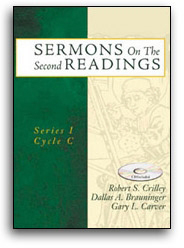
Sermons On The Second Readings
Series I, Cycle C
Foreword
Preaching is paradoxical. Implicit within the call to preach you will find both sublime joy and unbearable burden.
Gary Carver's sermons reflect both. Here you will find a joyful exuberance of expression. You can tell Gary loves to stand before his great congregation and proclaim the richness of God's truth. His sermons are full of delightful language and interesting illustrations. They are enjoyable to read, which is something that cannot be said about many sermons!
And yet, there is within these sermons the burden of one who stands under the call of God with a commission to proclaim all God's truths, including those that challenge and confront us. His sermons are not designed to entertain or inform; they are a call to respond.
As these sermons express so eloquently, the freedom we have in Christ demands some significant choices on our part. As preachers, we face choices each day about how we will respond to the call of God upon our lives. Those choices make a difference in what happens when we stand before a congregation on Sunday to break the bread of God's Word for a hungry people.
As you read these outstanding messages, may they ignite within your own heart a profound joy and burden that hungers for next Sunday!
Michael Duduit
Editor, Preaching magazine
Preface
In 1974 my wife Sharlon and I traveled to Louisville, Kentucky, where I was to take my entrance exams for post-graduate study at The Southern Baptist Theological Seminary. With time to kill and also trying to ease my pre-exam jitters, I meandered into a used bookstore. There I saw it. Upon the shelf and priced at $1.25, it was a copy of Victor Frankl's Man's Search for Meaning. I was somewhat familiar with the book and his theory of logotherapy. My favorite undergraduate professor, Swan Haworth, had told me about the sabbatical study he had with Dr. Frankl in Vienna. But I had never read the book. I began reading its pages and could not put it down. In significant ways that book changed my attitude toward life and directly influenced my approach to preaching.
After reading of Frankl's experiences in the World War II concentration camps of Auschwitz and Dachau, I became riveted upon his most influential words, "Everything can be taken from a man but one thing: the last of the human freedoms -- to choose one's attitude in any given set of circumstances, to choose one's way."1 He talks of those who experienced the inhuman treatment and simply gave up and died. He speaks of others who made an inner decision to exercise a spiritual freedom that enabled them to exhibit remarkable acts of sacrifice and kindness toward others, even in the face of untold cruelty. It was this decision that enabled Frankl and others to survive when everything else had been taken away. Frankl lost everything, except his freedom to choose. It was his decision to exercise that choice that led him to enlighten thousands by his life and his writings. He proceeds to say, "It is this spiritual freedom -- which cannot be taken away -- that makes life meaningful and purposeful."2 Thus, he formulated logotherapy or "meaning" therapy in which he states that if one has a "why" to live, one can endure almost any "how."
As I began to read these wonderful biblical texts from Galatians in which Paul preaches about the wonderful freedom that is ours because of Jesus' love as shown by his death on the cross, I felt that this little set of sermons must be titled Free To Choose. Because of Christ, we are free to choose, but it is equally true that we must also bear the responsibilities of having such a choice and the consequences that our decisions may bring. As C. S. Lewis explained, "If we insist on keeping Hell ... We shall not see Heaven ... All that are in Hell, choose it! No soul that seriously and constantly desires joy will ever miss it. Those who seek find. To those who knock, it is opened!"3 We are free to choose heaven's joy or ... It is our choice. As Søren Kierkegaard stated, "I am; therefore, I must decide."
It was with Frankl's and Kierkegaard's recurring words ringing in my ears that I chose to preach these ten sermons during the season of Pentecost without a manuscript before and with a congregation of worship. As with my other collections of sermons with CSS, Out From The Ordinary, Acting On The Absurd, Distinctively Different, Search For Serendipity and Smiling In The Dark, there is no consistent style or form to these sermons. Each sermon draws its substance and form from the experience of the respective texts, as did both the contemporary and traditional services of worship in which they were presented. As always, deliberate effort was made to craft and present these sermons in such a way as to preserve the oral nature of biblical preaching. The congregation at worship was invited to stand to hear the scriptural texts and the sermons were delivered without notes.
I wish to express my deepest gratitude to the loving family of faith at the First Baptist Church of Chattanooga, Tennessee. Many of these sermons were preached during the year-long celebration of our 150th anniversary of service to this great city. Their graciousness has been extended to me and my family for these seventeen years, the longest tenure of anyone who has served this people as pastor. In the early 1960s, this great church exercised its freedom of choice to re-locate and stayed in downtown Chattanooga, moving only six blocks. The church's witness and ministry to the heart of this downtown inner city is beyond calculation.
I want to express my heartfelt gratitude to the Connections Worship Planning team at First Baptist: Mary Jayne Allen, John Echols, Jonathan Crutchfield, Connie Campbell, Dave Smith, David Long, Karen Henderson, Melissa Phillips, Barry Kelly, Rodney Strong, Janice Bond, Harriette Grammer, Maria Stinnett, and Eric Tally. Without a doubt, their creativity and hard work under the guiding brilliance of John Echols have made our contemporary worship service an experience of pure joy and one that at least a dozen other churches have studied or emulated.
I also want to thank the Connections Band, led by Dr. Crutchfield and its members Tim Messer, Steve Yantis, Randy Jones, John Yantis, and Lanny Coe. The current lists of Connections Singers include Roberta Echols, Janice Bond, Laura Helton, Ann-Marie Blentlinger, Grady Worley, Jeff McDaniel, Reggie Alley, and Shawn Coulter. There are no words to express my gratitude for their sacrificial gifts of their time, talents, and energy. This service of worship experience honors God because of them.
Judy Sullivan has worked tirelessly to see this project completed. She is not only the most competent of secretaries, but a trusted confidant and cherished friend. She defines "second mile."
I am deeply appreciative of my friend and sometimes editor, Michael Duduit, who took time from a demanding schedule to write the foreword. Dr. Duduit's contribution to the work of homiletics is beyond significant through his widely-read journal, Preaching. His kindness to me has been extravagant as he was one of the first to publish my sermons. I hope that his circulation did not suffer too badly. Again, Thomas Lentz and Teresa Rhoads of CSS Publishing Company have been encouragers and affirmed and corrected the choices I made.
Especially I want to thank my loving wife Sharlon. Her choice 36 years ago to take on the challenge of being my wife was an ambitious and courageous decision and one that has brought to my life its greatest fulfillment and joy.
Lastly, Sharlon and I want to thank our grandparents. Even though Sharlon never knew three of her grandparents, we both are aware of their rich contributions to our lives. Because they made good and godly choices, they have helped to enable us to exercise the blessed freedom we know in Christ. It is to these who have preceded us in this journey that this book is dedicated.
____________
1. Viktor E. Frankl, Man's Search for Meaning: An Introduction to Logotherapy (New York: Pocket Books, 1959), p. 104.
2. Op. cit., p. 106.
3. C. S. Lewis, The Great Divorce (New York: Macmillan Publishing Company, 1946), p. vi.
Preaching is paradoxical. Implicit within the call to preach you will find both sublime joy and unbearable burden.
Gary Carver's sermons reflect both. Here you will find a joyful exuberance of expression. You can tell Gary loves to stand before his great congregation and proclaim the richness of God's truth. His sermons are full of delightful language and interesting illustrations. They are enjoyable to read, which is something that cannot be said about many sermons!
And yet, there is within these sermons the burden of one who stands under the call of God with a commission to proclaim all God's truths, including those that challenge and confront us. His sermons are not designed to entertain or inform; they are a call to respond.
As these sermons express so eloquently, the freedom we have in Christ demands some significant choices on our part. As preachers, we face choices each day about how we will respond to the call of God upon our lives. Those choices make a difference in what happens when we stand before a congregation on Sunday to break the bread of God's Word for a hungry people.
As you read these outstanding messages, may they ignite within your own heart a profound joy and burden that hungers for next Sunday!
Michael Duduit
Editor, Preaching magazine
Preface
In 1974 my wife Sharlon and I traveled to Louisville, Kentucky, where I was to take my entrance exams for post-graduate study at The Southern Baptist Theological Seminary. With time to kill and also trying to ease my pre-exam jitters, I meandered into a used bookstore. There I saw it. Upon the shelf and priced at $1.25, it was a copy of Victor Frankl's Man's Search for Meaning. I was somewhat familiar with the book and his theory of logotherapy. My favorite undergraduate professor, Swan Haworth, had told me about the sabbatical study he had with Dr. Frankl in Vienna. But I had never read the book. I began reading its pages and could not put it down. In significant ways that book changed my attitude toward life and directly influenced my approach to preaching.
After reading of Frankl's experiences in the World War II concentration camps of Auschwitz and Dachau, I became riveted upon his most influential words, "Everything can be taken from a man but one thing: the last of the human freedoms -- to choose one's attitude in any given set of circumstances, to choose one's way."1 He talks of those who experienced the inhuman treatment and simply gave up and died. He speaks of others who made an inner decision to exercise a spiritual freedom that enabled them to exhibit remarkable acts of sacrifice and kindness toward others, even in the face of untold cruelty. It was this decision that enabled Frankl and others to survive when everything else had been taken away. Frankl lost everything, except his freedom to choose. It was his decision to exercise that choice that led him to enlighten thousands by his life and his writings. He proceeds to say, "It is this spiritual freedom -- which cannot be taken away -- that makes life meaningful and purposeful."2 Thus, he formulated logotherapy or "meaning" therapy in which he states that if one has a "why" to live, one can endure almost any "how."
As I began to read these wonderful biblical texts from Galatians in which Paul preaches about the wonderful freedom that is ours because of Jesus' love as shown by his death on the cross, I felt that this little set of sermons must be titled Free To Choose. Because of Christ, we are free to choose, but it is equally true that we must also bear the responsibilities of having such a choice and the consequences that our decisions may bring. As C. S. Lewis explained, "If we insist on keeping Hell ... We shall not see Heaven ... All that are in Hell, choose it! No soul that seriously and constantly desires joy will ever miss it. Those who seek find. To those who knock, it is opened!"3 We are free to choose heaven's joy or ... It is our choice. As Søren Kierkegaard stated, "I am; therefore, I must decide."
It was with Frankl's and Kierkegaard's recurring words ringing in my ears that I chose to preach these ten sermons during the season of Pentecost without a manuscript before and with a congregation of worship. As with my other collections of sermons with CSS, Out From The Ordinary, Acting On The Absurd, Distinctively Different, Search For Serendipity and Smiling In The Dark, there is no consistent style or form to these sermons. Each sermon draws its substance and form from the experience of the respective texts, as did both the contemporary and traditional services of worship in which they were presented. As always, deliberate effort was made to craft and present these sermons in such a way as to preserve the oral nature of biblical preaching. The congregation at worship was invited to stand to hear the scriptural texts and the sermons were delivered without notes.
I wish to express my deepest gratitude to the loving family of faith at the First Baptist Church of Chattanooga, Tennessee. Many of these sermons were preached during the year-long celebration of our 150th anniversary of service to this great city. Their graciousness has been extended to me and my family for these seventeen years, the longest tenure of anyone who has served this people as pastor. In the early 1960s, this great church exercised its freedom of choice to re-locate and stayed in downtown Chattanooga, moving only six blocks. The church's witness and ministry to the heart of this downtown inner city is beyond calculation.
I want to express my heartfelt gratitude to the Connections Worship Planning team at First Baptist: Mary Jayne Allen, John Echols, Jonathan Crutchfield, Connie Campbell, Dave Smith, David Long, Karen Henderson, Melissa Phillips, Barry Kelly, Rodney Strong, Janice Bond, Harriette Grammer, Maria Stinnett, and Eric Tally. Without a doubt, their creativity and hard work under the guiding brilliance of John Echols have made our contemporary worship service an experience of pure joy and one that at least a dozen other churches have studied or emulated.
I also want to thank the Connections Band, led by Dr. Crutchfield and its members Tim Messer, Steve Yantis, Randy Jones, John Yantis, and Lanny Coe. The current lists of Connections Singers include Roberta Echols, Janice Bond, Laura Helton, Ann-Marie Blentlinger, Grady Worley, Jeff McDaniel, Reggie Alley, and Shawn Coulter. There are no words to express my gratitude for their sacrificial gifts of their time, talents, and energy. This service of worship experience honors God because of them.
Judy Sullivan has worked tirelessly to see this project completed. She is not only the most competent of secretaries, but a trusted confidant and cherished friend. She defines "second mile."
I am deeply appreciative of my friend and sometimes editor, Michael Duduit, who took time from a demanding schedule to write the foreword. Dr. Duduit's contribution to the work of homiletics is beyond significant through his widely-read journal, Preaching. His kindness to me has been extravagant as he was one of the first to publish my sermons. I hope that his circulation did not suffer too badly. Again, Thomas Lentz and Teresa Rhoads of CSS Publishing Company have been encouragers and affirmed and corrected the choices I made.
Especially I want to thank my loving wife Sharlon. Her choice 36 years ago to take on the challenge of being my wife was an ambitious and courageous decision and one that has brought to my life its greatest fulfillment and joy.
Lastly, Sharlon and I want to thank our grandparents. Even though Sharlon never knew three of her grandparents, we both are aware of their rich contributions to our lives. Because they made good and godly choices, they have helped to enable us to exercise the blessed freedom we know in Christ. It is to these who have preceded us in this journey that this book is dedicated.
____________
1. Viktor E. Frankl, Man's Search for Meaning: An Introduction to Logotherapy (New York: Pocket Books, 1959), p. 104.
2. Op. cit., p. 106.
3. C. S. Lewis, The Great Divorce (New York: Macmillan Publishing Company, 1946), p. vi.
