
"Friend, Why Are You Here?"
Sermon
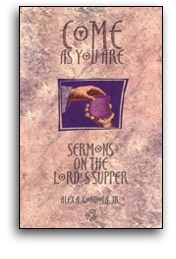
Come As You Are
Sermons On The Lord's Supper
In the sixth century A.D., Saint Columba sailed from Ireland to the Isle of Iona on the West Coast of Scotland. Since that day, Iona has been considered a holy place by many in the Christian Church. Perhaps some of you have visited the island. For one thing, Iona is the burial ground for over sixty Norwegian, Irish, and Scottish kings, including Duncan and Macbeth; as well as for many martyrs from the early Celtic Christians.
But the focal point of Iona is the magnificent Abbey Church, the foundation of which is over 1,400 years old. This gem of early Christian architecture has been lovingly rebuilt, stone by stone, largely by the volunteer labor of Christians on retreat. Once the exterior was restored, the interior was refurbished, and a new pulpit, lectern, and altar were installed. Now the ancient Abbey Church is used for worship once again.
In the refurbishment project, it came time to prepare the bread plates to be used for Holy Communion. There were to be eight bread plates in all. They were made of wood. And the suggestion was made to carve a verse from Scripture into the rim of each plate. Seven verses were quickly selected. Only one verse remained.
The committee in charge asked the supervising architect of the project to make the final selection. His choice was from the Gospel of Matthew, chapter 26: "Friend, why are you here?" (v. 50, RSV).
Let's recall the setting for this quotation by Jesus. Do you remember? It's late Maundy Thursday Eve. Jesus is with his disciples in the garden of Gethsemane. And Judas, the Betrayer, arrives, leading a band of Temple guards armed with swords and clubs. Judas has already worked out a plan with the soldiers, saying, "The one I will kiss is the man; arrest him" (v. 48, RSV).
He comes up to Jesus and says, "Hail, Master!" and betrays him with a kiss. Then Jesus looks at Judas, his betrayer, calls him "Friend" (which I think is ironic) and asks, "Why are you here?" (Ironic again: Jesus already knows.)
That same question might be asked of each of us as we prepare to receive Communion: "Friend, why are you here?"
It's likely that, in a congregation as large as this one, worshipers have come to church for a variety of different reasons. Some of us might be here simply because we come to church every Sunday (that doesn't just apply to the ministers and the organist!). Frequently, a faithful worshiper will say to me, "It just doesn't seem like a Sunday if I don't go to church!" Perhaps for some of us, churchgoing is a habit that has brought us here today.
I certainly don't want to be critical of the habit of regular worship. Some habits are bad for us. But some habits are good ones, and the habit of regular worship is one that is good. Believe me, I'm very grateful for those faithful men and women who have made a habit of coming to church every Sunday. But I hope that mere habit isn't the only thing that brought you to worship today.
Others may perhaps be here because they want to support the minister. Another very noble motive! No preacher likes to preach to an empty church! Far be it for me to discourage anyone from supporting a member of the clergy -- especially this one! Still, a desire to please your pastor, as praiseworthy as that may be, is not the best reason for coming to worship.
Other reasons for being here? Curiosity, perhaps? I once had a gentleman tell me that he had been driving past this church for years and thought it was "cute" and wondered what it looked like inside, so he stopped in on a Sunday morning. I guess his curiosity was satisfied, since I noticed he didn't come back the next week! Perhaps some of us are here out of a feeling of moral superiority. Others may be golfing today, or weeding their gardens, or sleeping in late. But not us! Or, maybe some of us are here because we're concerned for ourselves or for someone we love. "Gee, I'm worried about those medical tests I have to take tomorrow (or those tests that Grandma took last week). Sure hope they come out all right. Better go to church." Perhaps some of us are here out of a sense of duty: "Lent is nearly over. I really should do something religious." Maybe some of us are here this morning because someone else "dragged" us!
Jesus' question for Judas is a valid question for us. "Friend, why are you here? Why are you here today?"
I hope, in the midst of all our mixed motives -- habit, a desire to support your minister or your church, curiosity, concern for yourself or another, or whatever -- I hope that, somewhere, in the midst of all our mixed motives, somewhere, deep down inside us, we are also moved by feelings of love and thanksgiving. Love for the One who loved us enough to die for us on a cross. There can be no greater love than that. Thankfulness for what Jesus has done.
Perhaps you've heard the often-told story of a little boy whose sister was seriously ill and desperately needed a transfusion. The doctor explained that she had the same disease her brother had conquered several years back, and that what she needed was a blood transfusion from someone who had overcome the disease. The two shared the same rare blood type. The brother was the perfect donor.
"Would you give your blood to save your sister?" the doctor asked. The little boy hesitated for a moment. His lip started to quiver. But after just the slightest hesitation, he smiled and said, "Yes."
Soon the two children were being wheeled into a hospital room, the sister looking pale and frail, the brother looking robust and healthy, but very nervous. A nurse inserted a needle into the little boy's arm, and the blood began to flow, and his brave smile began to fade more and more. Finally, near the end of the transfusion, he asked the doctor, "When do I die?"
Only then did the doctor realize why the little boy had hesitated. He had thought that when he had been asked to give his blood, he was being asked to give up his life for his sister. He was prepared to sacrifice himself so his sister might live. Fortunately, both children recovered. But, you can't imagine a greater love than that.
But all of us have a condition much more serious than the little girl's. And Jesus gave, not only his blood, but also his life, to save us: "He was wounded for our transgressions, crushed for our iniquities; upon him was the punishment that made us whole, and by his bruises we are healed" (Isaiah 53:5, NRSV). We have been "loved to death" (his death) by Jesus Christ.
Friend, why are you here? Because, deep down, you realize that Jesus loves you? Because you acknowledge that his "blood," his death on the cross, is the cure for your sin, my sin, the sin sickness of our world? Because you believe that, somehow, by receiving the Sacrament in faith, something of Jesus will come to live in you? Because you want to become more like him, to bring his kind of healing and wholeness to others in our world?
Friend, why are you here? Whatever motive brought you here this morning, I hope you have decided to receive the salvation from sin that Christ offers us freely. And I hope that when you leave the sanctuary this morning, it will be with a sense that you are forgiven, cleansed, made new, changed.
But the focal point of Iona is the magnificent Abbey Church, the foundation of which is over 1,400 years old. This gem of early Christian architecture has been lovingly rebuilt, stone by stone, largely by the volunteer labor of Christians on retreat. Once the exterior was restored, the interior was refurbished, and a new pulpit, lectern, and altar were installed. Now the ancient Abbey Church is used for worship once again.
In the refurbishment project, it came time to prepare the bread plates to be used for Holy Communion. There were to be eight bread plates in all. They were made of wood. And the suggestion was made to carve a verse from Scripture into the rim of each plate. Seven verses were quickly selected. Only one verse remained.
The committee in charge asked the supervising architect of the project to make the final selection. His choice was from the Gospel of Matthew, chapter 26: "Friend, why are you here?" (v. 50, RSV).
Let's recall the setting for this quotation by Jesus. Do you remember? It's late Maundy Thursday Eve. Jesus is with his disciples in the garden of Gethsemane. And Judas, the Betrayer, arrives, leading a band of Temple guards armed with swords and clubs. Judas has already worked out a plan with the soldiers, saying, "The one I will kiss is the man; arrest him" (v. 48, RSV).
He comes up to Jesus and says, "Hail, Master!" and betrays him with a kiss. Then Jesus looks at Judas, his betrayer, calls him "Friend" (which I think is ironic) and asks, "Why are you here?" (Ironic again: Jesus already knows.)
That same question might be asked of each of us as we prepare to receive Communion: "Friend, why are you here?"
It's likely that, in a congregation as large as this one, worshipers have come to church for a variety of different reasons. Some of us might be here simply because we come to church every Sunday (that doesn't just apply to the ministers and the organist!). Frequently, a faithful worshiper will say to me, "It just doesn't seem like a Sunday if I don't go to church!" Perhaps for some of us, churchgoing is a habit that has brought us here today.
I certainly don't want to be critical of the habit of regular worship. Some habits are bad for us. But some habits are good ones, and the habit of regular worship is one that is good. Believe me, I'm very grateful for those faithful men and women who have made a habit of coming to church every Sunday. But I hope that mere habit isn't the only thing that brought you to worship today.
Others may perhaps be here because they want to support the minister. Another very noble motive! No preacher likes to preach to an empty church! Far be it for me to discourage anyone from supporting a member of the clergy -- especially this one! Still, a desire to please your pastor, as praiseworthy as that may be, is not the best reason for coming to worship.
Other reasons for being here? Curiosity, perhaps? I once had a gentleman tell me that he had been driving past this church for years and thought it was "cute" and wondered what it looked like inside, so he stopped in on a Sunday morning. I guess his curiosity was satisfied, since I noticed he didn't come back the next week! Perhaps some of us are here out of a feeling of moral superiority. Others may be golfing today, or weeding their gardens, or sleeping in late. But not us! Or, maybe some of us are here because we're concerned for ourselves or for someone we love. "Gee, I'm worried about those medical tests I have to take tomorrow (or those tests that Grandma took last week). Sure hope they come out all right. Better go to church." Perhaps some of us are here out of a sense of duty: "Lent is nearly over. I really should do something religious." Maybe some of us are here this morning because someone else "dragged" us!
Jesus' question for Judas is a valid question for us. "Friend, why are you here? Why are you here today?"
I hope, in the midst of all our mixed motives -- habit, a desire to support your minister or your church, curiosity, concern for yourself or another, or whatever -- I hope that, somewhere, in the midst of all our mixed motives, somewhere, deep down inside us, we are also moved by feelings of love and thanksgiving. Love for the One who loved us enough to die for us on a cross. There can be no greater love than that. Thankfulness for what Jesus has done.
Perhaps you've heard the often-told story of a little boy whose sister was seriously ill and desperately needed a transfusion. The doctor explained that she had the same disease her brother had conquered several years back, and that what she needed was a blood transfusion from someone who had overcome the disease. The two shared the same rare blood type. The brother was the perfect donor.
"Would you give your blood to save your sister?" the doctor asked. The little boy hesitated for a moment. His lip started to quiver. But after just the slightest hesitation, he smiled and said, "Yes."
Soon the two children were being wheeled into a hospital room, the sister looking pale and frail, the brother looking robust and healthy, but very nervous. A nurse inserted a needle into the little boy's arm, and the blood began to flow, and his brave smile began to fade more and more. Finally, near the end of the transfusion, he asked the doctor, "When do I die?"
Only then did the doctor realize why the little boy had hesitated. He had thought that when he had been asked to give his blood, he was being asked to give up his life for his sister. He was prepared to sacrifice himself so his sister might live. Fortunately, both children recovered. But, you can't imagine a greater love than that.
But all of us have a condition much more serious than the little girl's. And Jesus gave, not only his blood, but also his life, to save us: "He was wounded for our transgressions, crushed for our iniquities; upon him was the punishment that made us whole, and by his bruises we are healed" (Isaiah 53:5, NRSV). We have been "loved to death" (his death) by Jesus Christ.
Friend, why are you here? Because, deep down, you realize that Jesus loves you? Because you acknowledge that his "blood," his death on the cross, is the cure for your sin, my sin, the sin sickness of our world? Because you believe that, somehow, by receiving the Sacrament in faith, something of Jesus will come to live in you? Because you want to become more like him, to bring his kind of healing and wholeness to others in our world?
Friend, why are you here? Whatever motive brought you here this morning, I hope you have decided to receive the salvation from sin that Christ offers us freely. And I hope that when you leave the sanctuary this morning, it will be with a sense that you are forgiven, cleansed, made new, changed.
