
God, Evil, And Hope: Opportunistic Love Overcoming Evil
Adult study
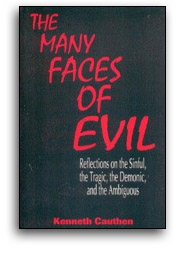
The Many Faces of Evil
Reflections On The Sinful, The Tragic, The Demonic, And The Ambiguous
I knew when I saw him coming that something was wrong. I didn't know the news was that bad. I was about fourteen years old at the time. I had a friend whose name was Alfred Graham. He was two or three years older than I, but we spent a lot of time together. Alfred's father bought a motorcycle. After a time, Alfred learned to ride it and actually gave me a lesson or two. I only rode it once by myself down the road about a half a mile and back. Soon tragedy struck. One Saturday, Alfred's father was doing some work around the house and needed some nails. He got on the motorcycle and rode into town to make the purchase. We all lived out in the country in those days. On the way back, he was in an accident that killed him instantly.
At that time, my mother, my father, and I had taken the job of cleaning the little country church where we were all members. That Saturday afternoon we were getting things ready for Sunday when Alfred came to tell us that his father had been killed. It was a very sad time. I shall never forget being in Alfred's house that weekend and hearing his mother crying out in her agony. Over and over, she screamed, "Why, why, why?" Those words sank deeply into my head and heart. I have often thought about those agonizing words as I pondered the question of suffering, accidents, and tragedy in the light of Christian faith.
In particular, I have wondered just what Alfred's mother meant by her question. What exactly was she asking? What kind of answer was she looking for? What could anyone have said that would have been a satisfactory reply? I don't know, of course, exactly what was in her mind. I have struggled with her question and with the various answers one might give. Nothing would have wiped away her sorrow. In one sense, she was not looking for anyone to take away her pain with some kind of intellectual response. It was, in part, simply a way of expressing her deep distress and anguish in the face of the unanswerable. Yet decades later her question still worries me. What can we say from this distance in the light of all that is involved?
At one level, a clear and simple answer is available. We know why it happened if why means how. Mr. Graham was coming down Hill Street at the edge of town. A truck was in front of him. He pulled over into the left lane to pass. As he began to pull around, the truck made a left turn. He ran into the back of the truck. His skull was split, killing him at once. I am sure that her question was not simply about the sequence of events that led up to the accident. Much more remains to be dealt with.
At another level, perhaps she was asking, "Why me? Why him? Why us? Why now, when things are going so well? Why now, when we thought we had many more years together? Why, when he was in the prime of life with so much to live for?" We are in a much more difficult realm now. We are talking about meaning and purpose. We could, of course, say that accidents can happen to anyone. Tragedy is no respecter of persons. No guarantees are available for anybody. No security can be purchased that will preserve us from disaster. Things like that occur. They can happen to anyone at any time. No one of us knows what we may face before the day, or the week, or the year is over. When we read in the papers about some terrible thing, don't we frequently say to ourselves, "There, but for the grace of God, or there, but for good fortune, go I." We know deep down that it could happen to us; yet when it does happen, we cannot help but ask as Alfred's mother did, "Why?" We all knew that if Mr. Graham or the truck had for some reason been 45 seconds earlier or later in arriving at that very spot on Hill Street, it would not have happened. He and the truck were there in that crucial space at the same instant. Still we must press our question on a deeper level. "Why?"
GOD AND OUR SUFFERING
A final level has to do with the ultimate question of meaning and purpose in relationship to our faith in God. In this context, the question is whether God intended anything in what happened. Did God directly and immediately cause it for some reason? Did God arrange just that combination of circumstances, so that Mr. Graham and the truck would arrive at that precise moment? Was God responsible for the fact that the truck turned just as Alfred's father pulled around to pass?
I cannot believe that God directly and immediately causes things like this to happen. I take such a position with all humility. The mysteries of God are beyond our understanding. It would be the height of arrogance to say that I know what God does and does not do in particular cases. Beyond that I know that strong theological traditions say otherwise. Many of us have been taught that every event is under God's control. Nothing happens but that God intends it or permits it or causes it.
Contrary to that way of thinking, I have come through many years of struggle and thought to the conclusion that it is wrong to say that God directly and immediately causes every event to happen as it did. God is, of course, indirectly and ultimately responsible for what happens, since God created the world and determined how it would operate. Some distance, however, lies between God and creation. An intervening area must be recognized between God's general control over the world and the specific and particular things that actually happen. This intervening distance means that we have some freedom of action in which we determine what happens. By our own choices a chain of events is set off that sometimes results in good consequences and sometimes in catastrophe. In this arena we are free to learn and to grow. We must face the consequences of our choices. Sometimes we make mistakes and have to pay the cost.
Another area of action not immediately determined by the will of God can be located. In the world of nature is to be found a sort of independence in which things happen in accordance with laws, processes, and arrangements that God has built into the world. A set of events takes place that God does not directly cause. This means that it is wrong to think that God manipulates us like puppets on a string.
Why was Mr. Graham in an accident? He was in an accident because in working out his own purposes, he chose to go into town on an errand. He happened to be at that corner on Hill Street at a particular time. Meanwhile, the driver of the truck, carrying out his own purposes, happened to be there at the same time. As a result of these choices and actions, the collision occurred. The laws of nature held. Metal crashed into the tender tissues of a human body. Brains spilled onto the pavement in a sight that made one sick.
If God did not directly and immediately cause this accident, where was God in all of this? Was God involved at all? I believe God was there in at least two ways. First of all God was present in sorrow and with a broken heart. God was there as the Suffering Companion who knows and cares, who feels every hurt and every grief of every creature. Jesus tells us that God has numbered the very hairs of our heads. Not a sparrow falls but that God takes notice.
God was present in a second way. God was there seeking to use that occasion as an opportunity to bring the greatest good out of that situation. God is present and at work in every event to increase happiness. God wants to bring about the most harmony, peace, and joy that can be had. Can we say how God does this? It might help to think about it this way. God has built into every living being an urge to fulfillment. I began by quoting the philosopher Whitehead who taught that in all life we find a threefold drive: an urge to live, to live well, and to live better. God has implanted that motivation in us and in every living creature on the face of the earth. When something goes wrong, God is still there, working through that urge.1 God is present in that striving to bring the best out of the worst. In and through all events divine purpose redirects and remakes life. God wants whatever good is possible under changed circumstances to happen. God can use our tragedy and suffering as an opportunity to deepen our understanding of life and to strengthen our spiritual foundations.
A few years ago, I chanced to be watching a television program called That's Incredible. Usually one does not expect to learn much that is religiously important on a program like that. On this particular show, the story was told of a musician who had lost an arm to cancer. He was cast into great depression and despair. He played the saxophone, I believe. That was the way he made his living. His music was a source of great joy to him. All of that was lost. His life seemed to be in ruins. Then an electronic technician made a device that could be attached to the stump of his arm. By connecting this machine to the nerve endings on one end and to the instrument on the other end, it was possible for him to play again. After a lot of practice, he gained his old skill back. He was brought on the stage so that we could watch him get connected to this device. Then he played - beautifully. He obviously was a very happy man. It was as though he had come back from death to life. Then he spoke. His words were quite remarkable. He said, "I would not have my arm back even if I could. Back then, I did not know what life was all about. Since I lost my arm, I have learned so much. I am such a different person that I had rather be where I am now than where I was when I had my arm."
It would be wrong, I think, to say that God arranged things to make this man get cancer in his arm in order to learn these lessons about life. It would be more accurate to believe that the cancer was the result of something going wrong in his body. Surely, God would have preferred the deepening of his spiritual life to occur in a more normal and healthy way, without the loss of his arm. Surely, God was sorry that the pain and misery happened. Nevertheless, it seems completely in accordance with our faith in a loving, caring God to think that God was at work in the opportunity that his illness provided to bring him to a deeper understanding and appreciation of life and love.
How does God work to bring about the best that is possible? One thing can be said. God creates life with a built-in resurrection potential. If all creatures have an urge to live, to live well, and to live better, something more follows. That urge is so strong that when it is frustrated, it seeks ways to overcome obstacles and make the best of the situation. Life keeps coming back from defeat and rises up to try again. When one path is blocked, another is sought.
I didn't see the cartoon. A friend told me about it. It showed a little stick figure arranged to look like a person. Let us call this little person Human. Human was running around having a good time. Then a fist or something like it came down and crushed this little creature. Soon Human got up and started running again. A bigger fist came down and mashed Human right into the earth. This time it took a little longer. After a while Human struggled to get up and move once more. The fist got bigger and bigger. The blow got heavier and more devastating. Every time Human came back. It took longer and longer. The feet were a little less steady. Nevertheless, life went on.
Finally, one last assault was made. A huge fist that overflowed the screen came down in a mighty force with a tremendous crashing noise. Human was crushed flat to the surface. All was quiet. No movement could be seen. Human, it appeared, was done for. It was all over. This last slam was too much. We watch. Nothing happens. Just when it appears that it is time to put up a little stone marking the place where the end came, a slight stirring can be seen. Then all is quiet again. After some time, another little commotion is evident. Slowly, gradually, painfully, Human struggles, falls, rises again, and at last stands unsteadily but surely. Then Human walks away.
I think this is what the cross and resurrection symbolize for human life on this earth. Life comes with a built-in resurrection potential that never ceases to look for a way to overcome and press on to success. That urge to live, that drive toward fulfillment of the potential for enjoyment, I believe, is present in all living things. It is displayed in the effort seeds make to sprout and grow into a plant with its leaves spread before the nourishing sun. In the face of adverse conditions, a seed takes advantage of every bit of moisture and food value in the soil and of every other circumstance and uses it for its own purpose to grow to healthy maturity. This
opportunism that seeks a way around obstacles is characteristic of all life, including human beings. God is the source and basis of this indwelling impetus toward fulfillment (eros) that will not be quenched until every energy has been exhausted.
My belief, then, is that God takes advantage of every opportunity provided in every situation to increase happiness for all in accordance with the health of the individual soul and the requirements of social justice. God is opportunistic within the limits of the possibilities for good compatible with the facts in a given case. God does not supernaturally orchestrate events from beyond to carry out a secret divine scheme. Surprising, unexpected, unlikely things bordering on the incredible can occur. We should be circumspect about putting limits on what is possible. If someone wants to call these astounding events in which good beyond reasonable expectation blesses our lives miracles, I have no objection. I do not believe in supernatural occurrences, but we should be cautious about drawing the boundaries of the natural that demarcate the possible from the impossible.
I have problems with miracles defined as supernatural interference with the law-abiding character of nature and with human freedom on two grounds. (1) They have not happened in my experience, nor have I observed such happenings in the world around me or in the lives of other people. (2) Supernatural miracles pose for me an insuperable theological problem: How do you account for the relative rarity and seeming arbitrariness of such occurrences? Why don't they happen more often? Why does God interfere supernaturally to benefit some and not others? I have heard no satisfactory answers to the questions. The usual and appropriate response is that God has purposes not known to us, and we must simply trust in God's wisdom. The notion that God has secrets that we cannot be let in on is unsatisfactory to me. Equally unsuitable is the idea that God manipulates events from the outside to deliver some but to let others perish. Such beliefs attribute to God mysterious ways of acting that are unworthy of a God of pure boundless love, in my view.
What, then, is our consolation in the midst of tragedy and suffering? We can say at least two things. The first is that God suffers with us as the Loving Companion who is always near, who always cares, who feels our hurts and knows our sorrows. The second thing to be said is that God never ceases to work in all things through the processes of nature and through our freedom to bring the greatest possible good out of every situation.
When tragedy and suffering come, we cannot help asking, "Why?" We can never fully answer that question in a way that quenches our perplexity. Life is full of meaning. Life is also full of mystery. We can be assured with some confidence that God is with us in all things. God gives us the gift of existence and builds into life an urge toward living to the fullest. God is with us to share all our sorrows and our joys. As the Creator, God instills into every life an urge to make use of every opportunity to actualize the potential for good with which we are born. As the Redeemer, God continues to work to bring new good out of evil, new life out of death, hope out of despair, and resurrection from every cross. Such consolation does not remove the heartache and pain. It does provide us with the courage to keep on living and trying, knowing that we are not alone.
IS GOD LIMITED?
Here an objection must be met. I have set forth a view of God perfect in love but limited in power. I have suggested that God works in and through the structures and processes of nature, history, and human freedom. God suffers with us in our tribulation and takes advantage of every opportunity and circumstance to promote our well-being. This means, however, that God's power is limited by the law-abiding character of nature and by the fact of human freedom. If God does not temporarily suspend or overrule the laws of nature and if human beings have the capacity to initiate chains of events and thus produce novelty, then to that extent, God's control is restricted. Many Christians will demur at that point because it denies that God is all-powerful. Christian tradition has taught that God controls all things right down to the specifics of individual events. God causes, permits, or otherwise arranges whatever happens so that in every event God is in full command of everything at all times. This God knows no bounds except those
imposed by self-contradiction. God cannot make a short, straight stick with only one end, and the like. However, God can create worlds, control the winds and the seas, and raise the dead. Kicking and screaming and resisting all the way, I have come to reject this view as not fitting as well with the facts of experience as the notion of a finite God who is limited by nature and by human freedom.
Much in the Bible supports the view of God as the Almighty Power, omnipotent and omniscient. Hence, I cannot claim that the Bible as a whole supports me in my view of a limited God. The dominant view is otherwise. Nevertheless, reflection on Scripture and experience has led me against my will to a doctrine of a finite, suffering, struggling God.2 God, I believe, has a hard time too. There are limits to what God can accomplish on earth. Because God loves, God agonizes with the world and with all human beings in their torment. The only God I can believe in is a God with a broken heart, a God who weeps, who is our companion and support. God is the Fellow-Sufferer who shares our grief, who feels the pain of our sorrows.3
To those who object that a finite God does not offer a sufficient basis for hope, I reply that my limited Deity has accomplished as much in this world as the Omnipotent Lord of Christian tradition. No less good and no more evil is to be found in the world in which my Suffering, Struggling, Compassionate Companion lives out the divine adventure than in the world ruled over down to the last tiniest detail by Calvin's Almighty God. We all live in the same world. It is this very world with its promises and perils, its monstrous horrors and its delightful pleasures, that has to be accounted for. I tentatively and in fear and trembling maintain that my theory works as well or better than the alternatives when all that counts and matters is factored into our thinking. To a fuller doctrine of hope, we now turn.
HOPE
If we ask what hope means specifically in our lives today, the answer can be put under three headings. A. We can triumph spiritually over suffering in the midst of suffering. B. We can change some things for the better here and now. C. We can live in the hope that life will be perfected in a realm beyond this world. To put the same points in different words, we can transcend the actual, transform the actual, and live in hope that the actual will be ultimately perfected. Let me spell this out more systematically.
A. Transcendence of the actual.
1. Fulfillment of the self-transcending moment. We refer to these occasional moments as "mountaintop experiences" - brief periods when we spontaneously rise above what is actually happening to experience an ecstatic moment of joy in loving union with God, the world, and each other. They don't last long, and they come only now and then. When they appear, it feels like a gift. Shortly, we have to go back down the mountain into real life with all its sin, its tragedy, its demonic dimensions, and its ambiguous decisions. Nevertheless, we can hope that now and then we will transcend it to experience another level of joy and happiness. Sometimes when the tragic and the demonic and the ambiguous cannot be changed, at least in the present moment, we can occasionally rise above these negative dimensions of life.
I remember an occasion four decades ago when the goodness of life broke into my own awareness with particular vividness. It was for me a rare moment of mystical ecstasy. I was walking from a classroom at Emory University to my apartment. It was one of those crisp days in March when the cloudless sky was totally blue. The sun was shining in all its Georgia brightness. The mixture of warmth and coolness told all that Spring was already awakening the dormant earth. I walked through a grove of pine trees and heard the wind softly breathing through the thick branches. All of a sudden and unexpectedly, I felt a surge of good feeling. It can only be described as an acute, deep awareness of the pure joy of being alive. It was as if the pine trees and all of nature shared the experience. All around me was the busy world of living and dying. Not far away was a little shopping center where people bought food, clothes, and medicine. About a block in the distance was Emory Hospital where people of all ages and of all races and of all stations in life were suffering and dying. The world in all of its beauty and pain was still there. Nevertheless, in my little cathedral in the pines I knew for a brief few moments what it meant for Genesis to proclaim that God looked at the world still fresh and pure and saw that it was good, very good.
2. The experience of blessedness in the midst of suffering. This is not transient and occasional like the first but a more or less continuous triumph over suffering, while the suffering continues (Romans 8:31-39). Nothing can separate us from the love of God. Peril, famine, sword, fire and flood, the unjust, the demonic, the ambiguous, and the tragic are all around, but the awareness that God suffers with us is a comfort in our tribulation. Not all of us can achieve this blessedness all the time, but it is a possibility for which we hope in the midst of pain, injustice, and tragic affliction.
B. Transformation of the actual.
Some things in actual life can be changed to make them better. We cannot bring about perfection in this life, but we may be able to improve them. Some problems can be solved, or at least partially so. If we are sick, we can hope to get better. If there is injustice, we may be able to change things to make them more just. If there is hatred, we can work for reconciliation. Demonic powers can, under the right circumstances, be cast out and overcome, at least in part. Trade-offs will often be unavoidable, so that we get something good only by having to take something bad along with it. Compromises are inevitable, but we can work for a better bargain that gets more of the good and less of the evil. Sometimes we have to take the lesser of two evils, but we can try to lessen the evil of the lesser evil. Some suffering can be relieved, and it is our obligation to overcome as much of it as we can. The unjust, the tragic, the demonic, and the ambiguous can in some circumstances be at least partially overcome, thus transforming the actual situation for the better.
Especially important in this connection are those kairotic4 moments in history and in our personal lives in which the times are ripe and ready for constructive change. A convergence of factors may produce a situation that is pregnant with new possibilities, requiring midwives to facilitate the birth. Such an opportunity presented itself in the eighteenth century when the American Revolution produced "a new nation conceived in liberty and dedicated to the proposition that all men (people) are created equal" (Abraham Lincoln). Philosophers had produced doctrines of human rights and of democratic rule. The social and economic circumstances of European settlers living in a new land imbued with such notions enabled them to take advantage of the opportunities to create a fledgling democracy with great promise. It was an imperfect union that centered on the prerogatives of white, property-owning males. It assumed African slavery and the inferiority of Native Americans. Its flaws have not yet been overcome. The new nation flourished at the expense of killing and pushing Native Americans from the land, destroying their culture in the process. Nevertheless, although accompanied by deep ambiguities and profound evils, the total situation exhibited dimensions of progress in the course of civilization.
Another situation pregnant with promise for the increase of justice and happiness occurred during the 1950s during the Civil Rights Movement. A complex constellation of factors coalesced to create possibilities for advancing the cause of justice that simply had not been present a quarter of a century before. Dr. Martin Luther King, Jr., along with many others, were ready and able to convert these opportunities into genuine gains that transformed the South in particular but the rest of the country as well. Racism in forms brutal and subtle remains, but genuine progress has occurred.
Our task is to be alert to those places in individual and social life where these right and ripe moments arise and then to take advantage of them to turn possibility into fact. Every new advance is associated with possible new evils and persisting old ones, but in the process lines of material, social, and moral amelioration can be traced. These advances are worth striving for and can make an enormous difference in the lives of people. Progress is potential in the historical process though not guaranteed. To actualize this potential in real gains of justice and joy is a moral imperative.
C. The perfection of the actual.
This is the final and ultimate dimension of hope. The first two are either temporary or partial. The sinful, the tragic, the ambiguous, and the demonic are still real, but we can occasionally or to some extent overcome them, but they are still present in fact. The Bible and Christian faith say something more. God works for a final victory when all suffering will be ended. All evil will be put down. Good will triumph once and for all and completely. The imperfect will be made perfect. Then there will be no more tears, no more pain, no more death. (Revelation 21:1-4; 1 Corinthians 15). Oppression of the weak and the outcast, tragedy, enslavement to evil powers, and thorns on the roses will be gone, eliminated.
How such a complete victory of good over evil could come to pass is unknown to us. The forms of a totally transformed life are hidden from our view. That it is even possible is not certain.5 That it will in fact happen is not an assured fact. A more modest hope would be to forego the notion of a final perfection and to rest content in the faith that God works ceaselessly and opportunistically to lure the world forward into creative advance. Perhaps sin, the tragic, the ambiguous, and the demonic cannot be totally rooted out of any finite world. Yet the hope of heaven is so attractive that it is difficult to eradicate from the human heart. Trust in divine love at the end is the final recourse of the human spirit.
Part of Christian discipleship is discernment. We must read and understand the signs of the times. We need to be sensitive to the situations we face and rejoice in the hope that is appropriate to each situation, taking into account all the circumstances that prevail at the moment. Sometimes a bad situation can be changed for the better. Sometimes it cannot. When it can, hope urges us to work militantly for the best transformation that is possible in the lives of individuals and in society. When the actual situation cannot be changed for the moment, we can hope for a triumph over the actual situation, to experience a spiritual victory in the midst of wrongdoing, famine, peril, and sword. Finally, beyond this life Christian hope looks for the perfection of the world - an ultimate once and for all victory over all suffering.
A final chapter taken from my own experience will show how the categories that have been employed throughout this essay have illuminated the meaning of my own life.
1. My inspiration comes primarily from Alfred North Whitehead, but compare what I have said with Paul Tillich. "Providence is a quality of every constellation of conditions which 'drives' or 'lures' toward fulfillment ... the quality of inner-directedness in every situation." Systematic Theology (Chicago: University of Chicago Press, 1951), 1:267.
2. The theological method I employ and my view of biblical authority can be found in my Toward a New Modernism (Lanham, MD: University Press of America, 1996), vii-xi, 1-76. For me the norm of theological thinking is the best we know from all sources up to now, the Bible and Christian tradition being chief among them. Put otherwise, all theological claims must be measured in the last analysis by canons arising from our own fallible, culturally conditioned reason and our own limited experience. For those who demand a stricter adherence to biblical themes or to traditional theology, my approach will not be acceptable. Yet I argue that the interpretive element is strong in all outlooks and that there is no such thing as a pure reading off of objective truth from unerring sources, uncontaminated by subjective judgment. We all walk by faith and not by sight. In the end I am a relativist and a pragmatist who has given up the hopeless quest for an unimpeachable certainty and settled for tentative, working hypotheses that provide understanding and means of coping with life within my own frame of reference. See the book itself for an acknowledgement of the weaknesses in my position, a critique of alternatives, and the grounds for my own approach.
3. I have developed this view technically and in more detail in Toward a New Modernism, 77-107, and in Theological Biology: The Case for a New Modernism (Lewiston: Edwin Mellen Press, 1991), 233-289. See also, Science, Secularization and God (Nashville: Abingdon Press, 1969). A
collection of sermons assuming a finite, suffering God can be found in The Triumph of Suffering Love (Valley Forge: Judson Press, 1966).
4. The Greek word kairos means special occasion, proper or convenient time, season of opportunity. Theologians use it to refer to a right and ripe moment when something new, good, and momentous can break forth into reality. A kairotic occasion contains a significant potential for a novel birth of meaning, goodness, or justice.
5. For many years I have posed this question: If heaven is possible, why not now? No answer I have ever heard is convincing. Earlier, I speculated that any world composed of a plurality of interacting finite, free beings in a law-abiding world will contain the possibility of evil that is likely to occur. Can there be free, finite beings in a world with perfect good and no evil? If so, why not now? Yet it would be foolish to deny that there may be possibilities of perfection unknown and unknowable to us that may yet come to pass. We walk by faith in hope as we seek to increase love for God and of neighbor.
At that time, my mother, my father, and I had taken the job of cleaning the little country church where we were all members. That Saturday afternoon we were getting things ready for Sunday when Alfred came to tell us that his father had been killed. It was a very sad time. I shall never forget being in Alfred's house that weekend and hearing his mother crying out in her agony. Over and over, she screamed, "Why, why, why?" Those words sank deeply into my head and heart. I have often thought about those agonizing words as I pondered the question of suffering, accidents, and tragedy in the light of Christian faith.
In particular, I have wondered just what Alfred's mother meant by her question. What exactly was she asking? What kind of answer was she looking for? What could anyone have said that would have been a satisfactory reply? I don't know, of course, exactly what was in her mind. I have struggled with her question and with the various answers one might give. Nothing would have wiped away her sorrow. In one sense, she was not looking for anyone to take away her pain with some kind of intellectual response. It was, in part, simply a way of expressing her deep distress and anguish in the face of the unanswerable. Yet decades later her question still worries me. What can we say from this distance in the light of all that is involved?
At one level, a clear and simple answer is available. We know why it happened if why means how. Mr. Graham was coming down Hill Street at the edge of town. A truck was in front of him. He pulled over into the left lane to pass. As he began to pull around, the truck made a left turn. He ran into the back of the truck. His skull was split, killing him at once. I am sure that her question was not simply about the sequence of events that led up to the accident. Much more remains to be dealt with.
At another level, perhaps she was asking, "Why me? Why him? Why us? Why now, when things are going so well? Why now, when we thought we had many more years together? Why, when he was in the prime of life with so much to live for?" We are in a much more difficult realm now. We are talking about meaning and purpose. We could, of course, say that accidents can happen to anyone. Tragedy is no respecter of persons. No guarantees are available for anybody. No security can be purchased that will preserve us from disaster. Things like that occur. They can happen to anyone at any time. No one of us knows what we may face before the day, or the week, or the year is over. When we read in the papers about some terrible thing, don't we frequently say to ourselves, "There, but for the grace of God, or there, but for good fortune, go I." We know deep down that it could happen to us; yet when it does happen, we cannot help but ask as Alfred's mother did, "Why?" We all knew that if Mr. Graham or the truck had for some reason been 45 seconds earlier or later in arriving at that very spot on Hill Street, it would not have happened. He and the truck were there in that crucial space at the same instant. Still we must press our question on a deeper level. "Why?"
GOD AND OUR SUFFERING
A final level has to do with the ultimate question of meaning and purpose in relationship to our faith in God. In this context, the question is whether God intended anything in what happened. Did God directly and immediately cause it for some reason? Did God arrange just that combination of circumstances, so that Mr. Graham and the truck would arrive at that precise moment? Was God responsible for the fact that the truck turned just as Alfred's father pulled around to pass?
I cannot believe that God directly and immediately causes things like this to happen. I take such a position with all humility. The mysteries of God are beyond our understanding. It would be the height of arrogance to say that I know what God does and does not do in particular cases. Beyond that I know that strong theological traditions say otherwise. Many of us have been taught that every event is under God's control. Nothing happens but that God intends it or permits it or causes it.
Contrary to that way of thinking, I have come through many years of struggle and thought to the conclusion that it is wrong to say that God directly and immediately causes every event to happen as it did. God is, of course, indirectly and ultimately responsible for what happens, since God created the world and determined how it would operate. Some distance, however, lies between God and creation. An intervening area must be recognized between God's general control over the world and the specific and particular things that actually happen. This intervening distance means that we have some freedom of action in which we determine what happens. By our own choices a chain of events is set off that sometimes results in good consequences and sometimes in catastrophe. In this arena we are free to learn and to grow. We must face the consequences of our choices. Sometimes we make mistakes and have to pay the cost.
Another area of action not immediately determined by the will of God can be located. In the world of nature is to be found a sort of independence in which things happen in accordance with laws, processes, and arrangements that God has built into the world. A set of events takes place that God does not directly cause. This means that it is wrong to think that God manipulates us like puppets on a string.
Why was Mr. Graham in an accident? He was in an accident because in working out his own purposes, he chose to go into town on an errand. He happened to be at that corner on Hill Street at a particular time. Meanwhile, the driver of the truck, carrying out his own purposes, happened to be there at the same time. As a result of these choices and actions, the collision occurred. The laws of nature held. Metal crashed into the tender tissues of a human body. Brains spilled onto the pavement in a sight that made one sick.
If God did not directly and immediately cause this accident, where was God in all of this? Was God involved at all? I believe God was there in at least two ways. First of all God was present in sorrow and with a broken heart. God was there as the Suffering Companion who knows and cares, who feels every hurt and every grief of every creature. Jesus tells us that God has numbered the very hairs of our heads. Not a sparrow falls but that God takes notice.
God was present in a second way. God was there seeking to use that occasion as an opportunity to bring the greatest good out of that situation. God is present and at work in every event to increase happiness. God wants to bring about the most harmony, peace, and joy that can be had. Can we say how God does this? It might help to think about it this way. God has built into every living being an urge to fulfillment. I began by quoting the philosopher Whitehead who taught that in all life we find a threefold drive: an urge to live, to live well, and to live better. God has implanted that motivation in us and in every living creature on the face of the earth. When something goes wrong, God is still there, working through that urge.1 God is present in that striving to bring the best out of the worst. In and through all events divine purpose redirects and remakes life. God wants whatever good is possible under changed circumstances to happen. God can use our tragedy and suffering as an opportunity to deepen our understanding of life and to strengthen our spiritual foundations.
A few years ago, I chanced to be watching a television program called That's Incredible. Usually one does not expect to learn much that is religiously important on a program like that. On this particular show, the story was told of a musician who had lost an arm to cancer. He was cast into great depression and despair. He played the saxophone, I believe. That was the way he made his living. His music was a source of great joy to him. All of that was lost. His life seemed to be in ruins. Then an electronic technician made a device that could be attached to the stump of his arm. By connecting this machine to the nerve endings on one end and to the instrument on the other end, it was possible for him to play again. After a lot of practice, he gained his old skill back. He was brought on the stage so that we could watch him get connected to this device. Then he played - beautifully. He obviously was a very happy man. It was as though he had come back from death to life. Then he spoke. His words were quite remarkable. He said, "I would not have my arm back even if I could. Back then, I did not know what life was all about. Since I lost my arm, I have learned so much. I am such a different person that I had rather be where I am now than where I was when I had my arm."
It would be wrong, I think, to say that God arranged things to make this man get cancer in his arm in order to learn these lessons about life. It would be more accurate to believe that the cancer was the result of something going wrong in his body. Surely, God would have preferred the deepening of his spiritual life to occur in a more normal and healthy way, without the loss of his arm. Surely, God was sorry that the pain and misery happened. Nevertheless, it seems completely in accordance with our faith in a loving, caring God to think that God was at work in the opportunity that his illness provided to bring him to a deeper understanding and appreciation of life and love.
How does God work to bring about the best that is possible? One thing can be said. God creates life with a built-in resurrection potential. If all creatures have an urge to live, to live well, and to live better, something more follows. That urge is so strong that when it is frustrated, it seeks ways to overcome obstacles and make the best of the situation. Life keeps coming back from defeat and rises up to try again. When one path is blocked, another is sought.
I didn't see the cartoon. A friend told me about it. It showed a little stick figure arranged to look like a person. Let us call this little person Human. Human was running around having a good time. Then a fist or something like it came down and crushed this little creature. Soon Human got up and started running again. A bigger fist came down and mashed Human right into the earth. This time it took a little longer. After a while Human struggled to get up and move once more. The fist got bigger and bigger. The blow got heavier and more devastating. Every time Human came back. It took longer and longer. The feet were a little less steady. Nevertheless, life went on.
Finally, one last assault was made. A huge fist that overflowed the screen came down in a mighty force with a tremendous crashing noise. Human was crushed flat to the surface. All was quiet. No movement could be seen. Human, it appeared, was done for. It was all over. This last slam was too much. We watch. Nothing happens. Just when it appears that it is time to put up a little stone marking the place where the end came, a slight stirring can be seen. Then all is quiet again. After some time, another little commotion is evident. Slowly, gradually, painfully, Human struggles, falls, rises again, and at last stands unsteadily but surely. Then Human walks away.
I think this is what the cross and resurrection symbolize for human life on this earth. Life comes with a built-in resurrection potential that never ceases to look for a way to overcome and press on to success. That urge to live, that drive toward fulfillment of the potential for enjoyment, I believe, is present in all living things. It is displayed in the effort seeds make to sprout and grow into a plant with its leaves spread before the nourishing sun. In the face of adverse conditions, a seed takes advantage of every bit of moisture and food value in the soil and of every other circumstance and uses it for its own purpose to grow to healthy maturity. This
opportunism that seeks a way around obstacles is characteristic of all life, including human beings. God is the source and basis of this indwelling impetus toward fulfillment (eros) that will not be quenched until every energy has been exhausted.
My belief, then, is that God takes advantage of every opportunity provided in every situation to increase happiness for all in accordance with the health of the individual soul and the requirements of social justice. God is opportunistic within the limits of the possibilities for good compatible with the facts in a given case. God does not supernaturally orchestrate events from beyond to carry out a secret divine scheme. Surprising, unexpected, unlikely things bordering on the incredible can occur. We should be circumspect about putting limits on what is possible. If someone wants to call these astounding events in which good beyond reasonable expectation blesses our lives miracles, I have no objection. I do not believe in supernatural occurrences, but we should be cautious about drawing the boundaries of the natural that demarcate the possible from the impossible.
I have problems with miracles defined as supernatural interference with the law-abiding character of nature and with human freedom on two grounds. (1) They have not happened in my experience, nor have I observed such happenings in the world around me or in the lives of other people. (2) Supernatural miracles pose for me an insuperable theological problem: How do you account for the relative rarity and seeming arbitrariness of such occurrences? Why don't they happen more often? Why does God interfere supernaturally to benefit some and not others? I have heard no satisfactory answers to the questions. The usual and appropriate response is that God has purposes not known to us, and we must simply trust in God's wisdom. The notion that God has secrets that we cannot be let in on is unsatisfactory to me. Equally unsuitable is the idea that God manipulates events from the outside to deliver some but to let others perish. Such beliefs attribute to God mysterious ways of acting that are unworthy of a God of pure boundless love, in my view.
What, then, is our consolation in the midst of tragedy and suffering? We can say at least two things. The first is that God suffers with us as the Loving Companion who is always near, who always cares, who feels our hurts and knows our sorrows. The second thing to be said is that God never ceases to work in all things through the processes of nature and through our freedom to bring the greatest possible good out of every situation.
When tragedy and suffering come, we cannot help asking, "Why?" We can never fully answer that question in a way that quenches our perplexity. Life is full of meaning. Life is also full of mystery. We can be assured with some confidence that God is with us in all things. God gives us the gift of existence and builds into life an urge toward living to the fullest. God is with us to share all our sorrows and our joys. As the Creator, God instills into every life an urge to make use of every opportunity to actualize the potential for good with which we are born. As the Redeemer, God continues to work to bring new good out of evil, new life out of death, hope out of despair, and resurrection from every cross. Such consolation does not remove the heartache and pain. It does provide us with the courage to keep on living and trying, knowing that we are not alone.
IS GOD LIMITED?
Here an objection must be met. I have set forth a view of God perfect in love but limited in power. I have suggested that God works in and through the structures and processes of nature, history, and human freedom. God suffers with us in our tribulation and takes advantage of every opportunity and circumstance to promote our well-being. This means, however, that God's power is limited by the law-abiding character of nature and by the fact of human freedom. If God does not temporarily suspend or overrule the laws of nature and if human beings have the capacity to initiate chains of events and thus produce novelty, then to that extent, God's control is restricted. Many Christians will demur at that point because it denies that God is all-powerful. Christian tradition has taught that God controls all things right down to the specifics of individual events. God causes, permits, or otherwise arranges whatever happens so that in every event God is in full command of everything at all times. This God knows no bounds except those
imposed by self-contradiction. God cannot make a short, straight stick with only one end, and the like. However, God can create worlds, control the winds and the seas, and raise the dead. Kicking and screaming and resisting all the way, I have come to reject this view as not fitting as well with the facts of experience as the notion of a finite God who is limited by nature and by human freedom.
Much in the Bible supports the view of God as the Almighty Power, omnipotent and omniscient. Hence, I cannot claim that the Bible as a whole supports me in my view of a limited God. The dominant view is otherwise. Nevertheless, reflection on Scripture and experience has led me against my will to a doctrine of a finite, suffering, struggling God.2 God, I believe, has a hard time too. There are limits to what God can accomplish on earth. Because God loves, God agonizes with the world and with all human beings in their torment. The only God I can believe in is a God with a broken heart, a God who weeps, who is our companion and support. God is the Fellow-Sufferer who shares our grief, who feels the pain of our sorrows.3
To those who object that a finite God does not offer a sufficient basis for hope, I reply that my limited Deity has accomplished as much in this world as the Omnipotent Lord of Christian tradition. No less good and no more evil is to be found in the world in which my Suffering, Struggling, Compassionate Companion lives out the divine adventure than in the world ruled over down to the last tiniest detail by Calvin's Almighty God. We all live in the same world. It is this very world with its promises and perils, its monstrous horrors and its delightful pleasures, that has to be accounted for. I tentatively and in fear and trembling maintain that my theory works as well or better than the alternatives when all that counts and matters is factored into our thinking. To a fuller doctrine of hope, we now turn.
HOPE
If we ask what hope means specifically in our lives today, the answer can be put under three headings. A. We can triumph spiritually over suffering in the midst of suffering. B. We can change some things for the better here and now. C. We can live in the hope that life will be perfected in a realm beyond this world. To put the same points in different words, we can transcend the actual, transform the actual, and live in hope that the actual will be ultimately perfected. Let me spell this out more systematically.
A. Transcendence of the actual.
1. Fulfillment of the self-transcending moment. We refer to these occasional moments as "mountaintop experiences" - brief periods when we spontaneously rise above what is actually happening to experience an ecstatic moment of joy in loving union with God, the world, and each other. They don't last long, and they come only now and then. When they appear, it feels like a gift. Shortly, we have to go back down the mountain into real life with all its sin, its tragedy, its demonic dimensions, and its ambiguous decisions. Nevertheless, we can hope that now and then we will transcend it to experience another level of joy and happiness. Sometimes when the tragic and the demonic and the ambiguous cannot be changed, at least in the present moment, we can occasionally rise above these negative dimensions of life.
I remember an occasion four decades ago when the goodness of life broke into my own awareness with particular vividness. It was for me a rare moment of mystical ecstasy. I was walking from a classroom at Emory University to my apartment. It was one of those crisp days in March when the cloudless sky was totally blue. The sun was shining in all its Georgia brightness. The mixture of warmth and coolness told all that Spring was already awakening the dormant earth. I walked through a grove of pine trees and heard the wind softly breathing through the thick branches. All of a sudden and unexpectedly, I felt a surge of good feeling. It can only be described as an acute, deep awareness of the pure joy of being alive. It was as if the pine trees and all of nature shared the experience. All around me was the busy world of living and dying. Not far away was a little shopping center where people bought food, clothes, and medicine. About a block in the distance was Emory Hospital where people of all ages and of all races and of all stations in life were suffering and dying. The world in all of its beauty and pain was still there. Nevertheless, in my little cathedral in the pines I knew for a brief few moments what it meant for Genesis to proclaim that God looked at the world still fresh and pure and saw that it was good, very good.
2. The experience of blessedness in the midst of suffering. This is not transient and occasional like the first but a more or less continuous triumph over suffering, while the suffering continues (Romans 8:31-39). Nothing can separate us from the love of God. Peril, famine, sword, fire and flood, the unjust, the demonic, the ambiguous, and the tragic are all around, but the awareness that God suffers with us is a comfort in our tribulation. Not all of us can achieve this blessedness all the time, but it is a possibility for which we hope in the midst of pain, injustice, and tragic affliction.
B. Transformation of the actual.
Some things in actual life can be changed to make them better. We cannot bring about perfection in this life, but we may be able to improve them. Some problems can be solved, or at least partially so. If we are sick, we can hope to get better. If there is injustice, we may be able to change things to make them more just. If there is hatred, we can work for reconciliation. Demonic powers can, under the right circumstances, be cast out and overcome, at least in part. Trade-offs will often be unavoidable, so that we get something good only by having to take something bad along with it. Compromises are inevitable, but we can work for a better bargain that gets more of the good and less of the evil. Sometimes we have to take the lesser of two evils, but we can try to lessen the evil of the lesser evil. Some suffering can be relieved, and it is our obligation to overcome as much of it as we can. The unjust, the tragic, the demonic, and the ambiguous can in some circumstances be at least partially overcome, thus transforming the actual situation for the better.
Especially important in this connection are those kairotic4 moments in history and in our personal lives in which the times are ripe and ready for constructive change. A convergence of factors may produce a situation that is pregnant with new possibilities, requiring midwives to facilitate the birth. Such an opportunity presented itself in the eighteenth century when the American Revolution produced "a new nation conceived in liberty and dedicated to the proposition that all men (people) are created equal" (Abraham Lincoln). Philosophers had produced doctrines of human rights and of democratic rule. The social and economic circumstances of European settlers living in a new land imbued with such notions enabled them to take advantage of the opportunities to create a fledgling democracy with great promise. It was an imperfect union that centered on the prerogatives of white, property-owning males. It assumed African slavery and the inferiority of Native Americans. Its flaws have not yet been overcome. The new nation flourished at the expense of killing and pushing Native Americans from the land, destroying their culture in the process. Nevertheless, although accompanied by deep ambiguities and profound evils, the total situation exhibited dimensions of progress in the course of civilization.
Another situation pregnant with promise for the increase of justice and happiness occurred during the 1950s during the Civil Rights Movement. A complex constellation of factors coalesced to create possibilities for advancing the cause of justice that simply had not been present a quarter of a century before. Dr. Martin Luther King, Jr., along with many others, were ready and able to convert these opportunities into genuine gains that transformed the South in particular but the rest of the country as well. Racism in forms brutal and subtle remains, but genuine progress has occurred.
Our task is to be alert to those places in individual and social life where these right and ripe moments arise and then to take advantage of them to turn possibility into fact. Every new advance is associated with possible new evils and persisting old ones, but in the process lines of material, social, and moral amelioration can be traced. These advances are worth striving for and can make an enormous difference in the lives of people. Progress is potential in the historical process though not guaranteed. To actualize this potential in real gains of justice and joy is a moral imperative.
C. The perfection of the actual.
This is the final and ultimate dimension of hope. The first two are either temporary or partial. The sinful, the tragic, the ambiguous, and the demonic are still real, but we can occasionally or to some extent overcome them, but they are still present in fact. The Bible and Christian faith say something more. God works for a final victory when all suffering will be ended. All evil will be put down. Good will triumph once and for all and completely. The imperfect will be made perfect. Then there will be no more tears, no more pain, no more death. (Revelation 21:1-4; 1 Corinthians 15). Oppression of the weak and the outcast, tragedy, enslavement to evil powers, and thorns on the roses will be gone, eliminated.
How such a complete victory of good over evil could come to pass is unknown to us. The forms of a totally transformed life are hidden from our view. That it is even possible is not certain.5 That it will in fact happen is not an assured fact. A more modest hope would be to forego the notion of a final perfection and to rest content in the faith that God works ceaselessly and opportunistically to lure the world forward into creative advance. Perhaps sin, the tragic, the ambiguous, and the demonic cannot be totally rooted out of any finite world. Yet the hope of heaven is so attractive that it is difficult to eradicate from the human heart. Trust in divine love at the end is the final recourse of the human spirit.
Part of Christian discipleship is discernment. We must read and understand the signs of the times. We need to be sensitive to the situations we face and rejoice in the hope that is appropriate to each situation, taking into account all the circumstances that prevail at the moment. Sometimes a bad situation can be changed for the better. Sometimes it cannot. When it can, hope urges us to work militantly for the best transformation that is possible in the lives of individuals and in society. When the actual situation cannot be changed for the moment, we can hope for a triumph over the actual situation, to experience a spiritual victory in the midst of wrongdoing, famine, peril, and sword. Finally, beyond this life Christian hope looks for the perfection of the world - an ultimate once and for all victory over all suffering.
A final chapter taken from my own experience will show how the categories that have been employed throughout this essay have illuminated the meaning of my own life.
1. My inspiration comes primarily from Alfred North Whitehead, but compare what I have said with Paul Tillich. "Providence is a quality of every constellation of conditions which 'drives' or 'lures' toward fulfillment ... the quality of inner-directedness in every situation." Systematic Theology (Chicago: University of Chicago Press, 1951), 1:267.
2. The theological method I employ and my view of biblical authority can be found in my Toward a New Modernism (Lanham, MD: University Press of America, 1996), vii-xi, 1-76. For me the norm of theological thinking is the best we know from all sources up to now, the Bible and Christian tradition being chief among them. Put otherwise, all theological claims must be measured in the last analysis by canons arising from our own fallible, culturally conditioned reason and our own limited experience. For those who demand a stricter adherence to biblical themes or to traditional theology, my approach will not be acceptable. Yet I argue that the interpretive element is strong in all outlooks and that there is no such thing as a pure reading off of objective truth from unerring sources, uncontaminated by subjective judgment. We all walk by faith and not by sight. In the end I am a relativist and a pragmatist who has given up the hopeless quest for an unimpeachable certainty and settled for tentative, working hypotheses that provide understanding and means of coping with life within my own frame of reference. See the book itself for an acknowledgement of the weaknesses in my position, a critique of alternatives, and the grounds for my own approach.
3. I have developed this view technically and in more detail in Toward a New Modernism, 77-107, and in Theological Biology: The Case for a New Modernism (Lewiston: Edwin Mellen Press, 1991), 233-289. See also, Science, Secularization and God (Nashville: Abingdon Press, 1969). A
collection of sermons assuming a finite, suffering God can be found in The Triumph of Suffering Love (Valley Forge: Judson Press, 1966).
4. The Greek word kairos means special occasion, proper or convenient time, season of opportunity. Theologians use it to refer to a right and ripe moment when something new, good, and momentous can break forth into reality. A kairotic occasion contains a significant potential for a novel birth of meaning, goodness, or justice.
5. For many years I have posed this question: If heaven is possible, why not now? No answer I have ever heard is convincing. Earlier, I speculated that any world composed of a plurality of interacting finite, free beings in a law-abiding world will contain the possibility of evil that is likely to occur. Can there be free, finite beings in a world with perfect good and no evil? If so, why not now? Yet it would be foolish to deny that there may be possibilities of perfection unknown and unknowable to us that may yet come to pass. We walk by faith in hope as we seek to increase love for God and of neighbor.

