
God's people are commissioned for mission
Preaching
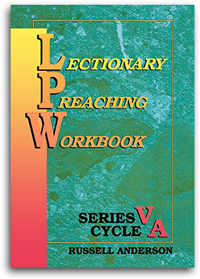
Lectionary Preaching Workbook
Series V, Cycle A
BRIEF COMMENTARY ON THE LESSONS
Lesson 1: Genesis 18:1--15 (C)
Three men appear to Abraham as he sits by the entrance of his tent in the heat of the day. Abraham extends gracious hospitality to them and one of the men reveals himself to be the Lord and announces that Sarah will have a child. Sarah laughs to herself at the idea of such an old woman bearing a child and is chastised by the Lord for her skepticism.
Lesson 1: Exodus 19:2--6 (RC); Exodus 19:2--8a (E, L)
Moses appears before God in Sinai to covenant with his people. Through his redeeming presence among his people, he has claimed the Hebrews as his special possession. In response to God's goodness, the people are called to be a kingdom of priests and a holy nation. They are to represent God to the nations.
Lesson 2: Romans 5:1--8 (C); Romans 5:6--11 (RC, E, L)
Having established the need for justification by grace through faith in the first few chapters, Paul discusses the consequences of our justification. ''We have peace with God'' (v. 1). He goes on to explain that our reconciliation with God is accomplished as God's initiative through Christ's death on the cross. Humankind had done nothing to merit God's saving action, since all have sinned (v. 8). For Christians, reconciliation is past tense; God is the subject and we are the objects. The believer has but to accept this reconciliation and rejoice.
Gospel: Matthew 9:35-10:8 (9--23) (C); Matthew 9:36-10:8 (RC); Matthew 9:35-10:8 (L); Matthew 9:35-10:8 (9--15) (E)
The Gospel begins with a summation of the main facets of Jesus' ministry - preaching, teaching and healing. In this ninth chapter, however, his healing ministry is on display. Jesus acts out of a sense of compassion for the multitudes (v. 36) but seems a bit daunted by the magnitude of human need. ''The harvest is plentiful but the laborers are few'' (v. 37). At the beginning of the tenth chapter, Jesus commissions and empowers the apostles (whose names are listed) to carry out the ministry of the kingdom. The harvest will be complete when many hands join in the task.
Psalm Of The Day
Psalm 116:1--2, 12--19 (C) - ''What shall I return to the Lord for all his bounty to me?'' (v. 16).
221
Psalm 100 (RC, E, L) - ''Know that the Lord is God ... we are his people; the sheep of his pasture'' (v. 3).
Prayer Of The Day
O Shepherd of our souls, when we are lost, find us and bring us home. When we are wounded, soothe our hurts with the balm of your compassion. And when we are confused, set us on the right pathway, so that we might be equipped to carry out the work of your kingdom. In Jesus' name. Amen.
THEOLOGICAL REFLECTION ON THE LESSONS
Lesson 1: Genesis 18:1--15
Welcoming the stranger. This story is not only a prime example of Abraham's generosity but of near--eastern hospitality. For these nomadic wanderers, living in a harsh environment, hospitality was a way of life. It wasn't just a matter of courtesy, one's life might depend on it. Hospitality to the stranger has been largely lost as the bonds of community break down. The church is the last bastion of hospitality to the stranger. Remember the words of Jesus, ''I was a stranger and you welcomed me.''
Lesson 1: Exodus 19:2--8a
On eagles' wings. As God prepares to lay out his covenant to Moses, he reminds him of how he has borne them up and carried them along, as on eagles' wings. Those who study eagles have observed that when it is time for the eaglets to try their wings, their mother will nudge them out of the nest. If the little eaglet is not equal to the challenge, she will swoop down underneath her baby, so he can latch on to her back. Time and again, when the sins and weaknesses of the Hebrews led to a precipitous plummet, the Lord swooped down to lift them up and carry them along.
Kingdom of priests. God informs his people that if they keep his covenant, they will serve him as a ''kingdom of priests and a holy nation'' (v. 6). God had ordained them into a special role and ministry. The people accepted the privilege of their priestly position but usually lost sight of the responsibility of their calling. As a priestly people, they were called to set an example of holy living and to represent God to the nations. In 1 Peter 2:9, this concept of a priestly people is applied to the Church. We are called to bring the nations to God and God to the nations.
Listen to your Elders. Moses presented the covenant of the Lord to the people through the elders (v. 7). They set an example of spiritual leadership for all the nation. Elders were looked upon as people of sound faith, wisdom and wide experience. In our cult of youth, we have dismissed the wisdom of our elders as being hopelessly outdated. With the exception of the Reformed tradition, most churches don't even call their leaders Elders. Isn't it time we turned back to the wealth of wisdom and spiritual discernment we have in our Christian elders?
Lesson 2: Romans 5:1--11
A religion for weaklings. Paul says that, ''while we were still weak, Christ died for the ungodly'' (v. 6). Christianity has long been accused of being a religion for weaklings and so it is. Christ does not offer salvation to supermen, only super sinners. Is that the reason that less men are active in the Lord's work than women, because men cannot admit that they are weak and vulnerable, while women can?
What time is it? Paul states that it was at the right time that Christ died for the ungodly (v. 6). The kind of time being spoken of here is a translation of the Greek kairos, denoting time as special or qualitative. Christ died for us sinners when the time was right and this very moment is the right time to accept God's salvation.
222
Friends of the Lord? The term friend does not exactly fit the relationship we have with the Lord because friendship implies equality. Paul talks about our being reconciled with the Lord through the cross. Reconciliation doesn't necessarily imply friendship but how could we characterize our relationship with the Lord? We are no longer enemies. We are much more than mere acquaintances. We are more than servants. So, I guess we really are friends with God. In the Gospel of John, Jesus tells his disciples that they are not merely servants but his friends, because he has revealed his heart to them. Friendship involves the grace of accepting the other just as she is. What a friend, we can reveal our true selves without fear of betrayal or rejection. What a friend we have in Jesus!
Gospel: Matthew 9:35-10:8
Ministry on the move. This lection opens with the statement that Jesus went about all the cities and villages, proclaiming the kingdom through word and deed. The Lord did not wait for people to come to him. He proclaimed the good news of the kingdom in the marketplaces and in the synagogues, in the cities and the countryside. Jesus brought the kingdom to bear at the point of human need, rather than expecting the people to minister to the kingdom at the point of its need. Regrettably, the church has often failed to employ this most successful mission strategy of our Lord.
Preaching, teaching and healing. If the kingdom is the food and the implement that Jesus used to serve it was a fork, the three tines on the fork would be preaching, teaching and healing. Preaching prevails on the heart, the seat of our will, where decisions are made. One must first decide to follow Christ. Healing ministers to the body and the mind, to effect wholeness. And teaching ministers to the mind, so that the disciple understands the implications and applications of the gospel for daily life.
Christ for the common person. Matthew comments that when Jesus viewed the crowds of needy people coming to him, he had compassion for them because they were so harassed and helpless (v. 36). These were peasant people, for the most part, the lilies of the field rather than the well--ordered flowers in an English garden.
Labor shortage. Christ viewed human need as an opportunity to usher people into the kingdom of God. When God's people satisfy human needs, doors open to the gospel. The problem resides in the gigantic scale of such needs. As Jesus beheld the hoards of hurting folk, he repined: ''The harvest is plentiful, but the laborers are few'' (v. 37). Who is going to supply the labor shortfall? Those disciples who seem to have it all together? Most of us are more like sheep than shepherds, in that we are all harassed and helpless to some degree. Yet, by God's grace, we can make a difference. The band of disciples that Jesus sent out were far from perfect, yet they did great things in Christ's name.
Mission strategy. The reason so many churches never seem to move out in mission is that they have no mission strategy or it's poorly defined. Jesus was very clear about his as he prepared to send out his disciples. He told them to limit their outreach to the Jews. This doesn't mean that he didn't care for Gentiles or Samaritans but his mission strategy was to reach the Jews and, through them, the rest of the world.
PREACHING APPROACHES WITH ILLUSTRATIONS
Lesson 1: Genesis 18:1--5
Sermon Title: Incognito
Sermon Angle: God appeared to Abraham incognito in the guise of three strangers. Abraham did not recognize the Lord but welcomed these strangers with profuse hospitality. One never knows when God will appear, but he often takes the form of the stranger, the visitor, the uninvited guest. In welcoming the stranger, we welcome the Lord.
223
Sermon Title: Limiting The Lord
Sermon Angle: When the Lord told Abraham that he was going to have a child, Sarah secretly laughed. That she should bear a child in her old age seemed impossible, even humorous. The stranger (God) reproved her by saying: ''Is anything too wonderful for the Lord?'' (v. 14). We can't be too hard on Sarah for her incredulity. We also limit the Lord to the level of our experience.
Lesson 1: Exodus 19:2--8a
Sermon Title: On Eagles' Wings
Sermon Angle: Before God established his covenant with the Hebrews, he recounted his great acts of redemption. He saved them from the power of their oppressor and bore them up on eagles' wings (v. 4). The eagle is a symbol of strength and majesty; no creature can soar with the eagle, which makes it immune to all predators. Just as the mother eagle swoops down to bear up her young, so the Lord lifts up those who are his own.
Outline:
1. To be human is to experience weakness
2. As God's children, we experience God's strength at the point of our weakness
3. God's strength is like an eagle's
- he may push us out of the nest to make us strong
- but swoops down to lift us up when we are too weak to fly
Sermon Title: A Priestly People
Sermon Angle: Through God's great acts of redemption he ordained the Hebrew people to be a kingdom of priests and a consecrated people. They were to bring the nations to God and God to the nations. In a similar vein, Luther enunciated the doctrine of the priesthood of all believers.
Outline:
1. The Hebrews were called to be a priestly people in response to God's salvation
2. We are called to be a priestly people in response to Christ's sacrifice
- witnessing to Christ's love
- offering our lives as a sacrifice of worship
- extending his forgiveness
Lesson 2: Romans 5:1--11
Sermon Title: Beyond Self--Justification
Sermon Angle: Paul's concept of justification is based on the premise that sin is real and that it needs to be accounted for. That's why Christ died on the cross, to pay the punishment of our sin, so that we might be declared not guilty by God. In our day, many people are more concerned with self--justification than being justified by God. Self--justification is an effort to evade responsibility by constructing excuses and blaming others. Self--justification makes a mockery of justice and righteousness. Justification by grace through faith takes sin seriously. We accept our guilt but hold that Christ has taken the rap for us. God now regards us as righteous and innocent.
Outline:
1. Our society has lost its moral compass
- sin and wrong are not recognized as such
- the guilty seek to justify rather than repent of their sin
2. Christ offers another way - justification through the cross (v. 6)
3. Move from self--justification to justification by Christ
- acknowledge your guilt
- accept his forgiveness and his righteousness
224
Gospel: Matthew 9:35-10:8 (9--23)
Sermon Title: The Pillars Of The Church
Sermon Angle: The gospels inform us that Jesus' ministry was divided into three main components - preaching, teaching and healing. His preaching was to make the kingdom known and call for a response. The teaching was to apply the principles of the kingdom to daily life. The healing was to make known that God's intention for his creation is wholeness of body, mind and spirit. If we make strong those pillars, the success of the Church's mission is assured.
Sermon Title: Itinerant Evangelists
Sermon Angle: Jesus commissioned his apostles to be itinerant evangelists, to take the gospel to the people, by word and deed. In our day, itinerant evangelists have gotten some bad press, with scandals, affairs and the like. Actually though, the church is a society of itinerant evangelists. The good news of Jesus is not to be hermetically sealed in the church structure, but proclaimed in the marketplace, the streets and the back alleys. We are to heal and empower the harassed and helpless through the gospel, wherever we go.
In David Buttrick's book, Homiletic, he distinguishes two arenas for preaching. There is in church preaching, usually performed by an ordained person in the context of the Christian community. When we lift up preaching, this is what we normally have in mind. The other type of preaching he labels out church preaching. This proclamation is performed primarily by the laity and the arena is not the church but the world. Yet few churches train their laity as to how they can present their faith in an authentically Christian manner and some lay people do not take seriously their commission to proclaim the Gospel out in the world. Instead of witnessing to Christ, many Christian people launch into a sales pitch for their congregation. Oh, you've got to come to our church! Our pastor is so neat! Our choir sings beautifully. We have a bowling league and softball teams. Our Sunday school is super and our youth group goes on all manner of fun outings. We have something for everybody in our church. We've got what you're looking for. Such an approach diverts the attention away from the crucial questions such as: What does Christ mean to me? Where is Christ in my life? What difference does my faith make in my daily existence?
We cannot assume that the audience for our in church preaching is totally Christian. Some of those on the church rolls have not internalized the gospel. Many who have turned a deaf ear to the gospel of grace are living under the law. Furthermore, those who are searching for God are apt to visit the local congregation at worship. Some degree of out church preaching must transpire in the in church setting. That is, the worship and sermon must address issues cogent to those outside the Christian faith. To use a phrase popularized by Patrick Kiefert, an Associate Professor at Luther Northwestern Seminary in St. Paul, Minnesota, the church is called to welcome the stranger, to be a community of welcome. In his book, Welcoming The Stranger, Kiefert related an experience that occurred on the now--defunct Dick Cavett Show. As a distinguished guest was being welcomed to the show, Cavett noticed that the fly on his trousers was unzipped. What could he do without embarrassing his guest? A light bulb went off in his head. He ordered all the guests to stand up and turn around and pull up their zipper, explaining that one of them had his open. Nobody in the audience knew which one of them had their barn door open. Cavett created an atmosphere of hospitality by not forcing his guests to reveal the intimate details of their life. If we want people to come back to our communities of faith, we must provide an environment where they can participate without standing out or feeling odd and embarrassed.
225
Lesson 1: Genesis 18:1--15 (C)
Three men appear to Abraham as he sits by the entrance of his tent in the heat of the day. Abraham extends gracious hospitality to them and one of the men reveals himself to be the Lord and announces that Sarah will have a child. Sarah laughs to herself at the idea of such an old woman bearing a child and is chastised by the Lord for her skepticism.
Lesson 1: Exodus 19:2--6 (RC); Exodus 19:2--8a (E, L)
Moses appears before God in Sinai to covenant with his people. Through his redeeming presence among his people, he has claimed the Hebrews as his special possession. In response to God's goodness, the people are called to be a kingdom of priests and a holy nation. They are to represent God to the nations.
Lesson 2: Romans 5:1--8 (C); Romans 5:6--11 (RC, E, L)
Having established the need for justification by grace through faith in the first few chapters, Paul discusses the consequences of our justification. ''We have peace with God'' (v. 1). He goes on to explain that our reconciliation with God is accomplished as God's initiative through Christ's death on the cross. Humankind had done nothing to merit God's saving action, since all have sinned (v. 8). For Christians, reconciliation is past tense; God is the subject and we are the objects. The believer has but to accept this reconciliation and rejoice.
Gospel: Matthew 9:35-10:8 (9--23) (C); Matthew 9:36-10:8 (RC); Matthew 9:35-10:8 (L); Matthew 9:35-10:8 (9--15) (E)
The Gospel begins with a summation of the main facets of Jesus' ministry - preaching, teaching and healing. In this ninth chapter, however, his healing ministry is on display. Jesus acts out of a sense of compassion for the multitudes (v. 36) but seems a bit daunted by the magnitude of human need. ''The harvest is plentiful but the laborers are few'' (v. 37). At the beginning of the tenth chapter, Jesus commissions and empowers the apostles (whose names are listed) to carry out the ministry of the kingdom. The harvest will be complete when many hands join in the task.
Psalm Of The Day
Psalm 116:1--2, 12--19 (C) - ''What shall I return to the Lord for all his bounty to me?'' (v. 16).
221
Psalm 100 (RC, E, L) - ''Know that the Lord is God ... we are his people; the sheep of his pasture'' (v. 3).
Prayer Of The Day
O Shepherd of our souls, when we are lost, find us and bring us home. When we are wounded, soothe our hurts with the balm of your compassion. And when we are confused, set us on the right pathway, so that we might be equipped to carry out the work of your kingdom. In Jesus' name. Amen.
THEOLOGICAL REFLECTION ON THE LESSONS
Lesson 1: Genesis 18:1--15
Welcoming the stranger. This story is not only a prime example of Abraham's generosity but of near--eastern hospitality. For these nomadic wanderers, living in a harsh environment, hospitality was a way of life. It wasn't just a matter of courtesy, one's life might depend on it. Hospitality to the stranger has been largely lost as the bonds of community break down. The church is the last bastion of hospitality to the stranger. Remember the words of Jesus, ''I was a stranger and you welcomed me.''
Lesson 1: Exodus 19:2--8a
On eagles' wings. As God prepares to lay out his covenant to Moses, he reminds him of how he has borne them up and carried them along, as on eagles' wings. Those who study eagles have observed that when it is time for the eaglets to try their wings, their mother will nudge them out of the nest. If the little eaglet is not equal to the challenge, she will swoop down underneath her baby, so he can latch on to her back. Time and again, when the sins and weaknesses of the Hebrews led to a precipitous plummet, the Lord swooped down to lift them up and carry them along.
Kingdom of priests. God informs his people that if they keep his covenant, they will serve him as a ''kingdom of priests and a holy nation'' (v. 6). God had ordained them into a special role and ministry. The people accepted the privilege of their priestly position but usually lost sight of the responsibility of their calling. As a priestly people, they were called to set an example of holy living and to represent God to the nations. In 1 Peter 2:9, this concept of a priestly people is applied to the Church. We are called to bring the nations to God and God to the nations.
Listen to your Elders. Moses presented the covenant of the Lord to the people through the elders (v. 7). They set an example of spiritual leadership for all the nation. Elders were looked upon as people of sound faith, wisdom and wide experience. In our cult of youth, we have dismissed the wisdom of our elders as being hopelessly outdated. With the exception of the Reformed tradition, most churches don't even call their leaders Elders. Isn't it time we turned back to the wealth of wisdom and spiritual discernment we have in our Christian elders?
Lesson 2: Romans 5:1--11
A religion for weaklings. Paul says that, ''while we were still weak, Christ died for the ungodly'' (v. 6). Christianity has long been accused of being a religion for weaklings and so it is. Christ does not offer salvation to supermen, only super sinners. Is that the reason that less men are active in the Lord's work than women, because men cannot admit that they are weak and vulnerable, while women can?
What time is it? Paul states that it was at the right time that Christ died for the ungodly (v. 6). The kind of time being spoken of here is a translation of the Greek kairos, denoting time as special or qualitative. Christ died for us sinners when the time was right and this very moment is the right time to accept God's salvation.
222
Friends of the Lord? The term friend does not exactly fit the relationship we have with the Lord because friendship implies equality. Paul talks about our being reconciled with the Lord through the cross. Reconciliation doesn't necessarily imply friendship but how could we characterize our relationship with the Lord? We are no longer enemies. We are much more than mere acquaintances. We are more than servants. So, I guess we really are friends with God. In the Gospel of John, Jesus tells his disciples that they are not merely servants but his friends, because he has revealed his heart to them. Friendship involves the grace of accepting the other just as she is. What a friend, we can reveal our true selves without fear of betrayal or rejection. What a friend we have in Jesus!
Gospel: Matthew 9:35-10:8
Ministry on the move. This lection opens with the statement that Jesus went about all the cities and villages, proclaiming the kingdom through word and deed. The Lord did not wait for people to come to him. He proclaimed the good news of the kingdom in the marketplaces and in the synagogues, in the cities and the countryside. Jesus brought the kingdom to bear at the point of human need, rather than expecting the people to minister to the kingdom at the point of its need. Regrettably, the church has often failed to employ this most successful mission strategy of our Lord.
Preaching, teaching and healing. If the kingdom is the food and the implement that Jesus used to serve it was a fork, the three tines on the fork would be preaching, teaching and healing. Preaching prevails on the heart, the seat of our will, where decisions are made. One must first decide to follow Christ. Healing ministers to the body and the mind, to effect wholeness. And teaching ministers to the mind, so that the disciple understands the implications and applications of the gospel for daily life.
Christ for the common person. Matthew comments that when Jesus viewed the crowds of needy people coming to him, he had compassion for them because they were so harassed and helpless (v. 36). These were peasant people, for the most part, the lilies of the field rather than the well--ordered flowers in an English garden.
Labor shortage. Christ viewed human need as an opportunity to usher people into the kingdom of God. When God's people satisfy human needs, doors open to the gospel. The problem resides in the gigantic scale of such needs. As Jesus beheld the hoards of hurting folk, he repined: ''The harvest is plentiful, but the laborers are few'' (v. 37). Who is going to supply the labor shortfall? Those disciples who seem to have it all together? Most of us are more like sheep than shepherds, in that we are all harassed and helpless to some degree. Yet, by God's grace, we can make a difference. The band of disciples that Jesus sent out were far from perfect, yet they did great things in Christ's name.
Mission strategy. The reason so many churches never seem to move out in mission is that they have no mission strategy or it's poorly defined. Jesus was very clear about his as he prepared to send out his disciples. He told them to limit their outreach to the Jews. This doesn't mean that he didn't care for Gentiles or Samaritans but his mission strategy was to reach the Jews and, through them, the rest of the world.
PREACHING APPROACHES WITH ILLUSTRATIONS
Lesson 1: Genesis 18:1--5
Sermon Title: Incognito
Sermon Angle: God appeared to Abraham incognito in the guise of three strangers. Abraham did not recognize the Lord but welcomed these strangers with profuse hospitality. One never knows when God will appear, but he often takes the form of the stranger, the visitor, the uninvited guest. In welcoming the stranger, we welcome the Lord.
223
Sermon Title: Limiting The Lord
Sermon Angle: When the Lord told Abraham that he was going to have a child, Sarah secretly laughed. That she should bear a child in her old age seemed impossible, even humorous. The stranger (God) reproved her by saying: ''Is anything too wonderful for the Lord?'' (v. 14). We can't be too hard on Sarah for her incredulity. We also limit the Lord to the level of our experience.
Lesson 1: Exodus 19:2--8a
Sermon Title: On Eagles' Wings
Sermon Angle: Before God established his covenant with the Hebrews, he recounted his great acts of redemption. He saved them from the power of their oppressor and bore them up on eagles' wings (v. 4). The eagle is a symbol of strength and majesty; no creature can soar with the eagle, which makes it immune to all predators. Just as the mother eagle swoops down to bear up her young, so the Lord lifts up those who are his own.
Outline:
1. To be human is to experience weakness
2. As God's children, we experience God's strength at the point of our weakness
3. God's strength is like an eagle's
- he may push us out of the nest to make us strong
- but swoops down to lift us up when we are too weak to fly
Sermon Title: A Priestly People
Sermon Angle: Through God's great acts of redemption he ordained the Hebrew people to be a kingdom of priests and a consecrated people. They were to bring the nations to God and God to the nations. In a similar vein, Luther enunciated the doctrine of the priesthood of all believers.
Outline:
1. The Hebrews were called to be a priestly people in response to God's salvation
2. We are called to be a priestly people in response to Christ's sacrifice
- witnessing to Christ's love
- offering our lives as a sacrifice of worship
- extending his forgiveness
Lesson 2: Romans 5:1--11
Sermon Title: Beyond Self--Justification
Sermon Angle: Paul's concept of justification is based on the premise that sin is real and that it needs to be accounted for. That's why Christ died on the cross, to pay the punishment of our sin, so that we might be declared not guilty by God. In our day, many people are more concerned with self--justification than being justified by God. Self--justification is an effort to evade responsibility by constructing excuses and blaming others. Self--justification makes a mockery of justice and righteousness. Justification by grace through faith takes sin seriously. We accept our guilt but hold that Christ has taken the rap for us. God now regards us as righteous and innocent.
Outline:
1. Our society has lost its moral compass
- sin and wrong are not recognized as such
- the guilty seek to justify rather than repent of their sin
2. Christ offers another way - justification through the cross (v. 6)
3. Move from self--justification to justification by Christ
- acknowledge your guilt
- accept his forgiveness and his righteousness
224
Gospel: Matthew 9:35-10:8 (9--23)
Sermon Title: The Pillars Of The Church
Sermon Angle: The gospels inform us that Jesus' ministry was divided into three main components - preaching, teaching and healing. His preaching was to make the kingdom known and call for a response. The teaching was to apply the principles of the kingdom to daily life. The healing was to make known that God's intention for his creation is wholeness of body, mind and spirit. If we make strong those pillars, the success of the Church's mission is assured.
Sermon Title: Itinerant Evangelists
Sermon Angle: Jesus commissioned his apostles to be itinerant evangelists, to take the gospel to the people, by word and deed. In our day, itinerant evangelists have gotten some bad press, with scandals, affairs and the like. Actually though, the church is a society of itinerant evangelists. The good news of Jesus is not to be hermetically sealed in the church structure, but proclaimed in the marketplace, the streets and the back alleys. We are to heal and empower the harassed and helpless through the gospel, wherever we go.
In David Buttrick's book, Homiletic, he distinguishes two arenas for preaching. There is in church preaching, usually performed by an ordained person in the context of the Christian community. When we lift up preaching, this is what we normally have in mind. The other type of preaching he labels out church preaching. This proclamation is performed primarily by the laity and the arena is not the church but the world. Yet few churches train their laity as to how they can present their faith in an authentically Christian manner and some lay people do not take seriously their commission to proclaim the Gospel out in the world. Instead of witnessing to Christ, many Christian people launch into a sales pitch for their congregation. Oh, you've got to come to our church! Our pastor is so neat! Our choir sings beautifully. We have a bowling league and softball teams. Our Sunday school is super and our youth group goes on all manner of fun outings. We have something for everybody in our church. We've got what you're looking for. Such an approach diverts the attention away from the crucial questions such as: What does Christ mean to me? Where is Christ in my life? What difference does my faith make in my daily existence?
We cannot assume that the audience for our in church preaching is totally Christian. Some of those on the church rolls have not internalized the gospel. Many who have turned a deaf ear to the gospel of grace are living under the law. Furthermore, those who are searching for God are apt to visit the local congregation at worship. Some degree of out church preaching must transpire in the in church setting. That is, the worship and sermon must address issues cogent to those outside the Christian faith. To use a phrase popularized by Patrick Kiefert, an Associate Professor at Luther Northwestern Seminary in St. Paul, Minnesota, the church is called to welcome the stranger, to be a community of welcome. In his book, Welcoming The Stranger, Kiefert related an experience that occurred on the now--defunct Dick Cavett Show. As a distinguished guest was being welcomed to the show, Cavett noticed that the fly on his trousers was unzipped. What could he do without embarrassing his guest? A light bulb went off in his head. He ordered all the guests to stand up and turn around and pull up their zipper, explaining that one of them had his open. Nobody in the audience knew which one of them had their barn door open. Cavett created an atmosphere of hospitality by not forcing his guests to reveal the intimate details of their life. If we want people to come back to our communities of faith, we must provide an environment where they can participate without standing out or feeling odd and embarrassed.
225
