
Grace In The Midst Of Exasperation
Sermon
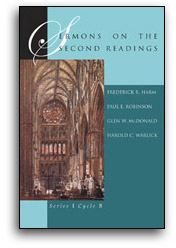
Sermons On The Second Readings
For Sundays In Advent, Christmas, And Epiphany
Spiritual storytelling (a.k.a. "my testimony") is often an inspiring experience for a gathered group of Christians. It is also inherently risky. The risk is that the story will sound wonderful. Whenever the overwhelming number of details of someone's garden-variety life are squeezed down to a significant few, it can seem that that four-minute abridged version of existence is fabulously more exciting or meaningful than anything the rest of us have experienced in the previous forty years. We may say to each other, "How awesome it is that God is at work in your life," when in fact what we're really thinking is, "Why isn't God doing things like that in me?"
Over the years it's hard for a growing disciple not to wonder, "Where is the proof that my life is different because I am a Christian? What hard evidence can I muster?" We may even muse, "If only I had come from the rough part of town. If only I had been in prison. Then the changes would be obvious and I could tell a better story than Compliant Suburban Teenager Meets God, or Light Finally Comes On For Dim-Witted Accountant." To write his book Reaching For the Invisible God, Philip Yancey asked a number of people how they knew their lives were different because they had trusted Christ. His most poignant response came from someone whose name he chose not to share, except to say that he hosts a national radio program and dispenses solid biblical advice every week. That man wrote:
I have no trouble believing God is good. My question is more, what good is he? I heard a while back that Billy Graham's daughter was undergoing marriage problems, so the Grahams and the in-laws all flew to Europe to meet with them and pray for the couple. They ended up getting divorced anyway. If Billy Graham's prayers don't get answered, what's the use of my praying? I look at my life -- the health problems, my own daughter's struggles, my marriage. I cry out to God for help, and it's hard to know just how he answers. Really, what can we count on God for?
That is the question. If we're trusting that God is here, at work in our lives, actually changing us, what exactly can we expect? Does Christian discipleship deliver real power for real change? Before such real change in our lives can come about, we have to understand why change is necessary ... and why our search for the evidence of spiritual progress can be so exasperating.
The Bible provides a fascinating assessment of the condition of humanity. God's Word asserts that every human being is a slave to desire. Every person is born with a particular set of desires -- desires that lead us away from God and into lives of sheer frustration. If we choose to receive Christ as Savior, however, we are given a brand new set of desires -- desires that lead us to please God and ultimately to be fulfilled and contented.
The important thing to note is that our slavery to desire is not negotiable. The only choice we have is which kind of desire we will obey. Does this mean that humans aren't free? Aren't we at liberty to choose whatever we want to do at a given moment? The fact of the matter is that our choices are always determined by our desires -- and we always end up doing what we truly desire at any given moment.
For example, there is abundant evidence from physicians, sociological research, the testimonies of friends and family and our own experience that quality of life is enhanced by exercise. The case has been made. Few individuals are likely to say, "Being out of shape has been a major asset in my life, and I hope to prolong my time on the couch." Investments in exercise equipment, workout plans, personal trainers, and specialized clothing have skyrocketed within the last quarter century. A majority of those polled on January 1 annually indicate their resolve to pursue a more vigorous regimen of exercise.
However -- take a snapshot of your neighborhood. More than fifty percent of America is overweight, and 25 percent is technically obese. What has happened to the expressed and even fervent desire for physical conditioning? It is routinely overwhelmed by a greater desire -- to eat whatever happens to taste good, and not to "sweat it" when it's time to work out. Day by day we obey our greatest desires at any particular moment. It's just that our cognitive resolutions to be in better shape stand little chance if we continually hang out at buffets. As millions can attest, this reality is nothing short of exasperating.
Nevertheless, as theologian R. C. Sproul argues in Chosen by God, most of us intuitively reject the notion that we are slaves to our strongest urges. We believe ourselves to be captains of our own souls and directors of our own agendas. We protest, "I don't always do what I desire. In fact right now I'd much prefer being on a golf course in Hawaii than sitting here reading about theology." That being said, we are still doing what we most desire. Tickets to Hawaii are expensive. So are greens fees. We may daydream about making the sacrifices necessary to chuck it all and head west, but when push comes to shove, reading this page at this place and time has risen to the top of all of our available alternatives. People always choose to do what they most want to do at any particular moment.
What does this have to do with following God? This has everything to do with following God. Scripture consistently declares that every human being is endowed with a set of desires that automatically steer us away from God. The Apostle Paul calls this a sin nature. It is the irrevocable legacy of being born into a fallen world. Ponder your highest and purest intentions: "I promise to be a holy person; I vow to think affirming thoughts; I resolve to stop hating those who have hurt me; I swear I will stay away from pornography; I promise I will no longer go through life feeling afraid." What happens when we send such good intentions to war against our sinful desires? The result is a spiritual catastrophe -- precisely what Paul chronicles in Romans 7, beginning at verse 15: "I do not understand my own actions. For I do not do what I want, but I do the very thing I hate." Verse 19 continues, "For I do not do the good I want, but the evil I do not want is what I do." It is exasperating indeed. The climax of frustration arrives with the despairing cry of verse 24: "Wretched man that I am! Who will rescue me from this body of death?"
Who exactly is this "wretched man"? This is no mere spiritual wannabe. This is the early Church's greatest thinker and missionary. Paul's best intentions are being stampeded by a herd of his own desires that he has no ability to control. If Paul feels this frustrated, what hope do we have that we can ever change? What makes us think that we can kick habits or resist temptations? The very next verse presents the answer: "Thanks be to God through Jesus Christ our Lord!"
It is through the Second Person of the Trinity that God pours out grace in the midst of exasperation. Jesus alone delivers power to change. How? It is no accident that Romans 8:1, 2 are among the most cherished verses in scripture: "There is therefore now no condemnation for those who are in Christ Jesus. For the law of the Spirit of life in Christ Jesus has set you free from the law of sin and of death."
Have you ever been riding in an airplane and suddenly started wondering, "How in the world is this thing staying up in the air?" Think about it: Planes are a great deal heavier than air. They cannot float. The law of gravity declares that whatever is heavier than air must be drawn directly toward the center of the earth. For centuries philosophers and inventors concluded that flying was a privilege reserved only for creatures born with wings. So how is it that over the next 24 hours more than 200,000 passenger flights will take off and land somewhere in the world?
The answer is Bernoulli's Principle. Airplane wings are curved in such a way that air flows faster above the wing than beneath it. According to Bernoulli's principle, if water or air is flowing faster along one side of an object than the other, the pressure along that side will decrease, and force will be exerted toward the low-pressure side. That's what gives airplane wings their lift. Every time a jet is ready to take off the air traffic controllers don't have to say to the pilot, "You'll be cleared for take-off just as soon as we suspend the law of gravity." The law of gravity is never suspended. It is always operational. Planes are able to fly simply because they are empowered by a greater law -- one that supersedes gravity.
Paul writes, "For the law of the Spirit of life in Christ Jesus has set you free from the law of sin and of death." In this world God does not eradicate our sinful desires. They still reside within us and they remain exceedingly powerful. But Christians can experience victory over those desires because of a higher law, a greater power. That greater power is mediated by the Holy Spirit.
Whenever someone chooses to become an intentional imitator of Jesus Christ, a brand new set of desires is placed inside them -- and so is the Holy Spirit, God's own Self living inside our hearts. Christians receive an entirely new nature -- a whole new level of passion and insight concerning spiritual things. That new set of desires is what often makes young disciples virtually intoxicated with excitement about pleasing God.
All too soon, though, reality sets in. Exasperation returns. Inside every Christian the old desires are still lurking. People who follow Jesus routinely feel "Balkanized" in their inner worlds. Old desires battle new desires. That's why disciples still sin. Rarely does a week go by that someone with a heart for God doesn't resolve to be warm, caring, and grace-giving to every person they meet. That would reflect our conscious desire. But other desires -- to be petty and small-minded and cynical -- are never very far away. Sometimes the darker desires win an overwhelming victory. Then we think, "Why did I do that? What's wrong with me?" The answer is that our inner natures remain a bundle of contradictions. We agonize, "Am I really a different person? Has anything about me actually changed? How can I truly say that I belong to God?"
For this reason it is crucial to remember, every day of our lives, God's guarantee that we are able in the here and now to experience life's most important change. What's the most important change in my whole life? It's not getting rid of a particular habit. There may be some habits that I never finally kick. It's not smoothing all the rough spots in my personality. I will undoubtedly reach the end of life still in a pitched battle against some form of selfishness. But there is one change that I can know has already taken place -- that I have moved from being someone who is spiritually lost to someone who has been adopted into God's own family.
Paul exults, beginning in verse 14: "For all who are led by the Spirit of God are children of God. For you did not receive a spirit of slavery to fall back into fear, but you have received a spirit of adoption. When we cry, 'Abba! Father!' it is that very Spirit bearing witness with our spirit that we are children of God."
The Holy Spirit whispers to us, "Don't lose heart. You belong to God. You are God's child. You have been rescued by grace and you will never be rejected." Yet how can we believe that, especially when we continue to make the same stupid mistakes and surrender to the same sick desires of our old natures? Here is the wonderful answer: God has already given us the status of righteousness. But we still don't have the reality of righteousness. God looks at Christians right now as God's perfect children, even though, in reality, we aren't even in the zip code of acting like perfect children. We can summarize our situation this way: "Even when we foul up, we don't foul out."
Imagine what it would be like if you were awarded the Olympic gold medal in the 50-meter freestyle -- which every four years showcases the world's fastest aquatic athletes -- even though you don't know how to swim. All you would have to do to claim the status of "fastest swimmer on planet earth" is show up at the medal ceremony, cry a little bit during the National Anthem, and then head for the post-race party. That's what God has done for us. If we enter a relationship with Jesus, then we are given the ultimate status in the universe -- we are God's own children -- even though we have done nothing to earn that status.
In our hearts we know that this simply can't be the whole picture. Who could possibly feel good about accepting a gold medal under such circumstances? That's why the Holy Spirit instructs us, "Keep the gold medal. It's really yours, and it will never be taken away. But now it's time for your reality to catch up with your status. Get in the pool and let's work on treading water."
Our call, in other words, is to keep changing. God's grace is an invitation to grow into the likeness of the One whose name we bear. As Paul puts it in verse 12, "So then, brothers and sisters, we are debtors, not to the flesh, to live according to the flesh -- for if you live according to the flesh you will die; but if by the Spirit you put to death the deeds of the body, you will live."
Bernoulli's Principle allows airplanes to overcome the law of gravity. That's very reassuring. But Bernoulli's Principle has never once pried an airplane off the ground. That's the pilot's job. For a plane to fly, somebody has to start its engine, taxi it to the runway, and gun the engines to reach sufficient speed to become airborne. In principle, God has provided everything we need to live a spiritual life -- but we will never get off the ground unless we make the right decisions and take the right steps to walk with God.
What are the right steps? We must decide to feed our new desires to follow God, and starve the old desires that make us want to run away. The Holy Spirit is the key to winning that battle. God promises that the Spirit who lives inside us will remind us of the right things to do, will strengthen our desires to carry them out, and will never let us forget that as God's children we are going to become what God has called us to be.
Stuart Briscoe, pastor of Elmbrook Church outside Milwaukee, illustrates the power of feeding and starving with an observation about cuckoo birds. Cuckoos aren't merely the obnoxious noisemakers heard at the top of the hour in certain clocks. They are certifiably real. Two species, in fact, nest in America. To be more accurate, cuckoos rarely make their own nests. When it's time for a female cuckoo to lay her eggs, she will scout the local territory until she finds the nest of another bird that already has eggs -- often the nest of a thrush -- and wait until that mother bird is absent. Then she will dart in to the nest and deposit at least one egg of her own.
Thrushes are apparently not overly skilled in algebra, for when the mother returns, she doesn't notice that there is an addition to her nest. She continues to go about the work of hatching the eggs. What happens when the nestlings appear? There are four tiny thrushes and one lumbering cuckoo, two to three times larger than the other birds.
What happens at mealtime? The big bird gets the worm. The cuckoo continues to grow while the thrushes fight for survival. Briscoe remarks, "When I was a kid, you could always find a baby cuckoo's nest. You walked along a hedgerow until you found dead little thrushes, which the cuckoo throws out one at a time."
God's children have two sets of desire in one nest. Which one shall we feed? We must feed the new desires and starve the old ones. We must feed the ones that strengthen our walk with Christ and starve the ones that have always taken us down. The more we choose the new desires, the stronger the Holy Spirit grows our personal resolve to choose the new desires the next time as well. We won't always succeed. Trying to become a spiritual person in a fallen world -- trying specifically to think, feel and live as Christ's person -- will always to some degree be exasperating. But through God's gift of grace, Christ's victory over sin, and the indwelling presence of the Spirit, we can know that we truly have the power to change.
Over the years it's hard for a growing disciple not to wonder, "Where is the proof that my life is different because I am a Christian? What hard evidence can I muster?" We may even muse, "If only I had come from the rough part of town. If only I had been in prison. Then the changes would be obvious and I could tell a better story than Compliant Suburban Teenager Meets God, or Light Finally Comes On For Dim-Witted Accountant." To write his book Reaching For the Invisible God, Philip Yancey asked a number of people how they knew their lives were different because they had trusted Christ. His most poignant response came from someone whose name he chose not to share, except to say that he hosts a national radio program and dispenses solid biblical advice every week. That man wrote:
I have no trouble believing God is good. My question is more, what good is he? I heard a while back that Billy Graham's daughter was undergoing marriage problems, so the Grahams and the in-laws all flew to Europe to meet with them and pray for the couple. They ended up getting divorced anyway. If Billy Graham's prayers don't get answered, what's the use of my praying? I look at my life -- the health problems, my own daughter's struggles, my marriage. I cry out to God for help, and it's hard to know just how he answers. Really, what can we count on God for?
That is the question. If we're trusting that God is here, at work in our lives, actually changing us, what exactly can we expect? Does Christian discipleship deliver real power for real change? Before such real change in our lives can come about, we have to understand why change is necessary ... and why our search for the evidence of spiritual progress can be so exasperating.
The Bible provides a fascinating assessment of the condition of humanity. God's Word asserts that every human being is a slave to desire. Every person is born with a particular set of desires -- desires that lead us away from God and into lives of sheer frustration. If we choose to receive Christ as Savior, however, we are given a brand new set of desires -- desires that lead us to please God and ultimately to be fulfilled and contented.
The important thing to note is that our slavery to desire is not negotiable. The only choice we have is which kind of desire we will obey. Does this mean that humans aren't free? Aren't we at liberty to choose whatever we want to do at a given moment? The fact of the matter is that our choices are always determined by our desires -- and we always end up doing what we truly desire at any given moment.
For example, there is abundant evidence from physicians, sociological research, the testimonies of friends and family and our own experience that quality of life is enhanced by exercise. The case has been made. Few individuals are likely to say, "Being out of shape has been a major asset in my life, and I hope to prolong my time on the couch." Investments in exercise equipment, workout plans, personal trainers, and specialized clothing have skyrocketed within the last quarter century. A majority of those polled on January 1 annually indicate their resolve to pursue a more vigorous regimen of exercise.
However -- take a snapshot of your neighborhood. More than fifty percent of America is overweight, and 25 percent is technically obese. What has happened to the expressed and even fervent desire for physical conditioning? It is routinely overwhelmed by a greater desire -- to eat whatever happens to taste good, and not to "sweat it" when it's time to work out. Day by day we obey our greatest desires at any particular moment. It's just that our cognitive resolutions to be in better shape stand little chance if we continually hang out at buffets. As millions can attest, this reality is nothing short of exasperating.
Nevertheless, as theologian R. C. Sproul argues in Chosen by God, most of us intuitively reject the notion that we are slaves to our strongest urges. We believe ourselves to be captains of our own souls and directors of our own agendas. We protest, "I don't always do what I desire. In fact right now I'd much prefer being on a golf course in Hawaii than sitting here reading about theology." That being said, we are still doing what we most desire. Tickets to Hawaii are expensive. So are greens fees. We may daydream about making the sacrifices necessary to chuck it all and head west, but when push comes to shove, reading this page at this place and time has risen to the top of all of our available alternatives. People always choose to do what they most want to do at any particular moment.
What does this have to do with following God? This has everything to do with following God. Scripture consistently declares that every human being is endowed with a set of desires that automatically steer us away from God. The Apostle Paul calls this a sin nature. It is the irrevocable legacy of being born into a fallen world. Ponder your highest and purest intentions: "I promise to be a holy person; I vow to think affirming thoughts; I resolve to stop hating those who have hurt me; I swear I will stay away from pornography; I promise I will no longer go through life feeling afraid." What happens when we send such good intentions to war against our sinful desires? The result is a spiritual catastrophe -- precisely what Paul chronicles in Romans 7, beginning at verse 15: "I do not understand my own actions. For I do not do what I want, but I do the very thing I hate." Verse 19 continues, "For I do not do the good I want, but the evil I do not want is what I do." It is exasperating indeed. The climax of frustration arrives with the despairing cry of verse 24: "Wretched man that I am! Who will rescue me from this body of death?"
Who exactly is this "wretched man"? This is no mere spiritual wannabe. This is the early Church's greatest thinker and missionary. Paul's best intentions are being stampeded by a herd of his own desires that he has no ability to control. If Paul feels this frustrated, what hope do we have that we can ever change? What makes us think that we can kick habits or resist temptations? The very next verse presents the answer: "Thanks be to God through Jesus Christ our Lord!"
It is through the Second Person of the Trinity that God pours out grace in the midst of exasperation. Jesus alone delivers power to change. How? It is no accident that Romans 8:1, 2 are among the most cherished verses in scripture: "There is therefore now no condemnation for those who are in Christ Jesus. For the law of the Spirit of life in Christ Jesus has set you free from the law of sin and of death."
Have you ever been riding in an airplane and suddenly started wondering, "How in the world is this thing staying up in the air?" Think about it: Planes are a great deal heavier than air. They cannot float. The law of gravity declares that whatever is heavier than air must be drawn directly toward the center of the earth. For centuries philosophers and inventors concluded that flying was a privilege reserved only for creatures born with wings. So how is it that over the next 24 hours more than 200,000 passenger flights will take off and land somewhere in the world?
The answer is Bernoulli's Principle. Airplane wings are curved in such a way that air flows faster above the wing than beneath it. According to Bernoulli's principle, if water or air is flowing faster along one side of an object than the other, the pressure along that side will decrease, and force will be exerted toward the low-pressure side. That's what gives airplane wings their lift. Every time a jet is ready to take off the air traffic controllers don't have to say to the pilot, "You'll be cleared for take-off just as soon as we suspend the law of gravity." The law of gravity is never suspended. It is always operational. Planes are able to fly simply because they are empowered by a greater law -- one that supersedes gravity.
Paul writes, "For the law of the Spirit of life in Christ Jesus has set you free from the law of sin and of death." In this world God does not eradicate our sinful desires. They still reside within us and they remain exceedingly powerful. But Christians can experience victory over those desires because of a higher law, a greater power. That greater power is mediated by the Holy Spirit.
Whenever someone chooses to become an intentional imitator of Jesus Christ, a brand new set of desires is placed inside them -- and so is the Holy Spirit, God's own Self living inside our hearts. Christians receive an entirely new nature -- a whole new level of passion and insight concerning spiritual things. That new set of desires is what often makes young disciples virtually intoxicated with excitement about pleasing God.
All too soon, though, reality sets in. Exasperation returns. Inside every Christian the old desires are still lurking. People who follow Jesus routinely feel "Balkanized" in their inner worlds. Old desires battle new desires. That's why disciples still sin. Rarely does a week go by that someone with a heart for God doesn't resolve to be warm, caring, and grace-giving to every person they meet. That would reflect our conscious desire. But other desires -- to be petty and small-minded and cynical -- are never very far away. Sometimes the darker desires win an overwhelming victory. Then we think, "Why did I do that? What's wrong with me?" The answer is that our inner natures remain a bundle of contradictions. We agonize, "Am I really a different person? Has anything about me actually changed? How can I truly say that I belong to God?"
For this reason it is crucial to remember, every day of our lives, God's guarantee that we are able in the here and now to experience life's most important change. What's the most important change in my whole life? It's not getting rid of a particular habit. There may be some habits that I never finally kick. It's not smoothing all the rough spots in my personality. I will undoubtedly reach the end of life still in a pitched battle against some form of selfishness. But there is one change that I can know has already taken place -- that I have moved from being someone who is spiritually lost to someone who has been adopted into God's own family.
Paul exults, beginning in verse 14: "For all who are led by the Spirit of God are children of God. For you did not receive a spirit of slavery to fall back into fear, but you have received a spirit of adoption. When we cry, 'Abba! Father!' it is that very Spirit bearing witness with our spirit that we are children of God."
The Holy Spirit whispers to us, "Don't lose heart. You belong to God. You are God's child. You have been rescued by grace and you will never be rejected." Yet how can we believe that, especially when we continue to make the same stupid mistakes and surrender to the same sick desires of our old natures? Here is the wonderful answer: God has already given us the status of righteousness. But we still don't have the reality of righteousness. God looks at Christians right now as God's perfect children, even though, in reality, we aren't even in the zip code of acting like perfect children. We can summarize our situation this way: "Even when we foul up, we don't foul out."
Imagine what it would be like if you were awarded the Olympic gold medal in the 50-meter freestyle -- which every four years showcases the world's fastest aquatic athletes -- even though you don't know how to swim. All you would have to do to claim the status of "fastest swimmer on planet earth" is show up at the medal ceremony, cry a little bit during the National Anthem, and then head for the post-race party. That's what God has done for us. If we enter a relationship with Jesus, then we are given the ultimate status in the universe -- we are God's own children -- even though we have done nothing to earn that status.
In our hearts we know that this simply can't be the whole picture. Who could possibly feel good about accepting a gold medal under such circumstances? That's why the Holy Spirit instructs us, "Keep the gold medal. It's really yours, and it will never be taken away. But now it's time for your reality to catch up with your status. Get in the pool and let's work on treading water."
Our call, in other words, is to keep changing. God's grace is an invitation to grow into the likeness of the One whose name we bear. As Paul puts it in verse 12, "So then, brothers and sisters, we are debtors, not to the flesh, to live according to the flesh -- for if you live according to the flesh you will die; but if by the Spirit you put to death the deeds of the body, you will live."
Bernoulli's Principle allows airplanes to overcome the law of gravity. That's very reassuring. But Bernoulli's Principle has never once pried an airplane off the ground. That's the pilot's job. For a plane to fly, somebody has to start its engine, taxi it to the runway, and gun the engines to reach sufficient speed to become airborne. In principle, God has provided everything we need to live a spiritual life -- but we will never get off the ground unless we make the right decisions and take the right steps to walk with God.
What are the right steps? We must decide to feed our new desires to follow God, and starve the old desires that make us want to run away. The Holy Spirit is the key to winning that battle. God promises that the Spirit who lives inside us will remind us of the right things to do, will strengthen our desires to carry them out, and will never let us forget that as God's children we are going to become what God has called us to be.
Stuart Briscoe, pastor of Elmbrook Church outside Milwaukee, illustrates the power of feeding and starving with an observation about cuckoo birds. Cuckoos aren't merely the obnoxious noisemakers heard at the top of the hour in certain clocks. They are certifiably real. Two species, in fact, nest in America. To be more accurate, cuckoos rarely make their own nests. When it's time for a female cuckoo to lay her eggs, she will scout the local territory until she finds the nest of another bird that already has eggs -- often the nest of a thrush -- and wait until that mother bird is absent. Then she will dart in to the nest and deposit at least one egg of her own.
Thrushes are apparently not overly skilled in algebra, for when the mother returns, she doesn't notice that there is an addition to her nest. She continues to go about the work of hatching the eggs. What happens when the nestlings appear? There are four tiny thrushes and one lumbering cuckoo, two to three times larger than the other birds.
What happens at mealtime? The big bird gets the worm. The cuckoo continues to grow while the thrushes fight for survival. Briscoe remarks, "When I was a kid, you could always find a baby cuckoo's nest. You walked along a hedgerow until you found dead little thrushes, which the cuckoo throws out one at a time."
God's children have two sets of desire in one nest. Which one shall we feed? We must feed the new desires and starve the old ones. We must feed the ones that strengthen our walk with Christ and starve the ones that have always taken us down. The more we choose the new desires, the stronger the Holy Spirit grows our personal resolve to choose the new desires the next time as well. We won't always succeed. Trying to become a spiritual person in a fallen world -- trying specifically to think, feel and live as Christ's person -- will always to some degree be exasperating. But through God's gift of grace, Christ's victory over sin, and the indwelling presence of the Spirit, we can know that we truly have the power to change.
