
Grace In The Midst Of Judgment
Sermon
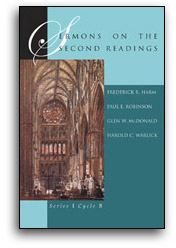
Sermons On The Second Readings
For Sundays In Advent, Christmas, And Epiphany
In his book Making Life Work, Chicago area pastor Bill Hybels cites a study that was published under an intriguing title: 178 Seconds to Live. The study concerned twenty pilots, all seasoned veterans in the cockpits of their small planes, but none of whom had ever taken instrument training. One by one they were placed in a flight simulator and told to do whatever they could to keep their planes level and under control. The simulator generated the conditions of a storm, including impenetrable, dark clouds. Even though the pilots had exceptional intuition born of years of actual flying, every one of them "crashed." Their planes went down, on average, within 178 seconds, or less than three minutes after they lost their visual reference points.
It may seem an odd way to put it, but it takes courage to rely on instruments more than intuition. It takes courage and supreme good judgment to rely more on unchanging standards and measurements than on personal instincts that we feel certain are telling us what to do next.
For pilots that's a matter of life and death -- and it happens to be doubly true for anyone contemplating an authentic spiritual existence. One of the great dangers of moving forward with God is that our intuition may scream that it knows better than God when it comes to the most appropriate ways to respond to life's joys and challenges.
Facing a personal crisis apart from an appreciation of the principles of scripture (and a determination to obey them) is like flying into a storm without instrument training. What makes us assume that our intuition concerning a particular realm of life -- whether sexuality or finances or relationships or morality -- is going to keep us from hitting the ground? And what has led us to conclude that no matter what the seriousness of our personal missteps, we can surely handle the consequences?
Paul offers a more ominous perspective. He opens the fifth chapter of his second letter to the church at Corinth joyfully enough -- with assurances that God's people will always have an embodied existence, and that whatever we happen to do with our bodies in this world matters. Our decisions and our actions are never trivial. His line of reasoning culminates, however, in verse 10: "For all of us must appear before the judgment seat of Christ, so that each may receive recompense for what has been done in the body, whether good or evil."
Research consistently reveals that neither church attenders nor the unchurched in our country are particularly concerned about the possible negative ramifications of that verse. Most of our neighbors are glibly confident of a happy outcome in the next world. In the mid-1990s when US News & World Report asked a large group of Americans whom they thought was worthy of going to heaven, Mother Teresa of Calcutta topped the list, receiving the support of 84 percent of those polled. Oprah Winfrey received a thumbs-up from 66 percent, Bill and Hillary Clinton merited 52 and 55 percent respectively, and O. J. Simpson brought up the rear at 16 percent. What was most revealing was the answer to the final question in the poll: Do you think you personally are going to heaven? A stunning 86 percent of the respondents felt confident about their chances -- that's 2 percent more than Mother Teresa, who perhaps more than anyone in recent times has been revered as a living saint. It's hard to imagine more outlandish spiritual self-assurance than that embraced by the typical American.
According to the authors of scripture, however, a Day of Reckoning awaits us -- one that will turn out to be considerably more challenging than a spiritual pop quiz. Appearing before "the judgment seat of Christ" connotes a courtroom atmosphere. Jewish and Christian teaching affirms the existence of an aggressive prosecutor who goes by the title Satan, which means "adversary." The cumulative data of our lives -- everything that we have ever said, done, or thought that has not been in conformity with the absolute holiness of God -- will be presented as evidence against us. In other words we will all be judged as to whether we have navigated our lives by God's "instruments" or chosen to fly by the seats of our pants.
Needless to say, this is a profoundly uncomfortable picture. It's no wonder that the marketplace spirituality of our times -- the ideas about God that we might pick up on talk shows or discover in New York Times best-selling paperbacks -- rarely, if ever, mention the possibility of giving an account of our lives to a higher power. We would much prefer a God who is adjusted to our behavior. Contemporary spirituality offers a therapeutic vision of the world. It promises resurrection without death, joy without sorrow, Easter Sunday without the messiness of Good Friday. The blessings and the promises that are associated with the Bible are offered at no cost and in exchange for modest commitment. In the words of cultural critic Kenneth Myers, we all become clients in the hands of a Smiling Heavenly Therapist who is there for us. We're certainly not here for God.
The difficulty with this non-judgmental-everybody-is-wonderful view of the cosmos is that beyond our personal imagination, it's genuinely hard to produce evidence that it's true, and there's a great deal at stake if it's not true. As C. S. Lewis reflected, "One cannot go against the grain of Reality without getting splinters."
How did Jesus portray reality? Over the course of his ministry Jesus consistently described his listeners as servants in a household who will have to stand one day in the presence of the master and own up to their performance or lack thereof. At that time there will be no distinction between public life and private life. Everything hidden will be revealed. Every word we have ever voiced, whether shouted aloud or whispered in secret, will be recited. In verse 10 Paul points out that our personal participation in this exercise will not be optional. "All of us must" have our day in God's court. This will surely be a moment when the availability of a great attorney will be crucial. Left to ourselves, we would be in the direst of straits. But in the grace of God, all will not be lost. In the grace of God, we ourselves (those who have trusted Christ) will not be lost.
Everyone who has enlisted as a lifelong learner of Jesus Christ -- not on his own terms, but on Christ's terms -- will be represented by a whale of an attorney. Our defender will be Jesus himself. 1 John 2:1 affirms, "If anyone does sin" -- and that would include the person currently on your left, the one on your right, and the one sitting in your chair -- "we have an advocate with the Father, Jesus Christ the righteous." The amazing fact is that when the record of sins of any Christian is opened in the next world, the angels will proclaim, "Lord, this file is empty. There is nothing written on it. Everything that was once recorded here has been erased."
The digital age has introduced us to the amazing power of a tiny bit of real estate on the computer keyboard. It's the Delete key. With one touch of the keyboard we have the power to alter reality. For that matter someone else -- with a quick, mindless, and unintentional keystroke at the IRS or the county board of records, for instance -- has the power to alter my reality. It's as if the document or the data on the screen that was just there a second ago ... never existed.
Something like that will take place in heaven, with an eternally happy outcome. I will discover the degree to which Someone Else has altered my reality. Jesus Christ erased my file. He canceled the prosecutor's best stuff. But it wasn't quick, mindless, or unintentional. The Son of God gave up his life so there would be no case against me.
How did that happen? It happened on the cross. Paul writes about Christ in another context (Colossians 2:13), "And when you were dead in trespasses and the uncircumcision of your flesh, God made you alive together with him." When did Jesus help me? When I was right there, working alongside him for the good of the kingdom, pitching in and earning gold stars for my performance? On the contrary, Paul affirms that I was dead. Spiritually dead. Legally dead. The case against me was open and shut. No chance for a hung jury. No possibility of appeal to a higher court. There is no higher court than the court of heaven.
But when that court demands an accounting for my performance in this world, the miracle is that Jesus' performance will stand in for mine. All my debt sheets will have been erased. Paul continues in Colossians, saying that Christ's work erased "the record that stood against us with its legal demands. He set this aside, nailing it to the cross."
When a first century criminal was spiked to a cross to hang there and die, it was customary to post a small placard that indicated the charges on which he had been convicted. In other words, something in his private record was made public. "Murderer." "Thief." "Insurrectionist." We recall that the words "King of the Jews" were posted above Jesus. That was the "blasphemous" claim of Jesus that according to the Pharisees merited his death.
Colossians 2:14 makes an extraordinary statement. When Jesus died, he took something with him to the cross. He took your record of failure and sin. He took mine, too. Jesus willingly accepted all the junk in all the files in all of human history and let it be posted on his cross, as if he were personally responsible for all of it. He died for it. That means justice has been served. That means our sin records, in principle, have been erased.
What do we mean, "in principle"? Jesus has acted. Now it is our call to act. The case against us is canceled when and if we are willing to say, "Thank you, Lord. You rescued me. You gave me my life back. Now I will live a brand new life -- not for me this time, but for you." That is the background of the wonderful words in 2 Corinthians 5:15: "And he died for all, so that those who live might live no longer for themselves, but for him who died and was raised for them."
Paul summarizes in verse 17, "So if anyone is in Christ, there is a new creation; everything old has passed away; see, everything has become new!" The newness of the Christian life includes a certainty of our status before God. We are clean. It's as if we never sinned. What is my essential identity? I am a person who is loved by God. I am a forgiven person. I am not someone who was forgiven up until two minutes ago when I nurtured that degrading thought and sacrificed the acceptance of God. I don't have to try to figure out how to make things right again. By God's grace, things already are right. Jesus made them right on the cross. A Christian is a new creation. The old grounds for being terrified of judgment are gone. A new emotional and spiritual freedom has arrived.
Because God has received payment in full, he doesn't require additional sacrifices on our part to preserve our forgiven status. In 1811 the United States government established the so-called Conscience Fund. American citizens, as they feel led, may send money or payments in kind to atone for mistakes of the past. Every year approximately $50,000 is received, and nearly four million dollars in all has been added to the fund over the years.
The letters and objects that have been sent to the government are astonishing. Early in the 1970s an ex-G.I. sent ten dollars to cover the cost of two blankets that he took at the end of World War II, an event about which he still felt guilty. A man sent several coins along with the confession that he had once placed some coins on a railroad track to see how the train would smash them. He wanted to atone for defacing American currency. A woman sent two brand new postage stamps, admitting that once she had received a letter with a stamp that had not been canceled, so she had peeled it off and used it again. Now she wanted to make things right. An anonymous note read, "I have not been able to sleep because of money that I failed to pay on my taxes. Enclosed is one hundred dollars. If I find that I still cannot sleep, I'll send you the rest."
In our relationships with others it's vital, when and where possible, to make restitution. But we are utterly incapable of settling accounts with God. Our nickels and dimes and most desperate sacrifices could never add up to more than Jesus has already done for us on the cross. Our debts are canceled. Period.
As forgiven people, then, we have a new identity. We have a new freedom. We are free because the greatest threats against us have been erased. Just one more question must be addressed. How should we respond?
In Saving Private Ryan, the character played by Tom Hanks makes the ultimate sacrifice for another soldier. As he lies dying, Hanks' eyes meet the eyes of his living comrade. "Earn this," he gasps with his final breath. Earn this? How could such a gift possibly be earned? Only one equation makes sense: a life for a life. We are called to surrender all former claims to our own existence so that we might be reborn to a new kind of life -- one lived not for ourselves but for the One who graciously gave his life for us.
It may seem an odd way to put it, but it takes courage to rely on instruments more than intuition. It takes courage and supreme good judgment to rely more on unchanging standards and measurements than on personal instincts that we feel certain are telling us what to do next.
For pilots that's a matter of life and death -- and it happens to be doubly true for anyone contemplating an authentic spiritual existence. One of the great dangers of moving forward with God is that our intuition may scream that it knows better than God when it comes to the most appropriate ways to respond to life's joys and challenges.
Facing a personal crisis apart from an appreciation of the principles of scripture (and a determination to obey them) is like flying into a storm without instrument training. What makes us assume that our intuition concerning a particular realm of life -- whether sexuality or finances or relationships or morality -- is going to keep us from hitting the ground? And what has led us to conclude that no matter what the seriousness of our personal missteps, we can surely handle the consequences?
Paul offers a more ominous perspective. He opens the fifth chapter of his second letter to the church at Corinth joyfully enough -- with assurances that God's people will always have an embodied existence, and that whatever we happen to do with our bodies in this world matters. Our decisions and our actions are never trivial. His line of reasoning culminates, however, in verse 10: "For all of us must appear before the judgment seat of Christ, so that each may receive recompense for what has been done in the body, whether good or evil."
Research consistently reveals that neither church attenders nor the unchurched in our country are particularly concerned about the possible negative ramifications of that verse. Most of our neighbors are glibly confident of a happy outcome in the next world. In the mid-1990s when US News & World Report asked a large group of Americans whom they thought was worthy of going to heaven, Mother Teresa of Calcutta topped the list, receiving the support of 84 percent of those polled. Oprah Winfrey received a thumbs-up from 66 percent, Bill and Hillary Clinton merited 52 and 55 percent respectively, and O. J. Simpson brought up the rear at 16 percent. What was most revealing was the answer to the final question in the poll: Do you think you personally are going to heaven? A stunning 86 percent of the respondents felt confident about their chances -- that's 2 percent more than Mother Teresa, who perhaps more than anyone in recent times has been revered as a living saint. It's hard to imagine more outlandish spiritual self-assurance than that embraced by the typical American.
According to the authors of scripture, however, a Day of Reckoning awaits us -- one that will turn out to be considerably more challenging than a spiritual pop quiz. Appearing before "the judgment seat of Christ" connotes a courtroom atmosphere. Jewish and Christian teaching affirms the existence of an aggressive prosecutor who goes by the title Satan, which means "adversary." The cumulative data of our lives -- everything that we have ever said, done, or thought that has not been in conformity with the absolute holiness of God -- will be presented as evidence against us. In other words we will all be judged as to whether we have navigated our lives by God's "instruments" or chosen to fly by the seats of our pants.
Needless to say, this is a profoundly uncomfortable picture. It's no wonder that the marketplace spirituality of our times -- the ideas about God that we might pick up on talk shows or discover in New York Times best-selling paperbacks -- rarely, if ever, mention the possibility of giving an account of our lives to a higher power. We would much prefer a God who is adjusted to our behavior. Contemporary spirituality offers a therapeutic vision of the world. It promises resurrection without death, joy without sorrow, Easter Sunday without the messiness of Good Friday. The blessings and the promises that are associated with the Bible are offered at no cost and in exchange for modest commitment. In the words of cultural critic Kenneth Myers, we all become clients in the hands of a Smiling Heavenly Therapist who is there for us. We're certainly not here for God.
The difficulty with this non-judgmental-everybody-is-wonderful view of the cosmos is that beyond our personal imagination, it's genuinely hard to produce evidence that it's true, and there's a great deal at stake if it's not true. As C. S. Lewis reflected, "One cannot go against the grain of Reality without getting splinters."
How did Jesus portray reality? Over the course of his ministry Jesus consistently described his listeners as servants in a household who will have to stand one day in the presence of the master and own up to their performance or lack thereof. At that time there will be no distinction between public life and private life. Everything hidden will be revealed. Every word we have ever voiced, whether shouted aloud or whispered in secret, will be recited. In verse 10 Paul points out that our personal participation in this exercise will not be optional. "All of us must" have our day in God's court. This will surely be a moment when the availability of a great attorney will be crucial. Left to ourselves, we would be in the direst of straits. But in the grace of God, all will not be lost. In the grace of God, we ourselves (those who have trusted Christ) will not be lost.
Everyone who has enlisted as a lifelong learner of Jesus Christ -- not on his own terms, but on Christ's terms -- will be represented by a whale of an attorney. Our defender will be Jesus himself. 1 John 2:1 affirms, "If anyone does sin" -- and that would include the person currently on your left, the one on your right, and the one sitting in your chair -- "we have an advocate with the Father, Jesus Christ the righteous." The amazing fact is that when the record of sins of any Christian is opened in the next world, the angels will proclaim, "Lord, this file is empty. There is nothing written on it. Everything that was once recorded here has been erased."
The digital age has introduced us to the amazing power of a tiny bit of real estate on the computer keyboard. It's the Delete key. With one touch of the keyboard we have the power to alter reality. For that matter someone else -- with a quick, mindless, and unintentional keystroke at the IRS or the county board of records, for instance -- has the power to alter my reality. It's as if the document or the data on the screen that was just there a second ago ... never existed.
Something like that will take place in heaven, with an eternally happy outcome. I will discover the degree to which Someone Else has altered my reality. Jesus Christ erased my file. He canceled the prosecutor's best stuff. But it wasn't quick, mindless, or unintentional. The Son of God gave up his life so there would be no case against me.
How did that happen? It happened on the cross. Paul writes about Christ in another context (Colossians 2:13), "And when you were dead in trespasses and the uncircumcision of your flesh, God made you alive together with him." When did Jesus help me? When I was right there, working alongside him for the good of the kingdom, pitching in and earning gold stars for my performance? On the contrary, Paul affirms that I was dead. Spiritually dead. Legally dead. The case against me was open and shut. No chance for a hung jury. No possibility of appeal to a higher court. There is no higher court than the court of heaven.
But when that court demands an accounting for my performance in this world, the miracle is that Jesus' performance will stand in for mine. All my debt sheets will have been erased. Paul continues in Colossians, saying that Christ's work erased "the record that stood against us with its legal demands. He set this aside, nailing it to the cross."
When a first century criminal was spiked to a cross to hang there and die, it was customary to post a small placard that indicated the charges on which he had been convicted. In other words, something in his private record was made public. "Murderer." "Thief." "Insurrectionist." We recall that the words "King of the Jews" were posted above Jesus. That was the "blasphemous" claim of Jesus that according to the Pharisees merited his death.
Colossians 2:14 makes an extraordinary statement. When Jesus died, he took something with him to the cross. He took your record of failure and sin. He took mine, too. Jesus willingly accepted all the junk in all the files in all of human history and let it be posted on his cross, as if he were personally responsible for all of it. He died for it. That means justice has been served. That means our sin records, in principle, have been erased.
What do we mean, "in principle"? Jesus has acted. Now it is our call to act. The case against us is canceled when and if we are willing to say, "Thank you, Lord. You rescued me. You gave me my life back. Now I will live a brand new life -- not for me this time, but for you." That is the background of the wonderful words in 2 Corinthians 5:15: "And he died for all, so that those who live might live no longer for themselves, but for him who died and was raised for them."
Paul summarizes in verse 17, "So if anyone is in Christ, there is a new creation; everything old has passed away; see, everything has become new!" The newness of the Christian life includes a certainty of our status before God. We are clean. It's as if we never sinned. What is my essential identity? I am a person who is loved by God. I am a forgiven person. I am not someone who was forgiven up until two minutes ago when I nurtured that degrading thought and sacrificed the acceptance of God. I don't have to try to figure out how to make things right again. By God's grace, things already are right. Jesus made them right on the cross. A Christian is a new creation. The old grounds for being terrified of judgment are gone. A new emotional and spiritual freedom has arrived.
Because God has received payment in full, he doesn't require additional sacrifices on our part to preserve our forgiven status. In 1811 the United States government established the so-called Conscience Fund. American citizens, as they feel led, may send money or payments in kind to atone for mistakes of the past. Every year approximately $50,000 is received, and nearly four million dollars in all has been added to the fund over the years.
The letters and objects that have been sent to the government are astonishing. Early in the 1970s an ex-G.I. sent ten dollars to cover the cost of two blankets that he took at the end of World War II, an event about which he still felt guilty. A man sent several coins along with the confession that he had once placed some coins on a railroad track to see how the train would smash them. He wanted to atone for defacing American currency. A woman sent two brand new postage stamps, admitting that once she had received a letter with a stamp that had not been canceled, so she had peeled it off and used it again. Now she wanted to make things right. An anonymous note read, "I have not been able to sleep because of money that I failed to pay on my taxes. Enclosed is one hundred dollars. If I find that I still cannot sleep, I'll send you the rest."
In our relationships with others it's vital, when and where possible, to make restitution. But we are utterly incapable of settling accounts with God. Our nickels and dimes and most desperate sacrifices could never add up to more than Jesus has already done for us on the cross. Our debts are canceled. Period.
As forgiven people, then, we have a new identity. We have a new freedom. We are free because the greatest threats against us have been erased. Just one more question must be addressed. How should we respond?
In Saving Private Ryan, the character played by Tom Hanks makes the ultimate sacrifice for another soldier. As he lies dying, Hanks' eyes meet the eyes of his living comrade. "Earn this," he gasps with his final breath. Earn this? How could such a gift possibly be earned? Only one equation makes sense: a life for a life. We are called to surrender all former claims to our own existence so that we might be reborn to a new kind of life -- one lived not for ourselves but for the One who graciously gave his life for us.
