
Have I Got News For You!
Sermon
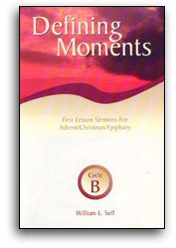
Defining Moments
First Lesson Sermons For Advent/Christmas/Epiphany
My favorite Christmas story is about the young boy who was given a very important role in the church Christmas play. He was to be the angel and announce the birth of Jesus. For weeks he rehearsed the line that had been given to him, "Behold, I bring you good tidings of great joy." The grandparents got in on it and any time the family was together and the boy was there, they would dress him up in his costume and he would rehearse his part for them, "Behold, I bring you good tidings of great joy." They were certain that when he grew up he would be another Charlton Heston playing Moses because of his dramatic ability. Every time the family gathered, he was given the signal, and on cue he would say, "Behold, I bring you good tidings of great joy."
So the great night came for the Christmas pageant and everybody was in place. All the grandparents and extended family were there. Visitors had come in and all the children were in costumes, complete with bathrobes for the three kings and fake wings and halos for the angels. All the mothers were excited and everyone was really into this thing. As the pageant started, the excitement was electric around the room. The dramatic event in the first part was the announcement by this angel, "Behold, I bring you good tidings of great joy." The light hit this young man and as he stood center stage in the middle of all this excitement, his brain froze. Every grandparent, aunt, uncle, and neighbor came to the edge of their seats, wanting to say it for him. You could see them in unison, mouthing, "Behold, I bring you good tidings of great joy." Still, his brain was frozen; he couldn't say it. He tried it again but it just wouldn't come. So finally in a heroic moment he filled his lungs with breath and blurted out the words, "Have I got news for you!"
I have become convinced that this is exactly what this season is trying to communicate, because the world needs Christmas. I like that frivolous song, "We Need a Little Christmas, and We Need a Little Christmas Right Now." I think the whole universe is trying to say something, and this is the only way the universe knows to say it. Perhaps the church needs to change that line in Scripture from "Behold, I bring you good tidings of great joy," to "Have we got news for you!" For if there is any time we can push back the sorrow of this world, if there is any time that we can unzip the clouds of depression that roll in on our heads, if there is any time we can pierce through the evening news and get a glimpse of hope, it is at Christmastime.
I don't know if the nation is in a recession or depression, but if you listen to the news very much, you are just about ready to give up on life. One story after another of how bad it is fills our family rooms. I felt good the other night before watching the evening news, but when it was over, all I could think of was that I need a little Christmas right now. Don't show me anything else that is bad. However, there are some people who get terribly upset about the $42 billion Christmas machine that rolls through our world. They get upset about it and its excesses. But everything has excesses and America has put excess into Christmas. Push away all the excesses, push away all the tinsel, get rid of all the things that are absolutely un-Christian, come down to the core of it, and what we are trying to do the world needs to hear. We need more than a little Christmas right now; we need a lot of Christmas right now.
Celebration is a necessary part of living. The ancient coronation hymn in Isaiah 9:2-7, used originally at the coronation of King Hezekiah, has been picked up by the Christian community as the coronation hymn for the Messiah. This coronation hymn is a theme for trumpets declaring the good news for all humankind, but it has been lost in the shuffle of our celebration and has been muted to the place that it becomes only a tone poem for violins as modern Christians have interpreted it. He comes as light, and he has not abandoned us. People walking in darkness need to understand that.
Sadly enough, the Christian message is no longer played on a trumpet but in many cases on a violin. When Christians try to rescue this message from the secular community, we make it a soothing, gentle lullaby. Religion becomes a spiritual aspirin tablet to be taken with a divine cup of warm milk. Such qualities are symptoms of a sick religion to which this song of Isaiah orchestrated for trumpets brings a tinny response.
This was written to grace the occasion for trumpets, for the anointing of one of Israel's kings, possibly good king Hezekiah. Its measures contain more than mere boastful nationalism. It promises the endurance of the Davidic throne as an instrument of God's service and leading a covenant people called to be his witnesses. Since the first century, Christians have sung it as a coronation song for Jesus. It echoes the hymn in Luke 1:32-33. In our day it vibrates to the music of Handel's Messiah. We cannot read it in the flat voice of David's speech. The birth of Christ should be seen as an experience beyond the power of common prose to describe to Christians of every century. For what Christ means to those who have met him and have more than a sentimental acquaintance with him can only be expressed in terms of blaring trumpets. So reading this passage with New Testament eyes we see the following.
He comes as light. The people who wander in darkness have seen a great light. This was sung as background, about King Ahaz and the disastrous alliances and the breakdown of public morality. This reign was also characterized by witchcraft and paganism. It was a reign in which it was said, "Surely, for this word for which they speak there is no dawn" (Isaiah 8:16-22).
This is not unlike our world, which has its own shadow of death -- war, poverty, rampant paganism, domestic violence, and the like. "On those who live in deep shadow a light is shown" (v. 2). To that end we follow him.
Light figures brightly in Christ's later disclosure of himself. He announced to Israel at the Feast of Lights in Jerusalem, a celebration that marked the light that followed the night and day during the exodus from Egypt, that he was the light of the world -- no wonder they killed him.
On November 11, 1918, the sun rose on the city of Mons, Belgium. All night long, the darkness had been shot through with the lurid flashes of gunfire and the staccato chatter of machine guns that echoed through the deserted streets. But at dawn, the last German outpost withdrew, and from their burned and shattered homes the people streamed into the streets. Down the street came the cry, "Hang out your flags." When the sun rose, it shone on a city of banners and the overwhelming joy of those who, having for four and a half years lived in a land of darkness, now walked free. So it is with Isaiah with his vision. The coronation of Hezekiah provides the opportunity to project the great deliverance onto the screen of the future. The enemy has gone; the captains and kings have departed. Gone is the threat of slavery; gone are the agents of destruction along with their bloody tunics, broken swords, and marching hobnail boots of the oppressor. Now we must proclaim the peace that has fallen over our delivered country. With undying hope, rekindled with every king's coronation in the hope that the ideal king would be sent by God to rule his people, they went on hoping, praying, trusting that he would come -- if not now, some other day. That is faith -- and when he comes, he will come as light and he will bring peace. It must be remembered that the Hebrew word for peace means not only the cessation of war but a condition of rich, harmonious, and positive well-being. It is living in harmony with ourselves, with others, and with God. This is what Christ brings.
Two artists were commissioned to paint their conception of peace. A panel of distinguished judges would determine which artist had best captured the idea. The winner would get a rich commission. After they had been painting for a long time, the judges assembled to view their works. The first artist unveiled his painting, and there was a beautiful, magnificent pastoral scene, with a farmer coming in after a hard day in the fields. His wife was cooking, his children were playing around the hearth, and all was at peace on this tranquil and beautiful farm. "That's it," said the judges, "but we'll look at the other rendering anyway." They removed the veil of the second painting. Instead of a tranquil, pastoral scene, there was a raging waterfall producing a mist which communicated hostility. But over on the side of the waterfall was a tiny branch of a tree growing out of the rock, and on the end of the branch was a bird's nest. On the edge of the nest was a mother bird, singing her heart out in the midst of the turbulence around her. The judges thought for a moment, then said, "That is peace, tranquility and celebration in the midst of turmoil."
Christ also comes as a royal son (v. 6). "To us a son is given," sang Isaiah. They thought the coronation of the king meant that he would become in some special sense God's son as leader of a messianic people (Psalm 2:7). Christ comes in a far more significant way as God's son, revealing his nature and acting in his power.
God in the flesh was scandalous to the first century mind -- too close, too much with us. Christ's ministry and Isaiah's message are what we need. For a nation -- the Messiah is God with us -- this royal son is God in the flesh: Wonderful Counselor, Mighty God, Everlasting Father, Prince of Peace (v. 6). We need him with us. We are lonely and helpless.
Man said to the universe, "Sir, I exist."
However, replied the universe, "The fact has not created within me a sense of obligation."
Christ comes as king forever. Isaiah sang, "There will be no end" concerning the stability of Hezekiah's just order. In a more certain way, we can say that of Christ. William Temple said it truly: "When we serve him in humble loyalty, he reigns; when we serve him self-assertedly, he reigns; when we rebel, he reigns. His reign does not open on our vote. History is a record of his judgments. Happy are they who faithfully obey his rules."
There will be no end.... The rule of Christ has endured wars and rumors of war. His reign has withstood Roman imperialism, Jewish legalism, pagan optimism, medieval institutionalism, excesses of reformers, wars and rumors of wars, youthquake, modern skepticism, southern provincialism, resurgent fundamentalism, and anything else future generations can throw at his reign. It has also been victimized by unprepared preachers, tone-deaf musicians, manipulative members, argumentative deacons, demanding denominations, unloving reformers, and greedy politicians, and still he continues to reign. He provides community in the face of alienation and love and affirmation in a hostile world. His reign is not a porcelain teacup that is easily broken. His reign is an oak tree with deep and abiding roots.
Our world desperately needs to know that not only has God come in Jesus Christ but that he reigns forever and in unexpected ways. Recently, the motion picture The Bridge Over the River Kwai was selected as one of the one hundred great films of the twentieth century. It is the story of some British prisoners of war during the Second World War. They were held by the Japanese in northern Burma in very difficult circumstances. It was made into a motion picture and won an Academy Award. Most of us know of it from that standpoint. But Ernest Gordon, theologian and preacher, later to become chaplain at Yale, wrote a book called Through the River of the Kwai, which told another side of the story of degradation and desolation experienced by those impoverished prisoners. This book tells how those in the camp interacted with one another. When these young soldiers realized that they were going to be there for a while, they began to have Bible studies and prayed diligently that they could be delivered from their present circumstances. He said, "We knew that the thrust of our praying was to be delivered from this prison camp and that was it. Our praying was shallow and superficial and we were railing against God for letting us be here. But something happened to us and that kind of railing against God disappeared. And we began to move toward a more mature faith. We began to pray about how we could relate to one another in those bad situations. No longer was it 'Why, God?' but it was 'How should we act, God?' " He said the most spiritual moment of his life was Christmas of 1944. Out of deference to the men in the camp, they were not given work detail that day and were given a bit more food. He said that as they moved around in the prison yard, they sensed that things were different. In one of the barracks (basically a thatched hut with dirt floor and open sides where men slept), one soldier began to sing a Christmas carol. It was echoed over in the infirmary where men were dying. Then all around the camp, the men began to sing, and those who could, those who were ambulatory, came to the parade field and sat there in a great circle. Gordon said, "God touched us that day." He said it was the most sacred event he had ever been involved with. No preaching, nothing of the usual church paraphernalia, just men united by their common misery, singing of God being with them and God's sovereignty, and he said, "We were touched by God." Christmas became real to him when he was touched by God in the surprising place of a Japanese prisoner-of-war camp in northern Burma.
In a world that is as desolate as that camp, we will blow our trumpet. We need to sing the coronation hymn. They need to hear again that God has invaded this earth and he shall reign forever and ever.
So the great night came for the Christmas pageant and everybody was in place. All the grandparents and extended family were there. Visitors had come in and all the children were in costumes, complete with bathrobes for the three kings and fake wings and halos for the angels. All the mothers were excited and everyone was really into this thing. As the pageant started, the excitement was electric around the room. The dramatic event in the first part was the announcement by this angel, "Behold, I bring you good tidings of great joy." The light hit this young man and as he stood center stage in the middle of all this excitement, his brain froze. Every grandparent, aunt, uncle, and neighbor came to the edge of their seats, wanting to say it for him. You could see them in unison, mouthing, "Behold, I bring you good tidings of great joy." Still, his brain was frozen; he couldn't say it. He tried it again but it just wouldn't come. So finally in a heroic moment he filled his lungs with breath and blurted out the words, "Have I got news for you!"
I have become convinced that this is exactly what this season is trying to communicate, because the world needs Christmas. I like that frivolous song, "We Need a Little Christmas, and We Need a Little Christmas Right Now." I think the whole universe is trying to say something, and this is the only way the universe knows to say it. Perhaps the church needs to change that line in Scripture from "Behold, I bring you good tidings of great joy," to "Have we got news for you!" For if there is any time we can push back the sorrow of this world, if there is any time that we can unzip the clouds of depression that roll in on our heads, if there is any time we can pierce through the evening news and get a glimpse of hope, it is at Christmastime.
I don't know if the nation is in a recession or depression, but if you listen to the news very much, you are just about ready to give up on life. One story after another of how bad it is fills our family rooms. I felt good the other night before watching the evening news, but when it was over, all I could think of was that I need a little Christmas right now. Don't show me anything else that is bad. However, there are some people who get terribly upset about the $42 billion Christmas machine that rolls through our world. They get upset about it and its excesses. But everything has excesses and America has put excess into Christmas. Push away all the excesses, push away all the tinsel, get rid of all the things that are absolutely un-Christian, come down to the core of it, and what we are trying to do the world needs to hear. We need more than a little Christmas right now; we need a lot of Christmas right now.
Celebration is a necessary part of living. The ancient coronation hymn in Isaiah 9:2-7, used originally at the coronation of King Hezekiah, has been picked up by the Christian community as the coronation hymn for the Messiah. This coronation hymn is a theme for trumpets declaring the good news for all humankind, but it has been lost in the shuffle of our celebration and has been muted to the place that it becomes only a tone poem for violins as modern Christians have interpreted it. He comes as light, and he has not abandoned us. People walking in darkness need to understand that.
Sadly enough, the Christian message is no longer played on a trumpet but in many cases on a violin. When Christians try to rescue this message from the secular community, we make it a soothing, gentle lullaby. Religion becomes a spiritual aspirin tablet to be taken with a divine cup of warm milk. Such qualities are symptoms of a sick religion to which this song of Isaiah orchestrated for trumpets brings a tinny response.
This was written to grace the occasion for trumpets, for the anointing of one of Israel's kings, possibly good king Hezekiah. Its measures contain more than mere boastful nationalism. It promises the endurance of the Davidic throne as an instrument of God's service and leading a covenant people called to be his witnesses. Since the first century, Christians have sung it as a coronation song for Jesus. It echoes the hymn in Luke 1:32-33. In our day it vibrates to the music of Handel's Messiah. We cannot read it in the flat voice of David's speech. The birth of Christ should be seen as an experience beyond the power of common prose to describe to Christians of every century. For what Christ means to those who have met him and have more than a sentimental acquaintance with him can only be expressed in terms of blaring trumpets. So reading this passage with New Testament eyes we see the following.
He comes as light. The people who wander in darkness have seen a great light. This was sung as background, about King Ahaz and the disastrous alliances and the breakdown of public morality. This reign was also characterized by witchcraft and paganism. It was a reign in which it was said, "Surely, for this word for which they speak there is no dawn" (Isaiah 8:16-22).
This is not unlike our world, which has its own shadow of death -- war, poverty, rampant paganism, domestic violence, and the like. "On those who live in deep shadow a light is shown" (v. 2). To that end we follow him.
Light figures brightly in Christ's later disclosure of himself. He announced to Israel at the Feast of Lights in Jerusalem, a celebration that marked the light that followed the night and day during the exodus from Egypt, that he was the light of the world -- no wonder they killed him.
On November 11, 1918, the sun rose on the city of Mons, Belgium. All night long, the darkness had been shot through with the lurid flashes of gunfire and the staccato chatter of machine guns that echoed through the deserted streets. But at dawn, the last German outpost withdrew, and from their burned and shattered homes the people streamed into the streets. Down the street came the cry, "Hang out your flags." When the sun rose, it shone on a city of banners and the overwhelming joy of those who, having for four and a half years lived in a land of darkness, now walked free. So it is with Isaiah with his vision. The coronation of Hezekiah provides the opportunity to project the great deliverance onto the screen of the future. The enemy has gone; the captains and kings have departed. Gone is the threat of slavery; gone are the agents of destruction along with their bloody tunics, broken swords, and marching hobnail boots of the oppressor. Now we must proclaim the peace that has fallen over our delivered country. With undying hope, rekindled with every king's coronation in the hope that the ideal king would be sent by God to rule his people, they went on hoping, praying, trusting that he would come -- if not now, some other day. That is faith -- and when he comes, he will come as light and he will bring peace. It must be remembered that the Hebrew word for peace means not only the cessation of war but a condition of rich, harmonious, and positive well-being. It is living in harmony with ourselves, with others, and with God. This is what Christ brings.
Two artists were commissioned to paint their conception of peace. A panel of distinguished judges would determine which artist had best captured the idea. The winner would get a rich commission. After they had been painting for a long time, the judges assembled to view their works. The first artist unveiled his painting, and there was a beautiful, magnificent pastoral scene, with a farmer coming in after a hard day in the fields. His wife was cooking, his children were playing around the hearth, and all was at peace on this tranquil and beautiful farm. "That's it," said the judges, "but we'll look at the other rendering anyway." They removed the veil of the second painting. Instead of a tranquil, pastoral scene, there was a raging waterfall producing a mist which communicated hostility. But over on the side of the waterfall was a tiny branch of a tree growing out of the rock, and on the end of the branch was a bird's nest. On the edge of the nest was a mother bird, singing her heart out in the midst of the turbulence around her. The judges thought for a moment, then said, "That is peace, tranquility and celebration in the midst of turmoil."
Christ also comes as a royal son (v. 6). "To us a son is given," sang Isaiah. They thought the coronation of the king meant that he would become in some special sense God's son as leader of a messianic people (Psalm 2:7). Christ comes in a far more significant way as God's son, revealing his nature and acting in his power.
God in the flesh was scandalous to the first century mind -- too close, too much with us. Christ's ministry and Isaiah's message are what we need. For a nation -- the Messiah is God with us -- this royal son is God in the flesh: Wonderful Counselor, Mighty God, Everlasting Father, Prince of Peace (v. 6). We need him with us. We are lonely and helpless.
Man said to the universe, "Sir, I exist."
However, replied the universe, "The fact has not created within me a sense of obligation."
Christ comes as king forever. Isaiah sang, "There will be no end" concerning the stability of Hezekiah's just order. In a more certain way, we can say that of Christ. William Temple said it truly: "When we serve him in humble loyalty, he reigns; when we serve him self-assertedly, he reigns; when we rebel, he reigns. His reign does not open on our vote. History is a record of his judgments. Happy are they who faithfully obey his rules."
There will be no end.... The rule of Christ has endured wars and rumors of war. His reign has withstood Roman imperialism, Jewish legalism, pagan optimism, medieval institutionalism, excesses of reformers, wars and rumors of wars, youthquake, modern skepticism, southern provincialism, resurgent fundamentalism, and anything else future generations can throw at his reign. It has also been victimized by unprepared preachers, tone-deaf musicians, manipulative members, argumentative deacons, demanding denominations, unloving reformers, and greedy politicians, and still he continues to reign. He provides community in the face of alienation and love and affirmation in a hostile world. His reign is not a porcelain teacup that is easily broken. His reign is an oak tree with deep and abiding roots.
Our world desperately needs to know that not only has God come in Jesus Christ but that he reigns forever and in unexpected ways. Recently, the motion picture The Bridge Over the River Kwai was selected as one of the one hundred great films of the twentieth century. It is the story of some British prisoners of war during the Second World War. They were held by the Japanese in northern Burma in very difficult circumstances. It was made into a motion picture and won an Academy Award. Most of us know of it from that standpoint. But Ernest Gordon, theologian and preacher, later to become chaplain at Yale, wrote a book called Through the River of the Kwai, which told another side of the story of degradation and desolation experienced by those impoverished prisoners. This book tells how those in the camp interacted with one another. When these young soldiers realized that they were going to be there for a while, they began to have Bible studies and prayed diligently that they could be delivered from their present circumstances. He said, "We knew that the thrust of our praying was to be delivered from this prison camp and that was it. Our praying was shallow and superficial and we were railing against God for letting us be here. But something happened to us and that kind of railing against God disappeared. And we began to move toward a more mature faith. We began to pray about how we could relate to one another in those bad situations. No longer was it 'Why, God?' but it was 'How should we act, God?' " He said the most spiritual moment of his life was Christmas of 1944. Out of deference to the men in the camp, they were not given work detail that day and were given a bit more food. He said that as they moved around in the prison yard, they sensed that things were different. In one of the barracks (basically a thatched hut with dirt floor and open sides where men slept), one soldier began to sing a Christmas carol. It was echoed over in the infirmary where men were dying. Then all around the camp, the men began to sing, and those who could, those who were ambulatory, came to the parade field and sat there in a great circle. Gordon said, "God touched us that day." He said it was the most sacred event he had ever been involved with. No preaching, nothing of the usual church paraphernalia, just men united by their common misery, singing of God being with them and God's sovereignty, and he said, "We were touched by God." Christmas became real to him when he was touched by God in the surprising place of a Japanese prisoner-of-war camp in northern Burma.
In a world that is as desolate as that camp, we will blow our trumpet. We need to sing the coronation hymn. They need to hear again that God has invaded this earth and he shall reign forever and ever.
