
Have You Considered The Price Tag?
Preaching
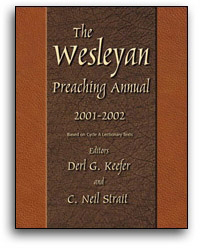
THE WESLEYAN PREACHING ANNUAL 2001--2002
Stephen Covey, author of First Things First and The Seven Habits of Highly Effective People, was being interviewed on a radio talk show. The interviewer stated that he was "too busy and seemed unable to balance his life with any degree of success."
After listening thoughtfully to this explanation, Covey responded by asking this provocative question: "Have you paid the price of deciding what kind of person you want to be?" (G. Curtis Jones, Paul M. Jones, 500 Illustrations, Nashville: Abingdon Press, 1998, p. 195).
All of us, at some time in our ministries, have had to wrestle with time, pressures and the balancing of demands. Covey implies that there must be a defining moment in our lives when we sort out all the options, demands and desires. The sorting becomes a defining moment for us, when it establishes our priorities and gives us a game plan for our ministries.
What goes into establishing the priorities of ministry? One, our calling from God. The various roles of ministry will determine some of our priorities. A chaplain will have a different set of priorities from those of a pastor. An evangelist a different set from a chaplain. So one must know the area of ministry to which he/she is called. A call to ministry is a call to prepare. And a part of the preparation is researching what is involved in the area to which one is drawn.
Two, passion, purpose and vision must be considered as one chooses priorities. What is driving life? Is it success? Ambition? Making money? One must lay his/her passions and purpose before the Lord and make sure these align with God's will. This, of all the exercises to determine priorities, may be the most defining and the most helpful. Genuine ministry must find a purpose that is biblical, and must have a passion to match the task.
One must come to terms with ambitious passions that are contrary to God's call, and place them in the right perspective. The material side of life must be committed to a proper priority. Fred Smith has reminded us that "when material things become a top priority, they become a stumbling block" ("The Responsibilities of Leadership," in Leadership Handbook of Management and Administration, James D. Bertley, Editor, Grand Rapids: Baker Books, 1994, p. 165).
This is where we are driven back to the purpose of our calling and ministry. Faith Popcorn talks, somewhere, about "the quest for an anchor." Purpose is an anchor. It keeps one on course when the tempting things come. It keeps one focused on the priorities of his/her life. Henry David Thoreau cautioned that "it's not enough to be busy ... the question is: What are we busy about?" (Guideposts, Feb., 1999, p. 32).
If we know the purpose of our ministries, the things that are going to drive and inspire us, the things we are going to give our lives to, then we have a map for planning our priorities.
A third item to be considered in planning our priorities is our journey with God. We are learning from Him as we invest in ministry. We are "in the school of Christ," as we deepen our relationship with Him. Through our prayer and devotional moments, in our study of the Word, we are learning how to live. We are growing into the stature and image of Christ, and all of this is helping us develop priorities.
Alister McGrath, in The Journey, writes these insightful words: "Spirituality is all about the way in which we encounter and experience God and the transformation of our consciousness and our lives as a result of that encounter and experience" (New York: Doubleday, 2000, p. 10).
So, along the journey of ministry, from all its experiences, from gut--wrenching to exciting and wonderful, flow the raw material that will help us come to priorities. The process is a weeding out, a rearranging, an addition here and there, a change, occasionally. It is an ever--changing process of growth, learning and changing circumstances. But happy is that person who keeps the process going. That person is paying the price for deciding what kind of person they want to be.
C. Neil Strait
July 7, 2002 Seventh Sunday After Pentecost
WORSHIP HELPS
CALL TO WORSHIP (Isaiah 55:6 NIV)
Women: Seek the Lord while He may be found.
Men: Call on Him while He is near:
Women: Let the wicked forsake their way
Men: And the evil man his thoughts.
OFFERING THOUGHT
The person who gives sacrificially honors God, and it is that person who prepares God's salvation for the world.
BENEDICTION
Possibilities abound this week because we have met with the God of possibilities.
SERMON BRIEFS
The Abnormal Christian Life
Romans 7:15--25
"I," "me," "my" and "myself" are repeated nearly forty times in these eleven verses and give us a picture of the problem Paul is dealing with in this passage. A life not under the full control of the Spirit is a life focused on self. "I do not understand what I do. For what I want to do I do not do, but what I hate I do" (v. 15) is a miserable way to live. It is an undisciplined lifestyle unyielded to the control of the Holy Spirit. The new Christian reads this passage and wonders if he must always live in a state of "benign rebellion." Is it ever possible to get to the place where he does what he truly wants to do - lovingly obey God?
In some capital murder sentences, the dead corpse was strapped to the body of the convicted murderer. One can only imagine the effort and stench of such a lifestyle. "Who will rescue me from this body of death?" is Paul's cry for help from an incomplete deliverance of his life of sin. He suggests there has to be something more - and there is. A sinning religion and defeated Christians is not God's plan for His church. What can we do?
I. Admit we have a personal struggle to please God.
A. It is not hard for me to understand what Paul is talking about both by personal experience as well as observance of hundreds of other new babes in Christ. Such a struggle is experienced in various ways.
B. Loss of first love. After the initial experience of salvation there is often a decline in witnessing, cooling of spiritual passion, self seeking, failure in personal prayer, struggle for daily Scripture reading and lack of personal joy.
C. Sins of the carnal nature can become more prevalent - jealousy, malice, slander, bitterness, filthy language and uncontrolled anger.
D. An unbreakable grip of addictive behavior such as alcohol, nicotine, pornography, or drugs.
E. Bitter roots. Weeds will return unless you take their roots out.
II. Ask the Holy Spirit to cleanse us of things unlike God.
A. Make a full surrender of your life to God to the best of your ability. You may have been saved, but now you need to make a total surrender of your life. You will be constantly badgered by sins of the flesh until you give God everything you are and ever hope to be. The disciples were bickering, anemic, afraid and carnal before they were filled with the Holy Spirit.
B. Die to a life of self fulfillment. The very thing that Paul was fighting in this passage is the thing that needs to be placed on our altar of sacrifice. The sacrifice Paul describes in Romans 12:1 is that of our living bodies rather than a dead animal. Young missionaries were headed out for their first term of a life of service to a tribe of cannibals. The captain of the ship on which they were traveling said, "Don't you know you may die out there on the mission field?" The young recruits responded, "We died before we got on the boat!"
C. Seek the Holy Spirit's cleansing to such a degree that the chains of bondage have been broken, the seeds of impurity have been rooted out and the sins of the flesh have been crucified.
III. Walk daily in the Spirit.
A. Maintain the discipline of a daily devotional life.
B. Seek times of refreshing with the Holy Spirit. There will be periods of temptation and testing when your spirit will need to be renewed.
C. Quickly confess anything that grieves the Holy Spirit. Never let sin get a foothold in your life.
D. Nurture the fruit of the Spirit so that it grows more and more. Love, joy, peace ... are the natural result of the Spirit filled life, but spiritual fruit can also be improved by personal attention.
E. Witness regularly to others of the power of the gospel. Pointing others to Jesus Christ should be the main focus of those filled and controlled by the Holy Spirit, since that is one of the main reasons the Holy Spirit came (John 16:14).
Conclusion
At salvation our spirit is quickened and we become a new creature in Christ Jesus. However, we usually experience a struggle going on within the life of a believer as described by Paul in Romans 7. A complete surrender to the Holy Spirit's fullness helps break the power of the sin nature over our life. Conversion brings pardon from sin and the fullness of the Holy Spirit brings power over sin.
Bill Hossler
Learn From Me
Matthew 11:16--19; 25--30
It happens every fall in the National Football League. A promising young rookie steps onto the field for his first game. He spent his college years being told that he is one of the best. He has read and believes the columnists who said that he would make a huge impact on the professional level. He's brimming with confidence and eager to show the world how good he really is with his performance.
Then it happens. He runs a crossing pattern and is blindsided by a veteran linebacker who knows how to deliver a crushing blow. As he lies on the field and tries to remember who he is and where he is, he finally focuses on that linebacker standing over him. Smiling, the wily veteran says, "Welcome to the NFL."
At that point the rookie realizes that he's in a different league. It's a whole new game. It's faster, more complex, more treacherous, and much more difficult than anything he had previously experienced. He realizes that no matter what talent he has, if he's unprepared he won't last in this league. So he goes to the weight room. He watches game film. He attends every team meeting and is the first one on the field to practice.
Fast--forward a few years. That rookie is now a veteran at the peak of his game. He soars into the air to make an acrobatic catch in the corner of the end zone. The home crowd is going crazy. The television analysts take a second look at it. Wow. In slow motion it looks even more graceful. One commentator says, "He makes it look so easy," and they go on to talk about "natural athleticism."
Was that catch easy? Yes. He'd practiced that fade pattern a thousand times. He'd discussed it at length with his quarterback and the offensive coordinator. He'd replayed it over and over in his mind. So when that play was called in the huddle, he and his teammates knew exactly how they would execute it. It almost came natural. That is, after training, practice and discipline, it came natural.
Jesus described the Christian life as an "easy yoke" or a "light burden." But he preceded that statement by inviting us to live with him, train with him, and learn from him. You see, Jesus wants us to live so close to him that it is much easier to do what is right than to do what is wrong. Yes, we can live in such a way that it is easier to be kind than it is to be hateful, easier to be humble than to be arrogant, easier to be last than to be first. But this only comes with training and preparation that takes place before we receive that crushing blow from the blind side.
Let's use an example from marriage. When a man is living close to his wife, when they laugh and cry and love with passion, when they do the hard work of marriage together, when he can't wait to get home to see her at the end of his work day, it would be very difficult to be unfaithful to her. It would be much easier to hold her close when the tough times come. But change that scenario. Look at a man who doesn't walk close to his wife, who neglects her needs, who looks for comfort elsewhere, who shares his hopes and dreams with another woman at his office. For that man unfaithfulness is easy. When temptation comes, the right way will seem almost impossible to him.
We desire an abundant, joyful walk with Jesus, a walk that will carry us through the hard hits of life. Yet so many of us want it to come without real change in our lives. We don't want to engage in spiritual discipline in order to know Jesus better and to know how better to walk with him.
Imagine someone who has never played football or studied football, who knows nothing about the sport and who is badly out of shape walking out on the field expecting, by sheer will power, to turn in a star performance. It's lunacy. Yet, many of us think that without training, by sheer will power, we can overcome the temptations of life. "So, ironically," Dallas Willard explains, "in our efforts to avoid the necessary pains of discipline we miss the easy yoke and light burden."1
Paul told Timothy to "train yourself to be godly" (1 Timothy 4:7), to engage in the spiritual disciplines so that when you have to go high in the corner of the end zone, you do it with grace. It's a natural response while carrying that easy yoke.
Phillip Stout
____________
1. Dallas Willard, The Spirit of the Disciplines: Understanding How God Changes Lives (San Francisco: HarperSanFrancisco, 1988), p. 7.
After listening thoughtfully to this explanation, Covey responded by asking this provocative question: "Have you paid the price of deciding what kind of person you want to be?" (G. Curtis Jones, Paul M. Jones, 500 Illustrations, Nashville: Abingdon Press, 1998, p. 195).
All of us, at some time in our ministries, have had to wrestle with time, pressures and the balancing of demands. Covey implies that there must be a defining moment in our lives when we sort out all the options, demands and desires. The sorting becomes a defining moment for us, when it establishes our priorities and gives us a game plan for our ministries.
What goes into establishing the priorities of ministry? One, our calling from God. The various roles of ministry will determine some of our priorities. A chaplain will have a different set of priorities from those of a pastor. An evangelist a different set from a chaplain. So one must know the area of ministry to which he/she is called. A call to ministry is a call to prepare. And a part of the preparation is researching what is involved in the area to which one is drawn.
Two, passion, purpose and vision must be considered as one chooses priorities. What is driving life? Is it success? Ambition? Making money? One must lay his/her passions and purpose before the Lord and make sure these align with God's will. This, of all the exercises to determine priorities, may be the most defining and the most helpful. Genuine ministry must find a purpose that is biblical, and must have a passion to match the task.
One must come to terms with ambitious passions that are contrary to God's call, and place them in the right perspective. The material side of life must be committed to a proper priority. Fred Smith has reminded us that "when material things become a top priority, they become a stumbling block" ("The Responsibilities of Leadership," in Leadership Handbook of Management and Administration, James D. Bertley, Editor, Grand Rapids: Baker Books, 1994, p. 165).
This is where we are driven back to the purpose of our calling and ministry. Faith Popcorn talks, somewhere, about "the quest for an anchor." Purpose is an anchor. It keeps one on course when the tempting things come. It keeps one focused on the priorities of his/her life. Henry David Thoreau cautioned that "it's not enough to be busy ... the question is: What are we busy about?" (Guideposts, Feb., 1999, p. 32).
If we know the purpose of our ministries, the things that are going to drive and inspire us, the things we are going to give our lives to, then we have a map for planning our priorities.
A third item to be considered in planning our priorities is our journey with God. We are learning from Him as we invest in ministry. We are "in the school of Christ," as we deepen our relationship with Him. Through our prayer and devotional moments, in our study of the Word, we are learning how to live. We are growing into the stature and image of Christ, and all of this is helping us develop priorities.
Alister McGrath, in The Journey, writes these insightful words: "Spirituality is all about the way in which we encounter and experience God and the transformation of our consciousness and our lives as a result of that encounter and experience" (New York: Doubleday, 2000, p. 10).
So, along the journey of ministry, from all its experiences, from gut--wrenching to exciting and wonderful, flow the raw material that will help us come to priorities. The process is a weeding out, a rearranging, an addition here and there, a change, occasionally. It is an ever--changing process of growth, learning and changing circumstances. But happy is that person who keeps the process going. That person is paying the price for deciding what kind of person they want to be.
C. Neil Strait
July 7, 2002 Seventh Sunday After Pentecost
WORSHIP HELPS
CALL TO WORSHIP (Isaiah 55:6 NIV)
Women: Seek the Lord while He may be found.
Men: Call on Him while He is near:
Women: Let the wicked forsake their way
Men: And the evil man his thoughts.
OFFERING THOUGHT
The person who gives sacrificially honors God, and it is that person who prepares God's salvation for the world.
BENEDICTION
Possibilities abound this week because we have met with the God of possibilities.
SERMON BRIEFS
The Abnormal Christian Life
Romans 7:15--25
"I," "me," "my" and "myself" are repeated nearly forty times in these eleven verses and give us a picture of the problem Paul is dealing with in this passage. A life not under the full control of the Spirit is a life focused on self. "I do not understand what I do. For what I want to do I do not do, but what I hate I do" (v. 15) is a miserable way to live. It is an undisciplined lifestyle unyielded to the control of the Holy Spirit. The new Christian reads this passage and wonders if he must always live in a state of "benign rebellion." Is it ever possible to get to the place where he does what he truly wants to do - lovingly obey God?
In some capital murder sentences, the dead corpse was strapped to the body of the convicted murderer. One can only imagine the effort and stench of such a lifestyle. "Who will rescue me from this body of death?" is Paul's cry for help from an incomplete deliverance of his life of sin. He suggests there has to be something more - and there is. A sinning religion and defeated Christians is not God's plan for His church. What can we do?
I. Admit we have a personal struggle to please God.
A. It is not hard for me to understand what Paul is talking about both by personal experience as well as observance of hundreds of other new babes in Christ. Such a struggle is experienced in various ways.
B. Loss of first love. After the initial experience of salvation there is often a decline in witnessing, cooling of spiritual passion, self seeking, failure in personal prayer, struggle for daily Scripture reading and lack of personal joy.
C. Sins of the carnal nature can become more prevalent - jealousy, malice, slander, bitterness, filthy language and uncontrolled anger.
D. An unbreakable grip of addictive behavior such as alcohol, nicotine, pornography, or drugs.
E. Bitter roots. Weeds will return unless you take their roots out.
II. Ask the Holy Spirit to cleanse us of things unlike God.
A. Make a full surrender of your life to God to the best of your ability. You may have been saved, but now you need to make a total surrender of your life. You will be constantly badgered by sins of the flesh until you give God everything you are and ever hope to be. The disciples were bickering, anemic, afraid and carnal before they were filled with the Holy Spirit.
B. Die to a life of self fulfillment. The very thing that Paul was fighting in this passage is the thing that needs to be placed on our altar of sacrifice. The sacrifice Paul describes in Romans 12:1 is that of our living bodies rather than a dead animal. Young missionaries were headed out for their first term of a life of service to a tribe of cannibals. The captain of the ship on which they were traveling said, "Don't you know you may die out there on the mission field?" The young recruits responded, "We died before we got on the boat!"
C. Seek the Holy Spirit's cleansing to such a degree that the chains of bondage have been broken, the seeds of impurity have been rooted out and the sins of the flesh have been crucified.
III. Walk daily in the Spirit.
A. Maintain the discipline of a daily devotional life.
B. Seek times of refreshing with the Holy Spirit. There will be periods of temptation and testing when your spirit will need to be renewed.
C. Quickly confess anything that grieves the Holy Spirit. Never let sin get a foothold in your life.
D. Nurture the fruit of the Spirit so that it grows more and more. Love, joy, peace ... are the natural result of the Spirit filled life, but spiritual fruit can also be improved by personal attention.
E. Witness regularly to others of the power of the gospel. Pointing others to Jesus Christ should be the main focus of those filled and controlled by the Holy Spirit, since that is one of the main reasons the Holy Spirit came (John 16:14).
Conclusion
At salvation our spirit is quickened and we become a new creature in Christ Jesus. However, we usually experience a struggle going on within the life of a believer as described by Paul in Romans 7. A complete surrender to the Holy Spirit's fullness helps break the power of the sin nature over our life. Conversion brings pardon from sin and the fullness of the Holy Spirit brings power over sin.
Bill Hossler
Learn From Me
Matthew 11:16--19; 25--30
It happens every fall in the National Football League. A promising young rookie steps onto the field for his first game. He spent his college years being told that he is one of the best. He has read and believes the columnists who said that he would make a huge impact on the professional level. He's brimming with confidence and eager to show the world how good he really is with his performance.
Then it happens. He runs a crossing pattern and is blindsided by a veteran linebacker who knows how to deliver a crushing blow. As he lies on the field and tries to remember who he is and where he is, he finally focuses on that linebacker standing over him. Smiling, the wily veteran says, "Welcome to the NFL."
At that point the rookie realizes that he's in a different league. It's a whole new game. It's faster, more complex, more treacherous, and much more difficult than anything he had previously experienced. He realizes that no matter what talent he has, if he's unprepared he won't last in this league. So he goes to the weight room. He watches game film. He attends every team meeting and is the first one on the field to practice.
Fast--forward a few years. That rookie is now a veteran at the peak of his game. He soars into the air to make an acrobatic catch in the corner of the end zone. The home crowd is going crazy. The television analysts take a second look at it. Wow. In slow motion it looks even more graceful. One commentator says, "He makes it look so easy," and they go on to talk about "natural athleticism."
Was that catch easy? Yes. He'd practiced that fade pattern a thousand times. He'd discussed it at length with his quarterback and the offensive coordinator. He'd replayed it over and over in his mind. So when that play was called in the huddle, he and his teammates knew exactly how they would execute it. It almost came natural. That is, after training, practice and discipline, it came natural.
Jesus described the Christian life as an "easy yoke" or a "light burden." But he preceded that statement by inviting us to live with him, train with him, and learn from him. You see, Jesus wants us to live so close to him that it is much easier to do what is right than to do what is wrong. Yes, we can live in such a way that it is easier to be kind than it is to be hateful, easier to be humble than to be arrogant, easier to be last than to be first. But this only comes with training and preparation that takes place before we receive that crushing blow from the blind side.
Let's use an example from marriage. When a man is living close to his wife, when they laugh and cry and love with passion, when they do the hard work of marriage together, when he can't wait to get home to see her at the end of his work day, it would be very difficult to be unfaithful to her. It would be much easier to hold her close when the tough times come. But change that scenario. Look at a man who doesn't walk close to his wife, who neglects her needs, who looks for comfort elsewhere, who shares his hopes and dreams with another woman at his office. For that man unfaithfulness is easy. When temptation comes, the right way will seem almost impossible to him.
We desire an abundant, joyful walk with Jesus, a walk that will carry us through the hard hits of life. Yet so many of us want it to come without real change in our lives. We don't want to engage in spiritual discipline in order to know Jesus better and to know how better to walk with him.
Imagine someone who has never played football or studied football, who knows nothing about the sport and who is badly out of shape walking out on the field expecting, by sheer will power, to turn in a star performance. It's lunacy. Yet, many of us think that without training, by sheer will power, we can overcome the temptations of life. "So, ironically," Dallas Willard explains, "in our efforts to avoid the necessary pains of discipline we miss the easy yoke and light burden."1
Paul told Timothy to "train yourself to be godly" (1 Timothy 4:7), to engage in the spiritual disciplines so that when you have to go high in the corner of the end zone, you do it with grace. It's a natural response while carrying that easy yoke.
Phillip Stout
____________
1. Dallas Willard, The Spirit of the Disciplines: Understanding How God Changes Lives (San Francisco: HarperSanFrancisco, 1988), p. 7.
