
Hidden In Broken Relationships
Sermon
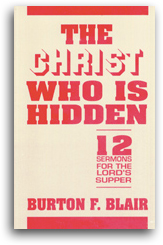
The Christ Who Is Hidden
Sermons For The Lord's Supper
Sometime ago I overheard two people talking about the woes of our world. Each person had a list of things that were wrong in our world. Finally, after each shared his thoughts about the worsening conditions in the world, one said, 'What we need is a better world to live in!'
This is the desperate cry everywhere in our world. None of us would disagree with that fact. To be sure, we might disagree what makes for a better world and how we should go about achieving it. Every last one of us has an idea about what would make for a better world. Conservatives and liberals have ideas about it, but they agree on very little as to what makes for a better world. Religious people as well as non-religious people have their opinions. However, the end result of most of these disagreements is confusion and very little action. And we still do not have a better world in which to live!
For those who follow the Christ, there is an answer for the making of a better world. Philemon is one of those books in the New Testament that we often simply overlook because it seems, at first glance, nothing more than some personal correspondence between Paul and a friend named Philemon. But when we look more closely, it is much more. It contains a needed message for us in our world today. It has a clue to what makes for a better world.
What do we know about this man named Philemon, to whom Paul writes these words? We have absolutely no information about his background, life, or character, beyond these meager twenty-five verses, in most Bibles simply a page long. Philemon is not mentioned any where else in the Scripture. There is no mention of him in any secular sources.
From this short letter, we can gather that Paul is writing to a close friend who evidently is a man of wealth. It is believed that Philemon lived in Colossae. From the letter, we are to understand that Paul is writing to Philemon from prison. We do not know the location of the prison, but it is generally assumed that it is located in Rome.
In this letter Paul is writing on the behalf of Onesimus, a run-away slave. Onesimus belongs to Philemon. After running away from Philemon, Onesimus reached Rome and came under the influence of Paul's ministry and was converted to Christ.
Apparently, as Onesimus fled from Philemon, he stole something from him. It could have been either money or a horse -- or perhaps both. Under the lordship of Christ, Onesimus had his conscience awakened. He wants to go back to his old master, Philemon, in order to make restitution. He wants everything to be right, but he is afraid of what Philemon might do to him. Therefore, Paul is writing Philemon for the sake of Onesimus.
To appreciate Onesimus' fears, we must understand something of the world in which he lived. In his day, two-thirds of the world's population was in slavery. And slaves simply had no civil rights. Those who were slaves were property to be sold and bought. Literally, the owners had the right to let them either live or die. Moreover, the normal punishment for a run-away slave, if caught, was death. No questions asked. No mercy given. Examples have to be made. Onesimus' concern is real -- as real as death.
From the tone of the letter, Paul knows and understands Philemon's situation very well. More than likely, Paul has stayed in Philemon's home as a guest. In fact, Philemon is close to Paul because it was likely Paul who won him to Christ. Because of their relationship in Christ, Paul knows that Philemon will consider his words carefully and will do more than he asks.
As Paul writes to Philemon, he states in one sentence his case: 'Perhaps this is why he [Onesimus] was parted from you for a while, that you might have him back forever, no longer as a slave but more than a slave, as a beloved brother (vss. 15-16).' Paul understands this separation to be God's will so that Philemon can have Onesimus back forever as a brother. In these words, Paul gives us a clue to how a better world comes about.
Reading the letter closely, several elements become clear. First, Paul wants to have Onesimus with him in Rome to help carry out the ministry of Christ (vss. 13-14). But Paul wants Philemon's blessing to keep Onesimus with him. Paul knows that the situation of Onesimus' running away must be cleared up. It is Paul who is sending Onesimus back to Philemon. Second, Paul expects Philemon to receive Onesimus, not as a slave, but as brother. In addition, Paul promises to repay Philemon anything Onesimus might owe. Listen again to Paul's words:
Formerly he was useless to you, but now he is indeed useful both to you and to me. I am sending him, that is, my own heart, back to you. I wanted to keep him with me, so that he might be of service to me in your place during my imprisonment for the gospel; but I preferred to do nothing without your consent, in order that your good deed might be voluntary and not something forced.
(vss. 12-14 NRSV)
As Christians, we like to talk a great deal about being brothers and sisters. And the sad thing is that is as far as it goes with many -- just talk. It is easier for us to talk about who we do not call our brothers and sisters than who we do. We believe that God created all of us. We talk about how Jesus died on the cross for all of us. We say that there on the cross that the deepest and most abiding truth is revealed: Each of us is loved by God!
Yet most of us realize that being brothers and sisters mean nothing unless it becomes personal. If we are going to make the world a better place, then we must take this clue from Paul. Our love must become involved love. It must be personal.
If we are to have a better world, we have to start where we are. We cannot start any other place. A better world starts when one or two of us begin to tear down the walls we have built up. It is not difficult to build walls of separation. We can have a disagreement with a person, hateful words can be spoken, and we begin to build a wall that separates us from the other person. Of course, we can name our own personal walls of separation. We build our walls up around 'hurt feelings,' 'prejudice,' and 'hate.'
The better world has to begin where we have built our walls. It starts as we are able to see each other as brothers or sisters. We no longer see our differences, nor allow walls to separate us; rather, we see only the other person as a person for whom Christ died. We start a better world when we stop judging others and begin to love them in the name of Jesus, regardless of who or what they are or what they have become. The better world begins when we stop fighting one another because of our differences and work together, because we all are saved by Jesus Christ.
Of course, sometimes before we can do this, we have to learn the lesson of the grace in forgiveness. An example is seen in the life of the late Corrie Ten Boom who, after World War II, felt called to preach forgiveness to all Europeans as they tried to make a new start. She had been imprisoned by the Nazis for helping the Jews. She had suffered much in a concentration camp.
Corrie felt sure that she had overcome her own desire for vengeance against the Nazi troops who had dehumanized her and her loved ones in the concentration camp. On one occasion, her ministry took her to Munich. Outside a church on a Sunday, she found herself face-to-face with one of the old guards of the camp. Suddenly, the pain and the fear she had experienced in the concentration camp came to her again.
The man came up to Corrie with a smile and joy in his heart. He spoke: 'How grateful I am for your message. To think that he has washed my sins away.' He put his hand out to her. It was too much. She kept her hand frozen by her side. Angry, vengeful feelings boiled up inside of her. She struggled to raise her hand, but she couldn't move it. She did not feel the slightest spark of forgiveness.
Corrie breathed a silent prayer: 'Jesus, I cannot forgive him. Give me your forgiveness.' Corrie recalled being touched then and there by the One who can forgive everyone everything. She felt God's forgiveness, and so she was able to raise her arm and take the hand of the man.
With forgiveness in our hearts, the words of Paul to Philemon become perfectly clear. Those who follow the Christ do not see others as slave or free, black or white, conservative or liberal, Protestant or Catholic, minister or laity. They see only brothers and sisters in Christ. In Jesus, we are bound together in ways which transcend and overcome our differences. We are bound together not only in the forgiveness of God, but also in God's unconditional love. The barriers of race, class, and position are torn down because we all are children of God in the blood of Jesus Christ. Nothing more or less!
The late Bishop Walter Underwood tells of a couple who came to him to be married. They were an older couple. Bishop Underwood asked, 'How long have you been dating?' They replied, 'Thirty-seven years.' In retrospect, Bishop Underwood said he perhaps should have refused to perform the wedding. He thought that anyone who took 37 years to make up their minds about getting married maybe shouldn't be married.
But isn't this like us? This is our problem, too. We look, discuss, and look some more, but never make up our minds to leap. We know that we are called to be brothers and sisters to the world. We know we are called to forgive one another. Yet we would rather argue about who are our brothers and sisters. We forget that if we bear the name of Jesus, then we are the brothers and sisters to the world.
The artist Gustave Dore was once traveling through Europe. He came to a border where he was required to show his passport. He searched through his pockets, but it was gone. 'I've lost my passport,' he explained to the guard, 'but it's all right. I'm Dore, the artist. Please let me go through.' 'No, sir,' the guard replied. 'People come every day claiming to be someone they aren't. I cannot let you pass. Here is a pencil and paper. Draw me a picture so you can prove who you are.'
Perhaps, it is time for those of us who call ourselves Christians to prove who we are. Our name identifies us as the ones who are brothers and sisters to all others who need brothers and sisters in this world. As followers of Christ, we are asked to live as Jesus lived. We are asked to love and forgive others as a proof of our relationship with Jesus.
The motivation for our behavior as Christians is our relationship with Jesus. As we come to this altar, we are called upon to remember that. These elements remind us that we love others because he first loved us, and we forgive others because he first forgave us.
This is the desperate cry everywhere in our world. None of us would disagree with that fact. To be sure, we might disagree what makes for a better world and how we should go about achieving it. Every last one of us has an idea about what would make for a better world. Conservatives and liberals have ideas about it, but they agree on very little as to what makes for a better world. Religious people as well as non-religious people have their opinions. However, the end result of most of these disagreements is confusion and very little action. And we still do not have a better world in which to live!
For those who follow the Christ, there is an answer for the making of a better world. Philemon is one of those books in the New Testament that we often simply overlook because it seems, at first glance, nothing more than some personal correspondence between Paul and a friend named Philemon. But when we look more closely, it is much more. It contains a needed message for us in our world today. It has a clue to what makes for a better world.
What do we know about this man named Philemon, to whom Paul writes these words? We have absolutely no information about his background, life, or character, beyond these meager twenty-five verses, in most Bibles simply a page long. Philemon is not mentioned any where else in the Scripture. There is no mention of him in any secular sources.
From this short letter, we can gather that Paul is writing to a close friend who evidently is a man of wealth. It is believed that Philemon lived in Colossae. From the letter, we are to understand that Paul is writing to Philemon from prison. We do not know the location of the prison, but it is generally assumed that it is located in Rome.
In this letter Paul is writing on the behalf of Onesimus, a run-away slave. Onesimus belongs to Philemon. After running away from Philemon, Onesimus reached Rome and came under the influence of Paul's ministry and was converted to Christ.
Apparently, as Onesimus fled from Philemon, he stole something from him. It could have been either money or a horse -- or perhaps both. Under the lordship of Christ, Onesimus had his conscience awakened. He wants to go back to his old master, Philemon, in order to make restitution. He wants everything to be right, but he is afraid of what Philemon might do to him. Therefore, Paul is writing Philemon for the sake of Onesimus.
To appreciate Onesimus' fears, we must understand something of the world in which he lived. In his day, two-thirds of the world's population was in slavery. And slaves simply had no civil rights. Those who were slaves were property to be sold and bought. Literally, the owners had the right to let them either live or die. Moreover, the normal punishment for a run-away slave, if caught, was death. No questions asked. No mercy given. Examples have to be made. Onesimus' concern is real -- as real as death.
From the tone of the letter, Paul knows and understands Philemon's situation very well. More than likely, Paul has stayed in Philemon's home as a guest. In fact, Philemon is close to Paul because it was likely Paul who won him to Christ. Because of their relationship in Christ, Paul knows that Philemon will consider his words carefully and will do more than he asks.
As Paul writes to Philemon, he states in one sentence his case: 'Perhaps this is why he [Onesimus] was parted from you for a while, that you might have him back forever, no longer as a slave but more than a slave, as a beloved brother (vss. 15-16).' Paul understands this separation to be God's will so that Philemon can have Onesimus back forever as a brother. In these words, Paul gives us a clue to how a better world comes about.
Reading the letter closely, several elements become clear. First, Paul wants to have Onesimus with him in Rome to help carry out the ministry of Christ (vss. 13-14). But Paul wants Philemon's blessing to keep Onesimus with him. Paul knows that the situation of Onesimus' running away must be cleared up. It is Paul who is sending Onesimus back to Philemon. Second, Paul expects Philemon to receive Onesimus, not as a slave, but as brother. In addition, Paul promises to repay Philemon anything Onesimus might owe. Listen again to Paul's words:
Formerly he was useless to you, but now he is indeed useful both to you and to me. I am sending him, that is, my own heart, back to you. I wanted to keep him with me, so that he might be of service to me in your place during my imprisonment for the gospel; but I preferred to do nothing without your consent, in order that your good deed might be voluntary and not something forced.
(vss. 12-14 NRSV)
As Christians, we like to talk a great deal about being brothers and sisters. And the sad thing is that is as far as it goes with many -- just talk. It is easier for us to talk about who we do not call our brothers and sisters than who we do. We believe that God created all of us. We talk about how Jesus died on the cross for all of us. We say that there on the cross that the deepest and most abiding truth is revealed: Each of us is loved by God!
Yet most of us realize that being brothers and sisters mean nothing unless it becomes personal. If we are going to make the world a better place, then we must take this clue from Paul. Our love must become involved love. It must be personal.
If we are to have a better world, we have to start where we are. We cannot start any other place. A better world starts when one or two of us begin to tear down the walls we have built up. It is not difficult to build walls of separation. We can have a disagreement with a person, hateful words can be spoken, and we begin to build a wall that separates us from the other person. Of course, we can name our own personal walls of separation. We build our walls up around 'hurt feelings,' 'prejudice,' and 'hate.'
The better world has to begin where we have built our walls. It starts as we are able to see each other as brothers or sisters. We no longer see our differences, nor allow walls to separate us; rather, we see only the other person as a person for whom Christ died. We start a better world when we stop judging others and begin to love them in the name of Jesus, regardless of who or what they are or what they have become. The better world begins when we stop fighting one another because of our differences and work together, because we all are saved by Jesus Christ.
Of course, sometimes before we can do this, we have to learn the lesson of the grace in forgiveness. An example is seen in the life of the late Corrie Ten Boom who, after World War II, felt called to preach forgiveness to all Europeans as they tried to make a new start. She had been imprisoned by the Nazis for helping the Jews. She had suffered much in a concentration camp.
Corrie felt sure that she had overcome her own desire for vengeance against the Nazi troops who had dehumanized her and her loved ones in the concentration camp. On one occasion, her ministry took her to Munich. Outside a church on a Sunday, she found herself face-to-face with one of the old guards of the camp. Suddenly, the pain and the fear she had experienced in the concentration camp came to her again.
The man came up to Corrie with a smile and joy in his heart. He spoke: 'How grateful I am for your message. To think that he has washed my sins away.' He put his hand out to her. It was too much. She kept her hand frozen by her side. Angry, vengeful feelings boiled up inside of her. She struggled to raise her hand, but she couldn't move it. She did not feel the slightest spark of forgiveness.
Corrie breathed a silent prayer: 'Jesus, I cannot forgive him. Give me your forgiveness.' Corrie recalled being touched then and there by the One who can forgive everyone everything. She felt God's forgiveness, and so she was able to raise her arm and take the hand of the man.
With forgiveness in our hearts, the words of Paul to Philemon become perfectly clear. Those who follow the Christ do not see others as slave or free, black or white, conservative or liberal, Protestant or Catholic, minister or laity. They see only brothers and sisters in Christ. In Jesus, we are bound together in ways which transcend and overcome our differences. We are bound together not only in the forgiveness of God, but also in God's unconditional love. The barriers of race, class, and position are torn down because we all are children of God in the blood of Jesus Christ. Nothing more or less!
The late Bishop Walter Underwood tells of a couple who came to him to be married. They were an older couple. Bishop Underwood asked, 'How long have you been dating?' They replied, 'Thirty-seven years.' In retrospect, Bishop Underwood said he perhaps should have refused to perform the wedding. He thought that anyone who took 37 years to make up their minds about getting married maybe shouldn't be married.
But isn't this like us? This is our problem, too. We look, discuss, and look some more, but never make up our minds to leap. We know that we are called to be brothers and sisters to the world. We know we are called to forgive one another. Yet we would rather argue about who are our brothers and sisters. We forget that if we bear the name of Jesus, then we are the brothers and sisters to the world.
The artist Gustave Dore was once traveling through Europe. He came to a border where he was required to show his passport. He searched through his pockets, but it was gone. 'I've lost my passport,' he explained to the guard, 'but it's all right. I'm Dore, the artist. Please let me go through.' 'No, sir,' the guard replied. 'People come every day claiming to be someone they aren't. I cannot let you pass. Here is a pencil and paper. Draw me a picture so you can prove who you are.'
Perhaps, it is time for those of us who call ourselves Christians to prove who we are. Our name identifies us as the ones who are brothers and sisters to all others who need brothers and sisters in this world. As followers of Christ, we are asked to live as Jesus lived. We are asked to love and forgive others as a proof of our relationship with Jesus.
The motivation for our behavior as Christians is our relationship with Jesus. As we come to this altar, we are called upon to remember that. These elements remind us that we love others because he first loved us, and we forgive others because he first forgave us.
