
His Coming is to be Welcomed, Not Feared
Sermon
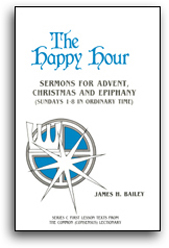
THE HAPPY HOUR
SERMONS FOR ADVENT, CHRISTMAS AND EPIPHANY (SUNDAYS 1-8 IN ORDINARY TIME)
One of the main objectives of the Moody Institute of Religion and Science is to relate science and the holy Scripture. Several years ago, Moody produced a three-hour movie depicting the creation. It is the most marvelous film of its kind I have ever viewed. For example, it shows creation and the miracle of creation in its many stages. A seed of corn and a flower seed are implanted in the soil. A movie camera is focused on both of these seeds for four months, twenty-four hours a day, every second of the hour. At the end of four months, by the process of fast action lens. they reduced this process from four months to twenty seconds; so that before your eyes, you could view the miracle of creation. You could see that seed from the moment of its implantation in the earth, as it burst through the soil and grew into a stalk, and then as an ear of corn. You could hear the sound of the ear as it began to blossom and burst and the flower as it bloomed. I thought I had truly stood in the very presence of the Almighty as I watched it.
One problem with this film was that the fast action cameras were not able to relate or capture what took place between the implanting of the seed and the blossoming of the flower. It showed nothing that the horticulturist or the farmer must have done, nothing of the tilling of the soil, nothing of having to fertilize it, weed it, or water it. As I reflected on the film, I realized that while I had seen a fragment of the miracle of creation, I had only seen a part. For I had not seen that which took place from the beginning to the end in terms of cultivation.
Now, Advent is to teach us the art of what we do between the implantation and the coming of Christ. It is to teach us what goes on during that interval. It is to teach us how to wait creatively, and to know what takes place between the beginning and the end, between the eschaton and the coming of Christ eschalogically, what we do between the promise and the fulfillment. Advent is to teach us how to practice waiting creatively and how to use our time constructively and creatively.
Zephaniah is saying that the seed has already been implanted in the earth ... the eschaton and the Lord's coming has already been decided. We are in the interval period between the seed having been planted and the blossoming of the rose of Sharon. We need to use creatively this period of waiting ... to wait patiently and creatively, by being busy rejoicing, and to "let not your hands grow weak." (verse sixteen) But most of all, Zephaniah is saying his coming is not to be feared but looked forward to ... that his judgment is not to damn us but to disperse justice and make all things right, and to "remove disaster from you". (verse eighteen)
I. The Lord is Coming
That is the message of Advent. He came once in Bethlehem and He will come again. In any intellectual circle, that is the proof for the fact that anything is going to happen. In a court of law, for example, proof is tied to precedent. In the field of science you say, "Well, because this sequence occurred one time, then it will occur again, that is the proof." The historian ties proof to the principle that history repeats itself. The Bible uses this same argument: because Jesus came once, He will come again.
For God, there is no such thing as time. The end and the beginning are the same, but he can view the world and life from eternity reaching to the future to the present, and from the present reaching back to the past. In other words, God sees it all, but you and I stand back here looking from the perspective of the past toward the future.
Yes, He is coming! We don't know when or exactly how. Jesus said, "You know not the day nor hour when the Son of Man comes." The disciples said, "Lord, give us some signs so we will know when you are coming, whether in a few weeks or years." But He said, "No, you wicked generation. A sign will not be given you."
In fact, the New Testament says the way you can tell a false prophet is: "A false prophet will always give you the impression that he has got some special insight or understanding about when Jesus will come." Always, the Bible says you can tell they are false prophets if they say they know when Jesus will come. Some passages suggest that He will come instantaneously, like a flash in the night or a call in the middle of the night. Others say He will come quietly and slowly, like the yeast in the dough or the small mustard seed that is planted, sprouts out and grows up into a huge tree. Some say it will be like the description in "O Little Town of Bethlehem," where we sing:
How silently, how silently
The wondrous gift is given
So God imparts to human heart
The blessings of his heaven.
No ear may hear his coming,
But in this world of sin.
Where meek souls will receive him still,
The dear Christ enters in.
Others say it will be a physical return. Still others say it will be a spiritual return. The Bible says both. It says, in John's gospel, "and the word became flesh" (that is physical) and dwelt among us and he will come in like manner again. And there are other passages that indicate to us that it will be a spiritual coming. For Jesus said, "I won't leave you alone forever, I will come again and receive you unto myself. My spirit shall come and be in you. The world doesn't see me, but you see me because in my spirit I live and dwell within you." No, we don't know how or when, but we do know He is coming. It will be a combination of the physical and spiritual. It will be a combination between the slow and the gradual and the instantaneous, but He will come!
II. Learn to be Patient
This scripture from Zephaniah teaches us that we need to learn how to be patient. Most of us lack the virtue of patience. If you are like me, you pray, "Lord, make me patient, but not right now. I ain't got time." We are instant-minded - instant coffee, instant food service, instant pizza, instant TV, instant hot water, instant everything. If God doesn't respond right away. we say "forget it, Mac, you ain't listening." That is just the way we react. We forget that God has an eternity and he isn't in any hurry. He has all the time of the world at his disposal.
I am impatient. During Advent we sing the Advent Christmas carols. I had rather sing "O Little Town of Bethlehem" and "Joy to the World." I can't wait for Christmas. I am impatient. I am worse than the children. I can't wait until Christmas to sing "Joy to the world, the Lord has come."
We need to be patient like the farmer. Most of us say farmers don't have anything to do, they just plant the seed and between gathering it in, they hunt, fish. and play golf. But you farmers know better than that. There are many things you have to do in between: cultivate the soil, weed it, fertilize it, water it and irrigate it. That is what Zephaniah is saying you and I are supposed to be doing: taking the example of the farmer, staying busy cultivating the kingdom of God while we are waiting for the coming of Jesus. The Bible says, "What you do from the time the seed is planted to the time of His coming is the performance upon which you are going to be judged. We shall be judged by that." In fact, Jesus said, "Blessed is he who, when his master comes, find him so doing."
Do you remember the parable of the talents? Talents were given to two fellows, and they got busy until the master came and put them to work. But one fellow took his talent and said, "The Lord is coming any day. I will wait for His coming." That is all he did. So when the Lord came, He found him not doing anything but waiting, and he threw him out.
The early Christians began to think (they misunderstood Jesus' sayings) that the end was coming any day. So, they quit working. We read in the Acts of the Apostles that they quit their jobs, stopped planting their seeds, sold their homes, gave away their possessions and generally tried to disregard the earthly life. Paul encouraged them to do that in 1 Corinthians but later Paul began to understand what Jesus really was saying. That is why Paul wrote in 2 Corinthians that he had been wrong. We are not supposed to just quit. We are supposed to be like a farmer, and cultivate while we are waiting.
For instance, it is sometimes hard to get millennium and secondcoming kinds of Christians to work in a church or do the Lord's work. They think he is coming any day so they just wait, because he is going to make all things right. Yet it says in James, "By what you do during that interval, by that you shall be judged."
Have you ever considered that if Paul and the early Christians had not changed their point of view, that Jesus was likely coming any second, we would not have the New Testament? Prior to that they didn't write anything down. They didn't need to. Jesus was coming any day (they thought). In fact, the early written Scriptures say, "and thus you have heard it has been said," but later on they say, "and thus it has been written." When they realized they were supposed to be about God's work in the interval time, they began to write the Scripture down and record it for us.
Reflect on the parable of the ten virgins; five were wise and five were foolish. The foolish did what? From the time of the announcement of the wedding to the time of the coming of the bridegroom, they lost their souls because they didn't do anything in the interval. We need to learn how to be patient.
When I counsel people, no matter what their problem, I find myself almost always doing the same thing. A young wife comes in. Her husband has left her. She is depressed. After we have gone through the whole listening process, I end by saying: "You are grieving yourself to death. You are depressed and you are making yourself sick. What God is going to make you answer for is what you are doing during this period of waiting." You think, "I hope maybe we can get back together, or I hope something will work out." "Wait a minute," I say, "you can't do anything about him. I can't either. But you can do something about you! And that is what God is going to judge you for. Now what I want you to do during this interval time of waiting is to be certain not to waste your time. I want you to work at making yourself more beautiful. I want you to become the most beautiful girl in town. I want you to concentrate on your spiritual life, to read the word of God every day and to pray. I want you to get involved in service to others. I want you to do some things that you can accomplish and achieve, so that you will feel good about yourself and love yourself and know you are beautiful because you have let God make you beautiful. So if it does turn out that there is a possibility of reconciliation somewhere down the line, or that you must start over, you will be a beautiful person to start a new life."
For someone in this position, I usually ask them, "Wait a minute. Let's say that what you want for you and your husband is to be reconciled right now, but what would you have? You would have the same thing you had to start with, and worse. You have told me he hasn't grown spiritually while you have been separated and you tell me all you have been doing while you have been separated is grieving and that you haven't grown spiritually. So you would have a bad marriage. You need to use this time to make yourself beautiful." Yes, we need to learn how to fill that interval period and how to be patient.
III. The Lord Has Taken Away The Judgments Against You.
Zephaniah says, "The Lord has taken away the judgment against you." (verse fifteen) "Also, I will change their shame into praise." (verse nineteen) When in verse twenty he says, "I will restore your fortune," Zephaniah is saying the Lord comes not to condemn the world but that the world might be saved.
After the movie, "The Day After", a scientist said to me, "We scientists have now looked in the mouth of hell and we are afraid, preacher." I replied, "For centuries, we ministers have been dealing with the deep and dark problems of humankind. We have looked into the mouth of hell and we are not afraid."
There is nothing about which we should be frightened, or should dread, concerning the judgment. I can't wait! That is the thing to which I look forward. That is the thing for which every Christian can live with hope. He is going to come and judge the world but, through the "suffering servant," he takes on himself my sin and iniquity. All wrong is going to be made right. I don't have to worry about a thing. I am a horrible sinner and am far from perfect. But I am going to point to Jesus when He says, "Now I need to examine you," and I will say, "There, examine him," and I am going to be saved by his works, not mine. I have trusted in Jesus and him alone and I don't have to worry about a thing. He will pass the judgment.
My father-in-law used to be a great fox hunter. He had the best dogs in the state, about four packs. He could identify the hound with the tenor voice, soprano or contralto, and call them by name. It was beautiful music. He could tell by the sound of their voice whether they were chasing a gray fox or a red one. These dogs get incredibly excited when they get on the path of a red one. Red foxes are smarter than gray ones. I remember a time when we chased a red fox all night. We turned out four fresh packs of hounds, but I knew they wouldn't catch that red fox. About dawn, I was out in the woods trying to find some of the dogs and, looking up on the side of a cliff, I saw this beautiful red fox stretching out on the edge of the cliff licking his paw. The hounds were scrambling down below unable to climb that rock. They were baying and barking and the fox didn't pay them any attention. You see, he was in his refuge. He had gone to his den, where he knew he was protected from all things. All the baying and barking of the hounds didn't upset him or frighten him. He wasn't afraid of the judgment at all, for he was secure.
That is what the Bible teaches. You and I are supposed to look forward to the judgment, because we know we have our refuge in Jesus. He is our Savior and we can look down on all the baying of the hounds and all the problems of life in the world and know we are protected. Be patient and wait upon the coming of the Lord, for he is coming. Because I trust Jesus, I will not fear the judgment.
Glory hallelujah, jubilee. I can't wait! Can you?
One problem with this film was that the fast action cameras were not able to relate or capture what took place between the implanting of the seed and the blossoming of the flower. It showed nothing that the horticulturist or the farmer must have done, nothing of the tilling of the soil, nothing of having to fertilize it, weed it, or water it. As I reflected on the film, I realized that while I had seen a fragment of the miracle of creation, I had only seen a part. For I had not seen that which took place from the beginning to the end in terms of cultivation.
Now, Advent is to teach us the art of what we do between the implantation and the coming of Christ. It is to teach us what goes on during that interval. It is to teach us how to wait creatively, and to know what takes place between the beginning and the end, between the eschaton and the coming of Christ eschalogically, what we do between the promise and the fulfillment. Advent is to teach us how to practice waiting creatively and how to use our time constructively and creatively.
Zephaniah is saying that the seed has already been implanted in the earth ... the eschaton and the Lord's coming has already been decided. We are in the interval period between the seed having been planted and the blossoming of the rose of Sharon. We need to use creatively this period of waiting ... to wait patiently and creatively, by being busy rejoicing, and to "let not your hands grow weak." (verse sixteen) But most of all, Zephaniah is saying his coming is not to be feared but looked forward to ... that his judgment is not to damn us but to disperse justice and make all things right, and to "remove disaster from you". (verse eighteen)
I. The Lord is Coming
That is the message of Advent. He came once in Bethlehem and He will come again. In any intellectual circle, that is the proof for the fact that anything is going to happen. In a court of law, for example, proof is tied to precedent. In the field of science you say, "Well, because this sequence occurred one time, then it will occur again, that is the proof." The historian ties proof to the principle that history repeats itself. The Bible uses this same argument: because Jesus came once, He will come again.
For God, there is no such thing as time. The end and the beginning are the same, but he can view the world and life from eternity reaching to the future to the present, and from the present reaching back to the past. In other words, God sees it all, but you and I stand back here looking from the perspective of the past toward the future.
Yes, He is coming! We don't know when or exactly how. Jesus said, "You know not the day nor hour when the Son of Man comes." The disciples said, "Lord, give us some signs so we will know when you are coming, whether in a few weeks or years." But He said, "No, you wicked generation. A sign will not be given you."
In fact, the New Testament says the way you can tell a false prophet is: "A false prophet will always give you the impression that he has got some special insight or understanding about when Jesus will come." Always, the Bible says you can tell they are false prophets if they say they know when Jesus will come. Some passages suggest that He will come instantaneously, like a flash in the night or a call in the middle of the night. Others say He will come quietly and slowly, like the yeast in the dough or the small mustard seed that is planted, sprouts out and grows up into a huge tree. Some say it will be like the description in "O Little Town of Bethlehem," where we sing:
How silently, how silently
The wondrous gift is given
So God imparts to human heart
The blessings of his heaven.
No ear may hear his coming,
But in this world of sin.
Where meek souls will receive him still,
The dear Christ enters in.
Others say it will be a physical return. Still others say it will be a spiritual return. The Bible says both. It says, in John's gospel, "and the word became flesh" (that is physical) and dwelt among us and he will come in like manner again. And there are other passages that indicate to us that it will be a spiritual coming. For Jesus said, "I won't leave you alone forever, I will come again and receive you unto myself. My spirit shall come and be in you. The world doesn't see me, but you see me because in my spirit I live and dwell within you." No, we don't know how or when, but we do know He is coming. It will be a combination of the physical and spiritual. It will be a combination between the slow and the gradual and the instantaneous, but He will come!
II. Learn to be Patient
This scripture from Zephaniah teaches us that we need to learn how to be patient. Most of us lack the virtue of patience. If you are like me, you pray, "Lord, make me patient, but not right now. I ain't got time." We are instant-minded - instant coffee, instant food service, instant pizza, instant TV, instant hot water, instant everything. If God doesn't respond right away. we say "forget it, Mac, you ain't listening." That is just the way we react. We forget that God has an eternity and he isn't in any hurry. He has all the time of the world at his disposal.
I am impatient. During Advent we sing the Advent Christmas carols. I had rather sing "O Little Town of Bethlehem" and "Joy to the World." I can't wait for Christmas. I am impatient. I am worse than the children. I can't wait until Christmas to sing "Joy to the world, the Lord has come."
We need to be patient like the farmer. Most of us say farmers don't have anything to do, they just plant the seed and between gathering it in, they hunt, fish. and play golf. But you farmers know better than that. There are many things you have to do in between: cultivate the soil, weed it, fertilize it, water it and irrigate it. That is what Zephaniah is saying you and I are supposed to be doing: taking the example of the farmer, staying busy cultivating the kingdom of God while we are waiting for the coming of Jesus. The Bible says, "What you do from the time the seed is planted to the time of His coming is the performance upon which you are going to be judged. We shall be judged by that." In fact, Jesus said, "Blessed is he who, when his master comes, find him so doing."
Do you remember the parable of the talents? Talents were given to two fellows, and they got busy until the master came and put them to work. But one fellow took his talent and said, "The Lord is coming any day. I will wait for His coming." That is all he did. So when the Lord came, He found him not doing anything but waiting, and he threw him out.
The early Christians began to think (they misunderstood Jesus' sayings) that the end was coming any day. So, they quit working. We read in the Acts of the Apostles that they quit their jobs, stopped planting their seeds, sold their homes, gave away their possessions and generally tried to disregard the earthly life. Paul encouraged them to do that in 1 Corinthians but later Paul began to understand what Jesus really was saying. That is why Paul wrote in 2 Corinthians that he had been wrong. We are not supposed to just quit. We are supposed to be like a farmer, and cultivate while we are waiting.
For instance, it is sometimes hard to get millennium and secondcoming kinds of Christians to work in a church or do the Lord's work. They think he is coming any day so they just wait, because he is going to make all things right. Yet it says in James, "By what you do during that interval, by that you shall be judged."
Have you ever considered that if Paul and the early Christians had not changed their point of view, that Jesus was likely coming any second, we would not have the New Testament? Prior to that they didn't write anything down. They didn't need to. Jesus was coming any day (they thought). In fact, the early written Scriptures say, "and thus you have heard it has been said," but later on they say, "and thus it has been written." When they realized they were supposed to be about God's work in the interval time, they began to write the Scripture down and record it for us.
Reflect on the parable of the ten virgins; five were wise and five were foolish. The foolish did what? From the time of the announcement of the wedding to the time of the coming of the bridegroom, they lost their souls because they didn't do anything in the interval. We need to learn how to be patient.
When I counsel people, no matter what their problem, I find myself almost always doing the same thing. A young wife comes in. Her husband has left her. She is depressed. After we have gone through the whole listening process, I end by saying: "You are grieving yourself to death. You are depressed and you are making yourself sick. What God is going to make you answer for is what you are doing during this period of waiting." You think, "I hope maybe we can get back together, or I hope something will work out." "Wait a minute," I say, "you can't do anything about him. I can't either. But you can do something about you! And that is what God is going to judge you for. Now what I want you to do during this interval time of waiting is to be certain not to waste your time. I want you to work at making yourself more beautiful. I want you to become the most beautiful girl in town. I want you to concentrate on your spiritual life, to read the word of God every day and to pray. I want you to get involved in service to others. I want you to do some things that you can accomplish and achieve, so that you will feel good about yourself and love yourself and know you are beautiful because you have let God make you beautiful. So if it does turn out that there is a possibility of reconciliation somewhere down the line, or that you must start over, you will be a beautiful person to start a new life."
For someone in this position, I usually ask them, "Wait a minute. Let's say that what you want for you and your husband is to be reconciled right now, but what would you have? You would have the same thing you had to start with, and worse. You have told me he hasn't grown spiritually while you have been separated and you tell me all you have been doing while you have been separated is grieving and that you haven't grown spiritually. So you would have a bad marriage. You need to use this time to make yourself beautiful." Yes, we need to learn how to fill that interval period and how to be patient.
III. The Lord Has Taken Away The Judgments Against You.
Zephaniah says, "The Lord has taken away the judgment against you." (verse fifteen) "Also, I will change their shame into praise." (verse nineteen) When in verse twenty he says, "I will restore your fortune," Zephaniah is saying the Lord comes not to condemn the world but that the world might be saved.
After the movie, "The Day After", a scientist said to me, "We scientists have now looked in the mouth of hell and we are afraid, preacher." I replied, "For centuries, we ministers have been dealing with the deep and dark problems of humankind. We have looked into the mouth of hell and we are not afraid."
There is nothing about which we should be frightened, or should dread, concerning the judgment. I can't wait! That is the thing to which I look forward. That is the thing for which every Christian can live with hope. He is going to come and judge the world but, through the "suffering servant," he takes on himself my sin and iniquity. All wrong is going to be made right. I don't have to worry about a thing. I am a horrible sinner and am far from perfect. But I am going to point to Jesus when He says, "Now I need to examine you," and I will say, "There, examine him," and I am going to be saved by his works, not mine. I have trusted in Jesus and him alone and I don't have to worry about a thing. He will pass the judgment.
My father-in-law used to be a great fox hunter. He had the best dogs in the state, about four packs. He could identify the hound with the tenor voice, soprano or contralto, and call them by name. It was beautiful music. He could tell by the sound of their voice whether they were chasing a gray fox or a red one. These dogs get incredibly excited when they get on the path of a red one. Red foxes are smarter than gray ones. I remember a time when we chased a red fox all night. We turned out four fresh packs of hounds, but I knew they wouldn't catch that red fox. About dawn, I was out in the woods trying to find some of the dogs and, looking up on the side of a cliff, I saw this beautiful red fox stretching out on the edge of the cliff licking his paw. The hounds were scrambling down below unable to climb that rock. They were baying and barking and the fox didn't pay them any attention. You see, he was in his refuge. He had gone to his den, where he knew he was protected from all things. All the baying and barking of the hounds didn't upset him or frighten him. He wasn't afraid of the judgment at all, for he was secure.
That is what the Bible teaches. You and I are supposed to look forward to the judgment, because we know we have our refuge in Jesus. He is our Savior and we can look down on all the baying of the hounds and all the problems of life in the world and know we are protected. Be patient and wait upon the coming of the Lord, for he is coming. Because I trust Jesus, I will not fear the judgment.
Glory hallelujah, jubilee. I can't wait! Can you?
