
How Does One Follow Jesus During The Threat Of War?
Sermon
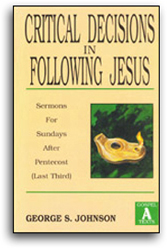
CRITICAL DECISIONS IN FOLLOWING JESUS
Sermons ForPentecost (Last Third)
It has been difficult for me to decide what sermon I should preach today. I had planned to preach on the lectionary text in Acts which is assigned for this Sunday. That story of Peter and Cornelius has been occupying my thoughts for several days, and I had a pretty good idea of how the sermon would be developed. But the present historical crisis has been capturing the attention of us all. My sense of call as a pastor has urged me to set aside the sermon on Peter and Cornelius and speak about following Jesus in the face of the threat of war. It has come to my attention that I would be shirking my duty if I did not offer you some help in following Jesus during this critical moment in history. God's Word has something to say to us about war, about enemies, the use of power and the sword, and about reconciliation. It has a lot to say about peace. One of our beatitudes says "Blessed are the peacemakers for they shall be called children of God."
The Issue Is Following Jesus
My sermon is intended to help you follow Jesus. It is not intended to change your mind, your politics; or convince you to believe as I do about the real reasons for this conflict in the Middle East. Some of my interpretation of what is happening will surface in my comments, but you can sift through that without necessarily agreeing. What I don't want you to miss is the call to follow Jesus - not just believe in God - but follow Jesus. Following Jesus is what the call of the gospel is all about. My job as your pastor is to urge you to follow Jesus, which is a lifelong journey.
Following Jesus is not always easy ... especially when it brings you face to face with ideas, allegiances, cultural norms and national trends that are in conflict with what Jesus taught and what he stood for. When we do things in the name of Jesus, we at times face strong opposition. Jesus knew that what he said would be a stumbling block to some. There is a "no" to the gospel as well as a "yes." Many of us have been struggling with how to respond to the threat of war, the possibility of our country's military involvement. The fact that we struggle at all may come from the desire within us to follow Jesus. How does one become a peacemaker when the talk is about war?
Following Jesus is not something that is done in a vacuum, in theory or in another world; it is not something that we can divorce from our daily lives, which includes our politics and our economics. Following Jesus is not something we take care of by going to church or sending our children to Sunday school and saying our prayers before we go to sleep. No, following Jesus is something that affects everything we do - our values, our work, our attitude toward sex, our use of money, and how we live as citizens of this world. Jesus did not give us the option of following him except in our politics or our economics.
Following Jesus is a lifelong journey. We continue to grow. We continue to change. We continue to understand more and more what Jesus and the kingdom of God is about. I was following Jesus 10 years ago, 20 years ago. But let me tell you, I have learned a lot in these 20 years. I don't think the same as I used to on many issues. Following Jesus has changed me. It hasn't come overnight. Don't be surprised if in this present historical situation you find you are thinking differently than 10 years ago. Following Jesus is a lifelong journey that takes you through many stages and growth experiences. Janet Hagberg and Robert Guelich have an interesting book called The Critical Journey which talks about stages of one's faith journey. I recommend it to you. If you are really upset with the way some of your friends are responding to the military buildup, it may be that they are at a different stage in their journey than you are.
In the threat of war or when your country is preparing for or thinking about war, how do you follow Jesus? What are your choices? That's the issue I want to address. There are moments in our lives when historical reality brings us face to face with critical decisions.
If you develop a terminal illness and learn that in one or two years you will die, you may ask the question, how do I follow Jesus in the face of a terminal illness? What are my choices? If you begin a new work and that work puts you face to face with tough decisions like, do I bend the rules to make more money, do I do as everyone else in the company to keep my job? How do I follow Jesus as a responsible employee of my company?
The same question must be addressed by us as citizens of the United States. How do I follow Jesus during the threat of war? It is not hypothetical. It is real. What does God's Word say to us about Iraq, Saddam Hussein, or about violence and killing Iraqi people? What does God's Word say about patriotism, about obedience to one's government, about following one's conscience? There is no simple answer.
The Scriptures Are A Resource
For most of us there is no chapter or verse you go to and say, "Okay, here is what the Bible says. That settles it. Either you believe it or you don't." There are no simple black and white options. We've done that with other issues haven't we? It doesn't work. We've done it with homosexual issues. We've done it with slavery, women's issues, the ordination of women, apartheid. Most of us, I hope, do not use the Bible to back up our bias or prejudice.
But there is guidance for us in the scriptures. I pray that the Holy Spirit may lead us to the truth and that the truth, centered in Jesus, may free us and energize us, may help us in the struggle. "God's Word is a lamp unto our feet, a light unto our path." "If we continue in God's word we will know the truth and the truth will make us free." This is a time to review the central message of the Bible. I want us to look at scripture to see how it can help us to follow Jesus - how we can be peacemakers.
Let me first address the argument for war found in the Old Testament. Didn't God's people go to war in obedience to God? War seems condoned in the Old Testament, it seems to be ordained of God. The whole idea of Holy War is found in the Old Testament. Doesn't God use war to punish, to bring judgment? Weren't the Israelites commanded to kill at certain times?
There are many things to be said about that. It is a difficult question, and a worthwhile question. Not everything in the Old Testament is helpful for ethics today. But what I want to emphasize is following Jesus. The Jewish rabbi from Nazareth, Jesus, seems to have believed that there is a better way to live than to kill and destroy, a better way to influence people, a better way to change the world. That is the way of love. "You have heard that it was said of old ... but I say to you." He showed us the power of love. You can use the Old Testament as a justification for war, but I don't think you can use Jesus. Our concern is with following Jesus because we meet in the name of Jesus.
Let's look at a few texts. In Isaiah the second chapter, we are given the prophet's vision of what the coming of the Messiah would bring to Israel, to the world. It talks about God's visitation, God's action to save, God's intervention in this world. We believe - and here we may differ from our Jewish or Arab friends - that Jesus was that Messiah. Jesus was the new name for God, not the only name, but the new name. Something new was introduced by Jesus. Jesus came to show us the way to address separation, conflict, hate, greed; and so Isaiah talks about the Messiah way, the Jesus way, when he says: "They shall beat their swords into plowshares, their spears into pruning hooks."
If we were to use language that would be appropriate to our military weapons today, swords and spears would read:
guns, tanks, missiles, nuclear weapons. God's coming to intervene would mean that nations, not just individuals, but nations would turn their weapons of killing each other into plowshares and pruning hooks, tools for growing food, for sustaining life. Weapons of destruction would be turned into tools for helping people live. That's what the coming of Jesus would bring about, a new vision, a new way of living together, of resolving conflict.
Isaiah goes on to say: "Neither shall they learn war anymore." I like that expression. Neither shall they learn war anymore.
War is something that people learn. It is a way of showing power to bring about submission from one's enemies. It is a way of solving differences of opinion. War seems inevitable when wealth or power is threatened or stolen. It's been around a long time. Perhaps we began "learning war" when we were given children's war toys, or when we watched movies and videos that exalted war. In the movie Robin Hood, there are more than 250 acts of violence. In the media these days there is talk of war. We are preparing, we are being programmed to think war, to justify war. We learn war when we gear our whole economic structure around war and the preparation for war.
Isaiah says that when the Messiah comes, when Jesus breaks into our lives, something radical happens. Our way of thinking changes. "Neither shall they learn war anymore." That's our vision and our vision shapes our thinking, our action. Following Jesus during the threat of war means going back to passages like this and reshaping our vision for this world. Following Jesus doesn't mean just getting your sins forgiven and looking forward to heaven. It means seeking the kingdom and God's justice on earth as in heaven. It means living and working to bring the way of Jesus, his vision, into reality. That messianic vision was ... "neither shall they learn war anymore."
Jesus' Way Was Different
Next I want to take you into the heart of Jesus' teaching found in the Sermon on the Mount. This sermon, we are told, is a collection of Jesus' main preaching. It's a kind of summary. If you want to get at the essence of what Jesus tried to get across, read the Sermon on the Mount. Here we have this familiar passage about how to find happiness and how to live as participants in the kingdom. Jesus points out that, in the Old Testament you read about an eye for an eye, but I want to show you a better way. He goes on to say, "Do not resist one who is evil with evil. Instead, respond with love." That's what turning the other cheek means. It means you use love, not revenge, as a weapon when relating to your enemy. The Old Testament may suggest that it's okay to hate your enemy, it's okay to kill. "But I say to you," says Jesus, "love your enemy." It seems to me that Jesus is suggesting that there is another way. One doesn't have to resort to killing and destroying. "Blessed are the peacemakers for they shall be called sons of God."
Now, many of us are very practical minded at this point, and we may say, it doesn't work with some people or with nations. That may be okay in the church or the home, but it isn't realistic in a world with people like Saddam Hussein or Noriega or Samoza or Hitler. This turning the other cheek just doesn't work.
But we meet in the name of Jesus. We may argue with Jesus. We may disagree with Jesus. We may disobey Jesus. We may choose not to follow Jesus. But don't change his teaching! Don't change his words to justify using violence to stop violence.
I want us to be honest in our struggle. How do you follow Jesus during the threat of war? Jesus said, "If you live by the sword, you will die by the sword." We can call Jesus a crazy liberal, a lunatic, or a wimp. We can choose to follow the empire instead of Jesus. But don't change the teachings of Jesus who came to teach us that love is more powerful than revenge, than the sword.
Perhaps the beatitudes give us the best clue as to how we follow Jesus, not only during the threat of war, but anytime.
"Blessed are the poor in spirit." Those who are able to keep their sanity and make good decisions are those who recognize their limitations as well as their potential. To be poor in spirit is like the first step in the 12-step program, which is to recognize one's powerlessness over one's addiction. It may be our addiction to wealth and privilege. It may be our addiction to racism or sexism. It may be our addiction to a war economy. The first step is to recognize one's addiction and seek help. Blessed are the poor in spirit, who sense their brokenness and need for help. This is not a time for rattling swords, but for soul searching and repentance. Is war the answer to our brokenness?
"Blessed are those who mourn." Those who find healing and wholeness are those who are willing to embrace the darkness in their lives. Often our tendency is to run, hide, cover up; deny our brokenness, our fears, our guilt. As Christians one gift we can offer each other is the gift of brokenness. "We all have sinned and come short of the glory of God." Sometimes our brokenness comes in the form of the pain of uncertainty, or the struggle of unanswered questions. We don't always know which direction to go or which decision to make. That can be painful. When war is the choice of one's country, maybe the first step in following Jesus is to own the darkness that comes upon us when we're not sure what to do. To mourn is to be in solidarity with those who suffer on both sides. Maybe this is a time for weeping as a sign of solidarity with all who will suffer if and when war breaks out.
We won't try to cover all the beatitudes this morning, only a couple more. "Blessed are those who hunger and thirst for righteousness, for justice." Following Jesus is to want more than anything the healing of people and society, the restoration of wholeness. It is called justice. This word comes from a first testament concept called mishpat. Mishpat is the reordering of relationships and resources so that all of creation can experience God's blessing. Jesus demonstrated that love is the most powerful instrument to bring that about. War seems to promote dominance and control. Reconciliation brings people together to share in the fruit of peace. Blessed are those who hunger and thirst for justice.
Finally, "blessed are the peacemakers." We all know that peace is more than the absence of conflict. Husband and wife may not be outwardly fighting, but that doesn't mean they are at peace. Law and order may bring an end to violence, but there may not be peace. Peace comes when all sides experience freedom to be whole, creative and participating in decisions that affect their destiny. Peacemaking is not obtaining my security at your expense. When I hear how people in the developing countries are suffering and will suffer even more because of the threat of war in the Middle East, I am reminded that peacemaking is far more than an end to conflict. One of the recent Popes said it well. "If you want peace, work for justice." As we seek to follow Jesus during this difficult time, we will look beyond the immediate moment, beyond the cost to us, beyond our need for security, beyond the talk of allied casualties. Our commitment to peacemaking makes us global citizens with a concern for all people. Following Jesus makes us members of the whole family of God. From that stance we make our decisions and take a stand.
I want you to know that it's okay if we don't agree on the issues that surround this crisis in the Middle East. I may be wrong in my analysis. At times like this we need to be patient with one another and forebearing toward one another in love. My prayer is that we may be attentive to the call to follow Jesus in all our decisions in life, especially in life and death issues.
Following Jesus during the threat of war may not be easy, but I'd rather be following him than to be following the way of an addictive society. It is a critical decision. Re-reading and reflecting on the beatitudes will be of help to each of us. Amen.
The Issue Is Following Jesus
My sermon is intended to help you follow Jesus. It is not intended to change your mind, your politics; or convince you to believe as I do about the real reasons for this conflict in the Middle East. Some of my interpretation of what is happening will surface in my comments, but you can sift through that without necessarily agreeing. What I don't want you to miss is the call to follow Jesus - not just believe in God - but follow Jesus. Following Jesus is what the call of the gospel is all about. My job as your pastor is to urge you to follow Jesus, which is a lifelong journey.
Following Jesus is not always easy ... especially when it brings you face to face with ideas, allegiances, cultural norms and national trends that are in conflict with what Jesus taught and what he stood for. When we do things in the name of Jesus, we at times face strong opposition. Jesus knew that what he said would be a stumbling block to some. There is a "no" to the gospel as well as a "yes." Many of us have been struggling with how to respond to the threat of war, the possibility of our country's military involvement. The fact that we struggle at all may come from the desire within us to follow Jesus. How does one become a peacemaker when the talk is about war?
Following Jesus is not something that is done in a vacuum, in theory or in another world; it is not something that we can divorce from our daily lives, which includes our politics and our economics. Following Jesus is not something we take care of by going to church or sending our children to Sunday school and saying our prayers before we go to sleep. No, following Jesus is something that affects everything we do - our values, our work, our attitude toward sex, our use of money, and how we live as citizens of this world. Jesus did not give us the option of following him except in our politics or our economics.
Following Jesus is a lifelong journey. We continue to grow. We continue to change. We continue to understand more and more what Jesus and the kingdom of God is about. I was following Jesus 10 years ago, 20 years ago. But let me tell you, I have learned a lot in these 20 years. I don't think the same as I used to on many issues. Following Jesus has changed me. It hasn't come overnight. Don't be surprised if in this present historical situation you find you are thinking differently than 10 years ago. Following Jesus is a lifelong journey that takes you through many stages and growth experiences. Janet Hagberg and Robert Guelich have an interesting book called The Critical Journey which talks about stages of one's faith journey. I recommend it to you. If you are really upset with the way some of your friends are responding to the military buildup, it may be that they are at a different stage in their journey than you are.
In the threat of war or when your country is preparing for or thinking about war, how do you follow Jesus? What are your choices? That's the issue I want to address. There are moments in our lives when historical reality brings us face to face with critical decisions.
If you develop a terminal illness and learn that in one or two years you will die, you may ask the question, how do I follow Jesus in the face of a terminal illness? What are my choices? If you begin a new work and that work puts you face to face with tough decisions like, do I bend the rules to make more money, do I do as everyone else in the company to keep my job? How do I follow Jesus as a responsible employee of my company?
The same question must be addressed by us as citizens of the United States. How do I follow Jesus during the threat of war? It is not hypothetical. It is real. What does God's Word say to us about Iraq, Saddam Hussein, or about violence and killing Iraqi people? What does God's Word say about patriotism, about obedience to one's government, about following one's conscience? There is no simple answer.
The Scriptures Are A Resource
For most of us there is no chapter or verse you go to and say, "Okay, here is what the Bible says. That settles it. Either you believe it or you don't." There are no simple black and white options. We've done that with other issues haven't we? It doesn't work. We've done it with homosexual issues. We've done it with slavery, women's issues, the ordination of women, apartheid. Most of us, I hope, do not use the Bible to back up our bias or prejudice.
But there is guidance for us in the scriptures. I pray that the Holy Spirit may lead us to the truth and that the truth, centered in Jesus, may free us and energize us, may help us in the struggle. "God's Word is a lamp unto our feet, a light unto our path." "If we continue in God's word we will know the truth and the truth will make us free." This is a time to review the central message of the Bible. I want us to look at scripture to see how it can help us to follow Jesus - how we can be peacemakers.
Let me first address the argument for war found in the Old Testament. Didn't God's people go to war in obedience to God? War seems condoned in the Old Testament, it seems to be ordained of God. The whole idea of Holy War is found in the Old Testament. Doesn't God use war to punish, to bring judgment? Weren't the Israelites commanded to kill at certain times?
There are many things to be said about that. It is a difficult question, and a worthwhile question. Not everything in the Old Testament is helpful for ethics today. But what I want to emphasize is following Jesus. The Jewish rabbi from Nazareth, Jesus, seems to have believed that there is a better way to live than to kill and destroy, a better way to influence people, a better way to change the world. That is the way of love. "You have heard that it was said of old ... but I say to you." He showed us the power of love. You can use the Old Testament as a justification for war, but I don't think you can use Jesus. Our concern is with following Jesus because we meet in the name of Jesus.
Let's look at a few texts. In Isaiah the second chapter, we are given the prophet's vision of what the coming of the Messiah would bring to Israel, to the world. It talks about God's visitation, God's action to save, God's intervention in this world. We believe - and here we may differ from our Jewish or Arab friends - that Jesus was that Messiah. Jesus was the new name for God, not the only name, but the new name. Something new was introduced by Jesus. Jesus came to show us the way to address separation, conflict, hate, greed; and so Isaiah talks about the Messiah way, the Jesus way, when he says: "They shall beat their swords into plowshares, their spears into pruning hooks."
If we were to use language that would be appropriate to our military weapons today, swords and spears would read:
guns, tanks, missiles, nuclear weapons. God's coming to intervene would mean that nations, not just individuals, but nations would turn their weapons of killing each other into plowshares and pruning hooks, tools for growing food, for sustaining life. Weapons of destruction would be turned into tools for helping people live. That's what the coming of Jesus would bring about, a new vision, a new way of living together, of resolving conflict.
Isaiah goes on to say: "Neither shall they learn war anymore." I like that expression. Neither shall they learn war anymore.
War is something that people learn. It is a way of showing power to bring about submission from one's enemies. It is a way of solving differences of opinion. War seems inevitable when wealth or power is threatened or stolen. It's been around a long time. Perhaps we began "learning war" when we were given children's war toys, or when we watched movies and videos that exalted war. In the movie Robin Hood, there are more than 250 acts of violence. In the media these days there is talk of war. We are preparing, we are being programmed to think war, to justify war. We learn war when we gear our whole economic structure around war and the preparation for war.
Isaiah says that when the Messiah comes, when Jesus breaks into our lives, something radical happens. Our way of thinking changes. "Neither shall they learn war anymore." That's our vision and our vision shapes our thinking, our action. Following Jesus during the threat of war means going back to passages like this and reshaping our vision for this world. Following Jesus doesn't mean just getting your sins forgiven and looking forward to heaven. It means seeking the kingdom and God's justice on earth as in heaven. It means living and working to bring the way of Jesus, his vision, into reality. That messianic vision was ... "neither shall they learn war anymore."
Jesus' Way Was Different
Next I want to take you into the heart of Jesus' teaching found in the Sermon on the Mount. This sermon, we are told, is a collection of Jesus' main preaching. It's a kind of summary. If you want to get at the essence of what Jesus tried to get across, read the Sermon on the Mount. Here we have this familiar passage about how to find happiness and how to live as participants in the kingdom. Jesus points out that, in the Old Testament you read about an eye for an eye, but I want to show you a better way. He goes on to say, "Do not resist one who is evil with evil. Instead, respond with love." That's what turning the other cheek means. It means you use love, not revenge, as a weapon when relating to your enemy. The Old Testament may suggest that it's okay to hate your enemy, it's okay to kill. "But I say to you," says Jesus, "love your enemy." It seems to me that Jesus is suggesting that there is another way. One doesn't have to resort to killing and destroying. "Blessed are the peacemakers for they shall be called sons of God."
Now, many of us are very practical minded at this point, and we may say, it doesn't work with some people or with nations. That may be okay in the church or the home, but it isn't realistic in a world with people like Saddam Hussein or Noriega or Samoza or Hitler. This turning the other cheek just doesn't work.
But we meet in the name of Jesus. We may argue with Jesus. We may disagree with Jesus. We may disobey Jesus. We may choose not to follow Jesus. But don't change his teaching! Don't change his words to justify using violence to stop violence.
I want us to be honest in our struggle. How do you follow Jesus during the threat of war? Jesus said, "If you live by the sword, you will die by the sword." We can call Jesus a crazy liberal, a lunatic, or a wimp. We can choose to follow the empire instead of Jesus. But don't change the teachings of Jesus who came to teach us that love is more powerful than revenge, than the sword.
Perhaps the beatitudes give us the best clue as to how we follow Jesus, not only during the threat of war, but anytime.
"Blessed are the poor in spirit." Those who are able to keep their sanity and make good decisions are those who recognize their limitations as well as their potential. To be poor in spirit is like the first step in the 12-step program, which is to recognize one's powerlessness over one's addiction. It may be our addiction to wealth and privilege. It may be our addiction to racism or sexism. It may be our addiction to a war economy. The first step is to recognize one's addiction and seek help. Blessed are the poor in spirit, who sense their brokenness and need for help. This is not a time for rattling swords, but for soul searching and repentance. Is war the answer to our brokenness?
"Blessed are those who mourn." Those who find healing and wholeness are those who are willing to embrace the darkness in their lives. Often our tendency is to run, hide, cover up; deny our brokenness, our fears, our guilt. As Christians one gift we can offer each other is the gift of brokenness. "We all have sinned and come short of the glory of God." Sometimes our brokenness comes in the form of the pain of uncertainty, or the struggle of unanswered questions. We don't always know which direction to go or which decision to make. That can be painful. When war is the choice of one's country, maybe the first step in following Jesus is to own the darkness that comes upon us when we're not sure what to do. To mourn is to be in solidarity with those who suffer on both sides. Maybe this is a time for weeping as a sign of solidarity with all who will suffer if and when war breaks out.
We won't try to cover all the beatitudes this morning, only a couple more. "Blessed are those who hunger and thirst for righteousness, for justice." Following Jesus is to want more than anything the healing of people and society, the restoration of wholeness. It is called justice. This word comes from a first testament concept called mishpat. Mishpat is the reordering of relationships and resources so that all of creation can experience God's blessing. Jesus demonstrated that love is the most powerful instrument to bring that about. War seems to promote dominance and control. Reconciliation brings people together to share in the fruit of peace. Blessed are those who hunger and thirst for justice.
Finally, "blessed are the peacemakers." We all know that peace is more than the absence of conflict. Husband and wife may not be outwardly fighting, but that doesn't mean they are at peace. Law and order may bring an end to violence, but there may not be peace. Peace comes when all sides experience freedom to be whole, creative and participating in decisions that affect their destiny. Peacemaking is not obtaining my security at your expense. When I hear how people in the developing countries are suffering and will suffer even more because of the threat of war in the Middle East, I am reminded that peacemaking is far more than an end to conflict. One of the recent Popes said it well. "If you want peace, work for justice." As we seek to follow Jesus during this difficult time, we will look beyond the immediate moment, beyond the cost to us, beyond our need for security, beyond the talk of allied casualties. Our commitment to peacemaking makes us global citizens with a concern for all people. Following Jesus makes us members of the whole family of God. From that stance we make our decisions and take a stand.
I want you to know that it's okay if we don't agree on the issues that surround this crisis in the Middle East. I may be wrong in my analysis. At times like this we need to be patient with one another and forebearing toward one another in love. My prayer is that we may be attentive to the call to follow Jesus in all our decisions in life, especially in life and death issues.
Following Jesus during the threat of war may not be easy, but I'd rather be following him than to be following the way of an addictive society. It is a critical decision. Re-reading and reflecting on the beatitudes will be of help to each of us. Amen.

