
How Should Christians Relate To Jews Today?
Sermon
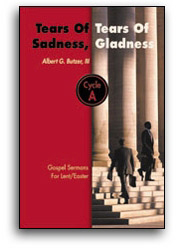
Tears Of Sadness, Tears Of Gladness
Gospel Sermons For Lent/Easter
How should Christians relate to Jews in today's world? That's a question all of us should ponder. Consider a true story about the relationship between a Presbyterian minister and a Jewish rabbi. The minister was my grandfather, Dr. Albert G. Butzer; the rabbi was my grandfather's friend and colleague, Dr. Joseph Fink. The two men served neighboring congregations in Buffalo, New York, from the years prior to World War II until the 1960s. One day my grandfather received the tragic news that Temple Beth Zion had caught fire. He climbed in his car and rushed to the temple, arriving while the flames were still burning. The damage to the temple was severe; it had been all but destroyed. My grandfather found Dr. Fink at the scene and offered the sanctuary of Westminster Church as the place where the Jewish congregation could worship until they were able to rebuild. The members of the temple accepted the offer and worshiped at Westminster while their new temple was being built. Many years later, long after both men were dead and gone, the temple returned the favor and offered its sanctuary to the Presbyterians while their church was being renovated.
These same two men jointly officiated at a number of Jewish--Christian weddings long before such ceremonies were as common as they are today. But most significant of all, Dr. Fink and my grandfather had a "gentleman's bet" which said that the one who lived longer would officiate at the funeral for the other! True to their agreement, when Dr. Fink died, my grandfather played a major role in the funeral at the temple for his dear clergy colleague. All across the years their deep and abiding friendship demonstrated much of what is possible in relationships between Christians and Jews.
Unfortunately, not all Judeo--Christian relationships are so amicable. In his best--selling book about the Bible called The Good Book, Peter Gomes, minister of the Memorial Church at Harvard University, tells about a college student who came to see him. It was the day after the University Choir had performed Bach's St. John's Passion on Good Friday evening. When the young woman arrived at Dr. Gomes' office she was in tears, and the tears were not tears of joy. According to Gomes, the student's dilemma was that she loved the music of Bach. The Good Friday performance had been "the most demanding and satisfying aesthetic experience of her young life."1 Yet, at the same time, the performance had torn her apart, because she was Jewish and she knew the German language in which Bach wrote St. John's Passion. While the music was beautiful, the words were filled with anti--Jewish sentiment. Professor Gomes noted that while the woman acknowledged the beauty of the music and the genius of Bach, her existential self said:
This text is against me and my people, and combined they represent everything horrid and hateful that has ever happened to any Jew at the hands of any Christian. How can this be good music or God's music? How dare I participate in it, much less enjoy it?2
Shortly after the conversation with the young woman, Gomes asked the choir director why the performance of the Passion had been given in German rather than in English. The choirmaster replied, "In German it is less harsh; we can have much of the beauty without most of the pain." "That pain," says Gomes, "was not the suffering of Jesus. It was rather the pain that Christians, in the name of that suffering Jesus, have imposed upon the Jews."3
There is no book of the Bible more responsible for much of the anti--Jewish rhetoric than the Gospel of John. Ironically, the Gospel of John gives us some of the most hauntingly beautiful words in the New Testament:
For God so loved the world that he gave his only Son, so that everyone who believes in him may not perish but may have eternal life. - John 3:16
I am the resurrection and the life. Those who believe in me, even though they die, will live, and everyone who lives and believes in me will never die.
- John 11:25--26
Do not let your hearts be troubled. Believe in God, believe also in me. In my Father's house there are many dwelling places. If it were not so, would I have told you that I go to prepare a place for you? And if I go and prepare a place for you, I will come again and will take you to myself, so that where I am, there you may be also. - John 14:1--3
But this same Gospel also gives us some of the most haunting anti--Jewish words in the Bible:
The man went away and told the Jews that it was Jesus who had made him well. Therefore the Jews started persecuting Jesus, because he was doing such things on the sabbath. - John 5:15--16
For this reason the Jews were seeking all the more to kill him, because he was not only breaking the sabbath, but was also calling God his own Father, thereby making himself equal to God. - John 5:18
The Jews took up stones again to stone him.
- John 10:31
When it was evening on that day, the first day of the week, and the doors of the house where the disciples had met were locked for fear of the Jews, Jesus came and stood among them and said, "Peace be with you."
- John 20:19
Nowhere is the tension between Jesus and the Jews more intense in John's Gospel than in the story about the man who had been blind from birth. Jesus heals the man of his blindness - that much is obvious. But the healing takes only the first seven verses of the chapter; the rest of the chapter concerns the controversy that surrounds the healing. Listen between the lines to some of that tension:
So for the second time [the Pharisees] called the man who had been blind, and they said to him, "Give glory to God! We know that this man is a sinner." He answered, "I do not know whether he is a sinner. One thing I do know, that though I was blind, now I see." They said to him, "What did he do to you? How did he open your eyes?" He answered them, "I have told you already, and you would not listen. Why do you want to hear it again? Do you also want to become his disciples?" Then they reviled him, saying, "You are his disciple, but we are disciples of Moses. We know that God has spoken to Moses, but as for this man, we do not know where he comes from." The man answered, "Here is an astonishing thing! You do not know where he comes from, and yet he opened my eyes. We know that God does not listen to sinners, but he does listen to one who worships him and obeys his will. Never since the world began has it been heard that anyone opened the eyes of a person born blind. If this man were not from God, he could do nothing." They answered him, "You were born entirely in sins, and are you trying to teach us?" And they drove him out.
- John 9:24--34
How are we to make sense of this? How are we to understand the bitter rivalry John describes between Jesus and "the Jews"? One way, of course, is to accept the tension at face value. It was the Jews who persecuted Jesus. It was the Jews who plotted to kill him. It was the Jews who took up stones against him. It was the Jews who demanded his crucifixion. With an attitude like that, is it any wonder why Judeo--Christian relationships have been so strained over the years?
But there is another way to interpret these verses - to get beneath all of the anti--Jewish rhetoric and try to understand the reason behind it. Some biblical scholars believe that the early Christians were being thrown out of the synagogue because they believed in Jesus. Since many of those early Christians had been Jews first, it must have been a painful time in which even family members became divided against each other. In fact, we catch a glimpse of this threat of excommunication in the part of the scripture that deals with the parents of the blind man. The Pharisees say to the parents: "Is this your son, who you say was born blind? How then does he now see?" The parents reply, "We know that this is our son, and that he was born blind; but we do not know how it is that now he sees, nor do we know who opened his eyes. Ask him; he is of age. He will speak for himself" (John 9:19--21). "The parents said this," writes John, "because they were afraid of the Jews; for the Jews had already agreed that anyone who confessed Jesus to be the Messiah would be put out of the synagogue" (John 9:22).
Can you see how much of the anti--Jewish rhetoric in John's Gospel is fueled by this threat of excommunication? Can you see why we need to be careful not to let a family--like feud in one ancient congregation become a universal principal for hatred between Christians and Jews? Remember that in the heat of an argument, family members will often say things to one another that they don't really mean. The Gospel of John is full of that kind of heated exchange. How then should Christians relate to Jews today?
For one thing, we should remember what is obvious - Jesus was a Jew, and without the Judaism from which Christianity grew, there would be no Church today. In one of his books John Shelby Spong, who served as the Episcopal Bishop of Newark, tells about a Moslem child he met at the airport in Tel Aviv. Spong was dressed in his clerical collar with a bishop's cross around his neck. At the center of the cross was the word YHWH, the Hebrew word for LORD. Spong says that he designed the cross intentionally to affirm the Jewishness of Jesus. On seeing the cross around the bishop's neck, the Moslem child asked Spong why it had Jewish writing on it. The bishop replied, "That is my way of reminding people that the Jesus we Christians worship was Jewish and was a gift of Judaism to the world." The child looked puzzled. "Jesus was Jewish?" she asked. "I thought Jesus was Catholic."4
For another thing, we Christians will want to engage Jewish people in religious dialogue rather than shy away from it. Why? Because most often truth is found in the midst of dialogue. The German Christian theologian, JÙrgen Moltmann, whose life and work were forever affected by the Nazi Holocaust of the Jews, offers a way that such a dialogue can proceed. He writes:
Today, Jewish--Christian dialogue inspires us to formulate what we think about Christ afresh. It does not constrain us to give up our Christian identity, for then the Jews would have no partner in the dialogue.5
Moltmann goes on to suggest that we Christians should neither retract nor reduce our belief in Jesus, the Christ [or Messiah] of God, in order to make our belief conform to the Jewish faith in God. For then, says Moltmann:
This Christian faith would cease to have any interest for Jews, and would have nothing more to say to them. But it does constrain us to see Jesus in a new way ... we have to see him with the eyes of the Jews too, in dialogue.6
When it comes to the Messiah, can Jews and Christians acknowledge that we have more in common than sometimes we think? For example, both of us are waiting for a messiah. Jews wait for their messiah who will come to earth, set things right, and establish God's reign here on earth. We Christians wait for our messiah to return to earth at the end of time, set things right, and establish God's reign here on earth. Both Christians and Jews are people who wait in faith and in hope for God to act; both of us believe in the promise of the messiah. Maybe we do have more in common than we sometimes think; and maybe that common thread of belief is enough to begin a dialogue which might put an end to years of bitter, hostile relations between our peoples.
We began with a story about a Presbyterian minister and a Jewish rabbi. Let's conclude with a story about a rabbi and a Catholic priest. Their names are Marc Gellman and Thomas Hartman, and together they are known as "The God Squad." They host a nationally syndicated weekly cable television show and have also appeared on Good Morning America. While their purpose is to discuss religious issues in everyday life, the subtle message they convey is that Jews and Christians can, in fact, respect each other, work together, and maintain their unique identities. Our common prayer is that their number will increase.
____________
1. Peter J. Gomes, The Good Book (New York: William Morrow and Company, Inc., 1996), p. 102.
2. Ibid., p. 103.
3.
4. John Shelby Spong, Rescuing The Bible From Fundamentalism (San Francisco: Harper San Francisco Publishers, 1991), p. 190.
5. JÙrgen Moltmann, Jesus Christ For Today's World (Minneapolis: Fortress Press, 1994), p. 109.
6. Ibid.
These same two men jointly officiated at a number of Jewish--Christian weddings long before such ceremonies were as common as they are today. But most significant of all, Dr. Fink and my grandfather had a "gentleman's bet" which said that the one who lived longer would officiate at the funeral for the other! True to their agreement, when Dr. Fink died, my grandfather played a major role in the funeral at the temple for his dear clergy colleague. All across the years their deep and abiding friendship demonstrated much of what is possible in relationships between Christians and Jews.
Unfortunately, not all Judeo--Christian relationships are so amicable. In his best--selling book about the Bible called The Good Book, Peter Gomes, minister of the Memorial Church at Harvard University, tells about a college student who came to see him. It was the day after the University Choir had performed Bach's St. John's Passion on Good Friday evening. When the young woman arrived at Dr. Gomes' office she was in tears, and the tears were not tears of joy. According to Gomes, the student's dilemma was that she loved the music of Bach. The Good Friday performance had been "the most demanding and satisfying aesthetic experience of her young life."1 Yet, at the same time, the performance had torn her apart, because she was Jewish and she knew the German language in which Bach wrote St. John's Passion. While the music was beautiful, the words were filled with anti--Jewish sentiment. Professor Gomes noted that while the woman acknowledged the beauty of the music and the genius of Bach, her existential self said:
This text is against me and my people, and combined they represent everything horrid and hateful that has ever happened to any Jew at the hands of any Christian. How can this be good music or God's music? How dare I participate in it, much less enjoy it?2
Shortly after the conversation with the young woman, Gomes asked the choir director why the performance of the Passion had been given in German rather than in English. The choirmaster replied, "In German it is less harsh; we can have much of the beauty without most of the pain." "That pain," says Gomes, "was not the suffering of Jesus. It was rather the pain that Christians, in the name of that suffering Jesus, have imposed upon the Jews."3
There is no book of the Bible more responsible for much of the anti--Jewish rhetoric than the Gospel of John. Ironically, the Gospel of John gives us some of the most hauntingly beautiful words in the New Testament:
For God so loved the world that he gave his only Son, so that everyone who believes in him may not perish but may have eternal life. - John 3:16
I am the resurrection and the life. Those who believe in me, even though they die, will live, and everyone who lives and believes in me will never die.
- John 11:25--26
Do not let your hearts be troubled. Believe in God, believe also in me. In my Father's house there are many dwelling places. If it were not so, would I have told you that I go to prepare a place for you? And if I go and prepare a place for you, I will come again and will take you to myself, so that where I am, there you may be also. - John 14:1--3
But this same Gospel also gives us some of the most haunting anti--Jewish words in the Bible:
The man went away and told the Jews that it was Jesus who had made him well. Therefore the Jews started persecuting Jesus, because he was doing such things on the sabbath. - John 5:15--16
For this reason the Jews were seeking all the more to kill him, because he was not only breaking the sabbath, but was also calling God his own Father, thereby making himself equal to God. - John 5:18
The Jews took up stones again to stone him.
- John 10:31
When it was evening on that day, the first day of the week, and the doors of the house where the disciples had met were locked for fear of the Jews, Jesus came and stood among them and said, "Peace be with you."
- John 20:19
Nowhere is the tension between Jesus and the Jews more intense in John's Gospel than in the story about the man who had been blind from birth. Jesus heals the man of his blindness - that much is obvious. But the healing takes only the first seven verses of the chapter; the rest of the chapter concerns the controversy that surrounds the healing. Listen between the lines to some of that tension:
So for the second time [the Pharisees] called the man who had been blind, and they said to him, "Give glory to God! We know that this man is a sinner." He answered, "I do not know whether he is a sinner. One thing I do know, that though I was blind, now I see." They said to him, "What did he do to you? How did he open your eyes?" He answered them, "I have told you already, and you would not listen. Why do you want to hear it again? Do you also want to become his disciples?" Then they reviled him, saying, "You are his disciple, but we are disciples of Moses. We know that God has spoken to Moses, but as for this man, we do not know where he comes from." The man answered, "Here is an astonishing thing! You do not know where he comes from, and yet he opened my eyes. We know that God does not listen to sinners, but he does listen to one who worships him and obeys his will. Never since the world began has it been heard that anyone opened the eyes of a person born blind. If this man were not from God, he could do nothing." They answered him, "You were born entirely in sins, and are you trying to teach us?" And they drove him out.
- John 9:24--34
How are we to make sense of this? How are we to understand the bitter rivalry John describes between Jesus and "the Jews"? One way, of course, is to accept the tension at face value. It was the Jews who persecuted Jesus. It was the Jews who plotted to kill him. It was the Jews who took up stones against him. It was the Jews who demanded his crucifixion. With an attitude like that, is it any wonder why Judeo--Christian relationships have been so strained over the years?
But there is another way to interpret these verses - to get beneath all of the anti--Jewish rhetoric and try to understand the reason behind it. Some biblical scholars believe that the early Christians were being thrown out of the synagogue because they believed in Jesus. Since many of those early Christians had been Jews first, it must have been a painful time in which even family members became divided against each other. In fact, we catch a glimpse of this threat of excommunication in the part of the scripture that deals with the parents of the blind man. The Pharisees say to the parents: "Is this your son, who you say was born blind? How then does he now see?" The parents reply, "We know that this is our son, and that he was born blind; but we do not know how it is that now he sees, nor do we know who opened his eyes. Ask him; he is of age. He will speak for himself" (John 9:19--21). "The parents said this," writes John, "because they were afraid of the Jews; for the Jews had already agreed that anyone who confessed Jesus to be the Messiah would be put out of the synagogue" (John 9:22).
Can you see how much of the anti--Jewish rhetoric in John's Gospel is fueled by this threat of excommunication? Can you see why we need to be careful not to let a family--like feud in one ancient congregation become a universal principal for hatred between Christians and Jews? Remember that in the heat of an argument, family members will often say things to one another that they don't really mean. The Gospel of John is full of that kind of heated exchange. How then should Christians relate to Jews today?
For one thing, we should remember what is obvious - Jesus was a Jew, and without the Judaism from which Christianity grew, there would be no Church today. In one of his books John Shelby Spong, who served as the Episcopal Bishop of Newark, tells about a Moslem child he met at the airport in Tel Aviv. Spong was dressed in his clerical collar with a bishop's cross around his neck. At the center of the cross was the word YHWH, the Hebrew word for LORD. Spong says that he designed the cross intentionally to affirm the Jewishness of Jesus. On seeing the cross around the bishop's neck, the Moslem child asked Spong why it had Jewish writing on it. The bishop replied, "That is my way of reminding people that the Jesus we Christians worship was Jewish and was a gift of Judaism to the world." The child looked puzzled. "Jesus was Jewish?" she asked. "I thought Jesus was Catholic."4
For another thing, we Christians will want to engage Jewish people in religious dialogue rather than shy away from it. Why? Because most often truth is found in the midst of dialogue. The German Christian theologian, JÙrgen Moltmann, whose life and work were forever affected by the Nazi Holocaust of the Jews, offers a way that such a dialogue can proceed. He writes:
Today, Jewish--Christian dialogue inspires us to formulate what we think about Christ afresh. It does not constrain us to give up our Christian identity, for then the Jews would have no partner in the dialogue.5
Moltmann goes on to suggest that we Christians should neither retract nor reduce our belief in Jesus, the Christ [or Messiah] of God, in order to make our belief conform to the Jewish faith in God. For then, says Moltmann:
This Christian faith would cease to have any interest for Jews, and would have nothing more to say to them. But it does constrain us to see Jesus in a new way ... we have to see him with the eyes of the Jews too, in dialogue.6
When it comes to the Messiah, can Jews and Christians acknowledge that we have more in common than sometimes we think? For example, both of us are waiting for a messiah. Jews wait for their messiah who will come to earth, set things right, and establish God's reign here on earth. We Christians wait for our messiah to return to earth at the end of time, set things right, and establish God's reign here on earth. Both Christians and Jews are people who wait in faith and in hope for God to act; both of us believe in the promise of the messiah. Maybe we do have more in common than we sometimes think; and maybe that common thread of belief is enough to begin a dialogue which might put an end to years of bitter, hostile relations between our peoples.
We began with a story about a Presbyterian minister and a Jewish rabbi. Let's conclude with a story about a rabbi and a Catholic priest. Their names are Marc Gellman and Thomas Hartman, and together they are known as "The God Squad." They host a nationally syndicated weekly cable television show and have also appeared on Good Morning America. While their purpose is to discuss religious issues in everyday life, the subtle message they convey is that Jews and Christians can, in fact, respect each other, work together, and maintain their unique identities. Our common prayer is that their number will increase.
____________
1. Peter J. Gomes, The Good Book (New York: William Morrow and Company, Inc., 1996), p. 102.
2. Ibid., p. 103.
3.
4. John Shelby Spong, Rescuing The Bible From Fundamentalism (San Francisco: Harper San Francisco Publishers, 1991), p. 190.
5. JÙrgen Moltmann, Jesus Christ For Today's World (Minneapolis: Fortress Press, 1994), p. 109.
6. Ibid.
