
It's Hell, I Say: Herod Speaks
Drama
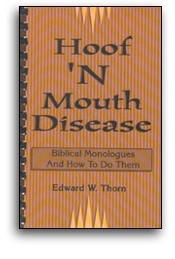
Hoof 'N Mouth Disease
Biblical Monologues and How to Do Them
Object:
THEME:
I regret the insensitive way I spent my life. I do wish for you to understand me, through my times and the culture that shaped me and my decisions.
SETTING FOR THE SERMON MONOLOGUE:
The sermon was used on the first Sunday after Epiphany. Epiphany is the season that recognizes the first revelation of Christ to the Gentiles (Magi). Whereas, in Advent we look forward to the coming of Christ, Epiphany is also the time that we contemplate His coming, and ask what our response to Him ought to be.
For this reason, I have chosen Herod as one who has had much time to look back and contemplate how he responded, and how that response might have been different.
ORAL STYLE SENTENCES THAT MAY NEED CLARIFICATION:
1. Page 89 (in book form): "The bowing, scraping, smiling, obsequious people ..." is rambling, yet gets across what otherwise might require several sentences to communicate. The following sentence on a "different point of view" is saying in shorthand that my (Herod's) perspective is that anyone who saw things differently was evil.
2. Page 92 (in book form): "Essential deaths." In oral style, and increasingly in written style, the essence is made clear and more dynamic without saying, "I, of course, thought these deaths were all essential." Similarly, "Loyal to Caesar" abbreviates the sentence of "I was loyal to Caesar."
3. Page 97 (in book form): "Regret, regret, regret," uses a kind of parallelism to escape the prodigious task of an extended elaboration on the psychological status of Herod's hell. In terms of Marshall McLuhan it is "cool." It says much while saying little.
* * *
It's hell --
hell, I say.
It's hell to know that I wasted my life.
I didn't think so at the time.
I thought I was something.
Others seemed to think I was something, too.
The bowing,
scraping,
smiling,
obsequious people
rarely gave a hint in my presence of anything but adoration and respect.
Out of my presence, I knew there was another element --
a different point of view --
evil ones, I thought.
Respect is something I coveted.
I was appointed by Caesar himself to overcome the Hasmoneans,
earlier called the Maccabees.
This group dominated the intertestamental period --
between the close of the Old Testament and the opening of the New Testament.
They led insurrections against the Greeks, and established
Israel's relative independence,
until Pompeii brought them under the Roman yoke in 63 B.C.
The Jews were, for the most part, an intolerant bunch.
Certainly, there were those who allied themselves with Rome,
but they were a scant minority, except for those who lived outside of Israel.
They considered the Gentiles (Roman soldiers) unclean.
They refused to accept Roman rule.
They began to overemphasize aspects of their religious ritual.
For example, Roman guards throughout the empire carried imperial standards.
These were poles that bore the Roman insignia at the top.
These standards would, at times, touch off riots among the pious Jews.
They took them to be a violation of the commandment to make no graven image.
They even forbade the use of coins that bore the emperor's portrait.
You Christians --
you have the same commandments --
Do you object to the coins and postage stamps in your pocket that
have an image of people your nation wishes to honor?
A side issue for me, from a first century perspective, is -- I do
wonder about your culture --
is the best you have to honor on postage stamps Marilyn Monroe and Elvis Presley?
Do you not have family portraits hanging on the wall of your home?
Do you understand the kind of narrow-mindedness I had to deal with?
Secondly, even if you do object to graven images,
is there not a place for tolerance of differences?
You should have seen the squabble that occurred when I allowed
Gentiles to erect statues of myself.
I guess I'm not a good Jew.
Perhaps if I had made more of an attempt to understand these stiff-necked people,
I would have modified my approach.
Maybe then I could have been more successful.
They certainly were an obstinate bunch,
but then I thought that as their appointed leader, they should just do as I said --
follow my authority without question.
We were not into this "democracy thing."
It became a power conflict.
I ruled by fear and cunning.
Of necessity, it was not important that these Jews love me --
only respect me.
The problem with that, I have discovered, in my eternal place of contemplation,
is whenever decisions are imposed --
when they are not owned by the people whom they affect,
the people will seek to undermine the authority of those who imposed these decrees.
You might not understand the fact that I tried --
I tried --
to win their loyalty,
while simultaneously trying to maintain my position with Rome
and the Gentile culture it represented --
not to mention my Gentile constituents.
I was not reared as a typical Jew --
and these Hebrew people never let me forget it.
I was an Idumean,
a descendant of Esau,
Jacob's, that is, Israel's, twin brother.
We were neighbors of the Judeans.
As a result of their conquest of our territory, we were forced to
become Jews --
outwardly.
In actuality, the sibling rivalry that commenced in the lifetime
of Jacob and Esau has never ceased.
Even in your day, there is strong conflict between their descendants.
As part of my attempt to be a good Roman, I created gymnasiums,
sponsored athletic events.
I underwrote the Olympic games in Greece and was named "Perpetual
President" of those Olympic games.
I believed this competition was good for the people,
but my fellow Jews got all hung up on the lack of clothing worn by the athletes.
I built a large theater and a hippodrome for chariot races in the city of Jerusalem,
and an amphitheater in the hills nearby.
This, too, they scorned.
I rebuilt the fallen walls of the city of Jerusalem.
And, I built the Temple in Jerusalem.
It was a temple that even the ancient Jewish historian, Josephus, described as
"magnificence never surpassed."
The cost was incalculable.
Did it win me love?
No!
Honor?
No!
Someplace along the way, I gave up trying to win their love,
but I did maintain, if not love --
if not respect --
then fear.
I maintained order.
In spite of all I did, history,
indeed, your biblical narrative,
has not treated me well.
The focus has often been on the assassinations I ordered --
all ordered to maintain the peace.
It is almost impossible for you to understand the chaos that
would have been prevalent in that part of the world had I not
been strong --
had I not been willing to make tough decisions.
Yes, I killed my brother-in-law.
I killed all the Hasmonean claimants to the throne.
Essential deaths.
Yes, I killed even my wife, Marianne, and her mother.
Of all my wives, she was my favorite,
but she too was a Hasmonean.
In time, I suspected her loyalty.
I also had reason to think she might have had an adulterous
relationship with my Uncle Joseph.
It seemed reasonable to execute him as well.
I was not one to let my emotions get in the way of my duty.
You've heard that Augustus Caesar is quoted as having said,
"I would sooner be Herod's pig, than his son."
That's easy for him to say, sitting in his ivory tower in Rome.
He sent me here to clean up this rebellious mess --
and clean it up I did,
regardless of my personal loyalties.
Two of my sons I killed because there was a rumor that they were plotting against me.
Maybe they did --
maybe they didn't,
but they were the sons of my beloved wife, Marianne, the Hasmonean princess.
As long as they were alive, the Hasmonean dream of a Jewish empire was still there.
I couldn't risk it.
You understand, I did this to keep the peace.
It was fitting that a few should die,
that the blood of many might not be spilt in the skirmishes and uprisings.
One other of my sons I killed shortly before my death --
though not Hasmonean, he seemed to be "ambitious."
Then of course, there were numerous minor would-be Messiahs that had to be,
shall we euphemistically say,
"neutralized."
At the time, this seemed to be the right thing to do.
Bloodthirsty --
no --
just looking after "number one" --
and, of course, loyal to Caesar --
yes, loyal to Caesar.
It was my job to maintain the peace.
In the last year of my life,
nearly as I can recollect,
three astrologers, Zoroastrian priests of Persia,
presented themselves to me.
Though they were men of high standing,
I might not have given them audience, were it not for the fact that they sought the King of the Israelites,
the recently born Messiah.
They came there to my palace because they assumed any new heir would be my offspring.
I inquired of the chief priests at the temple I built for the
Jews, where the Messiah was to be born.
Bethlehem, they said --
according to scriptures, Bethlehem.
I asked the Magi to return and bring me word when they found him.
I intended to kill the child.
But, they never returned.
I was alarmed.
Alarmed, yes.
You say,
but you were an old man.
Why be alarmed?
You had already ruled 36 years.
Why did you care?
Why did you want to kill him?
What possible threat was he?
Were you protecting your sons?
No way!
I was doing my duty, as I saw it.
He was but one more potential rabble-rouser in a long line of them.
I was, after all, the Palestinian arm of Caesar.
In retrospect, how limited my perspective was!
Since I could not find out who he was,
I ordered all male babes, under two years of age, in the
Bethlehem area, executed.
How was I to know?
Bethlehem is a small area, I reasoned.
Only a handful would die.
It is fitting that a few should die to prevent the death of the many.
Many of these babes were born to the poor --
to families that already had too many mouths to feed.
I thought of myself as doing a righteous thing.
It was merely a method of population control.
I, who killed my own sons, certainly was not hesitant to slay the sons of another.
I didn't even shed a tear.
How could I know?
I was sheltered from all that.
I was reared to think in terms of power --
not to think in terms of others.
I had no ability to comprehend.
I never heard the screams of these mothers.
Had I heard them,
I'm still not sure I would have understood.
They were rabble --
not quite human.
I had no more concern than you might have if you trapped a rat.
Vermin!
That's what they were to me.
I had heard an old wives' tale that when one dies, his life
flashes before his eyes.
That cut no ice with me.
I had no reason to think I was less than perfect.
You imagine that we tyrants are some sort of evil plotters.
Not really.
Not as I know myself, or others like me.
I would imagine that the Pharaohs,
the Hitlers, etc.,
were just like me.
We thought we were doing good!
A narcissist like me can't comprehend any morality that is concerned with the common good,
unless it is also good for the ruling class.
What was good for Herod the Great was good for all my adherents.
As I lay dying, however, my life did pass before me --
like a judgment of God --
gentle, but oh so firm and certain.
For the first time, I "heard" the screams of the bereaved.
I felt the sorrow of those I had hurt.
I felt the sadness of the poor, who bore the brunt of the taxation that built the monuments to myself throughout Palestine.
Their offspring --
even one single child --
meant more to them than all theaters,
amphitheaters,
hippodromes,
athletic contests,
and royal palaces in the whole of
the Roman empire.
Those taxes I took could have fed,
clothed,
and nurtured their young ones.
I have a different perspective now --
but it's too late.
Too late, it is, to pass on to my sons and their sons' sons
the knowledge of what really matters.
My tiny empire was split up among three of my sons --
One of them,
my son Herod Antipas,
was responsible for the death of John the Baptist.
Jesus Himself appeared before him on the eve of His death.
It was he --
my son and his men --
that mocked Him,
put on Him a royal robe,
and sent Him back to Pilate for judgment.
On it goes.
It's the system.
Perhaps I could have made a difference.
Maybe not a big one,
but one in my small area of the world --
and a difference in my family.
It's hell.
Regret,
regret,
regret.
That's hell.
I see it now, but I can't repair the past.
The future can be different --
not because of me,
but because of you --
the spiritual descendants of the One whose life I almost snuffed out.
the One my heir might have saved.
This Child's kingdom was not one of force,
deceit,
and power.
In my own time,
I scorned any other kind.
This Child's kingdom was not a threat.
I know that now.
I know --
know and regret --
To you, however,
the Savior has been revealed --
Learn of him!
Make him your Lord.
I regret the insensitive way I spent my life. I do wish for you to understand me, through my times and the culture that shaped me and my decisions.
SETTING FOR THE SERMON MONOLOGUE:
The sermon was used on the first Sunday after Epiphany. Epiphany is the season that recognizes the first revelation of Christ to the Gentiles (Magi). Whereas, in Advent we look forward to the coming of Christ, Epiphany is also the time that we contemplate His coming, and ask what our response to Him ought to be.
For this reason, I have chosen Herod as one who has had much time to look back and contemplate how he responded, and how that response might have been different.
ORAL STYLE SENTENCES THAT MAY NEED CLARIFICATION:
1. Page 89 (in book form): "The bowing, scraping, smiling, obsequious people ..." is rambling, yet gets across what otherwise might require several sentences to communicate. The following sentence on a "different point of view" is saying in shorthand that my (Herod's) perspective is that anyone who saw things differently was evil.
2. Page 92 (in book form): "Essential deaths." In oral style, and increasingly in written style, the essence is made clear and more dynamic without saying, "I, of course, thought these deaths were all essential." Similarly, "Loyal to Caesar" abbreviates the sentence of "I was loyal to Caesar."
3. Page 97 (in book form): "Regret, regret, regret," uses a kind of parallelism to escape the prodigious task of an extended elaboration on the psychological status of Herod's hell. In terms of Marshall McLuhan it is "cool." It says much while saying little.
* * *
It's hell --
hell, I say.
It's hell to know that I wasted my life.
I didn't think so at the time.
I thought I was something.
Others seemed to think I was something, too.
The bowing,
scraping,
smiling,
obsequious people
rarely gave a hint in my presence of anything but adoration and respect.
Out of my presence, I knew there was another element --
a different point of view --
evil ones, I thought.
Respect is something I coveted.
I was appointed by Caesar himself to overcome the Hasmoneans,
earlier called the Maccabees.
This group dominated the intertestamental period --
between the close of the Old Testament and the opening of the New Testament.
They led insurrections against the Greeks, and established
Israel's relative independence,
until Pompeii brought them under the Roman yoke in 63 B.C.
The Jews were, for the most part, an intolerant bunch.
Certainly, there were those who allied themselves with Rome,
but they were a scant minority, except for those who lived outside of Israel.
They considered the Gentiles (Roman soldiers) unclean.
They refused to accept Roman rule.
They began to overemphasize aspects of their religious ritual.
For example, Roman guards throughout the empire carried imperial standards.
These were poles that bore the Roman insignia at the top.
These standards would, at times, touch off riots among the pious Jews.
They took them to be a violation of the commandment to make no graven image.
They even forbade the use of coins that bore the emperor's portrait.
You Christians --
you have the same commandments --
Do you object to the coins and postage stamps in your pocket that
have an image of people your nation wishes to honor?
A side issue for me, from a first century perspective, is -- I do
wonder about your culture --
is the best you have to honor on postage stamps Marilyn Monroe and Elvis Presley?
Do you not have family portraits hanging on the wall of your home?
Do you understand the kind of narrow-mindedness I had to deal with?
Secondly, even if you do object to graven images,
is there not a place for tolerance of differences?
You should have seen the squabble that occurred when I allowed
Gentiles to erect statues of myself.
I guess I'm not a good Jew.
Perhaps if I had made more of an attempt to understand these stiff-necked people,
I would have modified my approach.
Maybe then I could have been more successful.
They certainly were an obstinate bunch,
but then I thought that as their appointed leader, they should just do as I said --
follow my authority without question.
We were not into this "democracy thing."
It became a power conflict.
I ruled by fear and cunning.
Of necessity, it was not important that these Jews love me --
only respect me.
The problem with that, I have discovered, in my eternal place of contemplation,
is whenever decisions are imposed --
when they are not owned by the people whom they affect,
the people will seek to undermine the authority of those who imposed these decrees.
You might not understand the fact that I tried --
I tried --
to win their loyalty,
while simultaneously trying to maintain my position with Rome
and the Gentile culture it represented --
not to mention my Gentile constituents.
I was not reared as a typical Jew --
and these Hebrew people never let me forget it.
I was an Idumean,
a descendant of Esau,
Jacob's, that is, Israel's, twin brother.
We were neighbors of the Judeans.
As a result of their conquest of our territory, we were forced to
become Jews --
outwardly.
In actuality, the sibling rivalry that commenced in the lifetime
of Jacob and Esau has never ceased.
Even in your day, there is strong conflict between their descendants.
As part of my attempt to be a good Roman, I created gymnasiums,
sponsored athletic events.
I underwrote the Olympic games in Greece and was named "Perpetual
President" of those Olympic games.
I believed this competition was good for the people,
but my fellow Jews got all hung up on the lack of clothing worn by the athletes.
I built a large theater and a hippodrome for chariot races in the city of Jerusalem,
and an amphitheater in the hills nearby.
This, too, they scorned.
I rebuilt the fallen walls of the city of Jerusalem.
And, I built the Temple in Jerusalem.
It was a temple that even the ancient Jewish historian, Josephus, described as
"magnificence never surpassed."
The cost was incalculable.
Did it win me love?
No!
Honor?
No!
Someplace along the way, I gave up trying to win their love,
but I did maintain, if not love --
if not respect --
then fear.
I maintained order.
In spite of all I did, history,
indeed, your biblical narrative,
has not treated me well.
The focus has often been on the assassinations I ordered --
all ordered to maintain the peace.
It is almost impossible for you to understand the chaos that
would have been prevalent in that part of the world had I not
been strong --
had I not been willing to make tough decisions.
Yes, I killed my brother-in-law.
I killed all the Hasmonean claimants to the throne.
Essential deaths.
Yes, I killed even my wife, Marianne, and her mother.
Of all my wives, she was my favorite,
but she too was a Hasmonean.
In time, I suspected her loyalty.
I also had reason to think she might have had an adulterous
relationship with my Uncle Joseph.
It seemed reasonable to execute him as well.
I was not one to let my emotions get in the way of my duty.
You've heard that Augustus Caesar is quoted as having said,
"I would sooner be Herod's pig, than his son."
That's easy for him to say, sitting in his ivory tower in Rome.
He sent me here to clean up this rebellious mess --
and clean it up I did,
regardless of my personal loyalties.
Two of my sons I killed because there was a rumor that they were plotting against me.
Maybe they did --
maybe they didn't,
but they were the sons of my beloved wife, Marianne, the Hasmonean princess.
As long as they were alive, the Hasmonean dream of a Jewish empire was still there.
I couldn't risk it.
You understand, I did this to keep the peace.
It was fitting that a few should die,
that the blood of many might not be spilt in the skirmishes and uprisings.
One other of my sons I killed shortly before my death --
though not Hasmonean, he seemed to be "ambitious."
Then of course, there were numerous minor would-be Messiahs that had to be,
shall we euphemistically say,
"neutralized."
At the time, this seemed to be the right thing to do.
Bloodthirsty --
no --
just looking after "number one" --
and, of course, loyal to Caesar --
yes, loyal to Caesar.
It was my job to maintain the peace.
In the last year of my life,
nearly as I can recollect,
three astrologers, Zoroastrian priests of Persia,
presented themselves to me.
Though they were men of high standing,
I might not have given them audience, were it not for the fact that they sought the King of the Israelites,
the recently born Messiah.
They came there to my palace because they assumed any new heir would be my offspring.
I inquired of the chief priests at the temple I built for the
Jews, where the Messiah was to be born.
Bethlehem, they said --
according to scriptures, Bethlehem.
I asked the Magi to return and bring me word when they found him.
I intended to kill the child.
But, they never returned.
I was alarmed.
Alarmed, yes.
You say,
but you were an old man.
Why be alarmed?
You had already ruled 36 years.
Why did you care?
Why did you want to kill him?
What possible threat was he?
Were you protecting your sons?
No way!
I was doing my duty, as I saw it.
He was but one more potential rabble-rouser in a long line of them.
I was, after all, the Palestinian arm of Caesar.
In retrospect, how limited my perspective was!
Since I could not find out who he was,
I ordered all male babes, under two years of age, in the
Bethlehem area, executed.
How was I to know?
Bethlehem is a small area, I reasoned.
Only a handful would die.
It is fitting that a few should die to prevent the death of the many.
Many of these babes were born to the poor --
to families that already had too many mouths to feed.
I thought of myself as doing a righteous thing.
It was merely a method of population control.
I, who killed my own sons, certainly was not hesitant to slay the sons of another.
I didn't even shed a tear.
How could I know?
I was sheltered from all that.
I was reared to think in terms of power --
not to think in terms of others.
I had no ability to comprehend.
I never heard the screams of these mothers.
Had I heard them,
I'm still not sure I would have understood.
They were rabble --
not quite human.
I had no more concern than you might have if you trapped a rat.
Vermin!
That's what they were to me.
I had heard an old wives' tale that when one dies, his life
flashes before his eyes.
That cut no ice with me.
I had no reason to think I was less than perfect.
You imagine that we tyrants are some sort of evil plotters.
Not really.
Not as I know myself, or others like me.
I would imagine that the Pharaohs,
the Hitlers, etc.,
were just like me.
We thought we were doing good!
A narcissist like me can't comprehend any morality that is concerned with the common good,
unless it is also good for the ruling class.
What was good for Herod the Great was good for all my adherents.
As I lay dying, however, my life did pass before me --
like a judgment of God --
gentle, but oh so firm and certain.
For the first time, I "heard" the screams of the bereaved.
I felt the sorrow of those I had hurt.
I felt the sadness of the poor, who bore the brunt of the taxation that built the monuments to myself throughout Palestine.
Their offspring --
even one single child --
meant more to them than all theaters,
amphitheaters,
hippodromes,
athletic contests,
and royal palaces in the whole of
the Roman empire.
Those taxes I took could have fed,
clothed,
and nurtured their young ones.
I have a different perspective now --
but it's too late.
Too late, it is, to pass on to my sons and their sons' sons
the knowledge of what really matters.
My tiny empire was split up among three of my sons --
One of them,
my son Herod Antipas,
was responsible for the death of John the Baptist.
Jesus Himself appeared before him on the eve of His death.
It was he --
my son and his men --
that mocked Him,
put on Him a royal robe,
and sent Him back to Pilate for judgment.
On it goes.
It's the system.
Perhaps I could have made a difference.
Maybe not a big one,
but one in my small area of the world --
and a difference in my family.
It's hell.
Regret,
regret,
regret.
That's hell.
I see it now, but I can't repair the past.
The future can be different --
not because of me,
but because of you --
the spiritual descendants of the One whose life I almost snuffed out.
the One my heir might have saved.
This Child's kingdom was not one of force,
deceit,
and power.
In my own time,
I scorned any other kind.
This Child's kingdom was not a threat.
I know that now.
I know --
know and regret --
To you, however,
the Savior has been revealed --
Learn of him!
Make him your Lord.
