
Jesus, The Servant
Worship
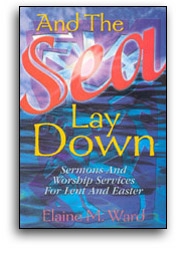
And The Sea Lay Down
Sermons And Worship Services For Lent And Easter
Call to Worship
"Jesus, the Master, rose from the table, took off his robe and washed his disciples' feet." Come, let us worship the Servant of God.
Processional Hymn
"For The Beauty Of The Earth" (words: Folliot S. Pierpoint, 1864; music: Conrad Kocher, 1838; arr. by W. H. Monk, 1861).
Children's Time
In our sacred story for today we read how Jesus was the Servant of God. He washed the feet of his disciples. A small girl, her arms full of books, walked through the park, thinking, as she looked at an old man, "It must be strange to be old and sit in the cold on a small park bench in a great coat." Just then the old man lifted his head and saw the girl watching him and he asked, "Yes?" "I just thought," the girl stammered. "I wondered ... do you need ... you look ... might I ... can I help you?" The old man smiled as he said, "You already have."
Talk About
How did the girl help the old man? What are some of the ways we can show love and be a "servant" for God?
Prayer of Confession
Dear Lord, forgive all of the times we have neglected the stranger or even those in our homes. Fill our hearts and minds with compassion, care for others and for creation. Forgive our selfishness in thinking of and caring only for ourselves. In the name of Christ, Servant of God. Amen.
Words of Assurance
God said, "I have loved you with an everlasting love" (Jeremiah 31:3).
Psalter Reading
Psalm 116:1-4, 12-19
Old Testament
Exodus 12:1-4 (5-10) 11-14
Epistle Lesson
1 Corinthians 11:23-26
New Testament
John 13:1-17, 31b-35
Sermon
When a brother visited the hermits in the desert and saw them working, he asked, "Why do you work for the bread that perishes? Mary has chosen the best part, to sit at the feet of the Lord without working." The Abbot told his disciple to give the brother a book and a cell and there he left him all day to read. At the ninth hour he looked out to see if the Abbot was going to call him to dinner and at last set out to find him. "Did the brethren not eat today, Father?" "Oh, yes, we have just eaten," the Abbot replied. "Why did you not call me?" he asked. "You are a spiritual man and do not need this food that perishes," the Abbot said. "Forgive me, Father," said the brother. The Abbot replied, "It was because Martha worked that Mary was able to learn."1
Jesus and his friends were eating together. Before we eat we wash our hands. In Jesus' time it was the feet. Feet that had walked in sandals through the garbage and debris of market street filled with smelly fish heads and bones, rotten, putrid fruit, and donkey droppings were stretched out across the floor, as the disciples reclined before the low table, eating together. Jesus, the honored one, the Master, arose from the table, took off his robe, and washed his disciples' feet.
Jesus knew that the meaning of life was the good news of God's love and our response of love and service. He taught "Love one another as I have loved you," and showed us how.
We long for such love. In Tennessee Williams' play, A Streetcar Named Desire, Blanche longed desperately to be loved. She was not easy to love, however, because she talked too much and the way she talked repelled those from whom she wished love. When Blanche met Mitch, overweight, lonely, and in need of love, as well, she shared with him one of the tragic moments in her life and Mitch took her in his arms. "You need somebody. I need somebody. Could it be you and me, Blanche?" Blanche stared at Mitch, her eyes filled with tears, as she reached out for him, saying, "Sometimes there's God, so quickly," and the scene closed.
To say to anyone, "I love you," is tantamount to saying, "You shall live forever." Only authentic love is expansive, humble, and generous, for in the presence of love there are miracles. Happiness depends on love. But to become love in human form, to become servant, is a reversal of our culture's values. Love is different from what our culture teaches. It is to value others as they are, rather than what we want them to be, and to desire the others' needs be met in order for them to live abundantly.
Jesus said for us to love our neighbor as ourself, therefore, love yourself, and we love because God loves us. One of the things I love and enjoy is reading essays, "talking with" the writer (dead or alive). As I sat with Loren Eisely in the dark, he told me about his insomnia, and my hankering for friendship was satisfied. His conversation was eloquent. I can hear him now, polishing every phrase until it shone, and I wondered how often we take advantage of diving beneath the surface of polite talk: "How are you? How are the children? What do you think about the election? Do you think it will snow?"
Here I was sitting with a great anthropologist while he told me the secrets of his night. Nor did I have to be rude and ask him to stop while I gathered together my own thoughts and feelings on the matter. Closing the book, it was my turn to speak, and imagine, a marvelously imaginative, brillant writer fell silent, listening!
Of course we can so engage all print, but essays, because they are short, honest, and relevant, are honed to a fine edge. They are the refined jewels of reflection, and we share that beauty with others.
To enter Eiseley's bedroom and endure his sleepless night is to sit beside his bed in his lonely room, as he tosses in his dreams, knitting the universe together with his dark thoughts. Then, hearing the earth shake from the drum roll of the surf, he rises to dress and saunter forth, summoning from the white spray the features and faces of the dead he knows. This sufferer of insomnia, this talker who cannot sleep, has shattered mine. I rise to leave but he stops me with his musing.
"Beareth all things, believeth all things, hopeth all things, endureth all things." Paul's words on the lips of the insomniac soothed my spirit. I feel in safe territory and sit again to listen to his final soliloquy: Stranded in an empty airport in the middle of the night in a strange city in a foreign country, dead tired, having missed his plane for which he must now wait until morning, longing to be home, he saw approach him an amazing conglomeration of sticks and broken, misshapen pulleys which made up the body of a man. His mind rang out with despair, as he thought Paul's words: "Wretched man that I am, who will save me?" And then his own: How could we for a single moment imagine that thought or wonder or wisdom would save us? His words mesmerized me as that figure entered Eiseley, contorting his shape, transforming his doubt into hope, again with Paul's words: "Beareth all things, believeth...." Believe, believe. This is the thread that weaves the night's dying into tomorrow's birth. "I, who do not sleep, can tell you this," he whispered. And then the immortal words: "And now faith, hope, and love abide, these three; and the greatest of these is love."
Failure to love is to live a lie, to be out of harmony with our true self, pursuing the wrong goals for the wrong reasons and caring more about other people's opinions than serving God. Jesus washed the feet of his disciples out of the harmony of his true self.
Out of that harmony we serve: raising and teaching children, cooking meals, tending flower or vegetable gardens, recycling cans and paper, saving water and energy, being there for the other, participating in rituals of worship and celebration, taking care of our mother earth, and gathering the offerings of the community in time, money, talent.
Jesus as God's servant knew the meaning of love and said, "Come unto me, all you who labor, and I will give you rest." A well-known sculptor had a burning ambition to create the greatest statue of Jesus Christ ever made. He began in his oceanside studio by shaping a clay model of a triumphant, regal figure. The head was thrown back and the arms were upraised in a gesture of great majesty. It was his conception of how Christ would look: strong and victorious. "This will be my masterpiece," he said, on the day the clay model was completed. During the night, however, a heavy fog rolled into the area and sea spray seeped through a partially opened window. The moisture affected the shape of the clay so that when the artist returned to the studio in the morning, he was shocked at what he found. Drops of moisture had formed on the model an illusion of bleeding or weeping. The head had drooped. The facial expression had been transformed into one of compassion. And the arms had dropped into a posture of welcome. It had become a wounded Christ-figure. The artist stared at the figure, agonizing over the time wasted and the need to begin all over again. Then, meaning came to him. He began to see that this image of Christ was, by far, the truer one. So he carved these words in the base of the newly shaped figure: "Come Unto Me."
Whether we sit at Jesus' feet to learn as Mary did or serve at Jesus' feet as Martha did, may we follow in the footsteps of our Lord, the Servant of God, in the name of the Parent, the Son, and the Holy Spirit. Amen.
Eucharist Hymn
"Bread Of The World" (words: Reginald Heber, 1827; John S. B. Hodges, 1868).
The Celebration of the Eucharist
Prayers of the People, the Pastor, and The Lord's Prayer
Pastoral Prayer
(A Psalm of Creation)
Let the lambs bleat,
the goats leap,
the mountains clap their hands for joy.
The earth is the Lord's and everything in it.
When the morning stars sing together,
let the cattle moo,
the doves coo,
the waters pour forth their praise.
The earth is the Lord's and everything in it.
You fill the hills with flocks and flowers,
the valleys with fields of grain
the deer drink from your pools of pleasure,
the dolphins dance in your deep,
the falcon flies,
the earth lies full with your abundance.
The earth is the Lord's and everything in it.
You are my sun by day
my moon by night,
as welcome as rain in a dry and thirsty desert.
In you I trust,
the earth is yours,
blessed be God, our Creator.
Offering
Doxology
Hymn of Dismissal
"Lord, Dismiss Us With Thy Blessing" (words: attr. to John Fawcett, 1773; music: The European Magazine and Review, 1792).
Benediction
Go now into the world in the name of God, who creates and serves out of love, and Jesus Christ, the Servant of God, and the Holy Spirit, who inspires and enables us to love. In Christ's name. Amen.
____________
1. Thomas Merton, The Wisdom of the Desert (New York: New Directions, 1960).
"Jesus, the Master, rose from the table, took off his robe and washed his disciples' feet." Come, let us worship the Servant of God.
Processional Hymn
"For The Beauty Of The Earth" (words: Folliot S. Pierpoint, 1864; music: Conrad Kocher, 1838; arr. by W. H. Monk, 1861).
Children's Time
In our sacred story for today we read how Jesus was the Servant of God. He washed the feet of his disciples. A small girl, her arms full of books, walked through the park, thinking, as she looked at an old man, "It must be strange to be old and sit in the cold on a small park bench in a great coat." Just then the old man lifted his head and saw the girl watching him and he asked, "Yes?" "I just thought," the girl stammered. "I wondered ... do you need ... you look ... might I ... can I help you?" The old man smiled as he said, "You already have."
Talk About
How did the girl help the old man? What are some of the ways we can show love and be a "servant" for God?
Prayer of Confession
Dear Lord, forgive all of the times we have neglected the stranger or even those in our homes. Fill our hearts and minds with compassion, care for others and for creation. Forgive our selfishness in thinking of and caring only for ourselves. In the name of Christ, Servant of God. Amen.
Words of Assurance
God said, "I have loved you with an everlasting love" (Jeremiah 31:3).
Psalter Reading
Psalm 116:1-4, 12-19
Old Testament
Exodus 12:1-4 (5-10) 11-14
Epistle Lesson
1 Corinthians 11:23-26
New Testament
John 13:1-17, 31b-35
Sermon
When a brother visited the hermits in the desert and saw them working, he asked, "Why do you work for the bread that perishes? Mary has chosen the best part, to sit at the feet of the Lord without working." The Abbot told his disciple to give the brother a book and a cell and there he left him all day to read. At the ninth hour he looked out to see if the Abbot was going to call him to dinner and at last set out to find him. "Did the brethren not eat today, Father?" "Oh, yes, we have just eaten," the Abbot replied. "Why did you not call me?" he asked. "You are a spiritual man and do not need this food that perishes," the Abbot said. "Forgive me, Father," said the brother. The Abbot replied, "It was because Martha worked that Mary was able to learn."1
Jesus and his friends were eating together. Before we eat we wash our hands. In Jesus' time it was the feet. Feet that had walked in sandals through the garbage and debris of market street filled with smelly fish heads and bones, rotten, putrid fruit, and donkey droppings were stretched out across the floor, as the disciples reclined before the low table, eating together. Jesus, the honored one, the Master, arose from the table, took off his robe, and washed his disciples' feet.
Jesus knew that the meaning of life was the good news of God's love and our response of love and service. He taught "Love one another as I have loved you," and showed us how.
We long for such love. In Tennessee Williams' play, A Streetcar Named Desire, Blanche longed desperately to be loved. She was not easy to love, however, because she talked too much and the way she talked repelled those from whom she wished love. When Blanche met Mitch, overweight, lonely, and in need of love, as well, she shared with him one of the tragic moments in her life and Mitch took her in his arms. "You need somebody. I need somebody. Could it be you and me, Blanche?" Blanche stared at Mitch, her eyes filled with tears, as she reached out for him, saying, "Sometimes there's God, so quickly," and the scene closed.
To say to anyone, "I love you," is tantamount to saying, "You shall live forever." Only authentic love is expansive, humble, and generous, for in the presence of love there are miracles. Happiness depends on love. But to become love in human form, to become servant, is a reversal of our culture's values. Love is different from what our culture teaches. It is to value others as they are, rather than what we want them to be, and to desire the others' needs be met in order for them to live abundantly.
Jesus said for us to love our neighbor as ourself, therefore, love yourself, and we love because God loves us. One of the things I love and enjoy is reading essays, "talking with" the writer (dead or alive). As I sat with Loren Eisely in the dark, he told me about his insomnia, and my hankering for friendship was satisfied. His conversation was eloquent. I can hear him now, polishing every phrase until it shone, and I wondered how often we take advantage of diving beneath the surface of polite talk: "How are you? How are the children? What do you think about the election? Do you think it will snow?"
Here I was sitting with a great anthropologist while he told me the secrets of his night. Nor did I have to be rude and ask him to stop while I gathered together my own thoughts and feelings on the matter. Closing the book, it was my turn to speak, and imagine, a marvelously imaginative, brillant writer fell silent, listening!
Of course we can so engage all print, but essays, because they are short, honest, and relevant, are honed to a fine edge. They are the refined jewels of reflection, and we share that beauty with others.
To enter Eiseley's bedroom and endure his sleepless night is to sit beside his bed in his lonely room, as he tosses in his dreams, knitting the universe together with his dark thoughts. Then, hearing the earth shake from the drum roll of the surf, he rises to dress and saunter forth, summoning from the white spray the features and faces of the dead he knows. This sufferer of insomnia, this talker who cannot sleep, has shattered mine. I rise to leave but he stops me with his musing.
"Beareth all things, believeth all things, hopeth all things, endureth all things." Paul's words on the lips of the insomniac soothed my spirit. I feel in safe territory and sit again to listen to his final soliloquy: Stranded in an empty airport in the middle of the night in a strange city in a foreign country, dead tired, having missed his plane for which he must now wait until morning, longing to be home, he saw approach him an amazing conglomeration of sticks and broken, misshapen pulleys which made up the body of a man. His mind rang out with despair, as he thought Paul's words: "Wretched man that I am, who will save me?" And then his own: How could we for a single moment imagine that thought or wonder or wisdom would save us? His words mesmerized me as that figure entered Eiseley, contorting his shape, transforming his doubt into hope, again with Paul's words: "Beareth all things, believeth...." Believe, believe. This is the thread that weaves the night's dying into tomorrow's birth. "I, who do not sleep, can tell you this," he whispered. And then the immortal words: "And now faith, hope, and love abide, these three; and the greatest of these is love."
Failure to love is to live a lie, to be out of harmony with our true self, pursuing the wrong goals for the wrong reasons and caring more about other people's opinions than serving God. Jesus washed the feet of his disciples out of the harmony of his true self.
Out of that harmony we serve: raising and teaching children, cooking meals, tending flower or vegetable gardens, recycling cans and paper, saving water and energy, being there for the other, participating in rituals of worship and celebration, taking care of our mother earth, and gathering the offerings of the community in time, money, talent.
Jesus as God's servant knew the meaning of love and said, "Come unto me, all you who labor, and I will give you rest." A well-known sculptor had a burning ambition to create the greatest statue of Jesus Christ ever made. He began in his oceanside studio by shaping a clay model of a triumphant, regal figure. The head was thrown back and the arms were upraised in a gesture of great majesty. It was his conception of how Christ would look: strong and victorious. "This will be my masterpiece," he said, on the day the clay model was completed. During the night, however, a heavy fog rolled into the area and sea spray seeped through a partially opened window. The moisture affected the shape of the clay so that when the artist returned to the studio in the morning, he was shocked at what he found. Drops of moisture had formed on the model an illusion of bleeding or weeping. The head had drooped. The facial expression had been transformed into one of compassion. And the arms had dropped into a posture of welcome. It had become a wounded Christ-figure. The artist stared at the figure, agonizing over the time wasted and the need to begin all over again. Then, meaning came to him. He began to see that this image of Christ was, by far, the truer one. So he carved these words in the base of the newly shaped figure: "Come Unto Me."
Whether we sit at Jesus' feet to learn as Mary did or serve at Jesus' feet as Martha did, may we follow in the footsteps of our Lord, the Servant of God, in the name of the Parent, the Son, and the Holy Spirit. Amen.
Eucharist Hymn
"Bread Of The World" (words: Reginald Heber, 1827; John S. B. Hodges, 1868).
The Celebration of the Eucharist
Prayers of the People, the Pastor, and The Lord's Prayer
Pastoral Prayer
(A Psalm of Creation)
Let the lambs bleat,
the goats leap,
the mountains clap their hands for joy.
The earth is the Lord's and everything in it.
When the morning stars sing together,
let the cattle moo,
the doves coo,
the waters pour forth their praise.
The earth is the Lord's and everything in it.
You fill the hills with flocks and flowers,
the valleys with fields of grain
the deer drink from your pools of pleasure,
the dolphins dance in your deep,
the falcon flies,
the earth lies full with your abundance.
The earth is the Lord's and everything in it.
You are my sun by day
my moon by night,
as welcome as rain in a dry and thirsty desert.
In you I trust,
the earth is yours,
blessed be God, our Creator.
Offering
Doxology
Hymn of Dismissal
"Lord, Dismiss Us With Thy Blessing" (words: attr. to John Fawcett, 1773; music: The European Magazine and Review, 1792).
Benediction
Go now into the world in the name of God, who creates and serves out of love, and Jesus Christ, the Servant of God, and the Holy Spirit, who inspires and enables us to love. In Christ's name. Amen.
____________
1. Thomas Merton, The Wisdom of the Desert (New York: New Directions, 1960).
