
A Just-In-Case Arrangement With God
Preaching
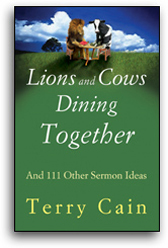
Lions And Cows Dining Together
And 111 Other Sermon Ideas
Object:
Purpose Statement: It may not be possible to have a playing-it-safe kind of approach to religion.
Judges 6 tells the story of Gideon testing God (or an angel of God) just to be sure he was talking to the right person. Gideon devises two schemes involving a burnt offering (vv. 17-22) and some wet wool (vv. 36-40). The wet wool experiment had to be run twice, if you remember, in order for Judge Gideon to be sure. There is nothing wrong with erring on the safe side, but when you are dealing with God there is supposed to be some trust involved. A distant, but somewhat related incident happened in Athens where Paul found a monument or altar labeled "to an unknown god" (Acts 17:22-24). It seems the Athenians had altars to various gods and to be on the safe side, and so as not to leave any god out, they erected an altar to any god they might have missed.
a. Covering the bases. Where did the phrase, "covering all the bases," originate? Did it mean in baseball having an infielder near each base in case it became the focal point of some action? Did it mean covering all the bases with a tarp when it rains? Did it mean having a runner on each base? Yet, we probably know very well what it means as a cliché: Cover all the possibilities to play it safe, or when in doubt, do the safe thing. There are other ways of wording this sage advice: Plug all the holes, leave no stone unturned, or throw spilled salt over the shoulder just in case there is something to the superstition. It is a good idea to have a "Get out of jail free" card (as in the game Monopoly for those not in the know) in case an occasion for its need should arise. It all sounds like good sound advice. After all, isn't that the principle behind insurance? But what does it look like when applied to religion?
b. Buying religious insurance. Gideon may have gone overboard testing God. And the Athenians ploy, while cautious, seems a shallow and hollow tribute destined to insult the unknown god. Do some Christians believe in God just in case there is one, but are not sure? In the first church I served, one of our members, who claimed to be an atheist, insisted that his whole family -- wife, daughters, and sons -- go to church because it would do them good even if there wasn't any God. He was a "good church worker" and a strong church supporter, but he hadn't found God. Some people go to church just to be safe. Some try to do the right thing morally to reserve a seat on the trip to heaven, just in case there is a heaven. It even gets more complicated. We may be careful not to wish any bad to another person, even if we don't like that person, because it may come back on us in some way. A little superstition sends us looking for religious insurance.
c. What's our motive? Should we be on our best behavior because "Candid Camera" or God may be watching, or because we are a person of integrity? Do we act so as not to get caught or punished, or because we are a very moral person? Do we love God and other people and give them our respect just to be safe and because it is the smart thing to do? Is our conduct expedient or compassionate? God is listening, so be careful how you answer that!
Judges 6 tells the story of Gideon testing God (or an angel of God) just to be sure he was talking to the right person. Gideon devises two schemes involving a burnt offering (vv. 17-22) and some wet wool (vv. 36-40). The wet wool experiment had to be run twice, if you remember, in order for Judge Gideon to be sure. There is nothing wrong with erring on the safe side, but when you are dealing with God there is supposed to be some trust involved. A distant, but somewhat related incident happened in Athens where Paul found a monument or altar labeled "to an unknown god" (Acts 17:22-24). It seems the Athenians had altars to various gods and to be on the safe side, and so as not to leave any god out, they erected an altar to any god they might have missed.
a. Covering the bases. Where did the phrase, "covering all the bases," originate? Did it mean in baseball having an infielder near each base in case it became the focal point of some action? Did it mean covering all the bases with a tarp when it rains? Did it mean having a runner on each base? Yet, we probably know very well what it means as a cliché: Cover all the possibilities to play it safe, or when in doubt, do the safe thing. There are other ways of wording this sage advice: Plug all the holes, leave no stone unturned, or throw spilled salt over the shoulder just in case there is something to the superstition. It is a good idea to have a "Get out of jail free" card (as in the game Monopoly for those not in the know) in case an occasion for its need should arise. It all sounds like good sound advice. After all, isn't that the principle behind insurance? But what does it look like when applied to religion?
b. Buying religious insurance. Gideon may have gone overboard testing God. And the Athenians ploy, while cautious, seems a shallow and hollow tribute destined to insult the unknown god. Do some Christians believe in God just in case there is one, but are not sure? In the first church I served, one of our members, who claimed to be an atheist, insisted that his whole family -- wife, daughters, and sons -- go to church because it would do them good even if there wasn't any God. He was a "good church worker" and a strong church supporter, but he hadn't found God. Some people go to church just to be safe. Some try to do the right thing morally to reserve a seat on the trip to heaven, just in case there is a heaven. It even gets more complicated. We may be careful not to wish any bad to another person, even if we don't like that person, because it may come back on us in some way. A little superstition sends us looking for religious insurance.
c. What's our motive? Should we be on our best behavior because "Candid Camera" or God may be watching, or because we are a person of integrity? Do we act so as not to get caught or punished, or because we are a very moral person? Do we love God and other people and give them our respect just to be safe and because it is the smart thing to do? Is our conduct expedient or compassionate? God is listening, so be careful how you answer that!
