
Kingdom Without End
Sermon
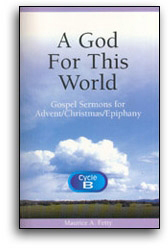
A God For This World
Gospel Sermons For Advent/Christmas/Epiphany
"I'm the luckiest son-of-gun that ever was born," said the late Senator Barry Goldwater of Arizona, who served five terms in the Senate before retiring in 1986. Goldwater, grandson of a Jewish immigrant peddler, successful businessman, and one-time Republican presidential candidate, thought our country is in trouble.
It is in trouble, he once said in an interview, because of the sad state of the Senate and Congress. Goldwater lamented the passing of giants in the Senate like Walter George, Richard Russell, Bob Taft, and Loehman of New York. Never one to mince words, he added, "Today we have a bunch of bums running for office. We have a Congress that should not be allowed any place."
More than that, when he was a boy, "A man's word was all you needed," said Goldwater. Our forefathers were immigrants who were honest and wanted to work, he said. Even today we have young people coming out west who are much like the immigrants. Then again, with his usual opinionated candor, Goldwater said, "We don't have a lot of bums and crooks and typical Easterners moving out here. To me, the difference about those days was decency and honesty."
But Goldwater doesn't lay all this country's problems on the shoulders of "bums from the East." He said, "Every country that has failed in the history of the world has failed because of the same things we are doing in America today." He added that if we don't make a decided change in the deficit, the country will be bankrupt in ten years.
He admitted it was a terrible thing to say about a country which has enjoyed so much prosperity and so many privileges. Nevertheless, he was hopeful about the young people he taught at universities. He saw them as different from their fathers and mothers. He then added: "I hope I'm wrong, but the way this country's going today, we haven't got that long" (Parade, Nov. 28, 1993, pp. 4-6).
If Goldwater sounded pessimistic from the conservative side of the aisle, similar feelings can be expressed from the more liberal side. For example, Henry Cisneros, at one time the Secretary for Housing and Urban Development, lamented how gridlocked the bureaucratic system is in Washington. It's difficult to get anything done through the massive governmental machinery to address such pressing needs as homelessness in this country. We have a permanent underclass. Violence and drive-by shootings are becoming commonplace, said Cisneros. Then Cisneros added: "I came to this job because I believe that time is running out on the American way of life as we know it" (Time, Dec. 6, 1993, p. 31).
If from both sides of the political aisle Cisneros and Goldwater seem overly pessimistic, Will and Ariel Durant can speak from the perspective of history. After completing their ten-volume history, The Story Civilization, they wrote a little sequel titled The Lessons of History. Most all civilizations eventually decline and decay, say the Durants. They begin, flourish, decline, and disappear.
Perhaps Shelley said it best when he wrote his famous poem:
I met a traveler from an antique land
Who said: Two vast and trunkless legs of stone
Stand in the desert. Near them, on the sand,
Half sunk, a shattered visage lies, whose frown,
And wrinkled lip, and sneer of cold command,
Tell that its sculptor well those passions read.
Which yet survive, stamped on these lifeless things,
The hand that mocked them and the heart that fed:
And on the pedestal these words appear:
"My name is Ozymandias, king of kings:
Look on my works, ye Mighty, and despair!"
Nothing beside remains. Round the decay
Of that colossal wreck, boundless and bare.
The lone and level sands stretch far away.
Will that be said of America? Will that be said of your favorite "kingdom," that society or group or organization or corporation in which you find meaning and identity? Will, after all is said and done, our civilization, our family, our business, our corporation, our little kingdom lie boundless and bare with the lone and level sands stretching far away?
Yes. Yes, they will. That is why in this season we come to set our faith and hope on a kingdom that will never end.
I
The kingdom of Christ will have no end because it is focused more on the future than the past.
To be sure, the angel Gabriel announced to Mary that her son would indeed be given the throne of his father David. He was to reign over Israel forever. At first glance it seemed as though Gabriel was predicting a restoration of the past.
Luke may have been reflecting that popular sentiment in his Gospel. It was true that the reign of David a thousand years earlier was looked upon as the Golden Age of Israel. It was true that many of the popular expectations regarding the Messianic Kingdom envisioned David's successor on the throne in the palace in Jerusalem. It was hoped they could restore the bygone years and return to the glorious past. Many people had a backward look to God.
But not Jesus. "No man putting his hand to the plow and looking back is fit for the Kingdom of God," said Jesus. You must concentrate more on what lies ahead than upon what you have accomplished, says Jesus. If you are the kind of person always waiting around to bury the previous generation before you enter the next one, you are not fit for God's Kingdom, said Jesus.
Thomas Wolfe has told us we cannot go home again. It is impossible to return to the peak experiences of history and expect we will relive them in all their glory and meaning. Nostalgia and sentiment may be nice moods for holidays, but they are not the energy of the kingdom without end. Hope and faith in the God of the future provide that.
Historians Will and Ariel Durant said, "There is no certainty that the future will repeat the past. Every year is an adventure" (The Lessons of History, p. 88). They then add significantly, "When the group or a civilization declines, it is through no mystic limitation of a corporate life, but through the failure of its political or intellectual leaders to meet the challenges of change" (ibid., p. 92).
Change was precisely what Jesus represented. It became more and more apparent that he wished for something more than a restoration of the past glory of David's kingdom. Observing the endless and vicious cycle of revenge and counter-revenge, distressed with the violence and brutality characteristic of most world empires, he looked to a future where people would share in the fabulous wealth and beauty of the earth and live peaceably and constructively rather than violently and destructively.
After all, David's kingdom was founded on war and violence. The admiring women of David's time had their song that told it all: "King Saul has killed his thousands, King David has killed his tens of thousands."
Restore that kind of kingdom? Re-create that kind of violence, bloodshed, and terror? That's the way of the brutal, self-annihilating past. "Put away your sword," Jesus told Peter after he had cut off the high priest's servant's ear in the Garden of Gethsemane. "They who live by the sword, die by the sword." If we resort to military power, my kingdom will be over as soon as the next greater military power comes along.
Christ's kingdom will never end because it accepts the challenge of a new future rather than re-creating a violent past.
II
Christ's kingdom will never end because it rests more on faith than fixity. It is flexible rather than rigid.
Many people's idea of the perfect kingdom or group is one which looks an awful lot like themselves. Prior to Jesus' time, his own people had developed a high sense of religious and moral exclusivism. Many of his own people had moved from thinking of themselves as God's chosen or elect people to thinking of themselves as God's elite people. Their definition of the true insider grew smaller and smaller until God's kingdom was smothered in the snobbish conceits of a few people well content in their ancestral and social and religious credentials. In other words, being in this kingdom depended little on what you yourself believed or did. Rather, it was largely a matter of resting on the genes and deeds of your ancestors.
Interestingly, one of the recent arguments for faith over fixity comes from a surprising quarter, from George Gilder's popular book, Wealth and Poverty. He says that in order to make progress out of poverty people need to have a good family life, they need to work hard, and they need, above all, to have faith. He says, "Faith in man, faith in the future, faith in the rising returns of giving ... faith in the providence of God are all essential to successful capitalism" (p. 73).
Gilder goes on to add that "a world without innovation succumbs to the sure laws of deterioration and decay" (p. 260). And in order to innovate, we have to believe that something new is possible. We have to be intuitive and imaginative. We have to be able to envision new realities and risk new dreams. We cannot, says Gilder, always "look before we leap." That is possible only when we assume the permanence and fixity of the present order of things.
We cannot fully grasp a new reality from the perspective of the old. We have to take risks and make the "leap of faith." We have to believe, says Gilder, in the cosmic mystery, in the Mind of God. Many people, he says, are "frozen by fear on the thresholds of higher consciousness" (p. 264). We are afraid to take risks, to take chances. We want to define the future by the past. We want to arrest progress so we can control our little paradise, our little niche of the good life.
Some years ago I received regularly the church newsletter of a minister friend of mine. I most always read his pastoral letters, only to discover they were usually about the religious experiences of his childhood or youth. In each issue he seemed to be on a nostalgia trip, bathing in the sentiment of the way things used to be. When I saw him next I joked with him and chided him about his faith being fixed more in the past than the future. I asked him if he had not had a significant experience in his spiritual formation since childhood.
How about you? Have you had a serious religious experience since your youth or childhood? Have you seriously studied the Bible or theology to discover whether your religious ideas have moved beyond the third grade level? Have you learned a new religious song or hymn in the last five years, or do you insist on singing always your beloved hymns of the distant past? Are you approaching the future more with fear than faith, more with fixity than with flexibility?
Christ's true kingdom will exist forever because it is based on faith over fear, flexibility over fixity. If you are clinging desperately to a receding, distant past, you will be left behind. Take the risk of faith today.
III
Christ's kingdom is without end because it is primarily spiritual and eternal rather than material and temporal.
Long ago Jesus told Pilate that if his kingdom were of this world, he would enlist the legions of angels to help him fight. And even before that he told the tempter on the Mount of Temptation that he would not, even for all the kingdoms of the world, give up his true devotion and obedience to God and his everlasting kingdom. Jesus did not say that his kingdom had nothing to do with this world. After all, he taught his disciples to pray, "Thy kingdom come, thy will be done on earth as it is in heaven." Yet it was to be a kingdom which transcended time and space.
Once again we turn to George Gilder, who notes astutely that "the only stable asset among the quakes and shadows is a disciplined brain. Matter melts, but mind and will can flash for a while ahead of the uncertain crowd, beam visions across the sky, and induce their incarnation in silicone and cement before the competition gathers." Gilder then adds, "The best, most compelling, most original, and flexible minds constitute the most enduring gold" (op. cit., p. 58).
Nevertheless, even though "matter melts" it is our habit to cling to it firmly, attach ourselves to it with a death grip. For example, we often attach ourselves to our business or corporation. Think how many people find their total identity within the mentality and milieu of one manifestation of business or corporate life. They truly are the corporate man or woman enslaved to that particular configuration of reality. And then when they retire, they are truly lost without identity, becoming soft and puffy, eventually dying prematurely.
Or it may be a nation. Stalin once sneeringly asked how many military divisions the Pope had, but Stalin is dead as is his empire, while Christ's Church lives. The Roman Empire is long gone, as are the Ottoman and the Hapsburg Empires, and the Third Reich too, buried with Ozymandias' dust heap of history -- once proud, invincible nations in the dust -- as alas, ours may someday be, sooner than we think perhaps. The only kingdom that lasts forever is Christ's kingdom of mind and spirit, never complete in this world, always looking for true fulfillment in the next.
One summer, my wife and I had the privilege of leading a number of our church people on a religious heritage tour of Great Britain. Since our Congregational roots as well as our national roots are to be found there, it was an important and meaningful trip.
Of course, we early on stopped at Westminster Abbey, replete with its glorious architecture and fabulous history. The Abbey, we learned, is directly under the control of the Queen of England, and not the Archbishop of Canterbury.
On the last day of our tour we returned to London, and many of us had resolved to attend Vespers at 5:00 p.m. in the Abbey. Most of us made it in time and actually sat in the choir loft, listening to the sacred words and the heavenly voices of the Men and Boys Choir of the Abbey. It was glorious, sitting there in the presence of hundreds of years of epochal history of the now-depleted British Empire.
It was then I saw it. It was engraved in the chancel, in front of the Abbey where Britain's monarchs had been crowned for years. There they were, these words from the Bible's last book -- Revelation. They said, "The Kingdoms of this world have become the kingdom of our Lord and of his Christ." And then that verse goes on to say, "And he shall reign forever and ever."
What king and kingdom do you serve this Christmas season? Have you given your heart and mind to the King of kings, the Lord of lords? Is this not the time to open up to receive him anew as your Lord and Master, and King of kings? This is the season to renew our love and loyalty to the kingdom without end.
Prayer
Almighty God, glorious in majesty, whose domain encompasses the myriad million blazing suns and whose power sustains the whirling galaxies thousands of light-years from our view, we adore and worship you. Your reality is beyond our comprehension, but you grant us a glimpse of your Being from the vistas of insight and revelation. Your mystery is unfathomable, yet you allow us to participate in your very nature, like being in the ocean but never possessing it. We bow before your awesome presence and praise you for all the splendid panoply of the universe.
In the presence of your greatness, it is for us to confess our too frequent smallness. Conscious of your grand scheme of things entire, we acknowledge our obsession with pettiness and trivial pursuits. Forgive our spiritual and intellectual nearsightedness, and lift up our eyes to the more distant horizons and the broader perspective you would have us behold.
In this season when we are reminded of the Christ Child and his spiritual kingdom without end, which even now encompasses the earth and two thousand years, renew our devotion to him and his cause of peace and love and service. Release us from the petty fiefdoms which gain our allegiance. Save us from the tyranny of negative thinking and from slavery to uncontrolled passions. Liberate us from all unworthy masters of our souls and draw us again into your service, which is perfect freedom.
In this season we especially pray for our families and friends, those near and dear ones who enrich our lives and help us to know the meaning of love. Repair by your grace any family hostilities and unresolved angers. Help forgiveness to prevail over grudge bearing and let the spirit of amendment take precedence over revenge. Bind up the wounds of grief with your balm of Gilead and infuse all despairing souls with the Spirit of the Christ who came to conquer death in all its forms, and to bring us into his kingdom without end. In the name of Christ we pray. Amen.
It is in trouble, he once said in an interview, because of the sad state of the Senate and Congress. Goldwater lamented the passing of giants in the Senate like Walter George, Richard Russell, Bob Taft, and Loehman of New York. Never one to mince words, he added, "Today we have a bunch of bums running for office. We have a Congress that should not be allowed any place."
More than that, when he was a boy, "A man's word was all you needed," said Goldwater. Our forefathers were immigrants who were honest and wanted to work, he said. Even today we have young people coming out west who are much like the immigrants. Then again, with his usual opinionated candor, Goldwater said, "We don't have a lot of bums and crooks and typical Easterners moving out here. To me, the difference about those days was decency and honesty."
But Goldwater doesn't lay all this country's problems on the shoulders of "bums from the East." He said, "Every country that has failed in the history of the world has failed because of the same things we are doing in America today." He added that if we don't make a decided change in the deficit, the country will be bankrupt in ten years.
He admitted it was a terrible thing to say about a country which has enjoyed so much prosperity and so many privileges. Nevertheless, he was hopeful about the young people he taught at universities. He saw them as different from their fathers and mothers. He then added: "I hope I'm wrong, but the way this country's going today, we haven't got that long" (Parade, Nov. 28, 1993, pp. 4-6).
If Goldwater sounded pessimistic from the conservative side of the aisle, similar feelings can be expressed from the more liberal side. For example, Henry Cisneros, at one time the Secretary for Housing and Urban Development, lamented how gridlocked the bureaucratic system is in Washington. It's difficult to get anything done through the massive governmental machinery to address such pressing needs as homelessness in this country. We have a permanent underclass. Violence and drive-by shootings are becoming commonplace, said Cisneros. Then Cisneros added: "I came to this job because I believe that time is running out on the American way of life as we know it" (Time, Dec. 6, 1993, p. 31).
If from both sides of the political aisle Cisneros and Goldwater seem overly pessimistic, Will and Ariel Durant can speak from the perspective of history. After completing their ten-volume history, The Story Civilization, they wrote a little sequel titled The Lessons of History. Most all civilizations eventually decline and decay, say the Durants. They begin, flourish, decline, and disappear.
Perhaps Shelley said it best when he wrote his famous poem:
I met a traveler from an antique land
Who said: Two vast and trunkless legs of stone
Stand in the desert. Near them, on the sand,
Half sunk, a shattered visage lies, whose frown,
And wrinkled lip, and sneer of cold command,
Tell that its sculptor well those passions read.
Which yet survive, stamped on these lifeless things,
The hand that mocked them and the heart that fed:
And on the pedestal these words appear:
"My name is Ozymandias, king of kings:
Look on my works, ye Mighty, and despair!"
Nothing beside remains. Round the decay
Of that colossal wreck, boundless and bare.
The lone and level sands stretch far away.
Will that be said of America? Will that be said of your favorite "kingdom," that society or group or organization or corporation in which you find meaning and identity? Will, after all is said and done, our civilization, our family, our business, our corporation, our little kingdom lie boundless and bare with the lone and level sands stretching far away?
Yes. Yes, they will. That is why in this season we come to set our faith and hope on a kingdom that will never end.
I
The kingdom of Christ will have no end because it is focused more on the future than the past.
To be sure, the angel Gabriel announced to Mary that her son would indeed be given the throne of his father David. He was to reign over Israel forever. At first glance it seemed as though Gabriel was predicting a restoration of the past.
Luke may have been reflecting that popular sentiment in his Gospel. It was true that the reign of David a thousand years earlier was looked upon as the Golden Age of Israel. It was true that many of the popular expectations regarding the Messianic Kingdom envisioned David's successor on the throne in the palace in Jerusalem. It was hoped they could restore the bygone years and return to the glorious past. Many people had a backward look to God.
But not Jesus. "No man putting his hand to the plow and looking back is fit for the Kingdom of God," said Jesus. You must concentrate more on what lies ahead than upon what you have accomplished, says Jesus. If you are the kind of person always waiting around to bury the previous generation before you enter the next one, you are not fit for God's Kingdom, said Jesus.
Thomas Wolfe has told us we cannot go home again. It is impossible to return to the peak experiences of history and expect we will relive them in all their glory and meaning. Nostalgia and sentiment may be nice moods for holidays, but they are not the energy of the kingdom without end. Hope and faith in the God of the future provide that.
Historians Will and Ariel Durant said, "There is no certainty that the future will repeat the past. Every year is an adventure" (The Lessons of History, p. 88). They then add significantly, "When the group or a civilization declines, it is through no mystic limitation of a corporate life, but through the failure of its political or intellectual leaders to meet the challenges of change" (ibid., p. 92).
Change was precisely what Jesus represented. It became more and more apparent that he wished for something more than a restoration of the past glory of David's kingdom. Observing the endless and vicious cycle of revenge and counter-revenge, distressed with the violence and brutality characteristic of most world empires, he looked to a future where people would share in the fabulous wealth and beauty of the earth and live peaceably and constructively rather than violently and destructively.
After all, David's kingdom was founded on war and violence. The admiring women of David's time had their song that told it all: "King Saul has killed his thousands, King David has killed his tens of thousands."
Restore that kind of kingdom? Re-create that kind of violence, bloodshed, and terror? That's the way of the brutal, self-annihilating past. "Put away your sword," Jesus told Peter after he had cut off the high priest's servant's ear in the Garden of Gethsemane. "They who live by the sword, die by the sword." If we resort to military power, my kingdom will be over as soon as the next greater military power comes along.
Christ's kingdom will never end because it accepts the challenge of a new future rather than re-creating a violent past.
II
Christ's kingdom will never end because it rests more on faith than fixity. It is flexible rather than rigid.
Many people's idea of the perfect kingdom or group is one which looks an awful lot like themselves. Prior to Jesus' time, his own people had developed a high sense of religious and moral exclusivism. Many of his own people had moved from thinking of themselves as God's chosen or elect people to thinking of themselves as God's elite people. Their definition of the true insider grew smaller and smaller until God's kingdom was smothered in the snobbish conceits of a few people well content in their ancestral and social and religious credentials. In other words, being in this kingdom depended little on what you yourself believed or did. Rather, it was largely a matter of resting on the genes and deeds of your ancestors.
Interestingly, one of the recent arguments for faith over fixity comes from a surprising quarter, from George Gilder's popular book, Wealth and Poverty. He says that in order to make progress out of poverty people need to have a good family life, they need to work hard, and they need, above all, to have faith. He says, "Faith in man, faith in the future, faith in the rising returns of giving ... faith in the providence of God are all essential to successful capitalism" (p. 73).
Gilder goes on to add that "a world without innovation succumbs to the sure laws of deterioration and decay" (p. 260). And in order to innovate, we have to believe that something new is possible. We have to be intuitive and imaginative. We have to be able to envision new realities and risk new dreams. We cannot, says Gilder, always "look before we leap." That is possible only when we assume the permanence and fixity of the present order of things.
We cannot fully grasp a new reality from the perspective of the old. We have to take risks and make the "leap of faith." We have to believe, says Gilder, in the cosmic mystery, in the Mind of God. Many people, he says, are "frozen by fear on the thresholds of higher consciousness" (p. 264). We are afraid to take risks, to take chances. We want to define the future by the past. We want to arrest progress so we can control our little paradise, our little niche of the good life.
Some years ago I received regularly the church newsletter of a minister friend of mine. I most always read his pastoral letters, only to discover they were usually about the religious experiences of his childhood or youth. In each issue he seemed to be on a nostalgia trip, bathing in the sentiment of the way things used to be. When I saw him next I joked with him and chided him about his faith being fixed more in the past than the future. I asked him if he had not had a significant experience in his spiritual formation since childhood.
How about you? Have you had a serious religious experience since your youth or childhood? Have you seriously studied the Bible or theology to discover whether your religious ideas have moved beyond the third grade level? Have you learned a new religious song or hymn in the last five years, or do you insist on singing always your beloved hymns of the distant past? Are you approaching the future more with fear than faith, more with fixity than with flexibility?
Christ's true kingdom will exist forever because it is based on faith over fear, flexibility over fixity. If you are clinging desperately to a receding, distant past, you will be left behind. Take the risk of faith today.
III
Christ's kingdom is without end because it is primarily spiritual and eternal rather than material and temporal.
Long ago Jesus told Pilate that if his kingdom were of this world, he would enlist the legions of angels to help him fight. And even before that he told the tempter on the Mount of Temptation that he would not, even for all the kingdoms of the world, give up his true devotion and obedience to God and his everlasting kingdom. Jesus did not say that his kingdom had nothing to do with this world. After all, he taught his disciples to pray, "Thy kingdom come, thy will be done on earth as it is in heaven." Yet it was to be a kingdom which transcended time and space.
Once again we turn to George Gilder, who notes astutely that "the only stable asset among the quakes and shadows is a disciplined brain. Matter melts, but mind and will can flash for a while ahead of the uncertain crowd, beam visions across the sky, and induce their incarnation in silicone and cement before the competition gathers." Gilder then adds, "The best, most compelling, most original, and flexible minds constitute the most enduring gold" (op. cit., p. 58).
Nevertheless, even though "matter melts" it is our habit to cling to it firmly, attach ourselves to it with a death grip. For example, we often attach ourselves to our business or corporation. Think how many people find their total identity within the mentality and milieu of one manifestation of business or corporate life. They truly are the corporate man or woman enslaved to that particular configuration of reality. And then when they retire, they are truly lost without identity, becoming soft and puffy, eventually dying prematurely.
Or it may be a nation. Stalin once sneeringly asked how many military divisions the Pope had, but Stalin is dead as is his empire, while Christ's Church lives. The Roman Empire is long gone, as are the Ottoman and the Hapsburg Empires, and the Third Reich too, buried with Ozymandias' dust heap of history -- once proud, invincible nations in the dust -- as alas, ours may someday be, sooner than we think perhaps. The only kingdom that lasts forever is Christ's kingdom of mind and spirit, never complete in this world, always looking for true fulfillment in the next.
One summer, my wife and I had the privilege of leading a number of our church people on a religious heritage tour of Great Britain. Since our Congregational roots as well as our national roots are to be found there, it was an important and meaningful trip.
Of course, we early on stopped at Westminster Abbey, replete with its glorious architecture and fabulous history. The Abbey, we learned, is directly under the control of the Queen of England, and not the Archbishop of Canterbury.
On the last day of our tour we returned to London, and many of us had resolved to attend Vespers at 5:00 p.m. in the Abbey. Most of us made it in time and actually sat in the choir loft, listening to the sacred words and the heavenly voices of the Men and Boys Choir of the Abbey. It was glorious, sitting there in the presence of hundreds of years of epochal history of the now-depleted British Empire.
It was then I saw it. It was engraved in the chancel, in front of the Abbey where Britain's monarchs had been crowned for years. There they were, these words from the Bible's last book -- Revelation. They said, "The Kingdoms of this world have become the kingdom of our Lord and of his Christ." And then that verse goes on to say, "And he shall reign forever and ever."
What king and kingdom do you serve this Christmas season? Have you given your heart and mind to the King of kings, the Lord of lords? Is this not the time to open up to receive him anew as your Lord and Master, and King of kings? This is the season to renew our love and loyalty to the kingdom without end.
Prayer
Almighty God, glorious in majesty, whose domain encompasses the myriad million blazing suns and whose power sustains the whirling galaxies thousands of light-years from our view, we adore and worship you. Your reality is beyond our comprehension, but you grant us a glimpse of your Being from the vistas of insight and revelation. Your mystery is unfathomable, yet you allow us to participate in your very nature, like being in the ocean but never possessing it. We bow before your awesome presence and praise you for all the splendid panoply of the universe.
In the presence of your greatness, it is for us to confess our too frequent smallness. Conscious of your grand scheme of things entire, we acknowledge our obsession with pettiness and trivial pursuits. Forgive our spiritual and intellectual nearsightedness, and lift up our eyes to the more distant horizons and the broader perspective you would have us behold.
In this season when we are reminded of the Christ Child and his spiritual kingdom without end, which even now encompasses the earth and two thousand years, renew our devotion to him and his cause of peace and love and service. Release us from the petty fiefdoms which gain our allegiance. Save us from the tyranny of negative thinking and from slavery to uncontrolled passions. Liberate us from all unworthy masters of our souls and draw us again into your service, which is perfect freedom.
In this season we especially pray for our families and friends, those near and dear ones who enrich our lives and help us to know the meaning of love. Repair by your grace any family hostilities and unresolved angers. Help forgiveness to prevail over grudge bearing and let the spirit of amendment take precedence over revenge. Bind up the wounds of grief with your balm of Gilead and infuse all despairing souls with the Spirit of the Christ who came to conquer death in all its forms, and to bring us into his kingdom without end. In the name of Christ we pray. Amen.
