
Living Through Hard Times
Sermon
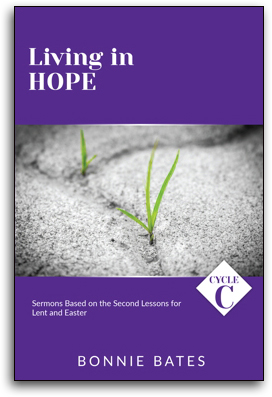
Living In Hope
Cycle C Sermons for Lent and Easter Based on the Second Lessons
Sometimes it is hard for us to accept the hardships of this life. Certainly, in the current situation, with so many people in so many communities and countries still affected by the COVID-19 pandemic, there is much worry and anxiety. Yet, worry and struggle have been a part of the human condition almost as long as human beings have been on the earth.
As Paul wrote this second letter to the church in Corinth, he was reminding the people that he, too had struggled: “in beatings, imprisonments, and riots; in hard work, sleepless nights and hunger” (2 Corinthians 6:5). His life, as follower of Jesus and as evangelist had been difficult, more difficult in some ways than our Christian lives have been. We, in the United States at least, are rarely beaten or imprisoned for our faith. We may have had hard work to do and some sleepless nights, but most of us have food to eat, homes to rest in, and places to be safe with other believers. What if it were not so?
When I was touring two dioceses of the Church of South India in February 2020, I watched people walk into small concrete buildings and sit on the floor for worship. I spoke with people who had walked for eight to ten kilometers to worship on Sundays or Holy Days. I sat with people at a table who shared the last they had to eat with us American visitors. I was honored and blessed and humbled to be with people of such faith and generosity. Having been a Christian all my life, I have rarely in a US church, save perhaps a Pentecostal church, seen people worshiping with such energy and celebration of the presence of the Holy Spirit. I learned a lot from these people; I have, I hope, brought forth much that I learned into my ministry here in the United States.
For one thing, I understand suffering and dedication in a different way. I have never had to walk miles to get to church ― even when snowstorms blocked the roads, my walk was several blocks, not several miles. I have been at the poverty level, but I have never gone without food for days or had to walk to a community well to access water. While I have been a faithful churchgoer and, I hope, disciple of Jesus, my life has been comparatively simple. I was never beaten or imprisoned or had no place to live and no food to eat. I have been safe in the expressions of my faith and my church participation.
In a primarily Hindu nation, with increasing Muslim faith citizens, India has only 12% of its population following Jesus. Yes, there is great joy, great fervor, and yet a recognition that all the people are children of God. For the most part, unless encouraged by the government to behave in alternative ways, the population is at peace with one another ― no matter their faith traditions. I actually preached at a community festival, the Siluvaggutta Jathara at Gangaram, a rural festival attended by Christians, Muslims, Hindis, and those with no faith at all. More than 1,000 people gathered to hear me preach from the gospel of Jesus Christ. There was no heckling, no shaming, no ignoring my message ― rather there were tears in the eyes of women, participation and affirmation, clapping and cheering at the conclusion of the message, and a deep sense of reverence in the attention paid to me. I cannot imagine a US group, even of a variety of Christian denominations, being more engaged and more attentive to the words of my mouth, which I know were the words God asked me to share. This reconciling of the people gathered as simply children of God, not of sects or faith traditions, was a profound experience of faith and reconciliation for me.
When Paul wrote of reconciliation, I am not sure this is what he was speaking about. He wanted us to remove the barriers and not be stumbling blocks to people of faith. And yet, Paul commended us to “in every way… in purity, understanding, patience and kindness; in the Holy Spirit and in sincere love; in truthful speech and in the power of God; with weapons of righteousness in the right hand and in the left” to open our hearts to our siblings in Christ. How powerful! How amazing the world might be if we focused on purity, understanding, patience, and kindness ― all gifts of the Holy Spirit. What might change in our relationships, in our faith communities, in our families, in our towns, states, and nations, if we focused on righteousness, sincere love, and reconciliation?
As I write this, our nation is still in the throes of a pandemic, still divided over issues of faith, race, and governmental decisions. We still, in the US, focus on our individual perspectives and our individual opinions, sometimes to the detriment of civil conversations and relationships. This seems to me to be the antitheses of the gospel and of Paul’s letter to the church in Corinth. We know from studies of this church and through Paul’s letters, that there was dissension in this church, arguments as to approach, and some problems with worship (as in the rich waiting until the poor arrived before sharing the community meal). The focus may have been like the attitudes in the US: what I want as an individual is most important and the common good is secondary. Yet, Paul reminded us that the relationships we have with one another are vitally important. Despite suffering and challenges, Paul called us to righteousness, reconciliation, and love.
My second brother died last year. My youngest brother died when he was five and I was twelve, but my remaining brother died last year. He had many challenges and issues in his life, among them addiction to alcohol and drugs. As children we played together, ice skated together, rode bikes together, and played football together in our backyard. We had a competitive but pretty good relationship. As his addictions came into play, we became more and more estranged. He was angrier, I was less tolerant. There were arguments, long periods of silence between us. These were more than sibling rivalry. I began to question if the person he became was actually the brother I knew at all. Some of you may be able to relate to this. The illness of addiction plagues many of us, many families. There is deep pain as relationships are damaged.
I am happy to say that before his death, my brother and I were reconciled. His addictions came to an end, but not before he committed a crime that landed him in prison for the last twelve years of his life. During those twelve years we were able to rebuild our relationship, talk, laugh, write letters, and remember the love we felt for one another. This was truly a gift for me. I know it was for him as well. I thought, after his death, about the wasted years ― more than thirty of them ― that were lost to us. His creativity, artistic, and carpentry skills were gifts. I have several photographs he took of nature framed and hanging in my home. I think of him often. I could look back with regret, and sometimes I do, but I try to think of our last years together, the years of our reconciliation and renewed relationship, as a gift from God.
The coming together in relationships is what Paul was writing about. Despite any suffering, challenges, pain, and anger we feel, we are called to walk into our relationships with the open heart of love. Paul loved the people of the churches he found, even when they were not behaving in righteous and charitable ways. God loves us even when we are not living and acting in righteous and charitable ways. Please note that Paul wrote of righteousness, not self-righteousness. The righteousness we are called to is the righteousness of God as lived out by Jesus. This righteousness is filled with acts of inclusion, acceptance, love, compassion, and healing. Yes, Jesus reminded us what it means to be siblings who are faithful to God, but rather than judge (except in cases of self-righteousness), Jesus loved. Jesus healed. Jesus wept over the pain people felt and acted to create. Jesus forgave, even from the cross.
Reconciliation is hard. Compassion is sometimes hard. Kindness is sometimes hard. Patience is sometimes hard. Love is sometimes hard. But love is not just what we feel. Love is a commandment, a calling, and a requirement of Jesus’ followers. This Lenten season, let us reflect on this all on us as Christians, to love God with our whole selves and to love our neighbor as ourselves. Let us follow the instructions in Paul’s letter to build community through the righteousness of God, through our faithfulness, and through our love. Let us be beacons of light and hope in a challenging world, in a challenging time. Pray it will be so. Amen.
As Paul wrote this second letter to the church in Corinth, he was reminding the people that he, too had struggled: “in beatings, imprisonments, and riots; in hard work, sleepless nights and hunger” (2 Corinthians 6:5). His life, as follower of Jesus and as evangelist had been difficult, more difficult in some ways than our Christian lives have been. We, in the United States at least, are rarely beaten or imprisoned for our faith. We may have had hard work to do and some sleepless nights, but most of us have food to eat, homes to rest in, and places to be safe with other believers. What if it were not so?
When I was touring two dioceses of the Church of South India in February 2020, I watched people walk into small concrete buildings and sit on the floor for worship. I spoke with people who had walked for eight to ten kilometers to worship on Sundays or Holy Days. I sat with people at a table who shared the last they had to eat with us American visitors. I was honored and blessed and humbled to be with people of such faith and generosity. Having been a Christian all my life, I have rarely in a US church, save perhaps a Pentecostal church, seen people worshiping with such energy and celebration of the presence of the Holy Spirit. I learned a lot from these people; I have, I hope, brought forth much that I learned into my ministry here in the United States.
For one thing, I understand suffering and dedication in a different way. I have never had to walk miles to get to church ― even when snowstorms blocked the roads, my walk was several blocks, not several miles. I have been at the poverty level, but I have never gone without food for days or had to walk to a community well to access water. While I have been a faithful churchgoer and, I hope, disciple of Jesus, my life has been comparatively simple. I was never beaten or imprisoned or had no place to live and no food to eat. I have been safe in the expressions of my faith and my church participation.
In a primarily Hindu nation, with increasing Muslim faith citizens, India has only 12% of its population following Jesus. Yes, there is great joy, great fervor, and yet a recognition that all the people are children of God. For the most part, unless encouraged by the government to behave in alternative ways, the population is at peace with one another ― no matter their faith traditions. I actually preached at a community festival, the Siluvaggutta Jathara at Gangaram, a rural festival attended by Christians, Muslims, Hindis, and those with no faith at all. More than 1,000 people gathered to hear me preach from the gospel of Jesus Christ. There was no heckling, no shaming, no ignoring my message ― rather there were tears in the eyes of women, participation and affirmation, clapping and cheering at the conclusion of the message, and a deep sense of reverence in the attention paid to me. I cannot imagine a US group, even of a variety of Christian denominations, being more engaged and more attentive to the words of my mouth, which I know were the words God asked me to share. This reconciling of the people gathered as simply children of God, not of sects or faith traditions, was a profound experience of faith and reconciliation for me.
When Paul wrote of reconciliation, I am not sure this is what he was speaking about. He wanted us to remove the barriers and not be stumbling blocks to people of faith. And yet, Paul commended us to “in every way… in purity, understanding, patience and kindness; in the Holy Spirit and in sincere love; in truthful speech and in the power of God; with weapons of righteousness in the right hand and in the left” to open our hearts to our siblings in Christ. How powerful! How amazing the world might be if we focused on purity, understanding, patience, and kindness ― all gifts of the Holy Spirit. What might change in our relationships, in our faith communities, in our families, in our towns, states, and nations, if we focused on righteousness, sincere love, and reconciliation?
As I write this, our nation is still in the throes of a pandemic, still divided over issues of faith, race, and governmental decisions. We still, in the US, focus on our individual perspectives and our individual opinions, sometimes to the detriment of civil conversations and relationships. This seems to me to be the antitheses of the gospel and of Paul’s letter to the church in Corinth. We know from studies of this church and through Paul’s letters, that there was dissension in this church, arguments as to approach, and some problems with worship (as in the rich waiting until the poor arrived before sharing the community meal). The focus may have been like the attitudes in the US: what I want as an individual is most important and the common good is secondary. Yet, Paul reminded us that the relationships we have with one another are vitally important. Despite suffering and challenges, Paul called us to righteousness, reconciliation, and love.
My second brother died last year. My youngest brother died when he was five and I was twelve, but my remaining brother died last year. He had many challenges and issues in his life, among them addiction to alcohol and drugs. As children we played together, ice skated together, rode bikes together, and played football together in our backyard. We had a competitive but pretty good relationship. As his addictions came into play, we became more and more estranged. He was angrier, I was less tolerant. There were arguments, long periods of silence between us. These were more than sibling rivalry. I began to question if the person he became was actually the brother I knew at all. Some of you may be able to relate to this. The illness of addiction plagues many of us, many families. There is deep pain as relationships are damaged.
I am happy to say that before his death, my brother and I were reconciled. His addictions came to an end, but not before he committed a crime that landed him in prison for the last twelve years of his life. During those twelve years we were able to rebuild our relationship, talk, laugh, write letters, and remember the love we felt for one another. This was truly a gift for me. I know it was for him as well. I thought, after his death, about the wasted years ― more than thirty of them ― that were lost to us. His creativity, artistic, and carpentry skills were gifts. I have several photographs he took of nature framed and hanging in my home. I think of him often. I could look back with regret, and sometimes I do, but I try to think of our last years together, the years of our reconciliation and renewed relationship, as a gift from God.
The coming together in relationships is what Paul was writing about. Despite any suffering, challenges, pain, and anger we feel, we are called to walk into our relationships with the open heart of love. Paul loved the people of the churches he found, even when they were not behaving in righteous and charitable ways. God loves us even when we are not living and acting in righteous and charitable ways. Please note that Paul wrote of righteousness, not self-righteousness. The righteousness we are called to is the righteousness of God as lived out by Jesus. This righteousness is filled with acts of inclusion, acceptance, love, compassion, and healing. Yes, Jesus reminded us what it means to be siblings who are faithful to God, but rather than judge (except in cases of self-righteousness), Jesus loved. Jesus healed. Jesus wept over the pain people felt and acted to create. Jesus forgave, even from the cross.
Reconciliation is hard. Compassion is sometimes hard. Kindness is sometimes hard. Patience is sometimes hard. Love is sometimes hard. But love is not just what we feel. Love is a commandment, a calling, and a requirement of Jesus’ followers. This Lenten season, let us reflect on this all on us as Christians, to love God with our whole selves and to love our neighbor as ourselves. Let us follow the instructions in Paul’s letter to build community through the righteousness of God, through our faithfulness, and through our love. Let us be beacons of light and hope in a challenging world, in a challenging time. Pray it will be so. Amen.
