
Moravian-Style Worship
Worship
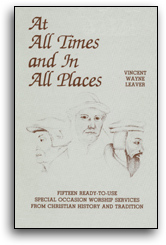
AT ALL TIMES AND IN ALL PLACES
FIFTEEN READY-TO-USE SPECIAL OCCASION WORSHIP SERVICES FROM CHRISTIAN HISTORY AND TRADITION
Background
John Wesley was greatly influenced by the simple faith of the Moravians. In 1735, on board ship bound to Georgia as a missionary, Wesley was frightened during three storms encountered on the voyage. He was amazed at the calmness of the 26 Moravians, including their Bishop Nitschmann. He knew they had found a level of faith and trust that he wanted. Later in London, another Moravian by the name of Peter Bohler encouraged Wesley to move from doctrine to simple faith.
The Moravian Brotherhood, or Unitas Fratrum, traced its origins back to the Hussite Movement in Bohemia. They had suffered great persecution in the Thirty Years War. They were revived in the eighteenth century by their leader Christian David. In America they settled primarily around Bethlehem, Pennsylvania and Salem, North Carolina. They were a missionary body. They were the most successful in missionary work among the American Indians.
Music played a leading role in American frontier religion. Music became a practical way to teach Christian truths in a way the people could remember. The Moravians were a unique religious order which had wide influence in mid-eighteenth century Protestantism. After fleeing the terrorism of the Hapsburg counter-Reformation they were permitted to settle in Saxony on the estate of Count von Zinzendorf, a devout Lutheran pietist. There they were allowed to shape their own church tradition within the context of the Lutheran State Church. Count Zinzendorf combined his Lutheran pietism with the Moravians' evangelical zeal and became their leader. The Moravians had peculiar monastic institutions, including communal housing and employment with family life subordinated. The whole community was organized into "choirs," based on marital status, age, and sex. Each "choir" was divided into cells of three to six members, who were an intimate religious fellowship. This may be the basis of Wesley's Methodist organizational structure. These "choirs" and "cells" had regular "love feasts" and services. The whole community worshiped three times a day and all day Sunday was set aside for that purpose. The focus of their religious efforts was personal fellowship with Christ. They were emotional, imaginative, and disinclined toward rational theological discussion. They believed strongly in intercessional prayer. They believed in sharing the Good News and for decades were the leaders in Protestant missions.
Moravian worship and music was often rather erotic in its symbolism and they were fond of emphasizing the blood of Christ. Toplady's hymn, "Rock of Ages," represents the nature of Moravian piety. In worship, there was little Bible reading or preaching. It was predominantly hymn-singing. The minister would lead off in one stanza after another from different hymns, in various combinations with the organist and congregation joining in after the first phrase or as soon as they recognized the hymn. They sang without hymn books, and knew hundreds of hymns by heart.
Planning and Worship Suggestions
In preparing this worship service, the music director, song leader and organist or piano player need to be included from the beginning.
A basic decision will be to decide whether to follow the old Moravian way of having a leader go from hymn to hymn by leading the congregation in singing familiar hymn verses, or to use a more structured format as indicated on the following pages. This decision may depend on your church's tradition and on the available music leadership.
If you choose a more structured approach, you may want to consider short statements of introduction to each hymn. For example, in introducing the prayers for the church and world, "Let us join now in prayer for the church throughout the world in singing the hymn, 'Jesus, With Thy Church Abide.' " For those who use hymnals and a bulletin for the service, a careful check for the correct page numbers is important to avoid undue confusion.
Order of Worship
(*congregation stand)
Announcements
Minister
*The Call to Worship
Congregation
Hymn "All Hail the Power of Jesus' Name"
Prayer of Confession
Congregation
Hymn "Dear Lord and Father of Mankind"
Declaration of Pardon
Choir
Hymn "Rise Up, O Men of God"
Congregation
*Act of Praise
Congregation
Hymn "It Is a Good Thing to Give Thanks"
*Gloria Patri
Congregation
Prayer of Illumination
Choir
Hymn "Master Speak, Thy Servant Heareth"
Scripture Lesson Psalm 23
*Affirmation of Faith
Congregation
Hymn "Amazing Grace"
Prayers for the Church and World
Hymn For All Nations
Choir
"This is My Song" - Verses 1, 2, and 3
Hymn For the Church
Choir
"Jesus, with Thy Church Abide" - Verses 1, 2, and 5
Hymn For a Christ-Like Life
Congregation
"O Young and Fearless Prophet" - Verses 1, 4, 5
The Offertory
Choir
Hymn "We Gather Together"
*The Presentation of the Offering
Congregation
Hymn "We Give Thee But Thine Own"
(Holy Communion may be celebrated)
*Prayer of Thanksgiving and Joy
Congregation
Hymn "Joyful, Joyful, We Adore Thee"
*Benediction
Hymn "The Lord Bless You and Keep You"
Chapter 6
A Mother's Day Service
A Celebration of
Women of the Bible
Background
This service was prepared for use on Mother's Day 1988 at Southwest and Coral Way United Methodist Churches, Miami, Florida. The service attempts to highlight awareness of the key roles women have played in God's Revelation as recorded in the Old and New Testaments. The service includes some of the more feminine references to God used in the Scriptures, such as Jesus' reference to God who acts like a mother hen gathering and protecting her brood under her wings, and the emphasis on nurture. It is interesting and important to note that women have played many roles and have not been limited to those traditional roles some people have assigned them in the church and in religious affairs.
Planning and Preparation
Most congregations would greatly benefit from a study of the women in the Old Testament and the New Testament, as well as from a study of women and their roles in the church over the past two-thousand years. Such studies should be encouraged.
The selection of hymns should be undertaken with a sensitivity to the use of masculine and feminine language. The sermon may focus on the examples of faith found in the lives of women in the Scriptures. If the minister is male, it would be important also to involve women in leading this service. The use of women and men in leading worship should be encouraged in other worship services as well. Liturgy and worship should be the work of the people and not a "one-person show" by the ordained minister.
Order of Worship
Call to Worship
"Praise ye the Lord for the avenging of Israel when the people willingly offered themselves. Hear, O ye kings, give ear, O ye princes. I, even I, will sing unto the Lord, I will sing praise to the Lord God of Israel."
(Judges 5:2-3: the song of Deborah and Barak on the Delivery From Sisera)
Hymn
Congregation
Prayer
Our Heavenly Parent, we thank you that you gather your people together and protect them as a mother hen gathers her brood under her wings. Truly you have brought us to birth and continue to nurture us in life. Although we have never seen you at any time, your only begotten Son, who is in your bosom, has declared you to us. May we be your faithful children, growing strong in faith and action. Protect us. Nurture us. Strengthen us. In Jesus' name we pray.
Silent Prayer
The Lord's Prayer
Minister and congregation
Hymn
Congregation
Act of Praise
Leader: We praise you Lord for famous women of the Old Testament.
People:
We thank you for examples of faith, courage and devotion to your will.
Leader:
We thank you for Sarah, mother of Nations.
People:
We praise you for Sarah's willingness to go into unfamiliar lands, for her trust in what appeared as your impossible promises, and for her faith even when it appeared to call for the sacrifice of her son and for the fulfilment of your promises in Isaac.
Leader:
We praise you for Miriam, courageous leader of Israel.
People:
We thank you for Miriam's courage as a young girl guarding her little bother Moses; for Miriam's quick action in offering Pharaoh's daughter a woman to nurse this child found in the little boat, and for Miriam's leadership in the wilderness as the Hebrew people fled Egypt.
Leader:
We thank you for Deborah, a woman of great power, a judge of the people of Israel.
People:
We praise you for Deborah's wisdom, for her awakening the people of Israel and for her courage as a military leader with Barak.
Leader:
We praise you for Abigail, a woman of wisdom and peace.
People:
We thank you for Abigail's peacemaking between David and Nabal.
Leader:
We thank you for Esther, a woman dedicated to the dreams and hopes of her people while living in a strange land.
People:
We praise you for Esther, who averted the massacre of her people in Persia.
Leader:
We praise you for Ruth, a loyal, gentle, yet decisive woman.
People:
We thank you for Ruth's faithfulness. From her marriage to Boaz came the House of David.
All: We thank you, Lord, for the faithful women of the Old Testament.
Affirmation of Faith: The Apostles Creed
Pastoral Prayer
Announcements
The Offering and Anthem
Act of Praise
Leader:
We thank you, Lord, for the faithful women of the New Testament.
People:
We praise you for their courage, faith and conviction in you, our Heavenly Parent.
Leader:
We thank you for Anna, the aged widow at the Temple in Jerusalem.
People:
We praise you for the prophetess Anna's insight in first recognizing the Christ you sent into the world.
Leader:
We thank you for Mary and Martha, faithful friends of Jesus.
People:
We thank you for the imagination and passion of Mary that led her to anoint Jesus, and for the practical, down-to-earth ways of Martha.
Leader:
We thank you for Mary Magdalene, Salome, and Mary the mother of Jesus, the women who went to the tomb on the resurrection morning.
People:
We thank you for these women who first saw the risen Christ and told the disciples of the Good News of Jesus' resurrection.
Leader:
We thank you for Eunice, grandmother of Timothy, and for Timothy's mother, both of whom nurtured him.
People:
We praise you for them and all women who nurture and train their children in the ways of the Lord.
Leader:
We praise you for Priscilla, a leader in the church at Corinth, Ephesus and Rome.
People:
We thank you for Priscilla's leadership and for her training of the eloquent Apollos, even as she worked as a tent maker.
Leader:
We thank you for Lydia, and for Mary the mother of John Mark, women who opened their homes as meeting places for the early Christians.
People:
We praise you for Mary, whose home became a center of Christian work in Jerusalem, and for Lydia, whose home in Philippi was a meeting place and a refuge for Paul and Silas when they were delivered from prison.
Leader:
We praise you for the godly service of Dorcas, also known as Tabitha, who sewed for the needy of Joppa.
People:
We thank you for the love generated by Dorcas among the needy, those who sent for Paul when Dorcas died. We glorify you for raising Dorcas from the dead through Paul.
Leader:
We thank you for Phoebe, deaconness at Cenchreae, who helped the needy and carried Paul's epistle to the Romans.
People:
We praise you for Phoebe's leadership, service and succor to many, including Paul.
Leader:
We praise you for Mary, mother of Jesus, who gave him birth, nurtured him in life, and suffered as she saw him rejected and crucified.
People:
We thank you for Mary, chosen of God as an agent of God's purpose. Indeed, she found favor with God.
All: For the many women of the New Testament who responded in faith and service, we thank you and praise you.
Hymn
Scripture
Sermon
Hymn
Benediction
May the love of God expressed in Jesus Christ and in the faithful women of the Old and New Testaments take firm root in your life. May you be nurtured and grow in the faith, now and in the years to come. Amen
John Wesley was greatly influenced by the simple faith of the Moravians. In 1735, on board ship bound to Georgia as a missionary, Wesley was frightened during three storms encountered on the voyage. He was amazed at the calmness of the 26 Moravians, including their Bishop Nitschmann. He knew they had found a level of faith and trust that he wanted. Later in London, another Moravian by the name of Peter Bohler encouraged Wesley to move from doctrine to simple faith.
The Moravian Brotherhood, or Unitas Fratrum, traced its origins back to the Hussite Movement in Bohemia. They had suffered great persecution in the Thirty Years War. They were revived in the eighteenth century by their leader Christian David. In America they settled primarily around Bethlehem, Pennsylvania and Salem, North Carolina. They were a missionary body. They were the most successful in missionary work among the American Indians.
Music played a leading role in American frontier religion. Music became a practical way to teach Christian truths in a way the people could remember. The Moravians were a unique religious order which had wide influence in mid-eighteenth century Protestantism. After fleeing the terrorism of the Hapsburg counter-Reformation they were permitted to settle in Saxony on the estate of Count von Zinzendorf, a devout Lutheran pietist. There they were allowed to shape their own church tradition within the context of the Lutheran State Church. Count Zinzendorf combined his Lutheran pietism with the Moravians' evangelical zeal and became their leader. The Moravians had peculiar monastic institutions, including communal housing and employment with family life subordinated. The whole community was organized into "choirs," based on marital status, age, and sex. Each "choir" was divided into cells of three to six members, who were an intimate religious fellowship. This may be the basis of Wesley's Methodist organizational structure. These "choirs" and "cells" had regular "love feasts" and services. The whole community worshiped three times a day and all day Sunday was set aside for that purpose. The focus of their religious efforts was personal fellowship with Christ. They were emotional, imaginative, and disinclined toward rational theological discussion. They believed strongly in intercessional prayer. They believed in sharing the Good News and for decades were the leaders in Protestant missions.
Moravian worship and music was often rather erotic in its symbolism and they were fond of emphasizing the blood of Christ. Toplady's hymn, "Rock of Ages," represents the nature of Moravian piety. In worship, there was little Bible reading or preaching. It was predominantly hymn-singing. The minister would lead off in one stanza after another from different hymns, in various combinations with the organist and congregation joining in after the first phrase or as soon as they recognized the hymn. They sang without hymn books, and knew hundreds of hymns by heart.
Planning and Worship Suggestions
In preparing this worship service, the music director, song leader and organist or piano player need to be included from the beginning.
A basic decision will be to decide whether to follow the old Moravian way of having a leader go from hymn to hymn by leading the congregation in singing familiar hymn verses, or to use a more structured format as indicated on the following pages. This decision may depend on your church's tradition and on the available music leadership.
If you choose a more structured approach, you may want to consider short statements of introduction to each hymn. For example, in introducing the prayers for the church and world, "Let us join now in prayer for the church throughout the world in singing the hymn, 'Jesus, With Thy Church Abide.' " For those who use hymnals and a bulletin for the service, a careful check for the correct page numbers is important to avoid undue confusion.
Order of Worship
(*congregation stand)
Announcements
Minister
*The Call to Worship
Congregation
Hymn "All Hail the Power of Jesus' Name"
Prayer of Confession
Congregation
Hymn "Dear Lord and Father of Mankind"
Declaration of Pardon
Choir
Hymn "Rise Up, O Men of God"
Congregation
*Act of Praise
Congregation
Hymn "It Is a Good Thing to Give Thanks"
*Gloria Patri
Congregation
Prayer of Illumination
Choir
Hymn "Master Speak, Thy Servant Heareth"
Scripture Lesson Psalm 23
*Affirmation of Faith
Congregation
Hymn "Amazing Grace"
Prayers for the Church and World
Hymn For All Nations
Choir
"This is My Song" - Verses 1, 2, and 3
Hymn For the Church
Choir
"Jesus, with Thy Church Abide" - Verses 1, 2, and 5
Hymn For a Christ-Like Life
Congregation
"O Young and Fearless Prophet" - Verses 1, 4, 5
The Offertory
Choir
Hymn "We Gather Together"
*The Presentation of the Offering
Congregation
Hymn "We Give Thee But Thine Own"
(Holy Communion may be celebrated)
*Prayer of Thanksgiving and Joy
Congregation
Hymn "Joyful, Joyful, We Adore Thee"
*Benediction
Hymn "The Lord Bless You and Keep You"
Chapter 6
A Mother's Day Service
A Celebration of
Women of the Bible
Background
This service was prepared for use on Mother's Day 1988 at Southwest and Coral Way United Methodist Churches, Miami, Florida. The service attempts to highlight awareness of the key roles women have played in God's Revelation as recorded in the Old and New Testaments. The service includes some of the more feminine references to God used in the Scriptures, such as Jesus' reference to God who acts like a mother hen gathering and protecting her brood under her wings, and the emphasis on nurture. It is interesting and important to note that women have played many roles and have not been limited to those traditional roles some people have assigned them in the church and in religious affairs.
Planning and Preparation
Most congregations would greatly benefit from a study of the women in the Old Testament and the New Testament, as well as from a study of women and their roles in the church over the past two-thousand years. Such studies should be encouraged.
The selection of hymns should be undertaken with a sensitivity to the use of masculine and feminine language. The sermon may focus on the examples of faith found in the lives of women in the Scriptures. If the minister is male, it would be important also to involve women in leading this service. The use of women and men in leading worship should be encouraged in other worship services as well. Liturgy and worship should be the work of the people and not a "one-person show" by the ordained minister.
Order of Worship
Call to Worship
"Praise ye the Lord for the avenging of Israel when the people willingly offered themselves. Hear, O ye kings, give ear, O ye princes. I, even I, will sing unto the Lord, I will sing praise to the Lord God of Israel."
(Judges 5:2-3: the song of Deborah and Barak on the Delivery From Sisera)
Hymn
Congregation
Prayer
Our Heavenly Parent, we thank you that you gather your people together and protect them as a mother hen gathers her brood under her wings. Truly you have brought us to birth and continue to nurture us in life. Although we have never seen you at any time, your only begotten Son, who is in your bosom, has declared you to us. May we be your faithful children, growing strong in faith and action. Protect us. Nurture us. Strengthen us. In Jesus' name we pray.
Silent Prayer
The Lord's Prayer
Minister and congregation
Hymn
Congregation
Act of Praise
Leader: We praise you Lord for famous women of the Old Testament.
People:
We thank you for examples of faith, courage and devotion to your will.
Leader:
We thank you for Sarah, mother of Nations.
People:
We praise you for Sarah's willingness to go into unfamiliar lands, for her trust in what appeared as your impossible promises, and for her faith even when it appeared to call for the sacrifice of her son and for the fulfilment of your promises in Isaac.
Leader:
We praise you for Miriam, courageous leader of Israel.
People:
We thank you for Miriam's courage as a young girl guarding her little bother Moses; for Miriam's quick action in offering Pharaoh's daughter a woman to nurse this child found in the little boat, and for Miriam's leadership in the wilderness as the Hebrew people fled Egypt.
Leader:
We thank you for Deborah, a woman of great power, a judge of the people of Israel.
People:
We praise you for Deborah's wisdom, for her awakening the people of Israel and for her courage as a military leader with Barak.
Leader:
We praise you for Abigail, a woman of wisdom and peace.
People:
We thank you for Abigail's peacemaking between David and Nabal.
Leader:
We thank you for Esther, a woman dedicated to the dreams and hopes of her people while living in a strange land.
People:
We praise you for Esther, who averted the massacre of her people in Persia.
Leader:
We praise you for Ruth, a loyal, gentle, yet decisive woman.
People:
We thank you for Ruth's faithfulness. From her marriage to Boaz came the House of David.
All: We thank you, Lord, for the faithful women of the Old Testament.
Affirmation of Faith: The Apostles Creed
Pastoral Prayer
Announcements
The Offering and Anthem
Act of Praise
Leader:
We thank you, Lord, for the faithful women of the New Testament.
People:
We praise you for their courage, faith and conviction in you, our Heavenly Parent.
Leader:
We thank you for Anna, the aged widow at the Temple in Jerusalem.
People:
We praise you for the prophetess Anna's insight in first recognizing the Christ you sent into the world.
Leader:
We thank you for Mary and Martha, faithful friends of Jesus.
People:
We thank you for the imagination and passion of Mary that led her to anoint Jesus, and for the practical, down-to-earth ways of Martha.
Leader:
We thank you for Mary Magdalene, Salome, and Mary the mother of Jesus, the women who went to the tomb on the resurrection morning.
People:
We thank you for these women who first saw the risen Christ and told the disciples of the Good News of Jesus' resurrection.
Leader:
We thank you for Eunice, grandmother of Timothy, and for Timothy's mother, both of whom nurtured him.
People:
We praise you for them and all women who nurture and train their children in the ways of the Lord.
Leader:
We praise you for Priscilla, a leader in the church at Corinth, Ephesus and Rome.
People:
We thank you for Priscilla's leadership and for her training of the eloquent Apollos, even as she worked as a tent maker.
Leader:
We thank you for Lydia, and for Mary the mother of John Mark, women who opened their homes as meeting places for the early Christians.
People:
We praise you for Mary, whose home became a center of Christian work in Jerusalem, and for Lydia, whose home in Philippi was a meeting place and a refuge for Paul and Silas when they were delivered from prison.
Leader:
We praise you for the godly service of Dorcas, also known as Tabitha, who sewed for the needy of Joppa.
People:
We thank you for the love generated by Dorcas among the needy, those who sent for Paul when Dorcas died. We glorify you for raising Dorcas from the dead through Paul.
Leader:
We thank you for Phoebe, deaconness at Cenchreae, who helped the needy and carried Paul's epistle to the Romans.
People:
We praise you for Phoebe's leadership, service and succor to many, including Paul.
Leader:
We praise you for Mary, mother of Jesus, who gave him birth, nurtured him in life, and suffered as she saw him rejected and crucified.
People:
We thank you for Mary, chosen of God as an agent of God's purpose. Indeed, she found favor with God.
All: For the many women of the New Testament who responded in faith and service, we thank you and praise you.
Hymn
Scripture
Sermon
Hymn
Benediction
May the love of God expressed in Jesus Christ and in the faithful women of the Old and New Testaments take firm root in your life. May you be nurtured and grow in the faith, now and in the years to come. Amen
