
The Multiple Uses Of Grace
Sermon
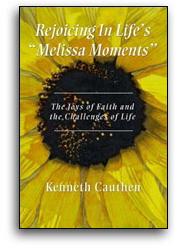
Rejoicing In Life's 'Melissa Moments'
The Joys Of Faith And The Challenges Of Life
You may have made use of a household oil having the brand name "3 in 1." It claims to clean, oil, and polish. When I was a teenager, I heard a preacher use this product as an analogy to the Trinity. He went on to indicate three ways God functions. I did not know it in those innocent days, but I later learned that this way of thinking about the Trinity is heretical. Nevertheless, the idea of something having multiple uses always arouses interest. Grace falls into this category.
We are most familiar with the idea that grace saves us from our sins. It is not by our good works but by the free gift of forgiveness that we become acceptable in God's sight. Salvation by grace through faith was a central theme of the Protestant Reformation. To be set free from the burden of having to measure up to the high demands of divine law by the unmerited favor of God's mercy is not only amazing but a source of "Blessed Assurance."
Oh, we have our problems in keeping faith itself from becoming a new work that substitutes for keeping the law. And we sometimes quantify it as if faith were something we must somehow summon up enough of to make it work. And, yes, we have difficulty accepting grace deep in our hearts as well as in our heads. As a result we go about still burdened with guilt and condemnation and feelings of worthlessness. Even those of us who have preached grace to others have sometimes been unable to believe that we really are set free by an unconditional love that we do not have to earn. We may sing, "Just as I am, without one plea," but we often act and feel as if we had to be perfect or be damned. Nevertheless, our confession is that we are saved by grace.
Grace also saves us from our uncertainty about ultimate truth and our doubts about ultimate goodness. A London taxi driver recognized that the person who was getting into his cab was none other than Bertrand Russell, the great philosopher. He told the following story about his encounter with his famous passenger. "I said to him, 'Sir Bertrand, what's it all about?' And, you know, he couldn't tell me." Well, Bertrand Russell is not the only one who suffers from this disability. None of us knows for sure "what it's all about." We cannot decipher the deepest mysteries of existence. The final facts about the origin and destiny of the universe are beyond our ken.
More serious is the difficulty of believing that the ultimate power that rules all is perfect goodness. Such confidence is not easy in a world so full of suffering and injustice. Can grace save us from the despair of finding no meaning as well as from the guilt of not doing the good? Maybe grace is even that amazing.
Living by grace is trusting that the great unknown will not be destructive of our worthy hopes. Grace lets us embrace the mystery in the confidence that in the final reckoning the absurdities and sufferings of this life will not annihilate our just aspirations. On our part the ability to believe in spite of everything to the contrary is assisted by the goodness we do experience. When we cast ourselves upon the sea of life in the trust that the final mysteries are merciful, we can be tranquil in the turbulence and somehow manage to cope with the glimmers of significance that are available to us.
Grace enables us to acknowledge the big mystery that is beyond us and to live with the small meanings that are available. Our ignorance about ultimates does not imply that our flickering insights and occasional intuitions are worthless. Seeing through a glass darkly only means we cannot see all things clearly. It does not mean that we see nothing at all.
Some other uses of grace may not be so familiar. Yet I want to suggest that grace not only saves us from our sin and from our doubt but also from our bafflement. One of the features of moral decision-making in our time is that it frequently involves a highly technical dimension to which only experts can speak. Even if we ask the experts, we don't get one clear answer from them. They are divided on many things. Someone said that if you laid all the economists in the world end to end, they would not add up to one sure conclusion. Another thing about experts is that they have political and moral commitments that may influence their advice. It is hard to know sometimes where their technical expertise ends and their personal value system begins.
Most politicians have moral beliefs, but they also ask which position will get them the most votes. That makes it difficult for us to trust them. Just look at their panic today when the political winds regarding abortion seem to blow strongest first one way and then another. Some Democrats who have been for campaign finance reform are having second thoughts now that they have been able to raise as many dollars as the Republicans from "soft money." Another complication is that where people are in the social hierarchy influences their outlook on things. Does anyone believe that the point of view someone holds about whether the capital gains tax should be reduced is a matter of pure economic theory and not also a matter of political preference and self-interest?
Nevertheless, even when we have deciphered the political inclinations of the experts and unmasked the political pressures of the politicians, many problems are still baffling. Some of them are just complex and admit no simple solution. What are we to do about the possibility that the continued burning of fossil fuels on a massive scale may alter the global climate with catastrophic results? Illegal drugs are on everybody's mind these days. Does anyone know a good way out of the impasse? Part of the predicament is that a lot of issues involve so many painful trade-offs. We are always in a quandary because we can gain some good only at the expense of bringing some evil along with it. Raising the minimum wage assists those who are on the low end of the wage scale, but it may increase unemployment. Some years ago the Supreme Court ruled that it was unconstitutional for the state of Oregon to ban the use of peyote in the religious services of the Native American Church. That violates religious freedom. Yet the use of peyote is illegal for all citizens in that state.
We have good reason to be puzzled about the best thing to do. We should add that the moral enterprise is most bewildering of all for those who really seek justice for all instead of acting instinctively on the basis of some unquestioned doctrine or merely out of narrow self-interest.
Today many Christians are puzzled and almost dazed wanting to do what is right but not sure what that implies. What would it involve to be freed gracefully from bafflement? First of all, we would be freed from the necessity and burden of knowing the whole truth all the time. This would enable us to act positively on the best we can figure out for now without claiming that we are absolutely right or without conceding that we have no basis for an opinion at all.
Finally, grace may create a confidence to act decisively even when we are about as uncertain as we are certain. If one option seems to us relatively better, all things considered, we have to go with that. We have no choice but to act on the best that we know up to now. We can proceed even zealously in the awareness that others are acting on insights different or contrary to ours that will get into the picture what we either cannot see or even object to. Beyond that we live in hope that, out of the efforts of all, some providence working beyond our ken will weave some pattern of meaning and goodness that will increase harmony and happiness on this earth. Yes, grace may be so amazing that it can save us from our bafflement.
One final use of grace remains. Here the test is even more severe. Yet I dare propose that grace can save us even from our morality, from our convictions, from our certainty, from our good works. I do not have access to that Great Computer in the sky. If I did, I would submit as a proposition to be tested that a good portion of the misery in this world has been caused by people who were pretty sure they were doing God's will.
Martin Marty tells of a young priest who was reporting to the bishop an experience he had at an ecumenical wedding. The priest saw a group of non-Catholics coming toward him to receive communion. Should he serve them? So he asked himself, "What would Jesus do?" Immediately the bishop interrupted. "You didn't serve them, did you?" Marty reflects that we are usually pretty sure how we want those "What would Jesus do?" stories to turn out. Ah, it may be that right here grace falters. But unless grace can save us from our good works, from our moral certainty, from our righteousness, we may be lost after all. The sin of us preachers may be our certainty about what the gospel really is. The sin of us professors may be our confidence that we understand things divine. The sin of preachers, priests, bishops, archbishops, cardinals, popes, and church convention presidents may be the certitude that they instruct and administer on the basis of traditions divinely authorized. We speak now of the sin of the good, decent people who are sure they have marked out a path that God not only approves but has ordained.
Karl Barth was once accosted by a critic who asked why he must always be right. Barth is reported to have replied, "But I always am right." Fortunately, the great theologian believed more than most of us in the triumph of grace in human life. Maybe grace can even save him from statements like that, assuming that he meant to be taken seriously, which is not at all certain. Doubtless, surprises will abound on Judgment Day. I suspect that those who will be most surprised are those who think they know what the surprises are to be.
We could all make our lists, couldn't we? We all have our inventory of those who have done evil in the name of good. In our catalogues would be those theologians of the nineteenth century who proved by the Bible and quoted Aristotle to show that slavery was permissible. On our lists would be all those theologians and preachers from the New Testament era until now who have put women in a place inferior to men. Good Pope John Paul II would be there with his guarantee that unnatural birth control and women priests are contrary to divine intention. Oh, yes, we could all make our index of errors. I am sure you see already the trap into which we are about to fall. When I make my directory of those other people who do evil in the name of good, I am saying that while they thought they knew what Jesus would do, they were wrong. But I and all who agree with me know what Jesus really would do.
Perhaps the deepest difficulty is knowing what our blind spots are. One Sunday morning I was on my way to a church to preach. I was entering I-490 West on the left side from I-590 South in Rochester. I looked in my rearview mirror, saw nothing coming, and started to pull over into the next lane. Just then I heard a horn blowing furiously. I turned quickly back just in time to see a woman go whizzing by me. If looks could kill, I would not be here right now. She was very unhappy with me. Who could blame her? I was about to do a dumb thing that would have been endangered both of us. I want to be a safe driver and am most of the time. That day, I forgot about the blind spot between my peripheral vision and the area covered by the rearview mirror. I could see all around except at that one place. The danger was right at the very point where I could not see. I could hope as I continued on to church that my preaching would not be afflicted with a similar blind spot in the spiritual vision I brought to the pulpit.
The dangerous thing about having a blind spot is that you don't know you have it. We don't see something, but we don't know we are not seeing it. So we plunge confidently ahead. Grace here is truly a pure gift that we can only accept in gratitude without even knowing what God is forgiving us for. All we can do is to acknowledge the fact that we have blind spots and rejoice in the unmerited favor that sets us free from the despair we might otherwise feel once the certainty of certainty is dissolved. God saves us even from the bad things we do in complete ignorance and with the best of intentions.
The conclusion of the matter is that grace defines the framework of the Christian life in all its parts. It is the atmosphere in which we live and breathe. The love of God sets us free from anxious concern about our imperfect achievements without cancelling the obligation to do what is possible. The confidence that we are loved no matter what sets us free to be what we are and to do what we can. We act on the basis of the insight we do have. We trust God to forgive us for our blind spots as we proceed. Grace, grace, amazing grace!
Before we conclude, one more point has to be made. It is one thing that God loves us no matter what and another thing for us to believe it in our hearts. No matter if God is trustworthy, that fact is to no avail unless we deeply trust that trustworthiness. At this very point we confront one of the most slippery issues in all of Christian thought. Suffice it to say that the truth in the old doctrine of predestination is that not only are we saved by grace but that God enables us to make the response of faith by which grace is appropriated. God offers us the gift and makes possible our acceptance of it. The troubling fact is that some receive the gift to accept the gift and some don't. We can only hope that as we work out our salvation in fear and trembling, God will work successfully in us to evoke a responsive love and trust by which grace may become effective in our own lives. That miracle happens now and again but not always. It occurs, if it does, when in the dark wilderness of life a bush burns with sufficient glow and steadiness to evoke that wild leap of affirmation. That evocative flame enables us to believe that, despite all that appears to the contrary, at the heart of all things is an everlasting fire whose name is love.
We are most familiar with the idea that grace saves us from our sins. It is not by our good works but by the free gift of forgiveness that we become acceptable in God's sight. Salvation by grace through faith was a central theme of the Protestant Reformation. To be set free from the burden of having to measure up to the high demands of divine law by the unmerited favor of God's mercy is not only amazing but a source of "Blessed Assurance."
Oh, we have our problems in keeping faith itself from becoming a new work that substitutes for keeping the law. And we sometimes quantify it as if faith were something we must somehow summon up enough of to make it work. And, yes, we have difficulty accepting grace deep in our hearts as well as in our heads. As a result we go about still burdened with guilt and condemnation and feelings of worthlessness. Even those of us who have preached grace to others have sometimes been unable to believe that we really are set free by an unconditional love that we do not have to earn. We may sing, "Just as I am, without one plea," but we often act and feel as if we had to be perfect or be damned. Nevertheless, our confession is that we are saved by grace.
Grace also saves us from our uncertainty about ultimate truth and our doubts about ultimate goodness. A London taxi driver recognized that the person who was getting into his cab was none other than Bertrand Russell, the great philosopher. He told the following story about his encounter with his famous passenger. "I said to him, 'Sir Bertrand, what's it all about?' And, you know, he couldn't tell me." Well, Bertrand Russell is not the only one who suffers from this disability. None of us knows for sure "what it's all about." We cannot decipher the deepest mysteries of existence. The final facts about the origin and destiny of the universe are beyond our ken.
More serious is the difficulty of believing that the ultimate power that rules all is perfect goodness. Such confidence is not easy in a world so full of suffering and injustice. Can grace save us from the despair of finding no meaning as well as from the guilt of not doing the good? Maybe grace is even that amazing.
Living by grace is trusting that the great unknown will not be destructive of our worthy hopes. Grace lets us embrace the mystery in the confidence that in the final reckoning the absurdities and sufferings of this life will not annihilate our just aspirations. On our part the ability to believe in spite of everything to the contrary is assisted by the goodness we do experience. When we cast ourselves upon the sea of life in the trust that the final mysteries are merciful, we can be tranquil in the turbulence and somehow manage to cope with the glimmers of significance that are available to us.
Grace enables us to acknowledge the big mystery that is beyond us and to live with the small meanings that are available. Our ignorance about ultimates does not imply that our flickering insights and occasional intuitions are worthless. Seeing through a glass darkly only means we cannot see all things clearly. It does not mean that we see nothing at all.
Some other uses of grace may not be so familiar. Yet I want to suggest that grace not only saves us from our sin and from our doubt but also from our bafflement. One of the features of moral decision-making in our time is that it frequently involves a highly technical dimension to which only experts can speak. Even if we ask the experts, we don't get one clear answer from them. They are divided on many things. Someone said that if you laid all the economists in the world end to end, they would not add up to one sure conclusion. Another thing about experts is that they have political and moral commitments that may influence their advice. It is hard to know sometimes where their technical expertise ends and their personal value system begins.
Most politicians have moral beliefs, but they also ask which position will get them the most votes. That makes it difficult for us to trust them. Just look at their panic today when the political winds regarding abortion seem to blow strongest first one way and then another. Some Democrats who have been for campaign finance reform are having second thoughts now that they have been able to raise as many dollars as the Republicans from "soft money." Another complication is that where people are in the social hierarchy influences their outlook on things. Does anyone believe that the point of view someone holds about whether the capital gains tax should be reduced is a matter of pure economic theory and not also a matter of political preference and self-interest?
Nevertheless, even when we have deciphered the political inclinations of the experts and unmasked the political pressures of the politicians, many problems are still baffling. Some of them are just complex and admit no simple solution. What are we to do about the possibility that the continued burning of fossil fuels on a massive scale may alter the global climate with catastrophic results? Illegal drugs are on everybody's mind these days. Does anyone know a good way out of the impasse? Part of the predicament is that a lot of issues involve so many painful trade-offs. We are always in a quandary because we can gain some good only at the expense of bringing some evil along with it. Raising the minimum wage assists those who are on the low end of the wage scale, but it may increase unemployment. Some years ago the Supreme Court ruled that it was unconstitutional for the state of Oregon to ban the use of peyote in the religious services of the Native American Church. That violates religious freedom. Yet the use of peyote is illegal for all citizens in that state.
We have good reason to be puzzled about the best thing to do. We should add that the moral enterprise is most bewildering of all for those who really seek justice for all instead of acting instinctively on the basis of some unquestioned doctrine or merely out of narrow self-interest.
Today many Christians are puzzled and almost dazed wanting to do what is right but not sure what that implies. What would it involve to be freed gracefully from bafflement? First of all, we would be freed from the necessity and burden of knowing the whole truth all the time. This would enable us to act positively on the best we can figure out for now without claiming that we are absolutely right or without conceding that we have no basis for an opinion at all.
Finally, grace may create a confidence to act decisively even when we are about as uncertain as we are certain. If one option seems to us relatively better, all things considered, we have to go with that. We have no choice but to act on the best that we know up to now. We can proceed even zealously in the awareness that others are acting on insights different or contrary to ours that will get into the picture what we either cannot see or even object to. Beyond that we live in hope that, out of the efforts of all, some providence working beyond our ken will weave some pattern of meaning and goodness that will increase harmony and happiness on this earth. Yes, grace may be so amazing that it can save us from our bafflement.
One final use of grace remains. Here the test is even more severe. Yet I dare propose that grace can save us even from our morality, from our convictions, from our certainty, from our good works. I do not have access to that Great Computer in the sky. If I did, I would submit as a proposition to be tested that a good portion of the misery in this world has been caused by people who were pretty sure they were doing God's will.
Martin Marty tells of a young priest who was reporting to the bishop an experience he had at an ecumenical wedding. The priest saw a group of non-Catholics coming toward him to receive communion. Should he serve them? So he asked himself, "What would Jesus do?" Immediately the bishop interrupted. "You didn't serve them, did you?" Marty reflects that we are usually pretty sure how we want those "What would Jesus do?" stories to turn out. Ah, it may be that right here grace falters. But unless grace can save us from our good works, from our moral certainty, from our righteousness, we may be lost after all. The sin of us preachers may be our certainty about what the gospel really is. The sin of us professors may be our confidence that we understand things divine. The sin of preachers, priests, bishops, archbishops, cardinals, popes, and church convention presidents may be the certitude that they instruct and administer on the basis of traditions divinely authorized. We speak now of the sin of the good, decent people who are sure they have marked out a path that God not only approves but has ordained.
Karl Barth was once accosted by a critic who asked why he must always be right. Barth is reported to have replied, "But I always am right." Fortunately, the great theologian believed more than most of us in the triumph of grace in human life. Maybe grace can even save him from statements like that, assuming that he meant to be taken seriously, which is not at all certain. Doubtless, surprises will abound on Judgment Day. I suspect that those who will be most surprised are those who think they know what the surprises are to be.
We could all make our lists, couldn't we? We all have our inventory of those who have done evil in the name of good. In our catalogues would be those theologians of the nineteenth century who proved by the Bible and quoted Aristotle to show that slavery was permissible. On our lists would be all those theologians and preachers from the New Testament era until now who have put women in a place inferior to men. Good Pope John Paul II would be there with his guarantee that unnatural birth control and women priests are contrary to divine intention. Oh, yes, we could all make our index of errors. I am sure you see already the trap into which we are about to fall. When I make my directory of those other people who do evil in the name of good, I am saying that while they thought they knew what Jesus would do, they were wrong. But I and all who agree with me know what Jesus really would do.
Perhaps the deepest difficulty is knowing what our blind spots are. One Sunday morning I was on my way to a church to preach. I was entering I-490 West on the left side from I-590 South in Rochester. I looked in my rearview mirror, saw nothing coming, and started to pull over into the next lane. Just then I heard a horn blowing furiously. I turned quickly back just in time to see a woman go whizzing by me. If looks could kill, I would not be here right now. She was very unhappy with me. Who could blame her? I was about to do a dumb thing that would have been endangered both of us. I want to be a safe driver and am most of the time. That day, I forgot about the blind spot between my peripheral vision and the area covered by the rearview mirror. I could see all around except at that one place. The danger was right at the very point where I could not see. I could hope as I continued on to church that my preaching would not be afflicted with a similar blind spot in the spiritual vision I brought to the pulpit.
The dangerous thing about having a blind spot is that you don't know you have it. We don't see something, but we don't know we are not seeing it. So we plunge confidently ahead. Grace here is truly a pure gift that we can only accept in gratitude without even knowing what God is forgiving us for. All we can do is to acknowledge the fact that we have blind spots and rejoice in the unmerited favor that sets us free from the despair we might otherwise feel once the certainty of certainty is dissolved. God saves us even from the bad things we do in complete ignorance and with the best of intentions.
The conclusion of the matter is that grace defines the framework of the Christian life in all its parts. It is the atmosphere in which we live and breathe. The love of God sets us free from anxious concern about our imperfect achievements without cancelling the obligation to do what is possible. The confidence that we are loved no matter what sets us free to be what we are and to do what we can. We act on the basis of the insight we do have. We trust God to forgive us for our blind spots as we proceed. Grace, grace, amazing grace!
Before we conclude, one more point has to be made. It is one thing that God loves us no matter what and another thing for us to believe it in our hearts. No matter if God is trustworthy, that fact is to no avail unless we deeply trust that trustworthiness. At this very point we confront one of the most slippery issues in all of Christian thought. Suffice it to say that the truth in the old doctrine of predestination is that not only are we saved by grace but that God enables us to make the response of faith by which grace is appropriated. God offers us the gift and makes possible our acceptance of it. The troubling fact is that some receive the gift to accept the gift and some don't. We can only hope that as we work out our salvation in fear and trembling, God will work successfully in us to evoke a responsive love and trust by which grace may become effective in our own lives. That miracle happens now and again but not always. It occurs, if it does, when in the dark wilderness of life a bush burns with sufficient glow and steadiness to evoke that wild leap of affirmation. That evocative flame enables us to believe that, despite all that appears to the contrary, at the heart of all things is an everlasting fire whose name is love.
