
Never Just Words
Sermon
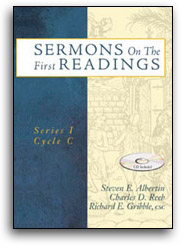
Sermons On The First Readings
Series I, Cycle C
"Sticks and stones may hurt my bones, but words can never harm me."
There has never been a bigger lie that has ever been so widely perpetuated. A friendly playground game erupts into a fight and insults fill the air. One of the combatants defiantly shouts, "Sticks and stones may hurt my bones, but words can never harm me." Even though such words attempt to minimize the harm inflicted by such insults, in fact they reveal just the opposite. These words have wounded him deeply.
Words are never just words. Words are immensely powerful. They don't just convey neutral information. They also the have the power to build up and to destroy. They can bestow value and take it away. They can motivate and deflate. One thing is clear. Words are never just words.
Think of the great coaches of the twentieth century, coaches like Vince Lombardi, John Wooden, and Knute Rockne. One skill they all possessed was the ability to use words effectively. They knew that words are never just words. Words rightly used can pack enormous power. They can build up. They can tear down. They can motivate players to do great things, virtually to "run through walls" for their coach and their team.
Think of a teacher you admire, a friend you value, a lover you treasure, or a parent you love. I am sure that one of the things that has made them special to you is that they all can use words so well. Their words not only can cut you to the quick, their words can also convey value and meaning to your life. What they say to you "turns on the lights," makes you smile, and helps you realize how special you are. Words are never just words.
As the parent of a daughter who was born profoundly deaf, I have had to struggle in ways that I never anticipated with the importance and power of words. The most important thing that deafness deprives you of is not just words but the language that comes with words. Without words and language it is difficult to understand this world in which we live. Basic information about life remains inaccessible. But even more than conveying information, words help us to build self-understanding and self-awareness. Without words it is difficult to communicate what most of us take for granted: that we are valuable, important, loved by those who care for us. Cut off from a world that they often cannot understand, a world that speaks in words they cannot understand, the deaf often become shy, withdrawn, and reclusive. That is why the development of words and language, even if they are in the "foreign language" of sign, is one of the most urgent educational tasks in raising deaf children.
Words are never just words. They are never just marks on a page, sounds in the air, or graceful gestures on the hands of the deaf. They are essential to the creation of human community. They help us to understand the world around us. They shape the development of our personality. They are essential to the development of our self-worth. They are part of what makes us human.
Words are also very important to the life of the church. Words are not just important because the church is a social gathering in which people communicate and try to understand each other. That could be said of any human organization or club. Words are not just important because we read a book filled with words called the Bible almost every time we gather. Every organization has its sacred texts and organizational documents. In the case of the church, words are of the very essence of our existence.
For Lutherans the Augsburg Confession Article 5 reminds us that the church is the creation of words, in fact, a very special kind of word, God's word. It says that church is where the Gospel is purely proclaimed and taught and where the sacraments are rightly administered in ways that are consistent with the Gospel.
The implications of this definition of the church are significant. It reminds us of what is necessary to the nature of the church and what is peripheral. The church is not a building. It is not just another club or an association of like-minded people. The church is not defined by a constitution, by-laws, a style of worship, quality of music, or ethnic tradition. Rather, the church is an "event" that "happens" in the midst of people, when a certain kind of word is "spoken." When the gospel "happens," there is the Christian church. When the sacraments are administered in such a way that this gospel is reinforced, there is the Christian church. Regardless of the denominational label on the door or in the constitution, there is only one church. That church happens when this special word called "the gospel" is rightly proclaimed, taught, shared, acted out, administered, or however it might "happen" in the midst of people. In the church, words are never just words. Words and particularly "the Word" of the gospel are the very life-blood of the church and without which it is no longer the Christian church.
But the word that creates the church is a very special kind of word. It is called the "Gospel," which means "Good News." This kind of word is "good news" as opposed to other kinds of words that are "bad news." For some denominations this distinction between the "bad news" and the "good news" is essential to the distinction that is at the heart of how we understand God and God's relationship to the world. That distinction is the distinction between Law and Gospel.
God relates to the world in two distinct and very different ways: through Law and Gospel. When God speaks, it is in either Law or Gospel. From the biblical point of view and especially from the point of view of the Old Testament, God's "word" is not just spoken language but God's acting in the world. In the Hebrew language the word for "word" and "action" is identical. Therefore God's word is also God's action in the world. When God speaks, God also acts. That action is either Law or Gospel.
The Law is the way God runs the world. The world knows all about the Law. Through the Law, God governs and protects. Through the Law, God rewards goodness and punishes evil. The Law is always conditional. "If" you do such and such, "then" such and such will be your reward. "If" you eat your spinach, "then" you get dessert. "If" you study hard, "then" your grade will improve. "If" you eat too many fatty foods, "then" you will get heart disease. "If" your company does not make a profit, "then" you go out of business. The law always "challenges" and "accuses." We never are able to satisfy its demands. Ultimately through the Law, God exposes our sin, reveals that we are never able to please him and that we are under his judgment and sentenced to die. The Law either drives us to despair or turns us into hypocrites pretending that we can live up to its demands. Therefore, ultimately the Law is always "bad news."
But this is not the only word of God. It is also not God's last word. The "other" word of God is the Gospel, "Good News." It is "good news" because in it God unconditionally, without strings attached, offers us his grace and mercy. Instead of conditions, instead of declaring "if ... then," it declares unilaterally "because ... therefore." "Because I love you, therefore you are the apple of my eye." "Because of Jesus' death and resurrection, therefore your sins are forgiven." The Gospel is Good News because it offers us a gift we do not deserve. It never accuses but always comforts. The Gospel like the Law calls for change, but the change is always a "get to" and never a "gotta." The Law demands our works. The Gospel offers us a gift, invites us to have "faith" in that gift, and promises through that gift to change our lives. The Christian faith believes that the Gospel is God's "last word" to us. Where the Law "hides" God's true nature, the Gospel "reveals" God's true nature which is love.
Today's First Lesson from the book of Jeremiah is pure, unadulterated Gospel! In so many ways it seems so out of character for Jeremiah. So much of the book of Jeremiah is filled with the Law, with Jeremiah's rants and raves, his anger and judgment against the sin of Israel. Much of the book of Jeremiah is directed at Israel as it expresses God's anger and disappointment with their immoral lives, their idolatry, their unfaithfulness to the covenant, and their infatuation with the ways of the world. But this section of the prophet is so very different. It comes from a small section of the book that scholars have named "The Book of Consolation." In these chapters the mood and message of Jeremiah dramatically change. The rants and raves become the promises and offers of God's grace and mercy.
Our text from Jeremiah is filled with one image after another each portraying the abundant grace and mercy of God. The prophet announces that it is time for the people to rejoice and sing aloud their praises to God. Why? Because God is going to be doing some wonderful things for them. The prophet piles up one image after another, all of which are intended to portray his love for them. God is the shepherd who will gather his scattered flock, the people of Israel. Their weeping will turn to joy because in the midst of their desert-like lives, he will bring them to water. Their lives will be blessed with plenty and abundance. Their father will reclaim them. They will enjoy all the rights and privileges of being the firstborn child. And when these promises are fulfilled, the people will get down, party, sing, dance, and celebrate like they have never done before. In that day their lives will at last be full and satisfied. There will be no more longing for something better. Talk about the Gospel? Talk about the "Good News"? This is it!
But what is especially shocking are the circumstances under which these words were first spoken. Jeremiah is daring to make these incredible claims about God and the future of Israel at a time when such words and sentiments seemed absurd. These words were probably spoken at the time when the nation lay in rubble. The Babylonians had swept into Judah and Jerusalem, burned the city, destroyed the Temple, and carried off the king and the key leaders into exile. The nation was devastated. In the eyes of the world, she was an ugly duckling, a puny upstart nation that had been properly put in its place by one of the truly great nations of the ancient world. Nevertheless, even though Israel had deserved this fate, God still loves her. Even though there was no merit or worthiness in her, God cannot turn his back on her. Even more, God promises to treat her with all the extravagant generosity and love he can muster.
This is the kind of love that the world has such a difficult time understanding, let alone appreciating. This is the kind of love that the world finds so difficult to express. The love that God has for this world and for his people is love that has no agenda. There are no ulterior motives. There are no strings attached. Contrary to the love of this world, love that loves only the lovable, this love loves the unlovable. Even more, the beloved becomes lovable because of the love of the lover. It is the decision of the lover to love the beloved that makes the beloved lovable. Israel was the ugly duckling, in ruins, destroyed, exiled, and broken. There was nothing attractive about her. And what made her plight even more devastating was that she had brought this fate upon herself. She had thumbed her nose at God. Look where it got her. Nevertheless, God chooses to love her simply because he wants to. Unlike the loves of this world where "I'll love you if you love me" or "I love you because of what you do for me," God's love embraced Israel even at the darkest moment in her history, even when she was most unlovable.
Of course, there have always been those who are utterly cynical about the possibility of such love. The philosopher Ayn Rand, writing some fifty years ago, attacked the whole notion of love. For her there was no such thing as selfless, altruistic love. All love has a vested interest. We love because it interests, benefits, and satisfies us. Everything we do in life is meant to benefit our self-interest. I think in many ways Ayn Rand was right. So much in life that pretends to be genuine selflessness is in fact self-interest disguised as love. People can be charitable but only when the lights and cameras are there to capture their generosity for the paparazzi and a tax deduction is available to lessen the IRS's take. People feed the hunger and house the homeless, but always want to make sure that they get credit for it. So much for selflessness! The real driving force is "What's in it for me?" Ayn Rand was right, except when you come face to face with texts like today's First Lesson. This kind of love wouldn't show up on her radar screen. She would find this kind of talk unintelligible. This love is like no other. There is no agenda, no self-interest, no "what's in it for me?" This is the love that can only come from God!
This is Good News! This is the Gospel! This is the good word that is at the heart of the Bible from beginning to end. This is the word that we see God speaking in the pages of scripture and in the lives of all those people who fill its pages. From Abraham, Isaac, and Jacob to Moses, David, and the prophets, we see God's word shaping people's lives, rescuing them from their own follies, delivering them from the hands of their enemies, not because they deserve it but because God chooses to love them. The word of God is never just words. It is never just marks on a page or sounds falling from human lips. It is God in action, choosing to love and save a world that is in big trouble.
We are currently in the midst of the season of Christmas, that season of the church year that is filled with an acute sense of fulfillment. The hopes and dreams of all the years have come to fulfillment in the birth of Christ. Today's Gospel from the opening prologue of the Gospel of Saint John announces that the Word of God has come among us. The Word that was there at the beginning of the creation of the world, the Word that sustained the people of Israel through the centuries, the Word that revealed his loving heart repeatedly to his chosen people, has at last become one of us. "And the Word became flesh and lived among us, and we have seen his glory, the glory as of a father's only son, full of grace and truth" (John 1:14).
Through this Word, God continues to do the unthinkable. God continues to love the unlovable. That is the message of this season of Christmas. That is the message of the life of Jesus. That is the message which is at the heart of the mission of the church. As we listen to the words of Jesus and see how he behaves and what happens to him, we see the Word of God in action. We see Jesus, the Word of God made flesh, transform the lives of people. We see that words are never just words that are weak and powerless but are the very means by which Jesus changes the world. The people that the world had discarded as ugly and worthless, the blind, the deaf, the diseased, Jesus treats differently. Jesus speaks and his word heals. People who were social outcasts, people like Zacchaeus, that little tax collector from Jericho who sat in a sycamore tree, people who were despised and rejected by the religious and social establishment, Jesus welcomed and took out to dinner. The twelve disciples were an unimpressive bunch of fisherman, tax collectors, and uneducated working folk. Nevertheless, Jesus calls them to be his disciples, no questions asked. There are no try-outs to endure, entrance exams to be taken or obstacle courses to be overcome. Jesus simply decides that he wants them. It is simply a unilateral action. His love for the unlovable makes them the beloved. From Jeremiah to Jesus it has always been this way with the word of God, making something out of nothing, proving that words, especially this "Word made flesh," are never just words.
That same incredible word takes shape in our lives. As Saint Francis once said, "Preach the gospel always, use words if necessary."
Married for over a half of century, a husband tenderly cares for his wife. Afflicted with Parkinson's disease she trembles, drools, mumbles, and needs her diapers changed several times a day. But he loves her and tells her that she is beautiful. She smiles and cries.
A teenager has come home from school in tears, rejected by her friends or those whom she thought were her friends. Though she is depressed and bedraggled, her mother hugs her, wipes away her tears, and tells her that she is the apple of her eye. The tears dry and a smile brightens the once darkened and saddened face.
It is another round in the endless rounds of debate and anger that seem to be destroying this marriage. And then she hears from him words she can't ever remember hearing from him. "I'm sorry. Forgive me." And the angry debate melts into a forgiving embrace.
Words are never just words. Words filled with the love of Christ can transform the world.
On this table are bread and wine, just ordinary bread and wine. There is nothing special or supernatural about them. But once these words are spoken, "This is my body ... This is my blood ..." everything is changed. Suddenly these words together with this bread and wine have the power to heal broken hearts and mend torn lives. These words are never just words.
In the font is water, just ordinary water, the same kind of water that comes out of your faucet in the kitchen sink or the spigot in the backyard. There is nothing special or supernatural about it. But once these words are spoken, "In the name of the Father, the Son and the Holy Spirit," everything is changed. Suddenly these words together with this water have the power to give a new life, a fresh start, and an opportunity to be born again. These words are never just words.
Ordinary people are gathered here in this place this morning. There is nothing special about us. We all have our skeletons in the closet. We all have our fears and worries. None of us sports wings and haloes. But once these words are spoken, "The peace of the Lord be with you ... and also with you," Jesus is among us. The hands we have shaken and the bodies we have embraced are not just ordinary flesh and blood but the flesh and blood of God. Sins have been forgiven. Love has been bestowed. The unlovable have become the beloved. These words are never just words.
When those Israelites first heard Jeremiah utter the words of today's First Lesson, they must have thought he was crazy. Broken, disgraced, humiliated, and carried off into exile in Babylon, they had hit rock bottom. They were sure that they were the ugliest of the ugly ducklings. But these words were never just words. They packed power. They were comfort and consolation. They sustained them through forty years of suffering in Babylon and for centuries beyond. They brought them joy in the midst of sadness. And one day that same "Word became flesh and lived among us" in the birth, life, death, and resurrection of Jesus. The good news is that this Word continues to be among us in the mission and ministry of this congregation and Christ's church everywhere. That Word is never just another harmless puff of hot air. That Word is the presence of the living God who is here to speak new life into our bedraggled lives.
Jeremiah believed that the day was coming when this Word would finally make all things right for his people. And when that day arrived, it would be a moment of joy, a time for dancing and singing and feasting and celebrating. That day is now here. Jesus, the Word made flesh, is alive and among us. Let us rejoice and sing. Let us dance and celebrate. It is time to do what the prophet said would happen every time this word is proclaimed and believed. I invite you to rise and join me in the party as we sing these words of the prophet Jeremiah from today's First Lesson in the words of the joyful canticle, "Listen! You Nations." As we sing these words, remember that words, these words, the words of the Gospel, are never just words but the very presence of the living, breathing, loving, almighty God. They can change everything!
There has never been a bigger lie that has ever been so widely perpetuated. A friendly playground game erupts into a fight and insults fill the air. One of the combatants defiantly shouts, "Sticks and stones may hurt my bones, but words can never harm me." Even though such words attempt to minimize the harm inflicted by such insults, in fact they reveal just the opposite. These words have wounded him deeply.
Words are never just words. Words are immensely powerful. They don't just convey neutral information. They also the have the power to build up and to destroy. They can bestow value and take it away. They can motivate and deflate. One thing is clear. Words are never just words.
Think of the great coaches of the twentieth century, coaches like Vince Lombardi, John Wooden, and Knute Rockne. One skill they all possessed was the ability to use words effectively. They knew that words are never just words. Words rightly used can pack enormous power. They can build up. They can tear down. They can motivate players to do great things, virtually to "run through walls" for their coach and their team.
Think of a teacher you admire, a friend you value, a lover you treasure, or a parent you love. I am sure that one of the things that has made them special to you is that they all can use words so well. Their words not only can cut you to the quick, their words can also convey value and meaning to your life. What they say to you "turns on the lights," makes you smile, and helps you realize how special you are. Words are never just words.
As the parent of a daughter who was born profoundly deaf, I have had to struggle in ways that I never anticipated with the importance and power of words. The most important thing that deafness deprives you of is not just words but the language that comes with words. Without words and language it is difficult to understand this world in which we live. Basic information about life remains inaccessible. But even more than conveying information, words help us to build self-understanding and self-awareness. Without words it is difficult to communicate what most of us take for granted: that we are valuable, important, loved by those who care for us. Cut off from a world that they often cannot understand, a world that speaks in words they cannot understand, the deaf often become shy, withdrawn, and reclusive. That is why the development of words and language, even if they are in the "foreign language" of sign, is one of the most urgent educational tasks in raising deaf children.
Words are never just words. They are never just marks on a page, sounds in the air, or graceful gestures on the hands of the deaf. They are essential to the creation of human community. They help us to understand the world around us. They shape the development of our personality. They are essential to the development of our self-worth. They are part of what makes us human.
Words are also very important to the life of the church. Words are not just important because the church is a social gathering in which people communicate and try to understand each other. That could be said of any human organization or club. Words are not just important because we read a book filled with words called the Bible almost every time we gather. Every organization has its sacred texts and organizational documents. In the case of the church, words are of the very essence of our existence.
For Lutherans the Augsburg Confession Article 5 reminds us that the church is the creation of words, in fact, a very special kind of word, God's word. It says that church is where the Gospel is purely proclaimed and taught and where the sacraments are rightly administered in ways that are consistent with the Gospel.
The implications of this definition of the church are significant. It reminds us of what is necessary to the nature of the church and what is peripheral. The church is not a building. It is not just another club or an association of like-minded people. The church is not defined by a constitution, by-laws, a style of worship, quality of music, or ethnic tradition. Rather, the church is an "event" that "happens" in the midst of people, when a certain kind of word is "spoken." When the gospel "happens," there is the Christian church. When the sacraments are administered in such a way that this gospel is reinforced, there is the Christian church. Regardless of the denominational label on the door or in the constitution, there is only one church. That church happens when this special word called "the gospel" is rightly proclaimed, taught, shared, acted out, administered, or however it might "happen" in the midst of people. In the church, words are never just words. Words and particularly "the Word" of the gospel are the very life-blood of the church and without which it is no longer the Christian church.
But the word that creates the church is a very special kind of word. It is called the "Gospel," which means "Good News." This kind of word is "good news" as opposed to other kinds of words that are "bad news." For some denominations this distinction between the "bad news" and the "good news" is essential to the distinction that is at the heart of how we understand God and God's relationship to the world. That distinction is the distinction between Law and Gospel.
God relates to the world in two distinct and very different ways: through Law and Gospel. When God speaks, it is in either Law or Gospel. From the biblical point of view and especially from the point of view of the Old Testament, God's "word" is not just spoken language but God's acting in the world. In the Hebrew language the word for "word" and "action" is identical. Therefore God's word is also God's action in the world. When God speaks, God also acts. That action is either Law or Gospel.
The Law is the way God runs the world. The world knows all about the Law. Through the Law, God governs and protects. Through the Law, God rewards goodness and punishes evil. The Law is always conditional. "If" you do such and such, "then" such and such will be your reward. "If" you eat your spinach, "then" you get dessert. "If" you study hard, "then" your grade will improve. "If" you eat too many fatty foods, "then" you will get heart disease. "If" your company does not make a profit, "then" you go out of business. The law always "challenges" and "accuses." We never are able to satisfy its demands. Ultimately through the Law, God exposes our sin, reveals that we are never able to please him and that we are under his judgment and sentenced to die. The Law either drives us to despair or turns us into hypocrites pretending that we can live up to its demands. Therefore, ultimately the Law is always "bad news."
But this is not the only word of God. It is also not God's last word. The "other" word of God is the Gospel, "Good News." It is "good news" because in it God unconditionally, without strings attached, offers us his grace and mercy. Instead of conditions, instead of declaring "if ... then," it declares unilaterally "because ... therefore." "Because I love you, therefore you are the apple of my eye." "Because of Jesus' death and resurrection, therefore your sins are forgiven." The Gospel is Good News because it offers us a gift we do not deserve. It never accuses but always comforts. The Gospel like the Law calls for change, but the change is always a "get to" and never a "gotta." The Law demands our works. The Gospel offers us a gift, invites us to have "faith" in that gift, and promises through that gift to change our lives. The Christian faith believes that the Gospel is God's "last word" to us. Where the Law "hides" God's true nature, the Gospel "reveals" God's true nature which is love.
Today's First Lesson from the book of Jeremiah is pure, unadulterated Gospel! In so many ways it seems so out of character for Jeremiah. So much of the book of Jeremiah is filled with the Law, with Jeremiah's rants and raves, his anger and judgment against the sin of Israel. Much of the book of Jeremiah is directed at Israel as it expresses God's anger and disappointment with their immoral lives, their idolatry, their unfaithfulness to the covenant, and their infatuation with the ways of the world. But this section of the prophet is so very different. It comes from a small section of the book that scholars have named "The Book of Consolation." In these chapters the mood and message of Jeremiah dramatically change. The rants and raves become the promises and offers of God's grace and mercy.
Our text from Jeremiah is filled with one image after another each portraying the abundant grace and mercy of God. The prophet announces that it is time for the people to rejoice and sing aloud their praises to God. Why? Because God is going to be doing some wonderful things for them. The prophet piles up one image after another, all of which are intended to portray his love for them. God is the shepherd who will gather his scattered flock, the people of Israel. Their weeping will turn to joy because in the midst of their desert-like lives, he will bring them to water. Their lives will be blessed with plenty and abundance. Their father will reclaim them. They will enjoy all the rights and privileges of being the firstborn child. And when these promises are fulfilled, the people will get down, party, sing, dance, and celebrate like they have never done before. In that day their lives will at last be full and satisfied. There will be no more longing for something better. Talk about the Gospel? Talk about the "Good News"? This is it!
But what is especially shocking are the circumstances under which these words were first spoken. Jeremiah is daring to make these incredible claims about God and the future of Israel at a time when such words and sentiments seemed absurd. These words were probably spoken at the time when the nation lay in rubble. The Babylonians had swept into Judah and Jerusalem, burned the city, destroyed the Temple, and carried off the king and the key leaders into exile. The nation was devastated. In the eyes of the world, she was an ugly duckling, a puny upstart nation that had been properly put in its place by one of the truly great nations of the ancient world. Nevertheless, even though Israel had deserved this fate, God still loves her. Even though there was no merit or worthiness in her, God cannot turn his back on her. Even more, God promises to treat her with all the extravagant generosity and love he can muster.
This is the kind of love that the world has such a difficult time understanding, let alone appreciating. This is the kind of love that the world finds so difficult to express. The love that God has for this world and for his people is love that has no agenda. There are no ulterior motives. There are no strings attached. Contrary to the love of this world, love that loves only the lovable, this love loves the unlovable. Even more, the beloved becomes lovable because of the love of the lover. It is the decision of the lover to love the beloved that makes the beloved lovable. Israel was the ugly duckling, in ruins, destroyed, exiled, and broken. There was nothing attractive about her. And what made her plight even more devastating was that she had brought this fate upon herself. She had thumbed her nose at God. Look where it got her. Nevertheless, God chooses to love her simply because he wants to. Unlike the loves of this world where "I'll love you if you love me" or "I love you because of what you do for me," God's love embraced Israel even at the darkest moment in her history, even when she was most unlovable.
Of course, there have always been those who are utterly cynical about the possibility of such love. The philosopher Ayn Rand, writing some fifty years ago, attacked the whole notion of love. For her there was no such thing as selfless, altruistic love. All love has a vested interest. We love because it interests, benefits, and satisfies us. Everything we do in life is meant to benefit our self-interest. I think in many ways Ayn Rand was right. So much in life that pretends to be genuine selflessness is in fact self-interest disguised as love. People can be charitable but only when the lights and cameras are there to capture their generosity for the paparazzi and a tax deduction is available to lessen the IRS's take. People feed the hunger and house the homeless, but always want to make sure that they get credit for it. So much for selflessness! The real driving force is "What's in it for me?" Ayn Rand was right, except when you come face to face with texts like today's First Lesson. This kind of love wouldn't show up on her radar screen. She would find this kind of talk unintelligible. This love is like no other. There is no agenda, no self-interest, no "what's in it for me?" This is the love that can only come from God!
This is Good News! This is the Gospel! This is the good word that is at the heart of the Bible from beginning to end. This is the word that we see God speaking in the pages of scripture and in the lives of all those people who fill its pages. From Abraham, Isaac, and Jacob to Moses, David, and the prophets, we see God's word shaping people's lives, rescuing them from their own follies, delivering them from the hands of their enemies, not because they deserve it but because God chooses to love them. The word of God is never just words. It is never just marks on a page or sounds falling from human lips. It is God in action, choosing to love and save a world that is in big trouble.
We are currently in the midst of the season of Christmas, that season of the church year that is filled with an acute sense of fulfillment. The hopes and dreams of all the years have come to fulfillment in the birth of Christ. Today's Gospel from the opening prologue of the Gospel of Saint John announces that the Word of God has come among us. The Word that was there at the beginning of the creation of the world, the Word that sustained the people of Israel through the centuries, the Word that revealed his loving heart repeatedly to his chosen people, has at last become one of us. "And the Word became flesh and lived among us, and we have seen his glory, the glory as of a father's only son, full of grace and truth" (John 1:14).
Through this Word, God continues to do the unthinkable. God continues to love the unlovable. That is the message of this season of Christmas. That is the message of the life of Jesus. That is the message which is at the heart of the mission of the church. As we listen to the words of Jesus and see how he behaves and what happens to him, we see the Word of God in action. We see Jesus, the Word of God made flesh, transform the lives of people. We see that words are never just words that are weak and powerless but are the very means by which Jesus changes the world. The people that the world had discarded as ugly and worthless, the blind, the deaf, the diseased, Jesus treats differently. Jesus speaks and his word heals. People who were social outcasts, people like Zacchaeus, that little tax collector from Jericho who sat in a sycamore tree, people who were despised and rejected by the religious and social establishment, Jesus welcomed and took out to dinner. The twelve disciples were an unimpressive bunch of fisherman, tax collectors, and uneducated working folk. Nevertheless, Jesus calls them to be his disciples, no questions asked. There are no try-outs to endure, entrance exams to be taken or obstacle courses to be overcome. Jesus simply decides that he wants them. It is simply a unilateral action. His love for the unlovable makes them the beloved. From Jeremiah to Jesus it has always been this way with the word of God, making something out of nothing, proving that words, especially this "Word made flesh," are never just words.
That same incredible word takes shape in our lives. As Saint Francis once said, "Preach the gospel always, use words if necessary."
Married for over a half of century, a husband tenderly cares for his wife. Afflicted with Parkinson's disease she trembles, drools, mumbles, and needs her diapers changed several times a day. But he loves her and tells her that she is beautiful. She smiles and cries.
A teenager has come home from school in tears, rejected by her friends or those whom she thought were her friends. Though she is depressed and bedraggled, her mother hugs her, wipes away her tears, and tells her that she is the apple of her eye. The tears dry and a smile brightens the once darkened and saddened face.
It is another round in the endless rounds of debate and anger that seem to be destroying this marriage. And then she hears from him words she can't ever remember hearing from him. "I'm sorry. Forgive me." And the angry debate melts into a forgiving embrace.
Words are never just words. Words filled with the love of Christ can transform the world.
On this table are bread and wine, just ordinary bread and wine. There is nothing special or supernatural about them. But once these words are spoken, "This is my body ... This is my blood ..." everything is changed. Suddenly these words together with this bread and wine have the power to heal broken hearts and mend torn lives. These words are never just words.
In the font is water, just ordinary water, the same kind of water that comes out of your faucet in the kitchen sink or the spigot in the backyard. There is nothing special or supernatural about it. But once these words are spoken, "In the name of the Father, the Son and the Holy Spirit," everything is changed. Suddenly these words together with this water have the power to give a new life, a fresh start, and an opportunity to be born again. These words are never just words.
Ordinary people are gathered here in this place this morning. There is nothing special about us. We all have our skeletons in the closet. We all have our fears and worries. None of us sports wings and haloes. But once these words are spoken, "The peace of the Lord be with you ... and also with you," Jesus is among us. The hands we have shaken and the bodies we have embraced are not just ordinary flesh and blood but the flesh and blood of God. Sins have been forgiven. Love has been bestowed. The unlovable have become the beloved. These words are never just words.
When those Israelites first heard Jeremiah utter the words of today's First Lesson, they must have thought he was crazy. Broken, disgraced, humiliated, and carried off into exile in Babylon, they had hit rock bottom. They were sure that they were the ugliest of the ugly ducklings. But these words were never just words. They packed power. They were comfort and consolation. They sustained them through forty years of suffering in Babylon and for centuries beyond. They brought them joy in the midst of sadness. And one day that same "Word became flesh and lived among us" in the birth, life, death, and resurrection of Jesus. The good news is that this Word continues to be among us in the mission and ministry of this congregation and Christ's church everywhere. That Word is never just another harmless puff of hot air. That Word is the presence of the living God who is here to speak new life into our bedraggled lives.
Jeremiah believed that the day was coming when this Word would finally make all things right for his people. And when that day arrived, it would be a moment of joy, a time for dancing and singing and feasting and celebrating. That day is now here. Jesus, the Word made flesh, is alive and among us. Let us rejoice and sing. Let us dance and celebrate. It is time to do what the prophet said would happen every time this word is proclaimed and believed. I invite you to rise and join me in the party as we sing these words of the prophet Jeremiah from today's First Lesson in the words of the joyful canticle, "Listen! You Nations." As we sing these words, remember that words, these words, the words of the Gospel, are never just words but the very presence of the living, breathing, loving, almighty God. They can change everything!
